
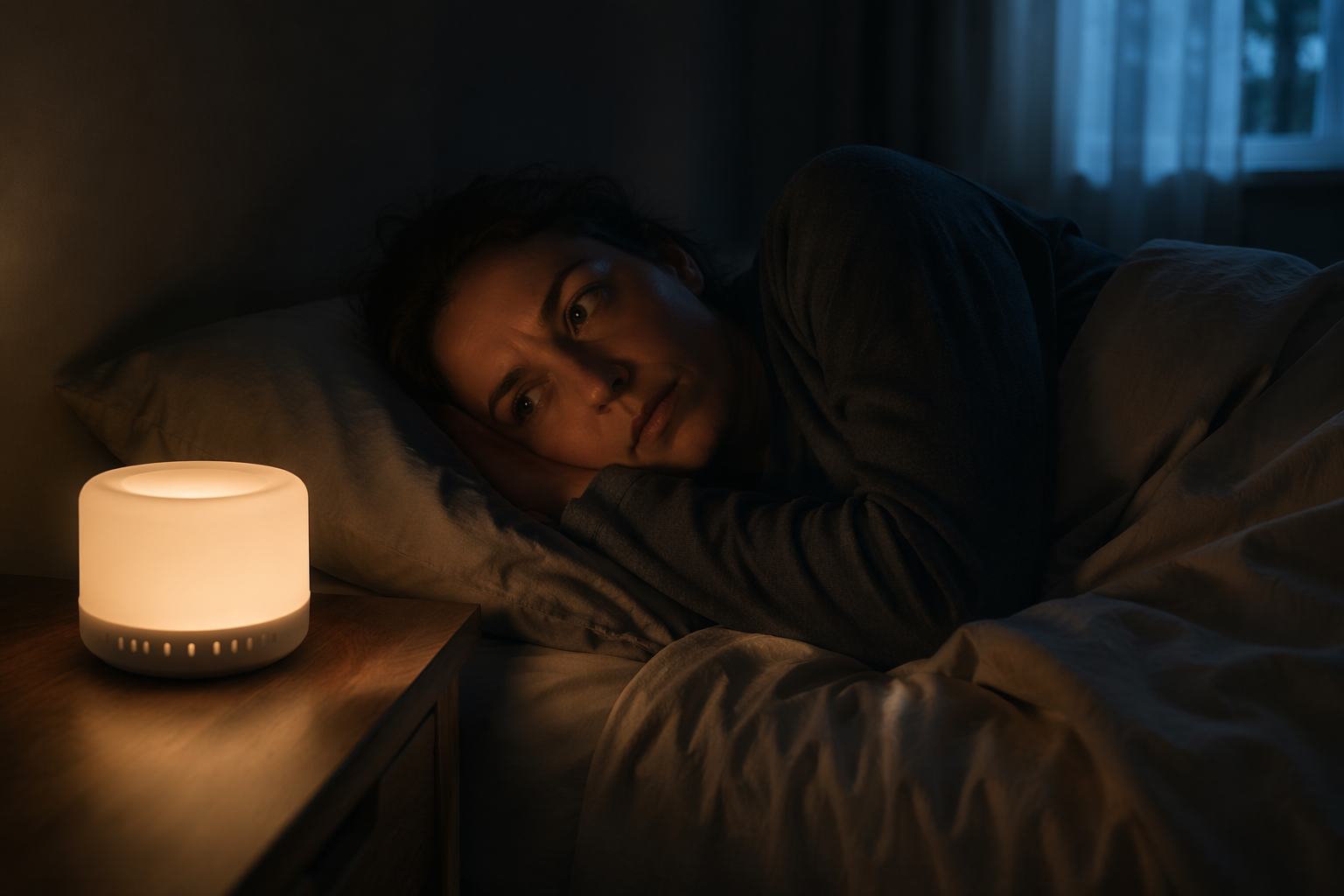
A white noise machine for adults with insomnia may make a bedroom feel less exposed to every creak, car door, hallway sound, or late-night thought. That is a real appeal. It is also not the same as evidence that the device treats insomnia. The available research does not consistently show that white noise improves objective sleep measures in adults with insomnia, and review-level evidence includes a less comfortable possibility: for some people, added noise may delay sleep onset rather than speed it up.
That distinction matters at 2:17 a.m. If the machine is simply a preferred background sound, the stakes are modest. If it is being sold or adopted as a treatment, the evidence has to carry more weight than the feeling that a steady sound ought to help.
The Evidence Is Thinner Than the Habit Suggests
White noise is popular partly because it sounds like a low-risk answer: no prescription, no complicated behavioral program, no appointment, no obvious next-day hangover. But popularity is not the same as demonstrated benefit. The strongest starting point is not a product page or a personal story; it is the systematic review literature, because reviews can show whether apparently promising individual studies hold together when examined as a group.
One major systematic review by Riedy and colleagues, published in Sleep Medicine Reviews in 2021, examined 38 studies on noise as a sleep aid. Its conclusion was not that white noise machines are a validated treatment for insomnia. The review found contradictory results across the literature and did not find consistent, significant improvement in objective sleep measures. It also noted that some individuals may experience delayed sleep onset with noise exposure rather than improvement.[1]
That is the part that gets softened in ordinary sleep advice. A machine can feel calming and still fail to change the measurable features of insomnia. It can reduce awareness of intermittent noise and still leave sleep latency, sleep duration, awakenings, or objectively measured sleep quality essentially unchanged. It can help one sleeper tolerate a specific bedroom problem without becoming a general treatment for chronic insomnia.
The review evidence is also a reminder to separate three claims that often get blended together:
- White noise may be pleasant or familiar to some adults.
- White noise may mask disruptive environmental sounds in some settings.
- White noise has not been consistently shown to meaningfully treat adult insomnia on objective sleep measures.
Only the third claim answers the treatment question. The first two may explain why people keep using the sound, but they do not prove that it shortens the insomnia night.
Why It Might Help One Person and Bother Another
The plausible mechanism is not mysterious. A steady sound can make sudden changes in the environment less noticeable. A truck passing outside, a neighbor’s door, a heating system click, or a partner moving in another room may stand out less against a constant sound bed. For someone whose insomnia is made worse by unpredictable external noise, that masking effect can feel like a small restoration of control.
But insomnia is not just the detection of sound. Many adults with insomnia are awake in a quiet room. Others are listening for sleep itself: checking whether the body has relaxed, whether the machine is helping, whether another poor night is beginning. In that situation, a white noise machine can become one more thing to monitor. The person does not only hear the sound; they start evaluating it.
This helps explain why subjective relief and objective sleep improvement can diverge. A person may prefer the room with white noise and still not fall asleep faster. Another may fall asleep no sooner but feel less irritated by background interruptions. A third may find the sound intrusive, especially if the volume is too high, the tone is harsh, or the machine is treated as a test that must work tonight.
| Question | What the Evidence Can Support |
|---|---|
| Can white noise feel soothing? | Yes, some adults may find steady background sound more comfortable. |
| Can it mask environmental noise? | Plausibly, especially when the problem is intermittent sound in the bedroom. |
| Does it consistently treat adult insomnia? | No consistent review-level support shows significant improvement in objective sleep measures. |
| Can it make sleep onset worse for some people? | Yes, review evidence notes delayed sleep onset in some individuals. |
A Machine Is Not Automatically Safer Because It Is Non-Drug
The usual reassurance is that white noise is “natural” or “non-pharmacological.” That can make the decision feel trivial, as if the only possible downside is wasted money. The more practical risks are quieter than that, but they matter.
The first is volume. If the initial setting does not help, the temptation is to turn the machine up: a little louder to cover the street, then a little louder to cover the louder street. High-volume exposure raises concern for hearing damage. The safest way to treat the machine, if it is used at all, is as background sound at the lowest effective level, not as an acoustic wall.
The second is masking. The very feature that makes a white noise machine attractive can also be a problem. A sleeper may need to hear an alarm, a child, a smoke detector, a phone call, a door, a pet, or a bed partner. The relevant question is not only “Can I sleep through noise?” but “What do I still need to hear?”
The third is dependence in the ordinary, behavioral sense. This does not mean addiction. It means the machine can become part of the insomnia ritual: checking the setting, changing the track, wondering whether brown noise would be better, moving the device, restarting the app, blaming the machine when sleep does not come. For an anxious sleeper, that kind of tinkering can keep attention attached to sleep effort.
How to Treat a Trial Honestly
For an adult with insomnia who still wants to try white noise, the fairest framing is a cautious environmental experiment. It is not a treatment plan, and it should not replace first-line insomnia care. It is a small test of whether masking a specific sound problem makes the bedroom easier to tolerate.
The most useful trial is boring: choose one steady sound, keep the volume low, place it away from the head, and do not keep adjusting it through the night. If the problem is a partner’s snoring, traffic, or hallway noise, the test is whether the sound reduces disruption without creating a new source of attention. If the room is already quiet and the main problem is lying awake with a racing mind, white noise has a weaker rationale.
A person should also decide in advance what would count as failure. If sleep onset feels slower, if the sound becomes irritating, if the volume keeps creeping upward, or if the machine becomes another object to manage during the night, the experiment has given useful information. The answer may simply be no.
The Bottom Line for Adults with Insomnia
A white noise machine can be reasonable for selected adults who are trying to soften a noisy sleep environment and who can use it at a low volume without missing important sounds. It may make the bedroom feel less hostile. That comfort is allowed to count.
But the evidence does not justify treating white noise machines as a proven insomnia intervention. Systematic review evidence is contradictory, does not show consistent significant improvement in objective sleep measures, and includes the possibility of delayed sleep onset for some users.[1] The most honest recommendation is modest: try it carefully if the situation fits, stop if it complicates the night, and do not let a soothing sound be mistaken for validated insomnia care.
References
- Riedy et al. systematic review on noise as a sleep aid, Sleep Medicine Reviews, 2021
Comments
Join the discussion with an anonymous comment.