
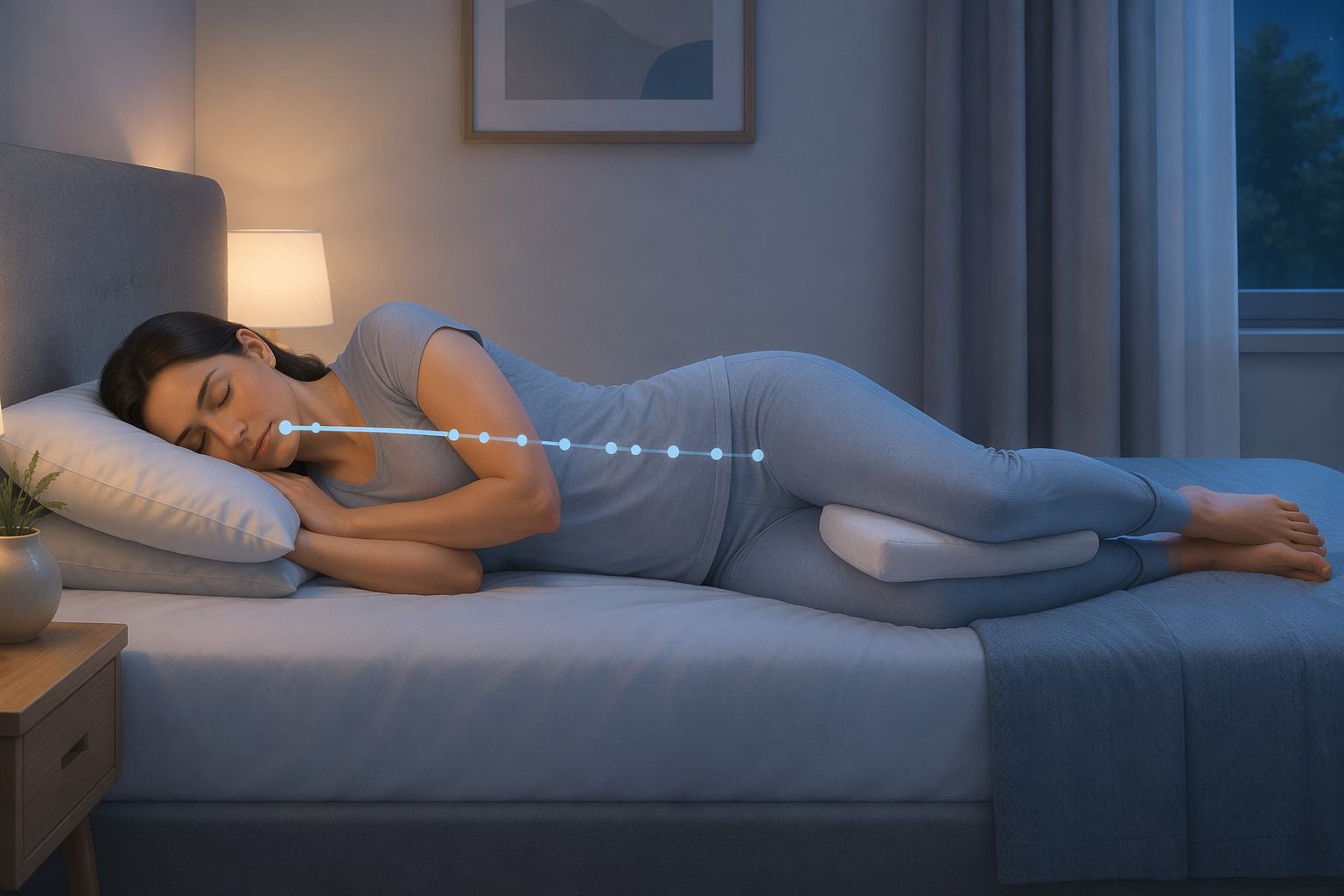
The usual clue is not at bedtime. It is the first movement out of bed: a low back that seizes, a neck that feels locked, or hips that complain before coffee. Poor sleep posture has been linked to waking spinal symptoms, and deep sleep is when muscles relax enough that sustained alignment starts to matter [1]. If you want the tissue-level why, the mechanics are laid out in The Biomechanics of Back-Friendly Sleep.
That is why the useful question is not which sleep position wins a ranking chart. HSS spine specialist Dr. Robert Griffin says there is no one sleep position that works for everyone because back pain is person-specific [2]. Harvard Health adds the tradeoff: back sleeping can spare the spine from sideways force, while side sleeping can reduce airway collapse but create pressure points at the shoulder and hip [3]. The goal is simpler: keep ears, shoulders, and hips as stacked as your body allows.
Quick comparison
| Position | What it usually does well | Main thing to watch |
|---|---|---|
| Back sleeping | Spreads weight more evenly and is often the easiest way to avoid twisting the spine | Can let the low back arch and may worsen snoring, sleep apnea, or reflux |
| Side sleeping | Often the most realistic compromise for adults who already sleep this way | Shoulder and hip pressure can build; the pelvis can roll forward |
| Stomach sleeping | May feel familiar to some sleepers | Hardest position to keep the neck and low back neutral |
Back sleeping
Back sleeping comes closest to spreading load evenly across the body. Mayo Clinic recommends a pillow under the knees so the lower back is supported instead of pulled into an arch [4]. One Spine Health Foundation summary, drawing on American Chiropractic Association figures, describes back sleeping as placing about 50 pounds of pressure on the spine; treat that number as directional rather than exact, but it matches the basic idea that the spine is less twisted when weight is distributed through the mattress [1].
The catch is that back sleeping is not the clean answer for everyone. Harvard Health notes that it can worsen breathing problems, which is why snoring, sleep apnea, and reflux change the decision [3]. If those are part of your picture, see the back-sleeping decision framework before you spend a week forcing a position that helps one symptom and aggravates another. If you stay on your back, start with the knee pillow first; that usually matters more than shopping for a new mattress.
Side sleeping
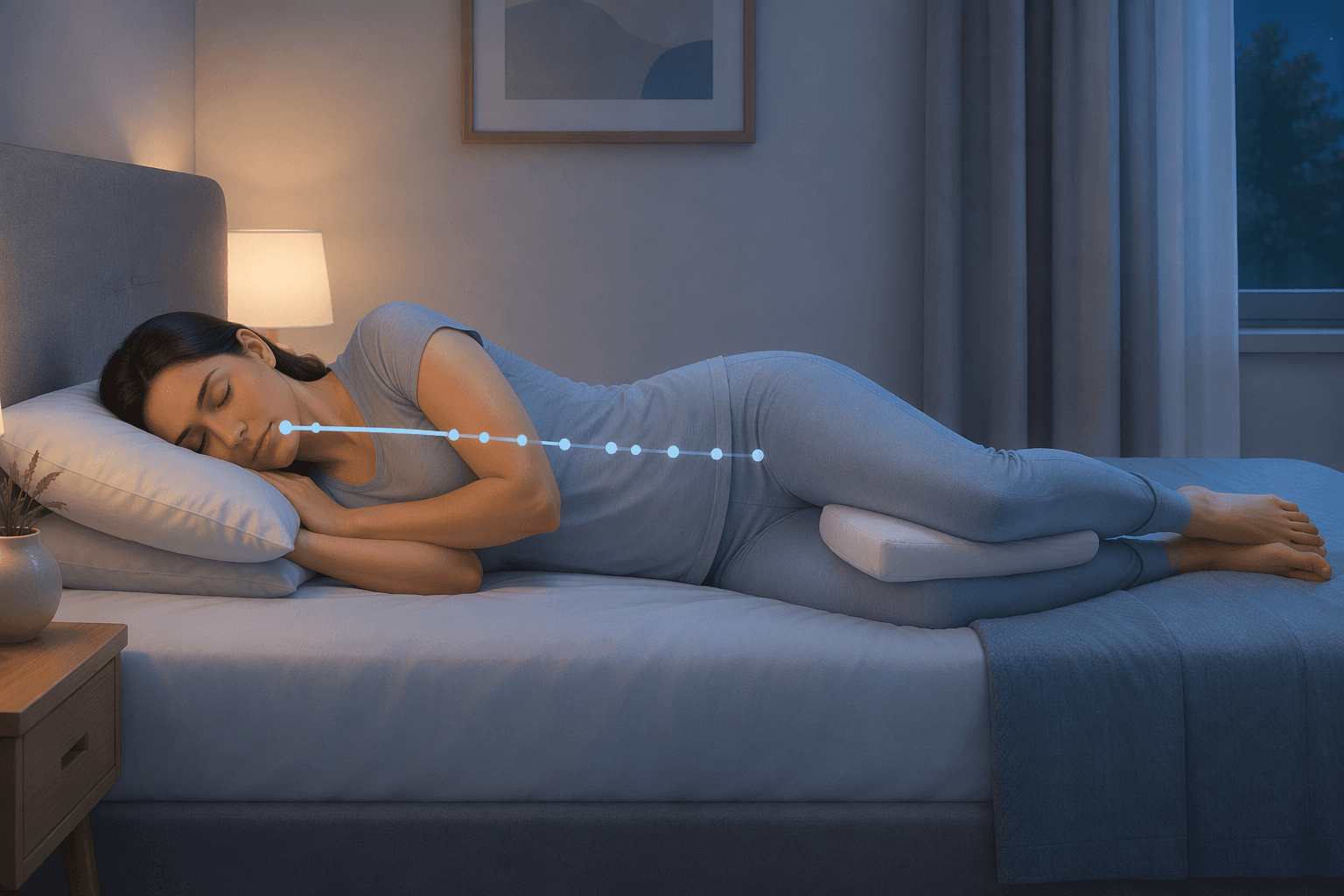
Side sleeping is where most adults already land: Sleep Foundation says more than 60% sleep on their side, while fewer than 10% sleep on their stomach [5]. That makes side sleeping less a perfect solution than a workable compromise. The problem is that many side sleepers let the top knee drift forward, which rotates the pelvis and tugs the low back with it.
A firm pillow between the knees is the simplest correction. The Spine Health Foundation says that setup can reduce spinal pressure by nearly half, citing American Chiropractic Association data [1]. Keep the pillow thick enough to stop the top knee from dropping inward, but not so bulky that it pushes the upper leg higher than the hip.
Head pillow height matters too. Confluent Health suggests side sleepers often need roughly 7 to 11 cm of pillow height to preserve the cervical curve, although shoulder width and mattress softness can push that number up or down [6]. If your neck wakes tighter than your low back, the head pillow is probably too tall; if your ear drops toward the mattress, it is probably too flat.
Stomach sleeping
Stomach sleeping is the hardest position to keep neutral because the neck has to stay turned and the low back tends to arch at the same time. If you are not ready to give it up, reduce the strain rather than pretending it is harmless: use a thin pillow or no pillow under the head, and place a flat pillow under the pelvis to soften the lumbar extension [6].
How to test a change
Do not judge a new setup on one strange night. The body often needs a few mornings to tell the difference between a position that feels unfamiliar and one that actually calms the stiff first movement. Change one variable at a time: knee pillow height, head pillow height, or pelvic support. Then watch which area complains first — neck, shoulder, hip, or low back — and whether the ache is fading, unchanged, or moving somewhere new.
The best way to sleep for your back is the position that keeps your alignment closest to neutral without creating a bigger problem elsewhere. For many readers that will be side sleeping with a firm knee pillow or back sleeping with knee support; for some, stomach sleeping can only be made less irritating, not ideal. If pain persists, worsens, radiates, or comes with numbness, weakness, fever, trauma, or bowel or bladder changes, it needs clinical evaluation rather than another pillow adjustment.
References
- Sleeping and the Spine — National Spine Health Foundation
- 5 Things You Should Know about Sleep and Low Back Pain — Hospital for Special Surgery
- Is your sleep position helping or hurting you? — Harvard Health
- Sleeping positions that reduce back pain — Mayo Clinic
- What Is the Best Sleeping Position? — Sleep Foundation
- Guide to the Best Sleeping Positions — Confluent Health
Comments
Join the discussion with an anonymous comment.