
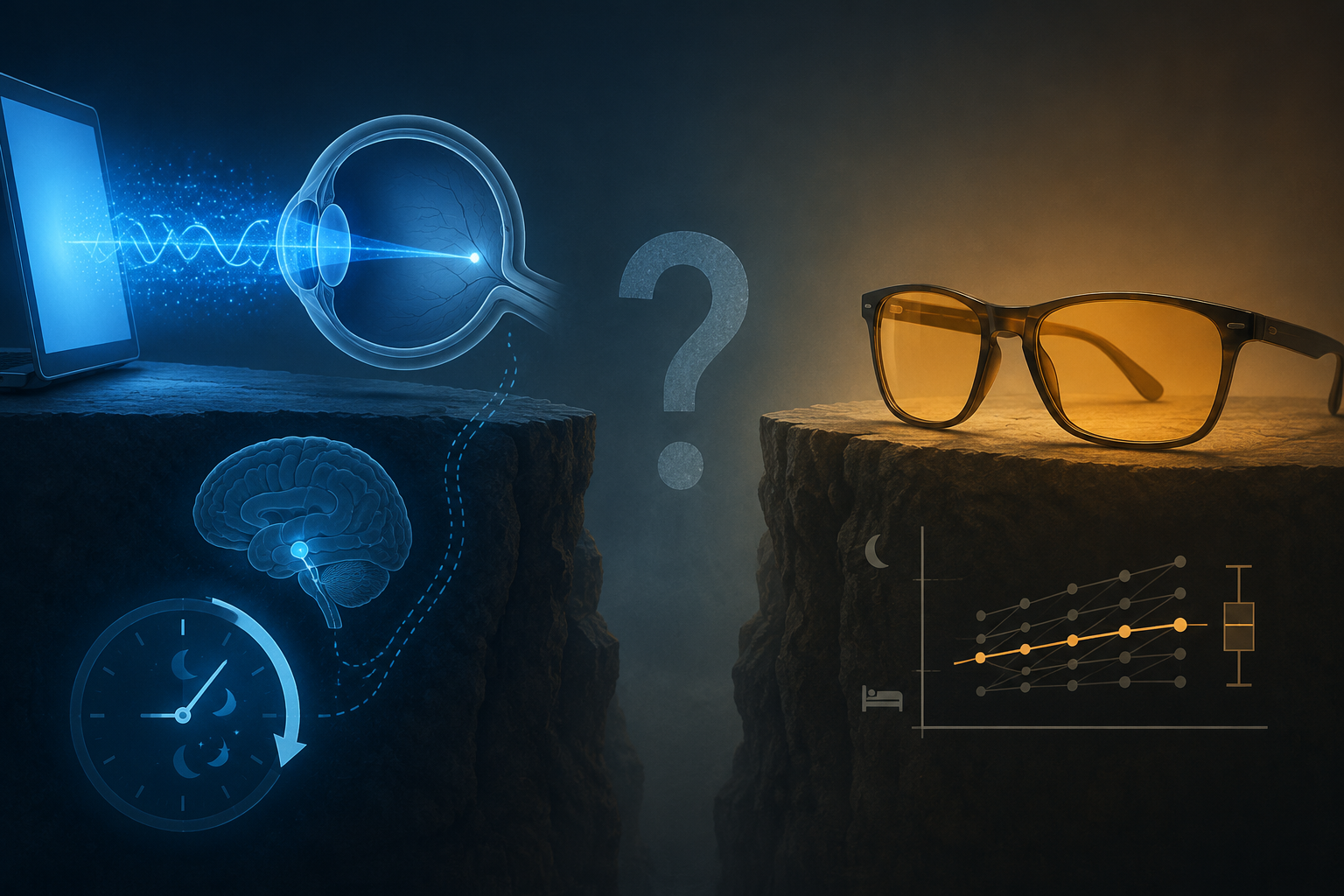
Blue light can affect sleep biology. That part is not the weak link. Short-wavelength evening light can feed into the circadian system, influence melatonin timing, and make the brain less ready for night. The harder question is narrower: does putting on blue-light-blocking glasses in the evening reliably improve sleep?
The best current answer is more restrained than most product pages suggest. The strongest reviews do not show meaningful, statistically reliable improvements in objective sleep outcomes for the general population. They do show a pattern many people will recognize: some users feel better, while actigraphy and other objective measures often move little or not at all.
The Main Evidence Is Cautious, Not Dismissive
The 2023 Cochrane review is the right place to start because it asks the question at review scale rather than through a single appealing experiment. It included 17 randomized controlled trials of blue-light-filtering spectacle lenses and concluded that they “probably make no difference to sleep quality,” while also finding little support for claims about eye strain or eye health.[1]
That sentence is easy to overread. It does not mean no one can feel helped by the glasses. It also does not mean the biology behind light and circadian timing is imaginary. It means that when trials are pulled together, the evidence does not support a confident claim that these lenses meaningfully improve sleep quality.
There are limits inside that conclusion. The Cochrane review was not only a sleep review; it also examined visual performance and macular health. Its sleep judgment came from a subset of the included trials, many of which were small or had risk-of-bias concerns.[1] That matters because weak evidence can under-detect small effects. It also means the honest conclusion is not “proven useless.” It is “not well supported as a reliable sleep intervention.”
The 2025 Meta-Analysis Shows Why Direction Is Not Proof
A 2025 systematic review and meta-analysis in Frontiers in Neurology narrowed the lens to double-blind crossover randomized trials with actigraphic sleep outcomes. That design choice is useful: if people cannot easily tell whether they are wearing the active or control lens, and if sleep is measured with a device rather than only by recall, the study is better protected against expectation effects.
The tradeoff is size. The review pooled only 3 double-blind crossover randomized controlled trials with 49 participants total.[2] That is a clean evidence window, but a small one. It can tell us what the best controlled data look like so far; it cannot close every question about specific groups, lens types, or routines.
| Outcome | Estimated change with blue-light-blocking glasses | Statistical result |
|---|---|---|
| Sleep onset latency | About 4.86 minutes shorter | Not statistically significant; p=0.54 |
| Total sleep time | About 8.75 minutes longer | Not statistically significant; p=0.70 |
Those numbers move in the hoped-for direction: people fell asleep a little sooner and slept a little longer. But the estimates were not statistically significant: sleep onset latency was about −4.86 minutes with p=0.54, and total sleep time was about +8.75 minutes with p=0.70.[2] A small favorable estimate is not the same thing as demonstrated benefit.
This is the point where marketing often gets slippery. A plausible mechanism plus a small average improvement can be made to sound like a practical guarantee. The trial data do not justify that. If a person is awake for an hour after getting into bed, the current actigraphy-based evidence does not support expecting ordinary blue-light glasses to reliably solve that problem.
Why People May Feel Better Anyway
Feeling better after using glasses is not embarrassing evidence. It is still evidence about that person’s experience. The question is what kind of evidence it is. In sleep research, subjective sleep quality and objective sleep measurement do not always move together, and blue-light glasses sit right in that split.
Bigalke and colleagues reported a pattern that captures the problem well: subjective sleep improved, but objective actigraphy did not show a matching change.[3] That does not make the subjective improvement fake. It means the glasses may have changed how the night felt, without clearly changing the measured duration or timing of sleep.
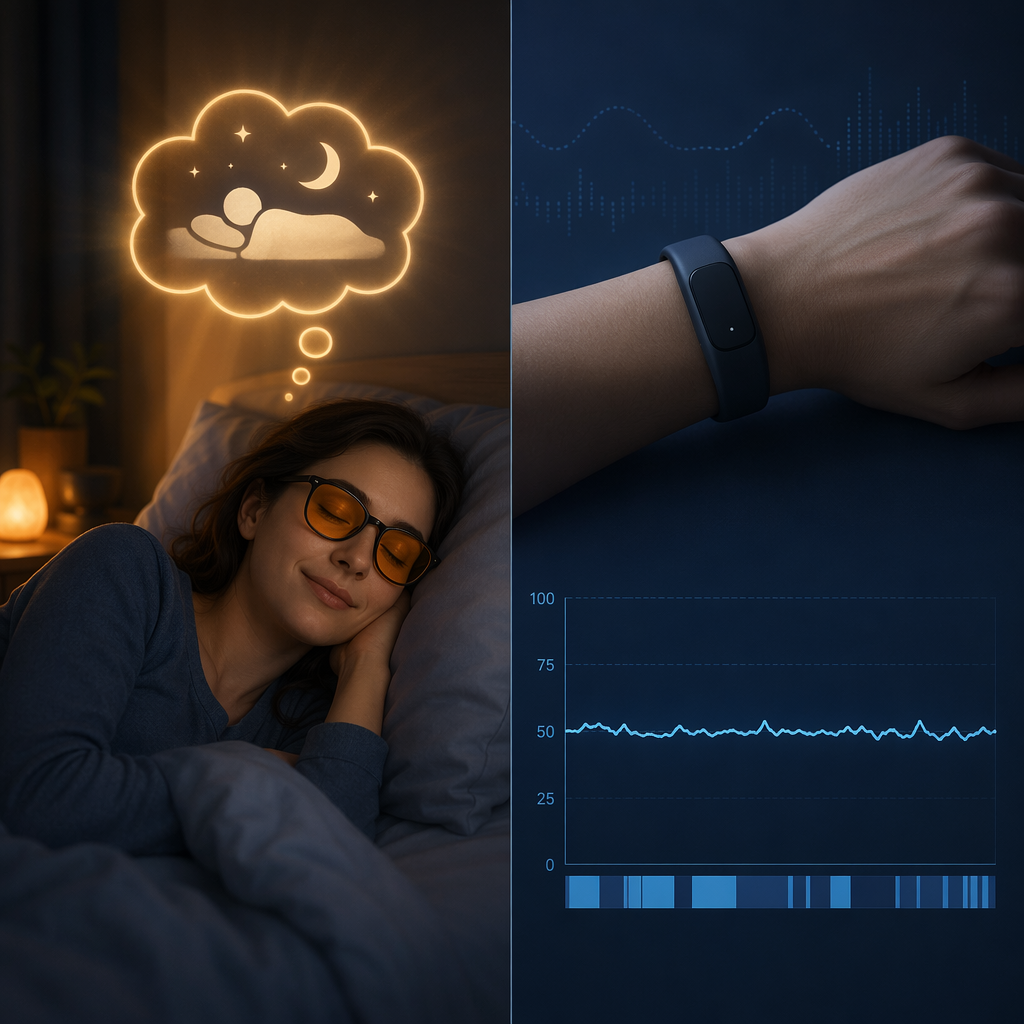
There are several ordinary reasons this can happen. Amber or yellow-tinted lenses can reduce glare and make screens feel less harsh. Putting them on can also become a behavioral boundary: work is ending, the lights are lower, the phone is less inviting, and the evening has begun to narrow. A ritual does not need to alter melatonin very much to make bedtime feel less abrupt.
Placebo effects belong in this same practical category, not as an insult. Cleveland Clinic puts the point plainly: “Sometimes, thinking you're doing something to reduce eye strain or support sleep can make symptoms feel better — even if the glasses aren't the true cause.”[4] In sleep, where arousal and expectation can shape the experience of the night, that is not trivial.
The boundary is that subjective relief should not be upgraded into a physiological claim without evidence. If the glasses help someone stop doom-scrolling, dim the room, and move toward bed, that is useful. It is different from saying the lenses themselves have been shown to produce reliable objective sleep improvements.
The Lens in a Study May Not Be the Lens in Your Drawer
There is another quiet problem: “blue-light glasses” is not a single intervention. A heavily amber research lens and a nearly clear over-the-counter lens can both be sold under the same general label, while filtering very different amounts of short-wavelength light.
Glickman and colleagues emphasized this issue with the melanopic daylight filtering density metric, which is meant to describe how strongly lenses filter light relevant to the melanopsin-containing retinal cells involved in circadian signaling. They reported that many over-the-counter lenses filter only about 10% to 25% of blue light, far less than the amber-tinted lenses often used in research protocols.[5]
That matters for interpretation. If a trial uses a strong amber lens and still finds only small, uncertain effects, it would be a stretch to assume a lightly tinted fashion-style pair will do more. If a person buys a pair with no clear spectral data, they may not know whether they are using a circadian intervention, a glare-reduction tool, or mostly a bedtime cue.
Where the Evidence May Still Be Interesting
The 2025 review notes that blue-light-blocking glasses may look more promising in specific clinical subgroups than in the general population.[2] That is worth studying, especially where circadian disruption is part of the clinical picture. But subgroup signals are not the same thing as a general recommendation.
Findings in groups such as people with insomnia, pregnancy-related sleep disruption, or bipolar disorder should be treated as research leads unless they are supported by larger, better replicated trials. The current material does not justify presenting blue-light glasses as standard therapy for any sleep disorder, and no clinical guideline in the provided evidence endorses them that way.
That distinction protects people in both directions. It avoids selling a low-risk accessory as treatment, but it also leaves room for more targeted trials where the mechanism, lens strength, timing, and population are specified carefully enough to test the idea properly.
How to Use Them Without Overbelieving Them
For everyday sleep hygiene, blue-light glasses are best treated as a low-drama cue rather than a proven fix. If putting them on helps you lower the lights, stop work earlier, and keep the evening quieter, that is a reasonable place for them. The glasses are then part of the routine, not the whole explanation for better sleep.
- Use them at the same point each evening if they help create a wind-down boundary.
- Do not use them as permission to keep bright rooms, late work, or stimulating screen habits unchanged.
- Be cautious with strong claims unless the product provides clear lens-filtering specifications.
- Judge your own result separately from the marketing claim: feeling calmer is useful, even if objective sleep effects are not well proven.
- If sleep problems are persistent, severe, or linked with a medical or mood condition, do not treat glasses as a substitute for clinical care.
The cleanest reading of the blue light glasses sleep evidence is not that the idea is foolish. It is that the mechanism has outrun the intervention data. Evening light matters. Lens specifications matter. Expectations and routines matter. But in the best available trials, the objective sleep changes are small and statistically uncertain, while the more consistent benefits are the kind people often feel when a habit makes night feel more controlled.
References
- Blue-light filtering spectacles probably make no difference for eye strain, eye health, or sleep, Cochrane, 2023.
- Efficacy of blue-light blocking glasses on actigraphic sleep outcomes, Frontiers in Neurology, 2025.
- Effects of blue-light blocking glasses on sleep and circadian rhythm, Sleep Health, 2021.
- Do Blue Light Glasses Work?, Cleveland Clinic, 2026.
- Melanopic daylight filtering density, Translational Vision Science & Technology, 2025.
Comments
Join the discussion with an anonymous comment.