
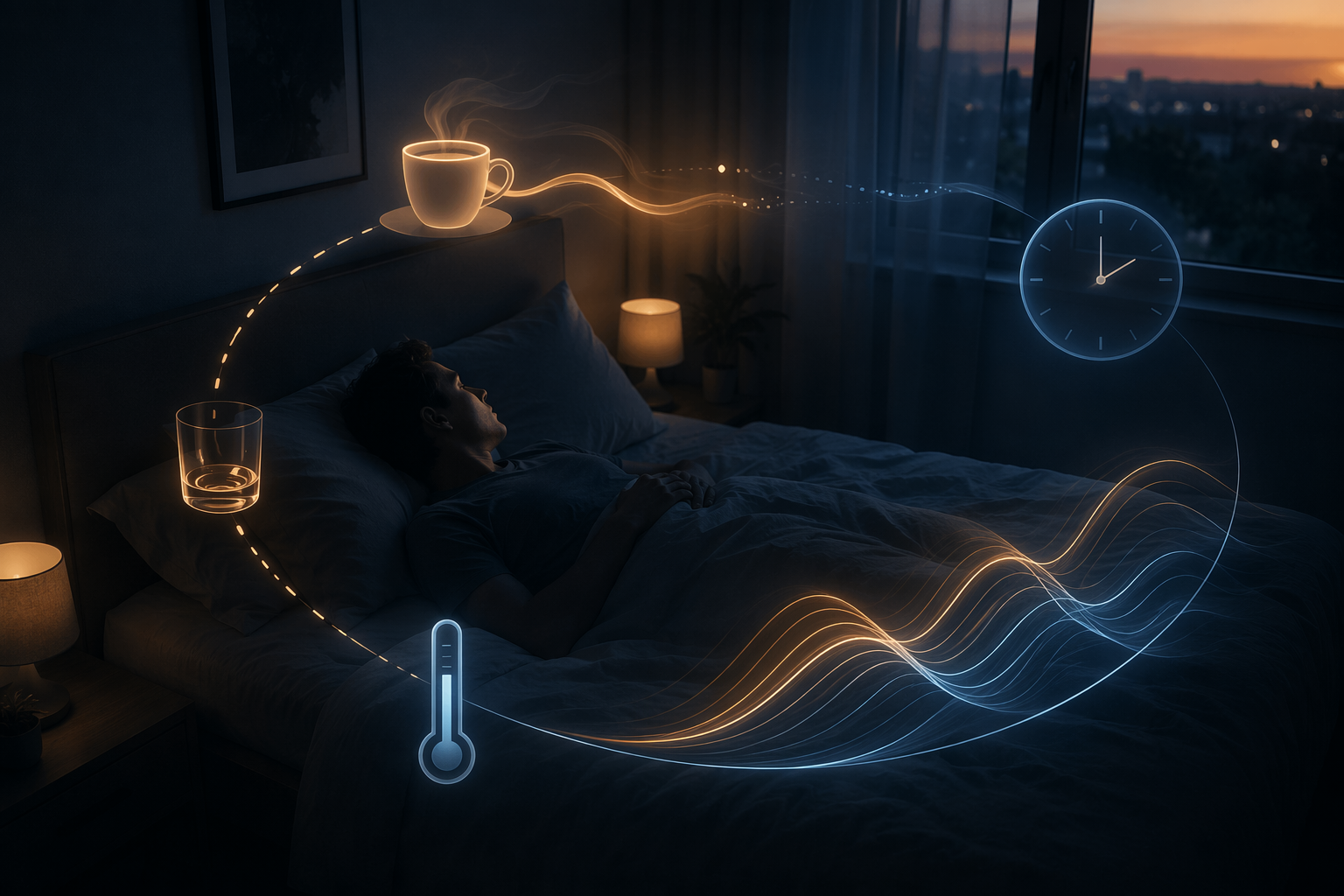
The strangest thing about “sleep hygiene” is not that tired people hear it so often. It is that the phrase can sound medically settled even when the literature behind it is surprisingly loose. In a 2024 bibliographic review of 548 published studies, only 44% defined what they meant by sleep hygiene at all; the review covered papers published through December 2021, so it is not the final word on the field, but it does explain why the advice often reaches readers as a vague moral instruction rather than a usable tool.[1]
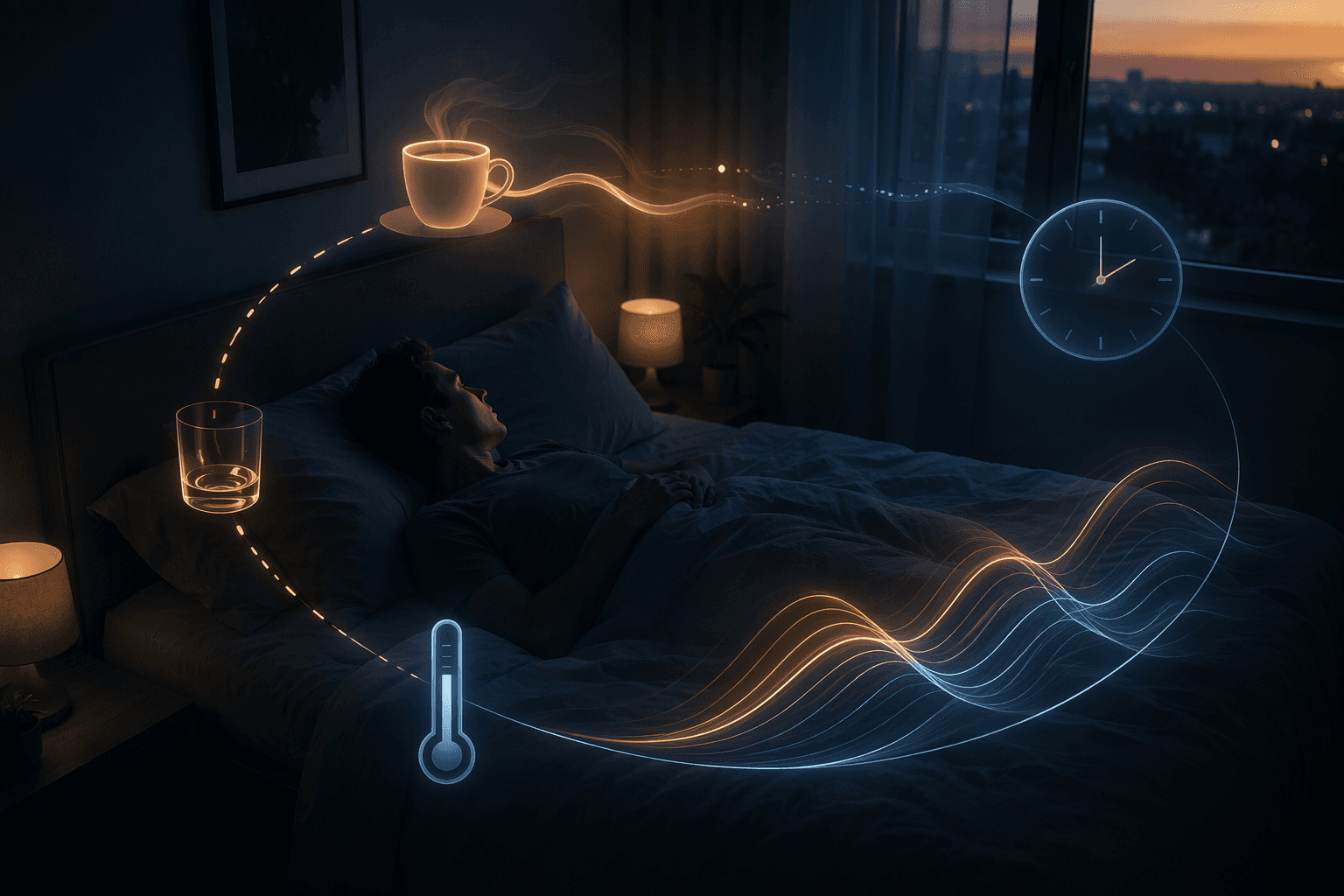
That does not mean healthy sleep habits are fake. It means the umbrella is too big to be useful until it is sorted. The same review found that researchers most often studied caffeine, alcohol, exercise, sleep timing, light exposure, napping, smoking, noise, temperature, wind-down routines, stress, and stimulus control. Even within that group, attention was uneven: caffeine appeared in 51% of studies, alcohol and exercise in 46%, sleep timing in 45%, light exposure in 42%, napping in 39%, smoking in 38%, noise in 37%, temperature in 34%, wind-down routines in 33%, and stress and stimulus control in 32% each.[1]
That ranking is not a perfect measure of effectiveness. A topic can be easy to study without being the most powerful, and individual biology still matters. But it gives a more honest starting point than the usual checklist. If someone has already tried “no screens” for three nights, skipped one late coffee, and bought a sleep mask, the right question is not whether they have obeyed sleep hygiene. It is which input they changed, whether they changed it consistently enough to matter, and what mechanism the change was supposed to influence.
Caffeine Is a Timing Problem, Not a Virtue Test
Caffeine advice is often delivered as a scolding: stop drinking it late. The more useful version starts with pharmacology. In most adults, caffeine has a half-life of about 4–6 hours, and in some people it can extend up to 12 hours. A 3 PM coffee is therefore not “afternoon” in the nervous system of every person who drinks it; for many sleepers, a meaningful amount is still active near bedtime.[2]
That mechanism changes the experiment. Instead of asking whether caffeine is allowed, ask when the last meaningful dose occurs and whether sleep onset changes when that cutoff moves earlier. Someone who falls asleep easily but wakes at 3 AM may not get the same answer as someone who lies awake for an hour. Someone who metabolizes caffeine slowly may need a noon cutoff; another person may tolerate early afternoon. The habit works best when it is treated as a dose-and-clock variable, not a personality flaw.
Alcohol Can Make Sleep Arrive While Making Sleep Worse
Alcohol is where sleep hygiene advice often feels insulting because the immediate effect is real: it can make falling asleep feel easier. The problem is what happens after sleep begins. Alcohol may hasten sleep onset through GABA-related sedating effects, but it suppresses REM sleep and increases fragmentation in the second half of the night. Even moderate consumption — more than 2 servings for men or more than 1 serving for women — has been associated with sleep quality decreases of up to 39%.[3]
That distinction matters because people usually remember the first half of the night better than the second. If alcohol helps someone get into bed but leaves them awake, hot, restless, or unrefreshed later, the sleep problem is not imaginary. The test is not simply “drink less forever.” A clearer trial is to separate alcohol from bedtime, reduce the amount, and watch for changes in awakenings, early-morning alertness, and next-day sleepiness.
The Sleep Window Is the Habit That Makes Other Habits Easier to Read
A consistent sleep window is less glamorous than supplement shelves and less clickable than blue-light warnings, but it gives the body a repeated signal about when sleep is expected. Major sleep-health guidance commonly emphasizes a regular sleep schedule, a relaxing bedtime routine, and a bedroom environment that supports sleep rather than alertness.[4][5][6][9]
The consistency also makes self-experimentation cleaner. If bedtime moves by several hours, caffeine changes, exercise shifts, and weekend sleep extends far into the morning, it becomes hard to know which variable helped or hurt. A stable wake time is often the anchor, because it sets the next day’s light exposure, meal timing, activity timing, and sleep pressure. The point is not to make life rigid. It is to reduce the number of moving parts enough that the body can receive the same cue repeatedly.
Light Tells the Brain What Time It Is
Light exposure is one of the places where generic advice gets flattened into “avoid screens,” which is too narrow. The real issue is circadian timing. Morning light helps reinforce wakefulness and daytime alignment; bright evening light, especially blue-enriched light, can push against the body’s preparation for sleep. Harvard Health’s guidance on blue light emphasizes that light at night can affect circadian rhythm, and sleep organizations commonly advise reducing bright light exposure close to bed.[7][9]
The practical version is not a theatrical blackout of modern life. It is a contrast: brighter days, dimmer evenings. Open the shades or get outside earlier in the day when possible; lower overhead lights in the last part of the evening; move highly stimulating screen tasks away from bed when the task itself is alerting. If a phone remains in the room, the behavioral part may matter as much as the wavelength: a stressful message at 11 PM is not just light exposure.
Temperature Works Because Sleep Requires a Body-Temperature Drop
Bedroom temperature gets treated as a comfort preference, but it also has a physiological reason to be on the list. Sleep onset is helped by a drop in core body temperature, often described as about 1–2°F, and a cooler room can support that thermoregulatory process. A commonly cited target is around 65°F, or 18.3°C, though bedding, clothing, age, health conditions, and a bed partner can shift what feels tolerable.[8]
This is also where the advice becomes more domestic than medical: a lighter blanket, cooler room, warm shower earlier in the evening, breathable sleepwear, or separating blanket preferences between partners may do more than another app reminder. The outcome to watch is not whether the room matches an ideal number. It is whether sleep onset, night sweats, awakenings, or early-morning discomfort change when heat is reduced.
Exercise Helps, but Timing and Intensity Decide How It Feels at Bedtime
Exercise appears near the top of the sleep-hygiene literature, tied with alcohol in the De Pasquale review’s component ranking.[1] The general direction is not surprising: regular physical activity can support sleep pressure, mood regulation, and circadian stability. But the phrase “exercise more” is too blunt for someone whose only available workout is late at night.
A useful test separates regularity from proximity. Moderate activity earlier in the day is a different sleep input than intense training close to bedtime. If late exercise is the only realistic option, the question becomes whether that specific session leaves the person calmer or physiologically revved: elevated heart rate, heat, and mental activation can delay the downshift some people need. The habit is not automatically wrong; it needs to be read against sleep onset and night quality.
Wind-Down Routines Are Behavioral, Not Decorative
A wind-down routine is easy to trivialize because it gets packaged as candles, tea, and soft playlists. The useful version is simpler: repeat a sequence that lowers cognitive and sensory load before bed. That may mean putting tomorrow’s obligations somewhere outside the mind, dimming lights, doing hygiene tasks in the same order, reading something low-stakes, stretching gently, or using a relaxation exercise.
The routine does not need to be long. It needs to be repeatable enough that the bed stops being the first quiet moment when the brain starts processing the day. This is also where people often reach for supplements, including options such as valerian root for sleep. Supplements should be judged separately from the behavioral routine, especially when evidence is mixed or the effect is smaller than the person hopes. A capsule cannot compensate for a bedroom that has become the place where work, conflict, scrolling, and sleep all compete.
Association Is Not the Same as Proof, but the Pattern Is Not Random
Outcome studies can support the framework without proving that every habit directly causes every improvement. In a 2023 cross-sectional study of 384 adults in Tabuk, Saudi Arabia, adults categorized as having poor sleep hygiene had higher rates of sleep problems than those with good sleep hygiene: 76.5% versus 56.1%. They also had higher rates of excessive daytime sleepiness, 22.5% versus 11.7%, and depression, 75.8% versus 59.6%.[10]
Those numbers should not be imported as U.S. prevalence estimates, and the study design cannot establish causation. Poor sleep hygiene may contribute to poor sleep; poor sleep may make healthy routines harder to maintain; depression, work schedules, family demands, medications, and health conditions may sit behind both. Still, the association is directionally consistent with the idea that sleep habits are not cosmetic. They cluster with outcomes people can feel the next day.
Broader prevalence data can explain why this advice reaches so many people, but it should not swallow the article. CDC NCHS reported on short sleep duration and sleep difficulties among U.S. adults using 2024 data in an April 2026 Data Brief, and a 2026 Resmed global survey reported that many people recognize sleep’s importance; the Resmed data are useful context, though the survey was commissioned by a sleep-device manufacturer.[11][12] The reader who is awake at night does not need another reminder that sleep matters. They need the advice separated into parts that can be tested.
How to Test Sleep Hygiene Without Turning Sleep Into a Second Job
The cleanest approach is to hold the sleep window relatively steady, then change the most plausible inputs first. For many adults, that means moving caffeine earlier, reducing alcohol near bedtime, making the evening darker and quieter, cooling the bedroom, protecting a short wind-down routine, and keeping wake time consistent. Napping, nicotine, noise, stress, and stimulus control may matter more for some people than for others, which is why the list should be a map rather than a verdict.
Tracking can help if it stays modest. A simple note on bedtime, wake time, alcohol, caffeine cutoff, exercise timing, awakenings, and next-day alertness is often enough to spot the obvious pattern. Wearables can add trend data, and a device such as the Whoop band may make habit changes easier to observe, but consumer sleep metrics should be treated as estimates rather than laboratory measurements. If the device says sleep improved but the person is still exhausted, the body gets a vote.
Two to four weeks is a reasonable window for consistent habit work because it is long enough to reduce random-night noise without asking someone to live indefinitely inside an experiment. The goal is not perfect sleep hygiene. It is to learn whether the modifiable inputs that fit the person’s life are strong enough to change sleep onset, awakenings, sleep duration, or daytime function.
Where the Checklist Stops
Sleep hygiene is a foundation for mild or situational sleep difficulty, not a standalone treatment for chronic insomnia disorder. When insomnia symptoms are persistent, clinically significant, or continue despite consistent habit changes, the next evidence-based step is cognitive behavioral therapy for insomnia, or CBT-I. Healthy sleep practices can support routine-building, but they should not be mistaken for insomnia treatment when the problem meets chronic insomnia criteria.[5][9]
That boundary matters because adding more rules can start to make sleep more fragile. If the relevant habits have been applied consistently for 2–4 weeks and sleep is still not improving, the answer is not a longer checklist. It is a different tool.
References
- Sleep hygiene – What do we mean? A bibliographic review. Sleep Medicine Reviews, 2024.
- Caffeine and Sleep. Sleep Foundation.
- Alcohol and Sleep. Sleep Foundation.
- Healthy Sleep Habits. NHLBI/NIH.
- Sleep tips: 6 steps to better sleep. Mayo Clinic.
- Sleep hygiene: Simple practices for better rest. Harvard Health.
- Blue light has a dark side. Harvard Health.
- Best Temperature for Sleep. Sleep Foundation.
- Healthy Sleep Habits. Sleep Education/AASM.
- Sleep Hygiene Practices and Its Impact on Mental Health and Functional Performance Among Adults. Cureus, 2023.
- Short Sleep Duration and Sleep Difficulties Among Adults: United States, 2024. CDC NCHS Data Brief #559, April 2026.
- 2026 Global Sleep Survey. Resmed, 2026.
Comments
Join the discussion with an anonymous comment.