
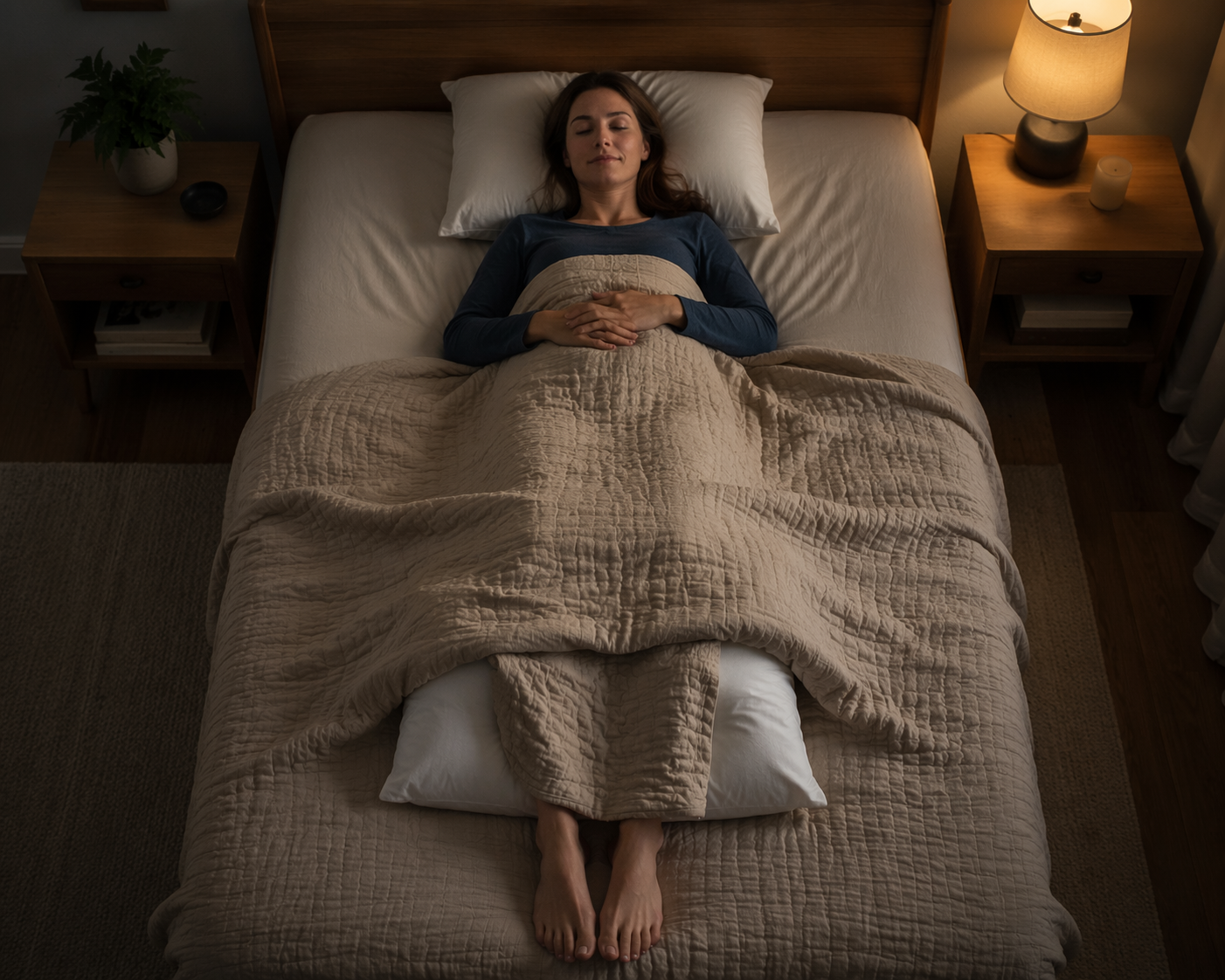
Sleeping on your back can be a good fit if your main problem is waking with neck or back stiffness and you do not have breathing, reflux, or late-pregnancy concerns. It is a poor fit if you snore heavily, have obstructive sleep apnea that worsens on your back, have significant GERD that breaks through at night, or are past 28 weeks of pregnancy. That dividing line matters more than any generic ranking of “best” sleep positions.
Back sleeping is not rare or strange. In a 2017 study of 664 adults cited by Sleep Foundation, about 38% of adults slept on their backs, compared with 54% on their sides and 7% on their stomachs.[1] Prevalence, though, only tells us that many people use the position. It does not prove that the position is healthy for every body.
| Back sleeping is more reasonable when… | Back sleeping deserves caution or avoidance when… |
|---|---|
| You wake with neck or low-back stiffness and can support the knees and neck well. | You snore, gasp, or have known obstructive sleep apnea, especially if it is worse when supine. |
| You want to reduce facial compression against a pillow and understand the wrinkle claim is plausible rather than trial-proven. | You have GERD symptoms that worsen lying flat, unless head-of-bed elevation reliably controls symptoms. |
| You can keep the head, neck, pelvis, and knees supported without forcing a rigid posture. | You are in the third trimester of pregnancy, after 28 weeks. |
If you want a faster profile-based screen before experimenting, use the Sleep on Your Back decision framework. The rest of this guide is for the harder question: if you are a candidate, how do you set up the position so it helps rather than quietly creating a new problem?
The strongest reasons not to force back sleeping
The clearest red flag is positional obstructive sleep apnea. When a person lies on the back, gravity can pull the tongue and soft palate backward, narrowing the airway. Sleep Foundation reports that about 50% of people with obstructive sleep apnea have positional OSA, meaning breathing events concentrate when they are supine.[1] For that group, back sleeping is not a neutral preference. It can be the position that makes the airway problem show up.
This is also why “just train yourself to sleep on your back” is bad advice for some snorers. Loud snoring, witnessed pauses, morning headaches, dry mouth, and daytime sleepiness deserve medical attention, not a pillow hack. Positional therapy that keeps someone off the back may reduce apnea-hypopnea index in positional OSA, but it should not be treated as a replacement for prescribed treatment such as CPAP in moderate-to-severe cases. Readers comparing snoring advice online may also run into mouth-taping claims; those belong in a separate evidence discussion, such as Mouth Taping for Sleep: What the Evidence Says.
GERD is the second place where lying flat can backfire. Harvard Health notes that sleeping on the back can worsen acid reflux because stomach contents are more likely to move upward when the body is horizontal.[2] This does not mean every person with reflux must avoid the back position forever, but it does mean the setup has to change. A flat mattress and a single thick pillow under the head are usually the wrong experiment.
Pregnancy has a cleaner boundary. Houston Methodist cites ACOG guidance against supine sleep after 28 weeks and notes research showing a doubled stillbirth risk, attributed to compression of the inferior vena cava when lying on the back.[3] After that point, side sleeping is the safer default. This is not the moment to troubleshoot knee pillows or mattress firmness. For pregnancy-specific sleep supports, see Pregnancy Sleep Aids: An Evidence-Tiered Safety Guide.
If you are a candidate, the setup matters more than the label
A useful back-sleeping setup has three jobs: support the knees so the low back can keep a natural curve, support the head without shoving the chin toward the chest, and elevate the upper body only when reflux or congestion calls for it. Without those details, “sleeping on your back” can mean anything from a fairly neutral rest position to eight hours of lumbar strain and airway crowding.
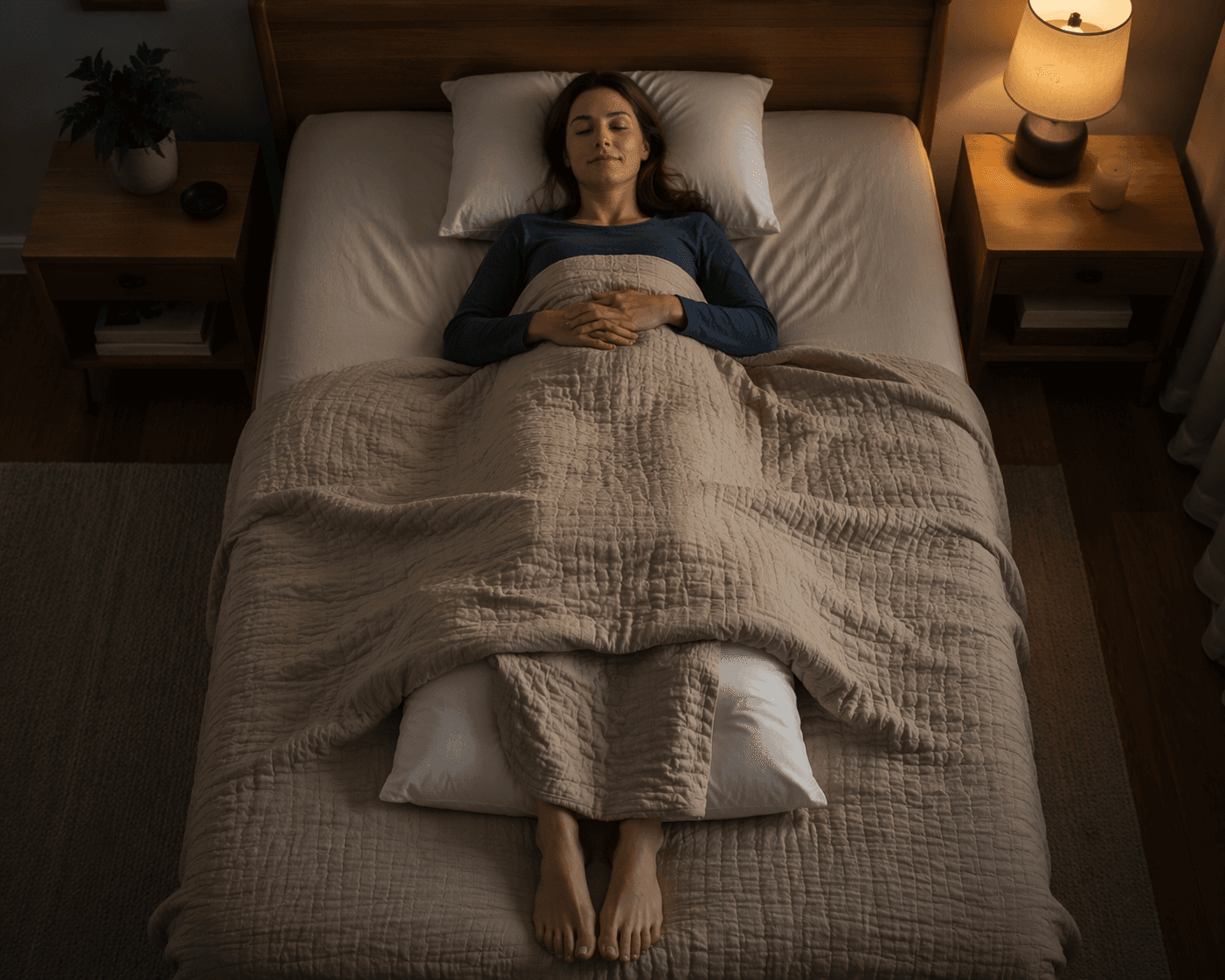
Put the knee pillow where it changes the pelvis, not just where it feels cozy
The knee pillow is not decoration. Mayo Clinic recommends placing a pillow under the knees when sleeping on the back to maintain the natural curve of the lower back and reduce strain.[4] The reason is mechanical: when the legs lie flat, the pelvis and lumbar spine may settle in a way that flattens the low back against the mattress. For some people, that increases tension through the low-back muscles by morning.
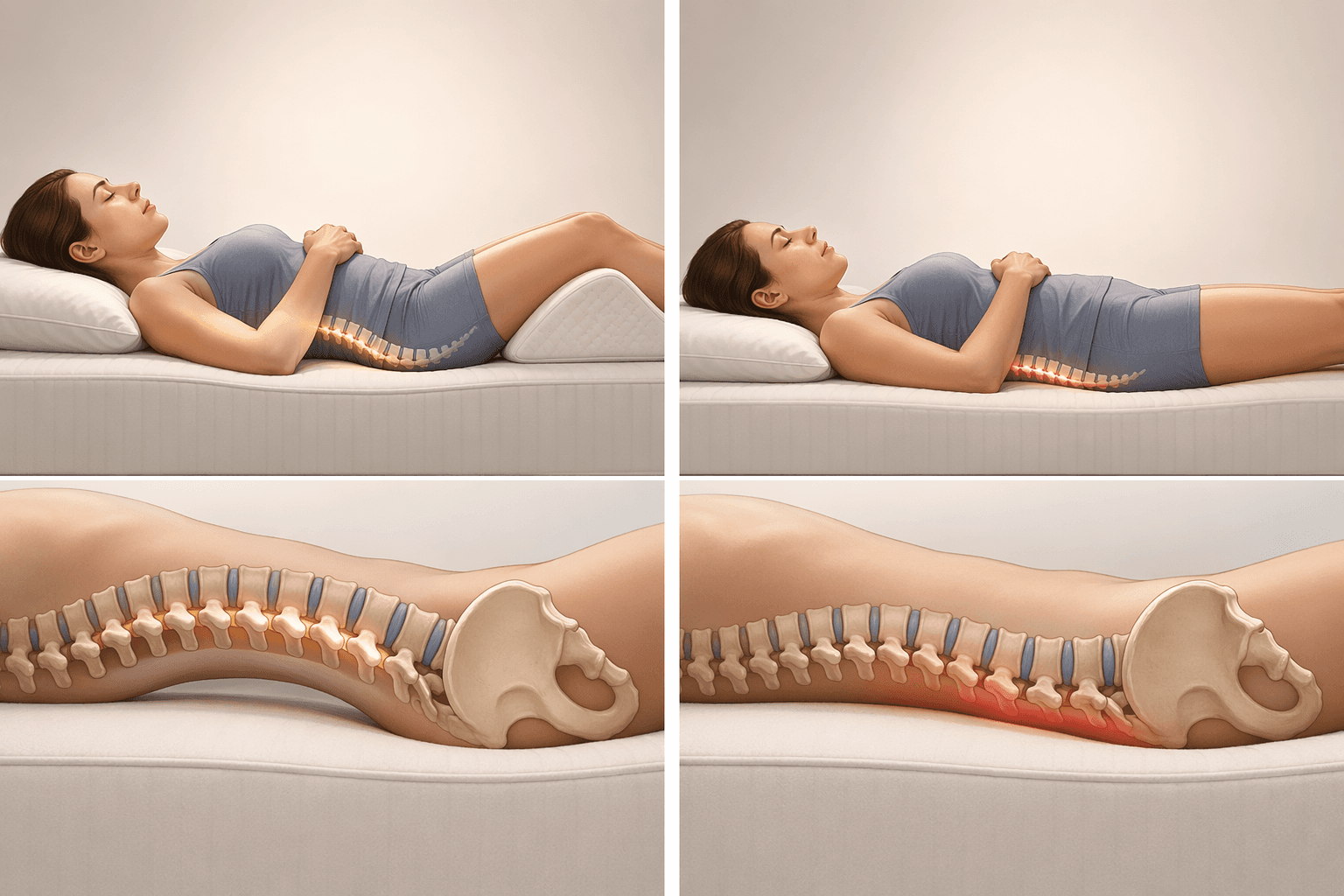
The pillow should sit under the knees or slightly under the lower thighs, not under the calves alone. The goal is a small bend at the knees that lets the pelvis relax. If the pillow is so tall that the hips feel flexed sharply, it can create a new kind of stiffness. If it is so low that nothing changes in the low back, it is not doing much. For readers with persistent pain patterns rather than general stiffness, the more detailed mechanics are covered in The Biomechanics of Back-Friendly Sleep and The Best Way to Sleep for Your Back.
Choose a head pillow that keeps the neck neutral
Back sleepers usually need a medium-loft head pillow: enough height to support the natural curve of the neck, not so much that the chin is driven toward the chest. That chin-tucked posture can matter for both neck comfort and breathing. A pillow that is too flat can let the head fall backward; a pillow that is too tall can flex the neck for hours.
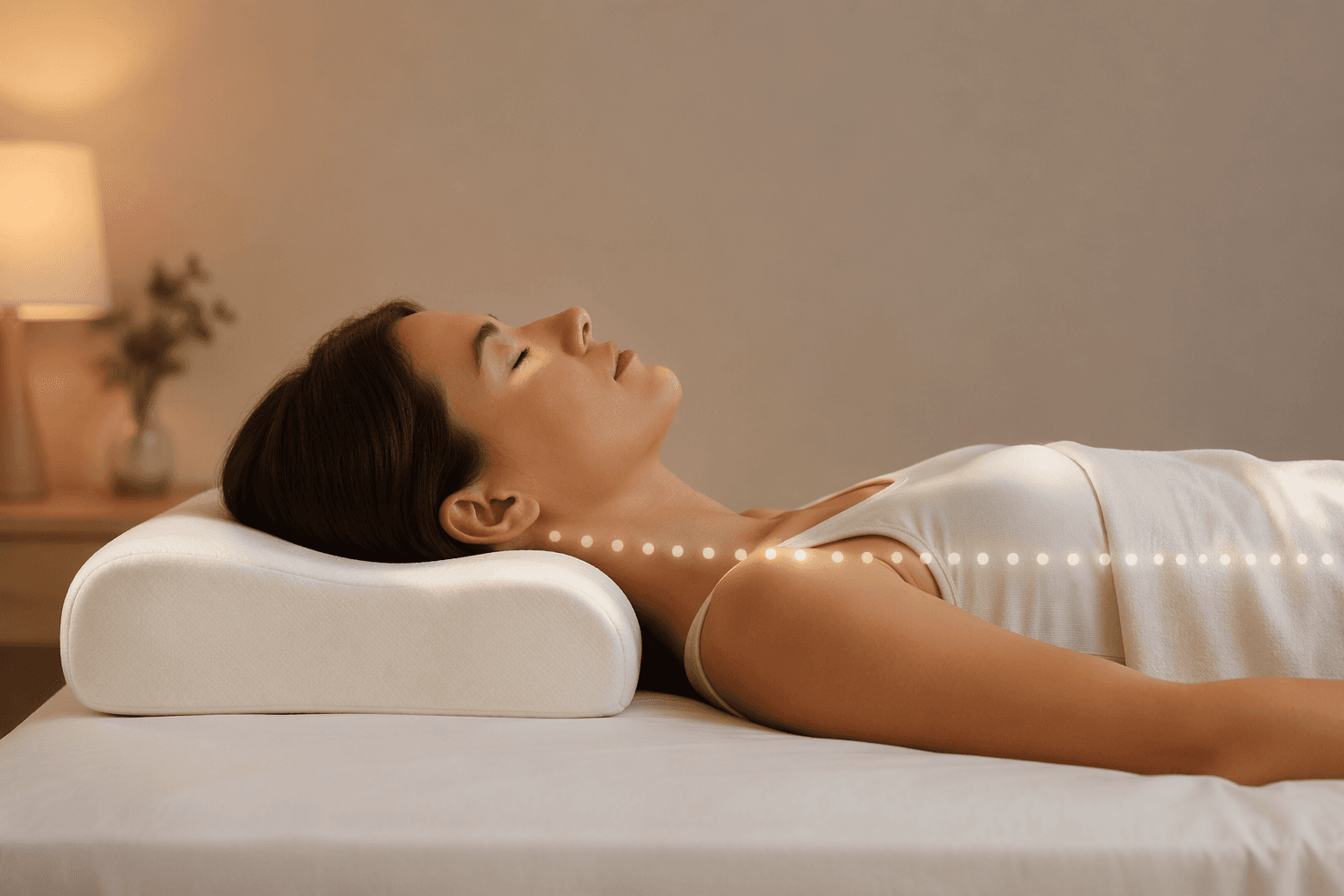
This is where some people get misled by firmness labels. A “supportive” pillow is not automatically a high pillow. The test is simpler: while lying on the mattress you actually use, the face should point upward without the throat feeling compressed, the back of the neck should feel held rather than suspended, and the shoulders should not be propped up on the pillow. Sleep Foundation also notes that back sleeping with a low-loft cervical pillow may reduce neck muscle overactivity and tension headache frequency.[1]
If a new pillow makes the neck feel better but worsens snoring, that is not a small trade-off to ignore. It is a sign to reassess the position, the pillow height, or both.
Use head-of-bed elevation for reflux; do not confuse it with stacking pillows
For reflux, the helpful change is usually elevating the upper body as a unit, not bending the neck with a pile of pillows. Verywell Health describes raising the head of the bed by about 6 inches as a way to reduce reflux while lying on the back.[5] Harvard Health gives the same basic direction: elevation can help keep stomach acid from moving upward during sleep.[2]
A wedge pillow or bed risers can create that incline more cleanly than two or three regular pillows. Stacked pillows often flex the neck and upper back while leaving the abdomen relatively flat, which can leave reflux unimproved and the neck irritated. If symptoms still wake you despite elevation, back sleeping is probably not the position to defend. Side sleeping, especially left-side sleeping for many reflux sufferers, is often the more practical choice.
What benefits are realistic?
The most defensible benefit of sleeping on your back is even support. When the head, shoulders, pelvis, and knees are supported well, body weight can be distributed across a broad surface instead of concentrated through one shoulder, hip, or side of the neck. That is why the position can be useful for some people with morning stiffness: it reduces the number of joints being compressed or rotated overnight.
But the benefit is conditional. A person lying flat with no knee support may not get a neutral spine at all. A person with a high pillow may trade low-back comfort for neck flexion. A person with positional apnea may get a straighter spine and worse breathing in the same night. The position works when the whole setup works.
Facial skin preservation belongs in the secondary-benefit category. The mechanism is plausible: sleeping face-down or face-sideways presses the skin into a pillow for long stretches, creating compression and creasing. Back sleeping avoids that pressure. Houston Methodist describes back sleeping as better for preventing facial wrinkles than side or stomach sleeping.[3] That is not the same as proof from controlled trials that switching to back sleeping measurably reverses or prevents wrinkles. It is a reasonable compression-avoidance argument, not a medical guarantee.
Head elevation may also help some people with sinus pressure or nasal drainage because gravity changes how fluid accumulates. That benefit is again setup-dependent. A slightly elevated upper body is different from a sharply flexed neck, and the latter can make both comfort and airflow worse.
A small study is a useful warning against universal claims
One small sensor-based study should keep the claims modest. Zhang et al. studied 13 healthy young adults without sleep disorders and found that subjects who preferred the supine position reported the worst subjective sleep quality.[6] The sample was small, narrow, and not designed to answer whether back sleeping helps older adults, people with pain, or people using a better support setup. Still, it directly undercuts the easy claim that back sleeping simply improves sleep quality for everyone.
That is the right way to treat the evidence: back sleeping may solve a mechanical comfort problem for one person and worsen breathing or reflux for another. The body’s response matters more than the elegance of the posture diagram. For a broader look at how position affects airway patency, spinal load, and sleep quality, see How Sleep Position Affects Sleep Quality and Health.
How to test back sleeping without overcommitting
If none of the major cautions apply, test the position like a sleep setup, not a character test. Use the actual mattress and pillows you plan to sleep with. Place a pillow under the knees. Choose a head pillow that keeps the neck neutral. If reflux is part of the picture, elevate the head of the bed rather than stacking pillows. Then watch what happens over several nights.
- Continue if morning neck or back stiffness decreases and breathing remains quiet and comfortable.
- Adjust pillow height if the neck feels flexed, the throat feels crowded, or headaches appear.
- Stop trying to force the position if snoring worsens, reflux wakes you, or you repeatedly feel better on your side.
- Do not use back sleeping in the third trimester of pregnancy; choose side sleeping instead.
People who want to make the switch may need behavioral training, because the body often returns to its usual position during sleep. That training is a separate task from deciding whether the position is appropriate. If you have already cleared the safety questions and need practical steps, use How to Train Yourself to Sleep on Your Back.
When side sleeping is the better answer
Side sleeping is not a consolation prize. For people with positional OSA, heavy snoring, late pregnancy, or reflux that worsens on the back, it is often the safer and more effective position. Mayo Clinic also recommends side sleeping with a pillow between the knees as one option for reducing back pain, especially when back sleeping does not feel good despite support.[4]
The cleanest decision is not “back versus side” in the abstract. It is whether sleeping on your back improves the thing you are trying to improve without worsening the thing you cannot afford to worsen. For the right person, supported back sleeping can reduce morning stiffness, keep the neck more neutral, and avoid facial compression. For the wrong person, side sleeping is not merely acceptable; it is the more responsible choice.
References
- How to Sleep on Your Back, Sleep Foundation.
- Is your sleep position helping or hurting you?, Harvard Health.
- Is There a 'Best' Sleep Position?, Houston Methodist, May 2024.
- Sleeping positions that reduce back pain, Mayo Clinic.
- How to Sleep on Your Back: Health Benefits and Tips, Verywell Health.
- The Relationship between Sleeping Position and Sleep Quality, PMC, 2022.
Comments
Join the discussion with an anonymous comment.