
A Boeing 787 economy seat can feel less punishing on a long flight for reasons that have little to do with the seat itself. The aircraft changes the air, pressure, noise floor, and light cues around your body. Those changes can make sleep less fragmented, especially on overnight flights. They do not make a narrow economy seat into a bed.
That distinction matters for anyone searching for Boeing 787 economy seat sleep comfort. The 787 is genuinely more sleep-friendly than many older aircraft at the physiological level: less oxygen stress, less dry-air irritation, less continuous cabin noise, and better tools for managing light. The mechanical level is harsher. Most passengers are still trying to sleep upright or partly reclined in a 9-abreast cabin, with limited shoulder room and limited control over posture.
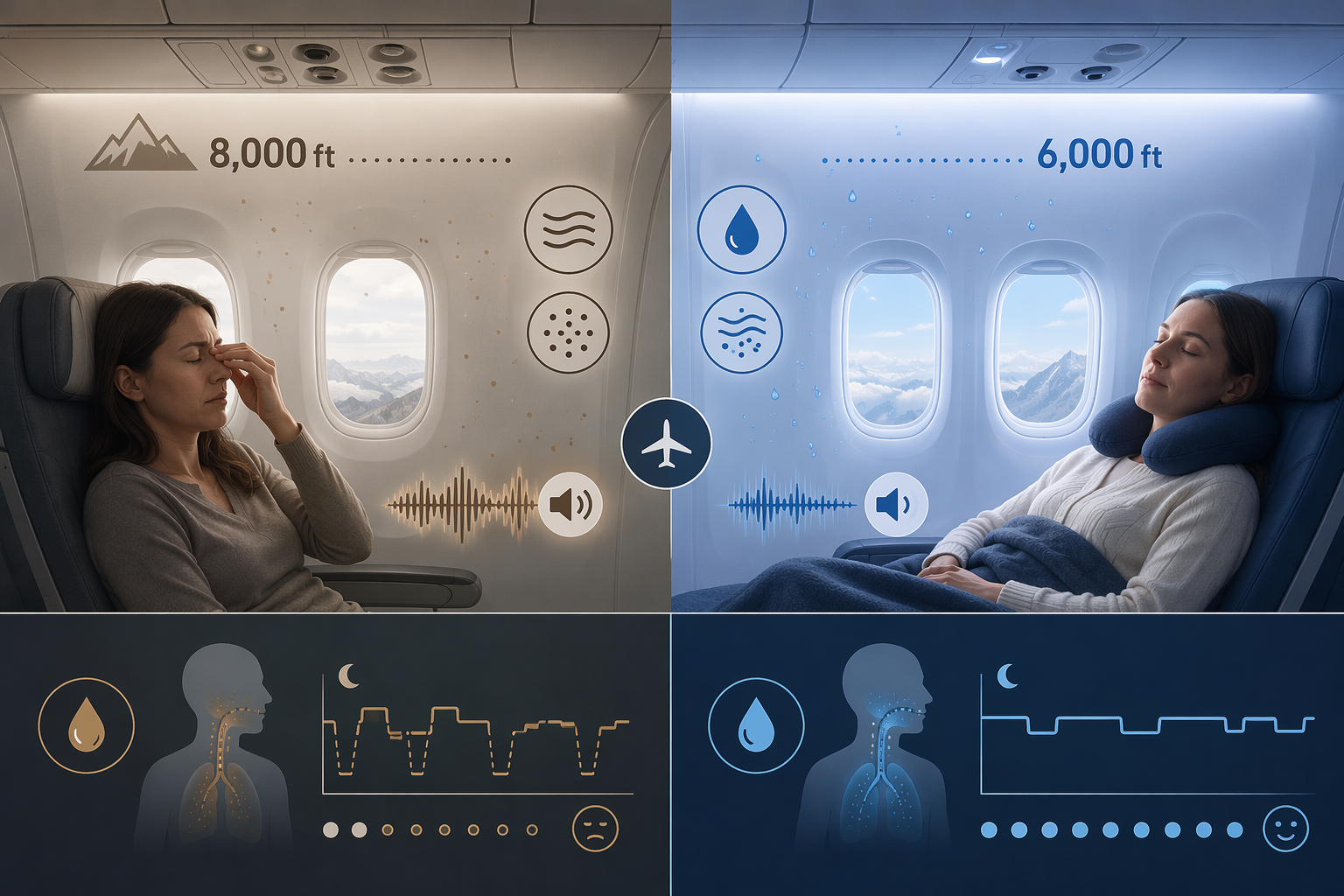
The 787 helps the body before it helps the posture
In a normal bedroom, sleep continuity depends on a long list of quiet supports: stable breathing, enough moisture in the airway, a low sound floor, and light cues that do not keep telling the brain it is daytime. Long-haul economy attacks all of those at once. The Boeing 787 does not remove the attack, but it softens several of its most irritating parts.
Boeing’s published 787 design materials describe a lower equivalent cabin altitude target, higher cabin humidity, larger dimmable windows, and LED lighting systems intended to create a more comfortable cabin environment than older aircraft designs.[1] Those are not decorative details. They are the parts of the aircraft most likely to change whether a passenger wakes repeatedly from breathing strain, dry mouth, noise intrusions, or poorly timed light.
They are also design targets, not guarantees. Actual cabin conditions can vary by aircraft, maintenance state, airline configuration, flight profile, and crew operation. A 787 gives the airline better tools; it does not guarantee that every overnight economy cabin becomes a controlled sleep lab.
Lower cabin altitude reduces one source of sleep fragmentation
The strongest sleep-related claim for the 787 starts with pressure. Boeing gives the 787 a design target of 6,000 feet equivalent cabin altitude, compared with the older industry-standard ceiling of 8,000 feet.[1] That difference sounds abstract until it is translated into sleep: at a higher cabin altitude, oxygen availability falls, breathing becomes a little more stressed, and susceptible passengers are more likely to experience arousals that break sleep into lighter, less restorative pieces.
This is not the same as saying every traveler will sleep well on a 787. It is a narrower and more useful claim: when cabin altitude is lower, the body has less hypoxic load to manage while it is trying to stay asleep. On a long overnight segment, that can mean fewer awakenings that feel like vague restlessness, shallow breathing, or unexplained fatigue after what should have been enough hours in the dark.
APEX reported a Boeing-attributed comparison in which 25% of passengers on conventional flights longer than 12 hours experienced noticeable respiratory distress, compared with 5% on the 787.[2] That statistic is highly relevant, but it should be handled carefully: the original study methodology is not independently available in the cited reporting, and the figure should not be read as an independent clinical trial result.
Even with that caveat, the mechanism is plausible and important. Sleep is not only disturbed by obvious events such as turbulence or meal service. It is also disturbed by the body repeatedly correcting small stressors. If lower cabin altitude reduces one of those stressors, the passenger may not notice the engineering directly; they may simply wake fewer times, or arrive feeling less wrung out than they expected.
Higher humidity matters because dry air wakes people quietly
Aircraft dryness is often treated as a skin-care inconvenience. For sleep, it is more basic than that. Dry cabin air increases moisture loss from the airway, mouth, eyes, and skin. Once the throat feels rough or the mouth dries out, the body has a new reason to wake, drink, cough, swallow, adjust a mask, remove a mask, or give up on sleep for a while.
The 787 is designed for substantially higher relative humidity than conventional aircraft: about 15–25% versus about 4–7% in older cabin environments, according to Boeing and reporting summarized by Simple Flying.[1][3] That is still dry compared with a comfortable bedroom, but it is a meaningful change from the near-desert air many long-haul passengers associate with overnight flights.
The sleep effect is not magic hydration. You can still become thirsty, especially if you drink alcohol, breathe through your mouth, or start the flight underhydrated. The better claim is that the cabin is less aggressively dehydrating. That matters because sleep on aircraft is already chopped into cycles by service, light, noise, posture changes, and other passengers. Dry-air awakenings add another cut.
On a 787, it makes sense to drink as if the cabin is improved rather than solved. Hydrate before sleep, keep water available, and do not assume the higher humidity will compensate for alcohol or caffeine. The aircraft reduces moisture loss; it does not give you the air of a well-humidified bedroom.
A quieter cabin makes your own noise control work better
Noise does not have to wake you fully to damage sleep. A sleeping brain continues to sort sound for relevance, and steady aircraft noise can keep sleep lighter even when you stop consciously noticing it. The same principle appears in other sleep-disruption settings, from acoustic startle during storms to low-frequency mechanical noise that fragments sleep without feeling dramatic in the moment.
For readers who want that mechanism in a non-travel setting, the site’s pieces on why thunderstorms disrupt sleep quality and how data center noise disrupts sleep without you hearing it are useful parallels. An aircraft cabin is not a thunderstorm or a server room, but the sleep problem is familiar: the body keeps monitoring sound while you are trying to stay asleep.
The 787 cabin has been reported as roughly 20% quieter at cruise than comparable aircraft such as the A330 and 777, though exact decibel measurements vary by source and location in the cabin.[3] Passenger reporting from long 787 economy flights also consistently notes the cabin’s relative quiet compared with older long-haul aircraft.[4]
The useful part is not that the cabin becomes silent. It is that the ambient floor is lower. Good foam earplugs or active noise-canceling headphones have less work to do, so the combined result can be meaningfully quieter than the same gear on a louder aircraft. That is one of the few 787 advantages a passenger can actively amplify without changing seats.
Light cues are useful only if the timing is useful
The 787’s electrochromic windows and programmable LED lighting are easy to oversell because they look like the visible face of the Dreamliner cabin. For sleep, their value is more specific. They can reduce harsh light exposure, help create a gradual dimming or wake-up sequence, and give the cabin a better chance of matching the time zone strategy of the flight.[1][3]
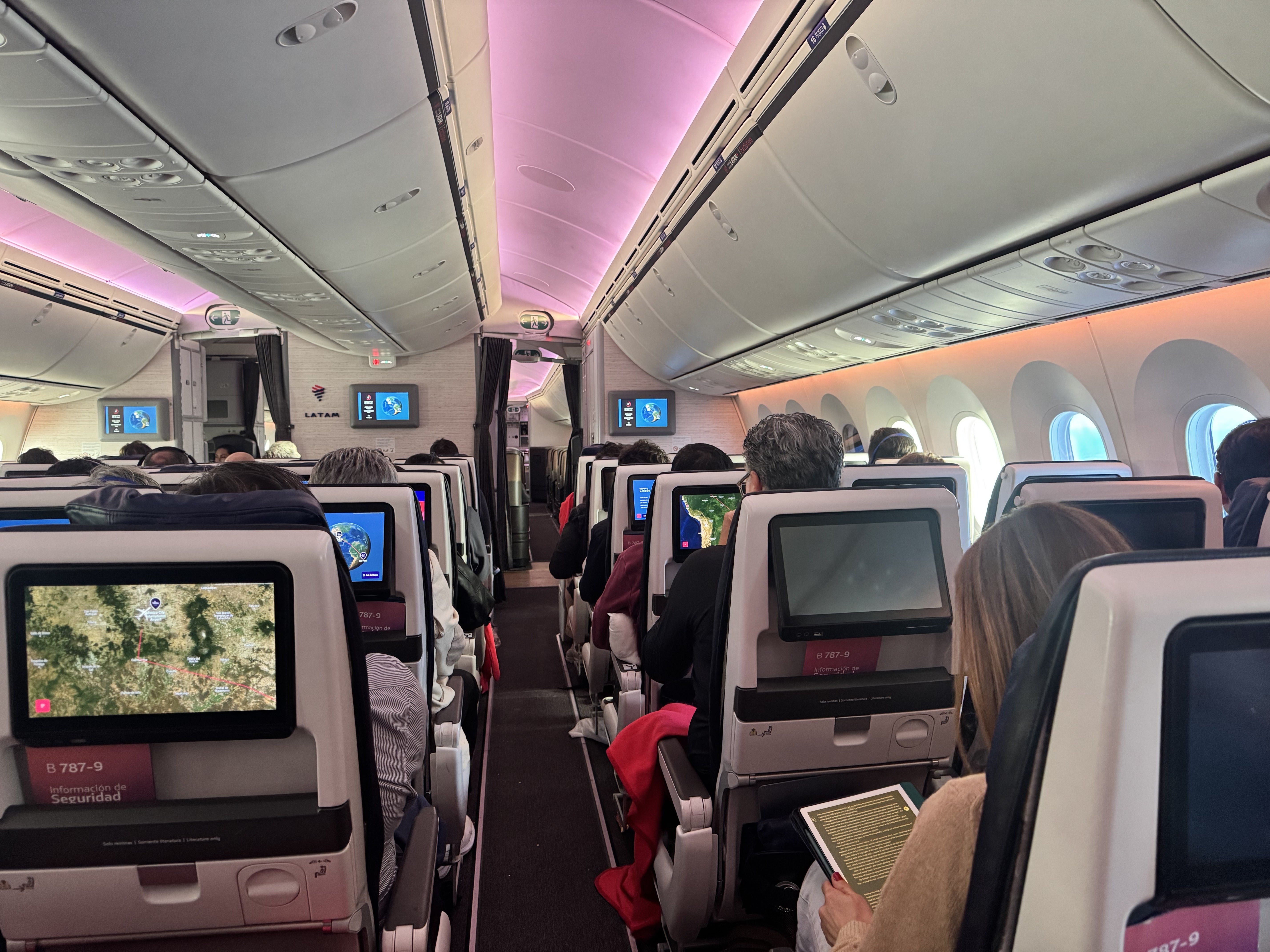
But light is a timing signal, not comfort decoration. Blue-toned brightness when your destination night has begun can make sleep harder; a controlled dim cabin during the biological night can help; a simulated sunrise before arrival can be useful if it aligns with when you actually need to wake. The aircraft can support those cues, but the airline decides how they are used.
In practice, crew schedules and passenger behavior can override the theoretical advantage. Reviews of airline-specific 787 cabins note that lighting and window control are not simply passenger-controlled sleep tools; crew decisions shape the cabin environment during service and rest periods.[5] A passenger can still work with the system by dimming the window when possible, using an eye mask when the cabin schedule conflicts with sleep, and treating meal service light as a predictable interruption rather than a personal failure to sleep.
The seat remains the binding constraint
The 787’s cabin environment deserves credit. The economy seat deserves much less romance. Most 787 operators use 9-abreast economy layouts, and published 787 economy specifications show seats roughly 16.2–17.3 inches wide, with pitch commonly ranging from about 30–34 inches and recline from about 3–6 inches depending on airline, subfleet, and configuration.[6][7][8][9]
| Sleep factor | What the 787 improves | What the seat still limits |
|---|---|---|
| Breathing load | Lower equivalent cabin altitude can reduce hypoxia-related strain | Upright posture can still restrict relaxed breathing for some passengers |
| Dryness | Higher humidity reduces the severity of dry-air exposure | Mouth breathing, alcohol, and long sleep windows can still cause thirst |
| Noise | Lower ambient cabin noise makes earplugs or ANC more effective | Seat location near galleys, lavatories, or talkative neighbors still matters |
| Light | Dimmable windows and LED lighting can support circadian timing | Crew-controlled lighting and screen glow can interrupt the plan |
| Posture | No major aircraft-level solution in standard economy | Width, pitch, recline, armrest sharing, and leg position remain decisive |
That last row is the one travelers feel in their necks and hips. Sleep is not only a brain state; it is also a musculoskeletal problem. A passenger who cannot support the head, unload the lower back, or keep the knees and shoulders from fighting the seat geometry will keep waking even in a better-pressurized, better-humidified cabin.
There are outliers that show the aircraft type is not destiny. Japan Airlines has operated a rare 8-abreast 2-4-2 787 economy layout with wider seats, while ANA’s documented 206-seat 787-9 configuration lists 33–34 inches of pitch and 6 inches of recline.[7][8] Those cabins are useful examples because they separate the 787’s engineering potential from the commercial choice to pack most economy cabins more tightly.
This is why a traveler should not book purely by aircraft model. A 787 with a tight 9-abreast layout and a poor seat assignment can still be miserable for sleep. A more generous 787 configuration can make the environmental advantages easier to feel because the body is not fighting posture every few minutes.
How to use the 787 differently
The practical response is not to treat the 787 like a miracle aircraft. It is to stop treating it like any other economy cabin. Its advantages are real enough to plan around.
- Take the lower cabin altitude seriously: if you usually feel unusually depleted after older long-haul aircraft, a 787 may reduce part of that physiological burden, even if the seat still feels cramped.
- Hydrate with better expectations, not false ones: the cabin is less dry than conventional aircraft, but it is still dry enough to wake you if you start the flight depleted or drink alcohol.
- Use the quieter cabin deliberately: bring earplugs or ANC headphones because a lower noise floor makes those tools more effective.
- Control light at the passenger level: dim the window when you can, use an eye mask when the cabin lighting schedule does not match your sleep target, and avoid treating the seatback screen as harmless if you are trying to shift toward destination night.
- Choose the seat as if it is still the main problem: aisle versus window, proximity to lavatories, recline conflicts, and head support will decide how much of the 787’s physiological advantage you can actually keep.
A few niche products may eventually blur the line between economy and lie-flat rest on specific 787 routes, but they do not change the normal 2026 economy calculation. For most travelers, the relevant aircraft is still a standard 787 economy cabin, not a sleep-pod exception.
The Boeing 787 is meaningfully better for economy sleep than many older long-haul aircraft because it makes the cabin less physiologically hostile. It lowers one breathing burden, reduces the worst dryness, softens the sound environment, and gives the cabin better light-control tools. Then the seat takes over. If you board expecting a bed, the 787 will disappoint you. If you board expecting a narrow seat inside a better-engineered sleep environment, you can use its advantages without pretending they solve the hardest part.
References
- 787 By Design, Boeing
- Dreamliner Cabin Pressure Tech Reduces Altitude Sickness, Benefits PaxEx, APEX
- How The Boeing 787's Unique Cabin Design Helps Reduce Jet Lag, Simple Flying
- 15 hours on a Boeing 787 Dreamliner in coach, CNET
- Taking comfort in small comforts on American’s 9-abreast 787, Runway Girl Network
- Best Economy Class Seats on United Boeing 787 Dreamliner, Travel Codex
- Economy Seats On The Dreamliner, Travel Update
- B787-9 Economy Class, ANA
- Missed opportunity: Why the B787 fails the comfort test in economy, Business Traveller
Comments
Join the discussion with an anonymous comment.