
The hard part of sleeping during a Cuba blackout often arrives after sunset, when the room is still holding the day’s heat and the window becomes a bad bargain: open it and mosquitoes come in; close it and the air stops moving. That choice matters because sleep is not just a matter of lying still. The body normally needs to release heat and let core temperature fall before sleep begins; hot, humid rooms interfere with that drop, increase wakefulness, and reduce deeper sleep stages.[1]
So the useful question is not simply how to “stay cool.” It is how to reduce the heat your body has to fight, use the short evening cooling window, keep air moving without feeding mosquitoes, and spend any battery power where it actually changes the night.
Start Before the Room Turns Into Stored Heat
The night plan starts in daylight, not at midnight. A room that absorbs sun all afternoon will keep giving that heat back after the power fails, and by then the person trying to sleep has fewer tools left.
During the hottest part of the day, block direct sun from hitting the sleep area. Close shutters, pull curtains, hang a sheet, or use cardboard on the sun-facing side if that is what is available. This is not decoration; it lowers the heat stored in walls, bedding, and furniture, so the body has less heat to shed later.
Keep the bed itself as heat-light as possible. Remove extra blankets, thick covers, plastic mattress protectors if they trap sweat, and piles of clothing from the sleeping surface. A cotton sheet or thin cloth gives sweat a place to spread and evaporate; a heavy or non-breathable layer keeps moisture against the skin and makes humid heat harder to tolerate.
If water is available, wash or dampen cloths before dark and place them where they can be reached without searching. A wet cloth on the neck, chest, forearms, or lower legs helps because these areas can lose heat efficiently. The goal is not to make the whole bed wet. In very humid air, soaked bedding can become clammy and useless; small damp surfaces are easier to refresh and less likely to trap heat.
Charge what can be charged while power exists, but decide its job in advance. A phone light, a small rechargeable fan, and a battery pack cannot all be treated as unlimited. If the fan exists, its most valuable hours are usually not the first warm minute of the evening but the period when someone is trying to fall asleep or when a child, older adult, pregnant person, or sick person is failing to cool down.
Use Sunset While the Outside Air Is Still Useful
There is often a brief period around dusk when outdoor air is less punishing than the room. That is the time to move heat out, not after the bedroom has become a sealed box.
- Open opposite sides of the home if mosquitoes can be blocked at the openings or over the sleeping person.
- Move the sleeping mat or bed closer to the path of air, not necessarily closest to the window.
- Put damp cloths on skin before sleep begins, then let moving air pass over them.
- If there is a fan, aim it across damp skin or across the bed area rather than at a wall.
- Once mosquitoes increase, protect the sleeper first; do not keep bare skin exposed just to preserve a little more breeze.
Evaporation is the reason this works. Sweat and damp cloths cool the skin when water changes into vapor, but high humidity slows that process. Air movement helps by carrying moist air away from the skin, which is why a weak breeze can matter more than it looks like it should.
A cool or lukewarm rinse before bed can help if water access allows it. Avoid making the body shiver; shivering is heat production, and the point is to lower heat burden, not start another fight inside the body. Dry lightly or stay slightly damp where air can move across the skin.
Do Not Trade Ventilation for Mosquito Bites
The blackout sleep problem in Cuba is not the same as a normal hot-bedroom problem. Opening windows may be the only way to get air, but reports in 2025 described a large wave of mosquito-borne illness, with Cuban health officials saying nearly one-third of the population had been affected by chikungunya or dengue; the same report noted that blackouts were pushing people to open windows and doors, allowing Aedes mosquitoes indoors.[2]
That makes a sealed room a dangerous kind of advice when the heat is severe, and an uncovered open room a dangerous kind of advice when mosquitoes are active. The better compromise is to protect the person while preserving airflow.
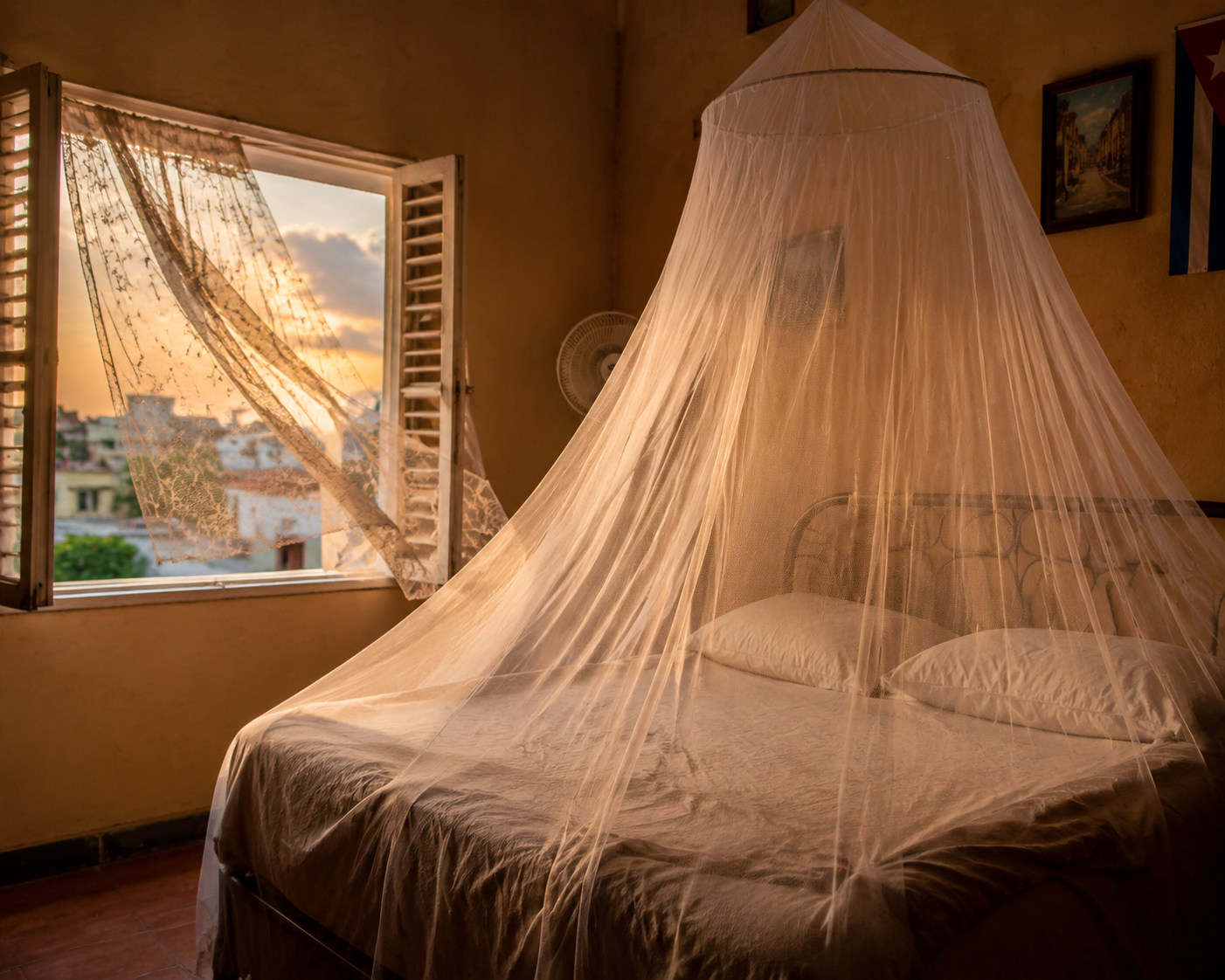
If there is a mosquito net, use it around the sleeping body rather than closing every possible source of air. Tuck the edges under the mattress, mat, or sleeping surface. Check for skin touching the net; mosquitoes can bite through fabric if an arm or foot is pressed against it. Keep the net loose enough to create space, but not so loose that it leaves gaps at the floor or bed edge.
If there is no proper net, improvise barriers at the points that matter most. A thin curtain, gauze, repaired screen, or tightly hung fabric over a window can reduce mosquito entry while still letting some air pass. A cloth hung directly over the sleeper may help, but it should not collapse onto the skin or block every breath of air; the aim is a screened sleeping pocket, not a suffocating tent.
Repellent, if available, belongs on exposed skin before the worst mosquito hours, not after everyone is already half asleep and scratching. Long, loose, light clothing can help when the air allows it, especially for children, but overheating is a real tradeoff. If a child is sweating heavily, flushed, or unable to settle, forcing more layers can worsen the heat problem.
| Situation | Better choice for the night |
|---|---|
| Window gives the only breeze, but mosquitoes are entering | Keep the window open only if the sleeper is under a net or the opening is screened with breathable fabric |
| Net blocks too much air | Raise it higher, create more space around the body, and use a fan or cross-breeze outside the net if possible |
| No net is available | Cover the most exposed skin, screen the opening with thin fabric, and choose a sleep spot with airflow but fewer insects |
| Child keeps kicking off covers | Prioritize a tucked net or screened space over heavy clothing that may trap heat |
Spend Fan Battery Where It Buys Sleep
A small rechargeable fan cannot turn a hot room into a safe bedroom by itself, but it can help the body shed heat at the moment sleep is trying to begin. In hot environments, airflow improves comfort partly by helping sweat evaporate; without that movement, humid air sits on the skin and the core temperature decline needed for sleep becomes harder.[1]
Use the lowest fan speed that can be felt on damp skin. Low speed usually preserves battery longer than high speed, and the first goal is not maximum wind for a few minutes; it is enough air movement to help someone cross into sleep and return to sleep after waking.
- Run the fan during the first sleep attempt rather than all evening while people are still awake and moving.
- Aim it at the upper body, neck, or damp cloths, not randomly into the room.
- Share airflow in shifts if several people need it; the person most heat-stressed gets priority.
- Keep the fan outside a mosquito net if it collapses the net onto skin; bites through netting defeat the protection.
- Save some charge for the hottest waking period, often the stretch after the room has fully absorbed the day’s heat.
If there is no fan, hand-fanning is not childish or symbolic. Havana Times accounts from 2026 describe families fanning children with cardboard, people moving to rooftops and sidewalks, and residents speaking of sleep as something that has become a privilege during the energy crisis.[3] Cardboard air is still air movement, and when it is used over damp skin or a sleeping child’s upper body, it can make the difference between repeated waking and a short stretch of sleep.
When the Bedroom Is the Worst Place to Sleep
Some nights the private room is not the safest or most sleepable place. Reports from Cuba describe people sleeping on rooftops and sidewalks during blackout heat, not because those are comfortable choices, but because indoor air can become unlivable.[3]
A shared outdoor or semi-outdoor sleep spot can work better when it offers moving air, a lower heat load than the bedroom, and enough people nearby to make the space safer. Courtyards, balconies, rooftops, porches, and sidewalks each carry different risks: falls, theft, insects, rain, noise, privacy, and the difficulty of caring for children or elders in the dark. The right place is not the prettiest or quietest one. It is the place where bodies can cool without becoming exposed to another danger.
If a household moves outside, keep the same sequence: reduce the bedding, preserve airflow, use nets or screened cloth where possible, and assign the most protected positions to those least able to tolerate heat. Infants and small children should not be placed where adults may roll onto them. Older adults should not be left alone on rooftops or stairs in darkness. A person who is dizzy, confused, very weak, or vomiting needs help, not a more creative sleep position.
Who Needs Priority When Everything Is Hot
In a household with one fan, one good net, or one cooler sleeping corner, fairness may not mean equal sharing by the clock. Pregnant people, older adults, infants, people with heart or kidney disease, and anyone with fever or chronic illness have less room for error when heat continues through the night. A May 2026 UN briefing on Cuba’s health emergency reported more than 32,000 pregnant women at increased risk, more than 100,000 delayed surgeries, and about 5 million people with chronic conditions facing interrupted care.[4]
Heat illness signs should end the sleep experiment. Heavy sweating with weakness, cool clammy skin, nausea, dizziness, headache, fainting, fast pulse, confusion, or worsening symptoms after cooling efforts are warning signs that require urgent attention where care is available.[5] During a blackout, the temptation is to wait until morning. For a vulnerable person, waiting can be the dangerous choice.
A Workable Night Sequence
The best sleep tips for Cuba’s blackout conditions are not a pile of tricks. They work better in order, because each step leaves the next one less desperate.
- In daylight, block sun from the sleep area, strip the bed down, prepare damp cloths, and charge only what can realistically be used at night.
- At sunset, open for cross-ventilation where mosquitoes can be blocked, move the sleeping place into the air path, and cool skin with water rather than soaking the whole bed.
- Before mosquitoes take over the room, put the person inside a net or screened sleeping space while keeping as much airflow as possible.
- Use fan battery on low speed, aimed at damp skin or the sleep area, during the first sleep attempt and the worst waking periods.
- If the room stays worse than outside, consider a safer shared outdoor spot with mosquito protection and priority places for vulnerable people.
None of this makes a blackout bedroom comfortable. It does give the body a better chance to do the one thing sleep requires: let heat go. Tonight, the first useful move is to lower the room’s heat burden before dark, then protect airflow without giving mosquitoes bare skin. After that, spend the battery, the better corner, and the hand-fanning where they are most likely to turn exhaustion into actual sleep.
References
- Effects of thermal environment on sleep and circadian rhythm, Journal of Physiological Anthropology, 2012.
- Cuban authorities battle wave of mosquito-borne illnesses, Al Jazeera, November 14, 2025.
- Cuba’s Energy Crisis Is Measured in Hours Without Sleep, Havana Times, June 2026.
- UN OCHA/WHO May 2026 briefing, UN News, May 2026.
- Tips for sleeping without air conditioning, HealthPartners.
Comments
Join the discussion with an anonymous comment.