
The hard part about trying to sleep during wildfire smoke and event cancellations is that staying inside can be the correct public-health choice and still leave you wide awake. The windows are shut. The evening run, soccer game, concert, outdoor class, or walk with a friend is gone. The room feels stuffy. The air purifier is humming. Your phone keeps offering one more update about wind direction or evacuation zones.
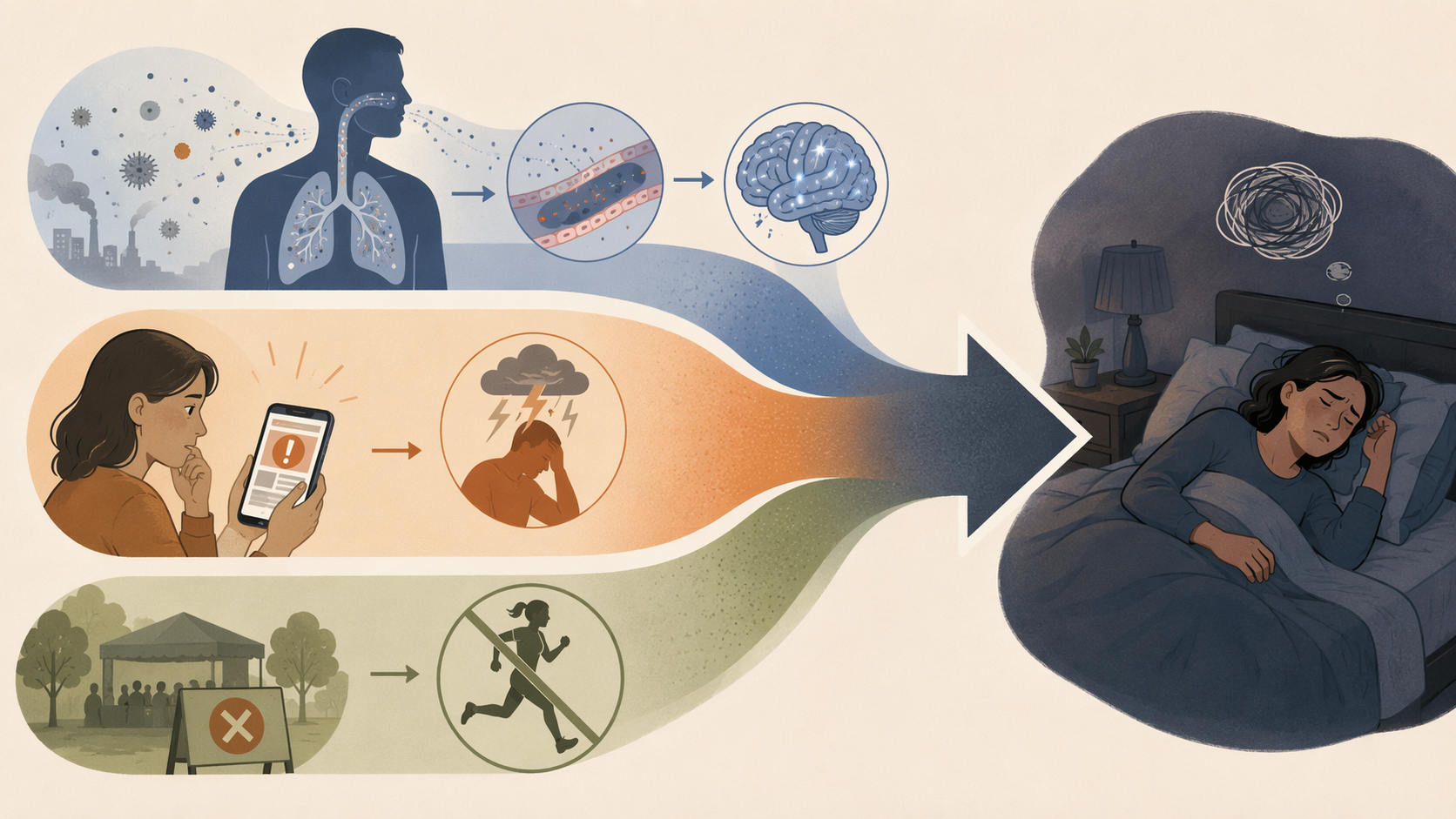
That sleeplessness is not just frustration with a ruined evening. During smoke events, sleep can be pulled apart by three forces at once: fine particles affecting the body and brain, threat signals keeping the nervous system alert, and cancelled routines removing the movement, light, and social timing that normally help the body shut down.
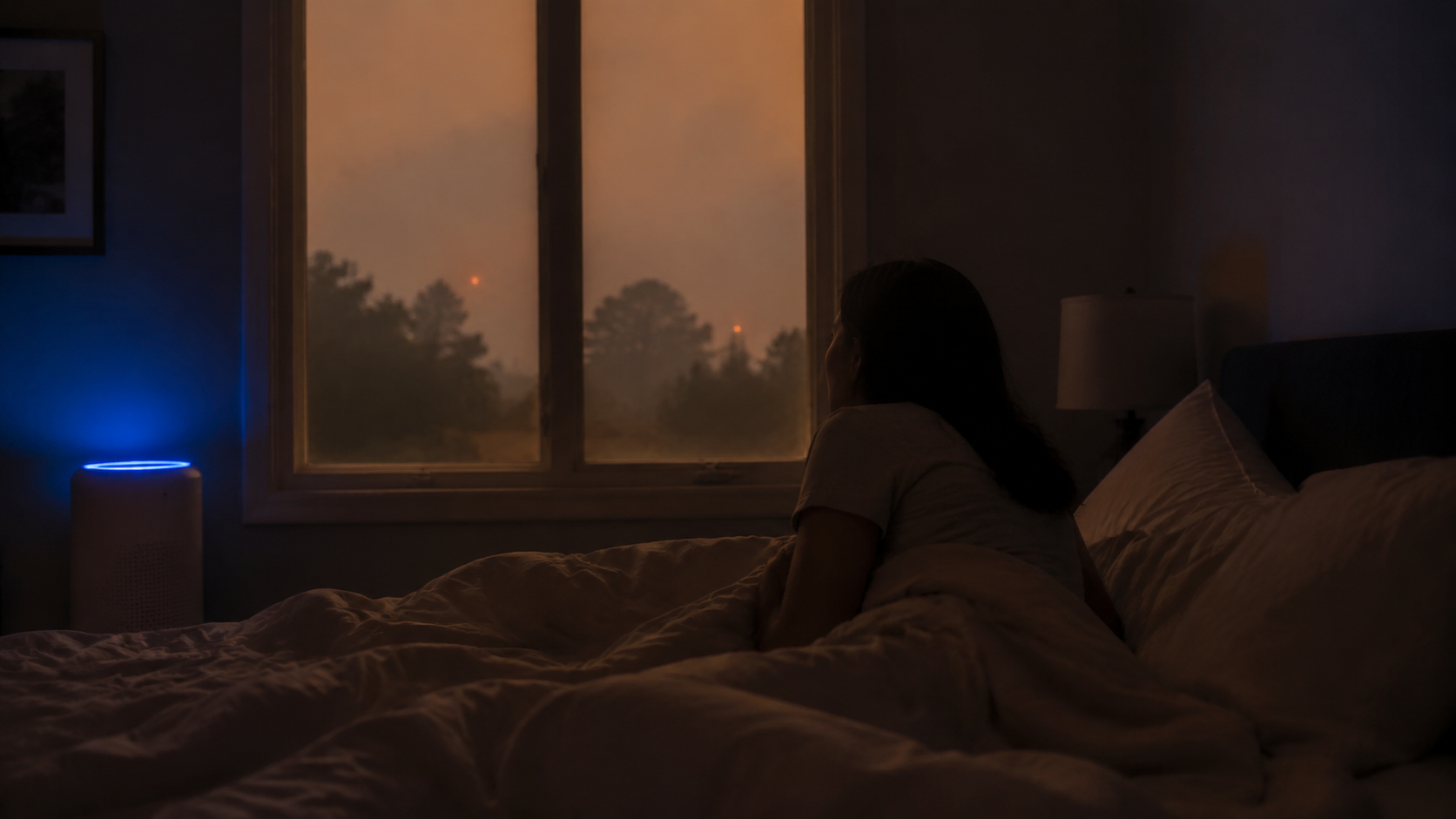
A systematic review of five wildfire studies found insomnia rates of 63% to 72.5% by self-report and 43.6% by clinical diagnosis among wildfire survivors, compared with an estimated general-population insomnia rate of about 30%.[1] Those figures should not be treated as a universal forecast for everyone who smells smoke for a few days; the review was small and the studies used varied methods. But they do confirm something many people feel during fire season: wildfire-related sleep loss can be severe, and it can persist beyond simple eye or throat irritation.
Why smoke can disturb sleep even when you stay indoors
The useful way to understand smoky-night insomnia is not to search for one cause. It is to separate the pathways, then notice where they meet in the bedroom.
| Pathway | What changes at night | What helps most |
|---|---|---|
| Physiological | Fine particulate matter irritates the airways, enters circulation, contributes to inflammation, and may affect brain regions involved in sleep regulation. | Make the bedroom a cleaner-air zone with a HEPA purifier, closed windows, and filtered HVAC air where available. |
| Psychological | Fire proximity, alerts, uncertainty, and fear keep the nervous system in a monitoring state. | Turn the bedroom into a low-alert safety cue; move checking behavior earlier and outside the bed when possible. |
| Behavioral | Cancelled events remove movement, daylight timing, social contact, and the usual evening sequence. | Replace the lost anchor indoors rather than expecting the body to wind down without one. |
This three-pathway model is a synthesis of separate lines of evidence, not a single published formula. That distinction matters because the fixes are different. A bedroom purifier can reduce particle exposure; it cannot, by itself, replace a cancelled walk or make a fire alert feel less threatening. At the same time, relaxation advice is thin comfort if the room air is still smoky.
The particle problem is smaller than dust and harder on sleep
Wildfire smoke is not ordinary dust with a worse smell. The major concern is PM2.5: particles smaller than 2.5 microns. These fine particles make up about 90% of wildfire smoke particulate matter, are small enough to travel deep into the lungs, can enter the bloodstream, and are associated with systemic inflammation.[2]
That mechanism helps explain why a smoky night can feel different from a mildly stuffy room. The irritation may start in the nose, throat, or chest, but the effect is not confined there. Fine particulate exposure has been described as reaching the frontal cortex and cerebellum, regions involved in sleep regulation.[2] For a person trying to sleep, that can show up as coughing, chest tightness, headache, restlessness, lighter sleep, or the sense that the body is on edge without a clear emotional reason.
The Environmental Protection Agency also notes that wildfire smoke exposure can be associated with mental health symptoms, including sleep disruption.[3] That does not mean every poor night during smoke is caused directly by particles. It means the body is dealing with an exposure that can plausibly affect both breathing comfort and the systems that help sleep remain stable.
This is why the bedroom matters more than the rest of the house at night. You do not need to make every room perfect before bedtime. You need the room where you will spend the longest continuous stretch breathing to have the cleanest air you can manage.
Fear can keep you awake even when smoke exposure is not the whole story
Smoke is also a signal. It tells the brain that something dangerous is nearby, even if the fire is not at your door. Alerts, evacuation maps, road closures, changing wind forecasts, and a visible orange sky all compete with the normal message of bedtime: nothing needs your attention right now.
In the wildfire-survivor literature, stress is not just background noise. One Greek wildfire study included in the systematic review found that fear of imminent death independently predicted insomnia, with a reported p value of 0.005, above and beyond physical smoke exposure.[1] That is a narrow finding from a specific context, not proof that every smoky-night insomnia episode is trauma. But it is important because it separates danger perception from air quality. A person can be indoors with filtered air and still have a nervous system that is listening for threat.
The practical consequence is that the bed should not become the place where you repeatedly assess the emergency. If you need to check official updates, do it on purpose, at set times, and away from the bed when possible. Keep emergency alerts enabled if you are in an affected area; the goal is not to ignore risk. The goal is to stop turning every half-awake moment into another round of scanning.
If smoke season has trained your body to associate bed with monitoring, dread, or repeated awakenings, short-term calming routines may not be enough. Cognitive behavioral therapy for insomnia can help break that conditioned bed-anxiety loop; the same principles described for disaster-related nighttime anxiety in CBT-I after an earthquake apply when the trigger is wildfire smoke rather than shaking ground. For persistent insomnia, CBT-I remains a more evidence-based direction than stacking supplements or gadgets; this broader treatment question is covered in which insomnia alternatives actually have evidence.
Cancelled events remove more than entertainment
Event cancellations during smoke are often framed as an inconvenience: no practice, no outdoor movie, no evening run club, no concert in the park. For sleep, the bigger issue is that those events are timing devices. They provide movement, daylight exposure, a transition out of work mode, social contact, and a predictable sequence that tells the body the day is moving toward its end.
Public agencies cancel these activities for good reasons. King County’s tiered response framework calls for cancelling children’s outdoor activities at AQI 151 to 200 and cancelling all outdoor public events at AQI 201 to 300.[4] California’s Level 5 guidance requires cancelling all outdoor activities.[5] Those thresholds are not sleep recommendations; they are exposure-reduction decisions. But once the cancellation happens, the sleep consequence lands inside the home.
There is not a peer-reviewed body of research that precisely quantifies how much wildfire-related event cancellations reduce sleep. The more careful conclusion is smaller and still useful: cancellations remove behaviors that normally support circadian timing and sleep pressure. If your outdoor plan disappears, your body may miss the exercise, light cue, social rhythm, and transition ritual, not just the event itself.
The replacement does not need to be elaborate. A low-intensity indoor walk, mobility routine, stair intervals if safe for your health, a video call with the person you would have met, or a set evening cleanup can preserve the shape of the night. The point is to give the body some version of “we did the evening thing; now we are moving toward bed.”
Make the bedroom the clean-room, not the whole home
During a smoke event, the highest-leverage sleep intervention is a bedroom clean-room plan. The EPA and CDC recommend using a portable air cleaner, keeping windows and doors closed, and using central HVAC filtration where available; the practical nighttime version is to prioritize the bedroom because that is where exposure accumulates while you sleep.[3][6]
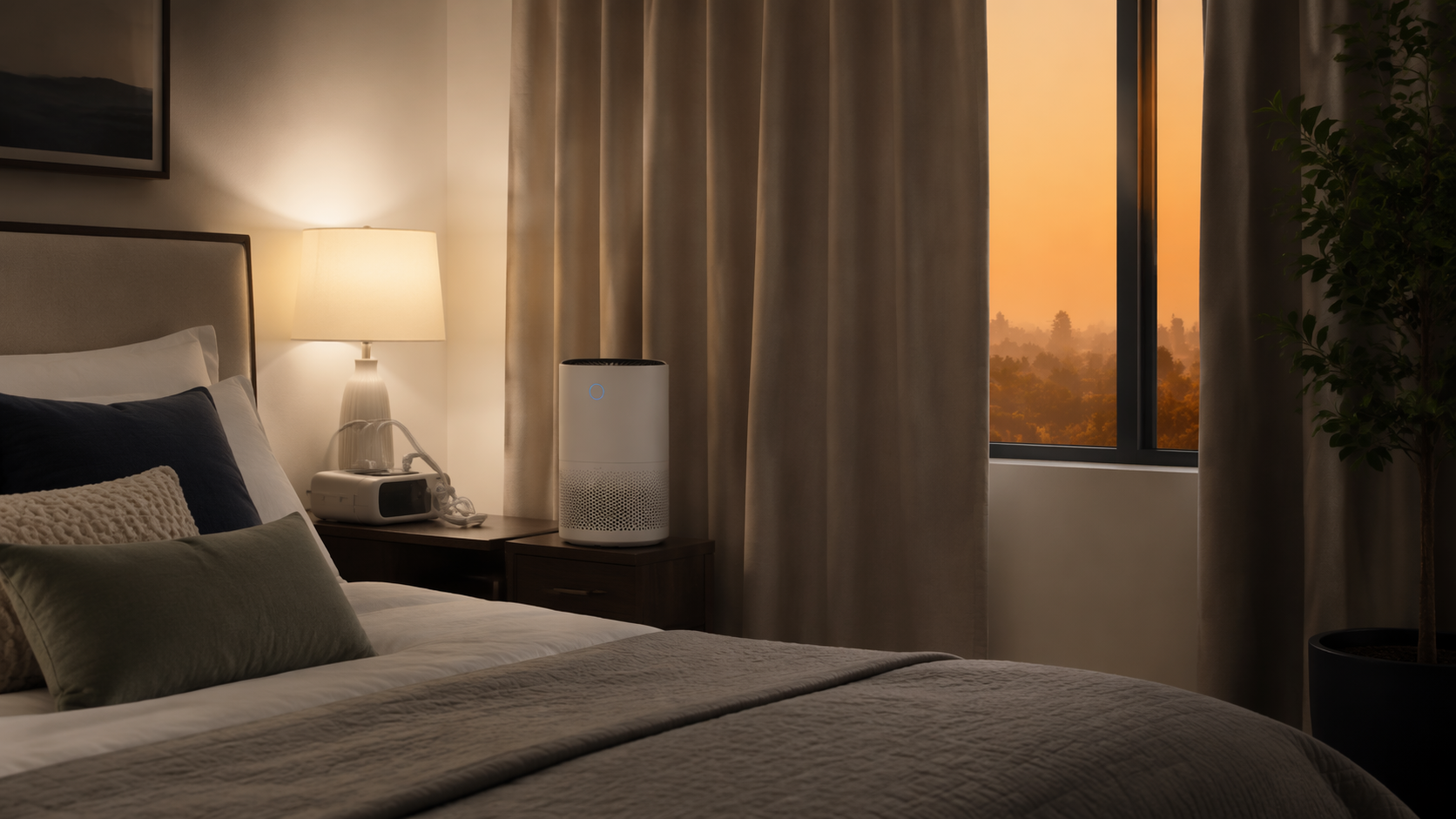
Start with the purifier. Use a true HEPA portable air cleaner sized for the bedroom, run it before bedtime, and keep it running while you sleep if the sound is tolerable. Place it where air can circulate rather than wedged behind furniture or trapped under a desk. If the purifier has a bright display, dim it or cover the light without blocking airflow. The machine should make the room feel steadier, not turn bedtime into a product-review session.
Then reduce the room’s intake of outdoor air. Keep windows closed. Close the bedroom door if other parts of the home are drafty or frequently opened. If you have central HVAC, run the fan in “on” mode rather than only “auto” when your system can handle it, and use a MERV-13 or higher filter if compatible with the equipment.[3] If you need more detail on purifier placement, window sealing, and clean-room setup, use this air quality advisory sleep guide as the operational checklist.
Closed windows can make the room too warm, especially when smoke overlaps with summer heat. That is not a minor comfort problem; heat itself can fragment sleep. If you do not have air conditioning, shift the cooling strategy toward the body: lighter bedding, a cool shower before bed, damp cloths, safe fan placement when indoor air is filtered, and cooling the sleeping surface where possible. The heat side of the problem is covered more fully in sleeping in heat without AC, and the combined heat-smoke problem is covered in the summer heat and wildfire smoke sleep guide.
A tonight-first bedroom sequence
- Pick one sleep room and treat it as the priority zone, especially if you cannot filter the entire home.
- Close windows and doors before the worst evening smoke period if forecasts suggest deterioration.
- Run the HEPA purifier continuously in the bedroom, with airflow unobstructed and lights dimmed.
- Use HVAC fan mode and a MERV-13 or higher filter if your system supports it.
- Move fire-update checking to a specific place outside the bed, while keeping required emergency alerts active.
- Replace cancelled outdoor activity with a brief indoor movement-and-transition routine earlier in the evening.
Who needs extra caution
The CDC identifies children, older adults, pregnant people, and people with asthma, COPD, or heart disease as groups at higher risk from wildfire smoke.[6] For these households, the bedroom plan is not just about sleeping better. It is a way to reduce overnight exposure during the hours when people may be least able to notice worsening symptoms.
CPAP users need one extra layer of attention. Built-in CPAP filters are not a substitute for cleaning the room air. Manufacturer guidance summarized by Easy Breathe recommends replacing CPAP filters every 2 to 4 weeks during normal use and more often during smoke events, with HEPA room filtration used as additional protection.[7] Because that guidance comes from a commercial source rather than a peer-reviewed clinical trial, treat it as practical maintenance advice and confirm device-specific instructions with your CPAP manufacturer or clinician.
If you wake with chest pain, severe shortness of breath, confusion, blue lips, or symptoms that feel urgent, that is not a sleep-hygiene problem. Follow local emergency guidance and seek medical care.
The control point that remains
Wildfire smoke makes sleep fragile because it attacks the night from more than one direction. PM2.5 can irritate the body and participate in inflammatory pathways. Fire proximity and alerts can keep the brain in a threat-monitoring state. Event cancellations can erase the movement, social rhythm, and evening sequence that usually help sleep arrive.
The best response is not one sleep hack. It is to make the bedroom the cleanest, safest, most predictable sleep zone available: HEPA purifier running, windows closed, HVAC filtration used when compatible, heat managed without pulling in smoke, emergency checking contained, and the lost evening routine replaced indoors.
References
- Wildfire Exposure and Sleep: A Systematic Review, PubMed Central, 2021, link
- How Wildfire Smoke Affects Your Brain and Body, Psychology Today, link
- Wildfire Smoke Course, U.S. Environmental Protection Agency, link
- Wildfire Smoke Response Framework, Public Health — Seattle & King County, link
- California schools must cancel outdoor activities under new wildfire smoke rules, The Fresno Bee, link
- Wildfire Smoke and Your Patients’ Health, Centers for Disease Control and Prevention, link
- CPAP Filters and Wildfire Smoke, Easy Breathe, link
Comments
Join the discussion with an anonymous comment.