
The most sleep-relevant thing about the Boeing 787 Dreamliner is not the window dimmer or the blue cabin lighting. It is cabin altitude. The 787 is designed to pressurize the cabin to about 6,000 feet, rather than the older 8,000-foot standard used on many previous-generation widebodies such as the 777, 767, 747, and A330; Boeing has also said the 777X will use the 6,000-foot approach [1][2].
That difference sounds small until you have spent eight or twelve hours in economy with a dull headache, dry eyes, and the strange fatigue that arrives before you have done anything except sit still. A lower cabin altitude does not turn a narrow seat into a bed. It does, however, reduce one of the basic physiological stresses of flight before the passenger starts trying to solve sleep with an eye mask, headphones, melatonin, or willpower.
Why 6,000 feet matters
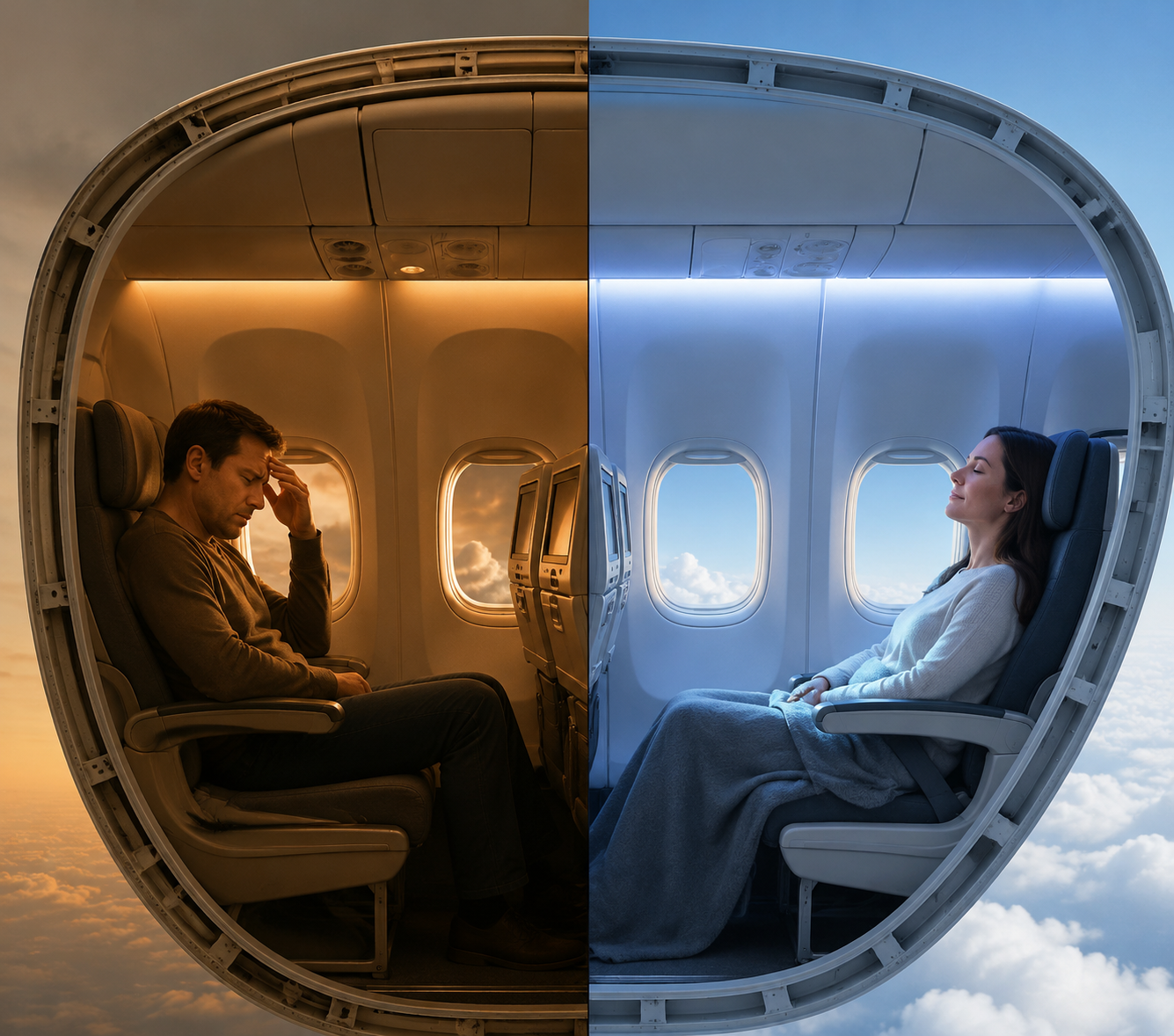
Cabin altitude is a pressure problem, not a branding phrase. At cruising altitude, an aircraft cabin is pressurized to a level that the human body can tolerate, but “tolerate” is not the same as “feel rested.” As cabin pressure altitude rises, the partial pressure of oxygen falls. Most healthy passengers remain safe, but comfort can deteriorate over time: more headache, more fatigue, more bodily unease, and less margin for sleep.
The strongest evidence commonly cited for the 787’s lower-altitude cabin is a 2007 New England Journal of Medicine study by Muhm and colleagues. The study placed 502 participants in a hypobaric chamber and exposed them to cabin-altitude conditions over 3 to 9 hours, then measured symptoms including discomfort, headache, and fatigue [3]. The important finding was not that everyone suddenly became miserable at one exact altitude. It was that symptoms increased significantly at 7,000 to 8,000 feet after several hours, and the authors concluded that maintaining cabin altitude at 6,000 feet or lower reduced passenger discomfort [3].
That is a useful threshold because it lines up with the duration of real long-haul flying. A short hop may end before the cabin environment has had much time to wear you down. On a transcontinental or intercontinental flight, three hours is only the beginning. By hour six, the passenger trying to sleep is no longer reacting to one bad variable; they are accumulating pressure, dryness, noise, light exposure, constrained posture, meal timing, and circadian mismatch. Lowering one of those stresses does not solve the whole system, but it changes the starting load.
The caveat is not decorative. The NEJM study was funded by Boeing and conducted in a chamber, not on an actual flight [3]. A chamber can isolate cabin altitude in a way real travel never does. It also strips away boarding stress, seatmates, turbulence, meal service, alcohol, airport sleep debt, and the fact that many people are already tired before the aircraft door closes. The authors noted that this setting may underestimate discomfort in real flight conditions [3].
That combination—industry funding, artificial environment, and still a measurable symptom difference—is exactly why the study should be read carefully rather than either worshipped or dismissed. It does not prove that every passenger sleeps better on a 787. It does support a narrower and more defensible claim: after several hours, a cabin pressurized around 6,000 feet is physiologically less punishing than one closer to 8,000 feet, and fatigue-related symptoms are part of that difference.
Humidity is the second real advantage, if the airline uses it well
Dry air is easy to underestimate because it feels like a comfort complaint. On a long flight, it becomes a sleep problem. Dry nasal passages and throat irritation make mouth breathing more likely, make awakenings more noticeable, and leave some passengers feeling wrung out even if they technically slept. The aircraft cannot decide your bedtime, but it can decide whether the air quietly keeps waking your body up.
The 787’s composite carbon-fiber fuselage is central here. Older aluminum aircraft have to manage humidity cautiously because moisture and metal corrosion are not friends. The 787’s materials allow higher cabin humidity without the same corrosion risk, and published descriptions commonly place 787 cabin humidity around 15% to 25%, compared with roughly 4% to 7% on older aircraft [4][5].
Those numbers should be treated as a plausible operating range, not a passenger guarantee. Actual humidity depends on how the airline operates the system and how many people are onboard. A full cabin adds moisture through respiration; a lightly loaded cabin behaves differently. Still, the design matters because it gives the aircraft and airline more room to make the environment human-friendly. A passenger does not need tropical air at 37,000 feet. They need air that does not make every breath feel like a small withdrawal from the body’s water supply.
This is also where aircraft design overlaps with ordinary sleep-environment thinking. Temperature, humidity, and air quality affect how stable sleep feels, which is why the cabin is part of the sleep surface even before the seat reclines. If you think about weather and indoor conditions as sleep variables at home, the same logic travels; Restful Ground’s piece on weather forecasts and sleep preparation is a useful companion for that broader environmental angle.
Noise, light, and jolts: the sleep interruptions that add up
Once altitude and humidity are addressed, the 787’s other sleep-related features work less like one dramatic intervention and more like a set of interruption reducers. They do not sedate the passenger. They reduce the number of reasons the passenger’s nervous system has to stay alert.
A quieter cabin means fewer chances to surface
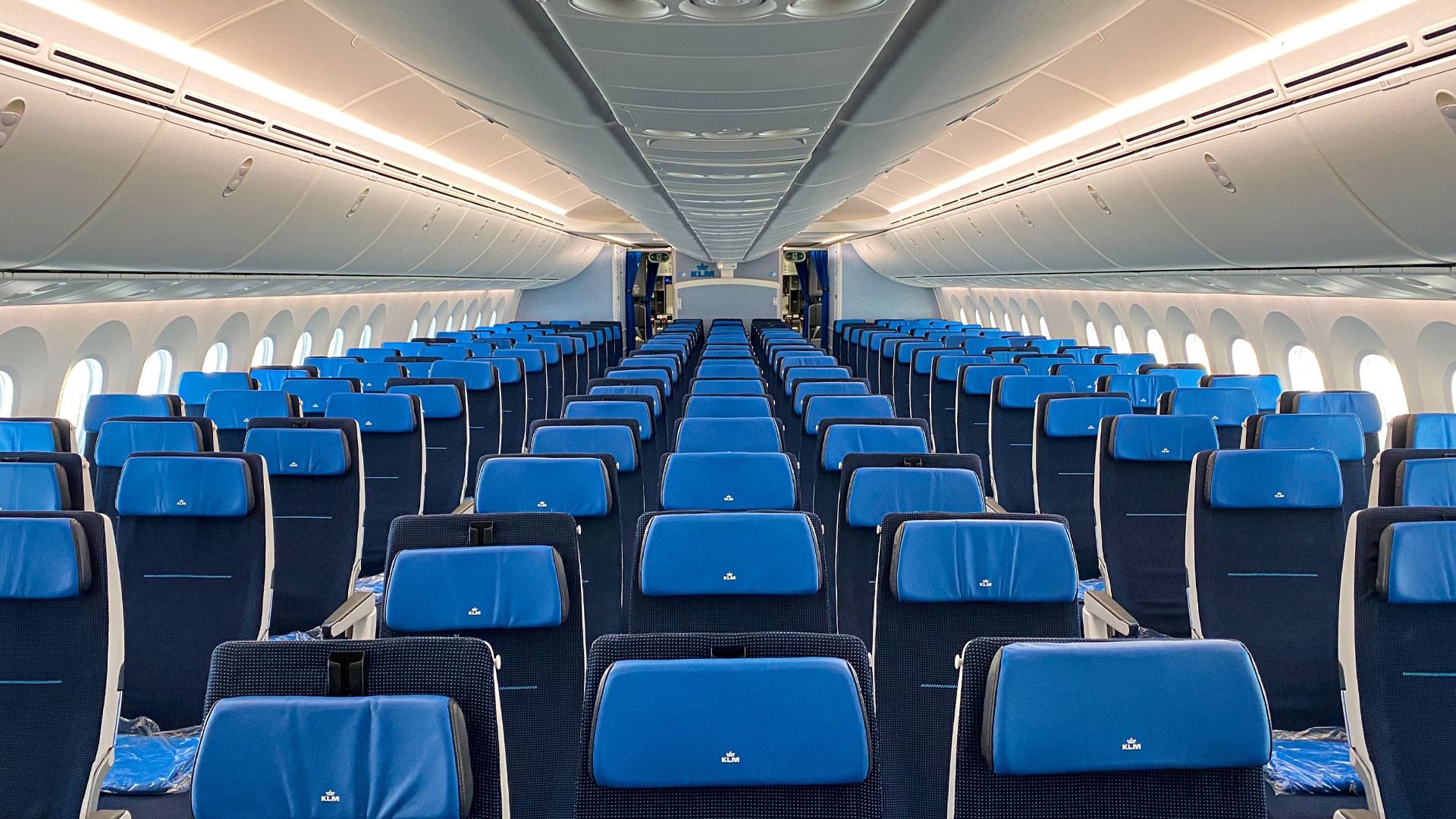
Boeing describes the 787 as about 20% quieter inside, using engine chevrons, composite-fuselage vibration dampening, and improved insulation as part of that reduction [1][2]. For sleep, the point is not silence. No long-haul economy cabin is silent. The point is fewer sharp edges in the soundscape: less engine roar, less vibration, and fewer low-grade stimuli that keep nudging the brain toward wakefulness.
This is one place where aircraft engineering and passenger equipment still have to cooperate. A quieter airframe makes noise-canceling headphones more effective, but it does not remove crying infants, meal carts, boarding announcements, or the neighbor who opens a plastic snack bag at 2 a.m. Cabin noise reduction is real; treating it as a replacement for sleep protection is where the claim gets too glossy.
Windows are less interesting as gadgets than as light control
The 787’s electrochromic windows have five settings, from clear to near-opaque [1][5][6]. They are often discussed as a novelty because there is no physical shade to pull down. For sleep, the novelty is secondary. The more important question is whether the cabin can control light in a way that protects rest and supports circadian timing.
Light is not just visual comfort. It is one of the body’s main timing signals. Poorly timed bright light can make it harder to sleep when the cabin schedule says “night,” while carefully timed light exposure can help the body begin shifting toward the destination. The 787’s larger dimmable windows and LED lighting system give crews more control over that signal than a cabin full of individual open-or-shut shades.
The LED system can simulate sunrise and sunset effects, a feature described as part of the aircraft’s approach to passenger comfort and jet lag mitigation [1][5]. That does not mean cabin lighting can cure jet lag. Melatonin timing, prior sleep debt, departure time, arrival time, and individual circadian phase all still matter. If you are using melatonin strategically, the more relevant question is timing rather than dose bravado; Restful Ground’s guide to when melatonin actually works goes deeper on that distinction.
Gust suppression protects the fragile part of in-flight sleep
The 787 also uses a gust suppression system that relies on real-time sensors and control surfaces to counter turbulence [1]. This is not the same as eliminating turbulence. It is an attempt to reduce the aircraft’s response to gusts so the cabin feels less abruptly unsettled.
That matters because in-flight sleep is often shallow and easily fractured. A bed at home can absorb small movements without waking you. An economy seat cannot. When the aircraft drops, shudders, or rocks hard enough, even a passenger who has finally drifted off may surface immediately, check the seatbelt sign, and restart the whole process of falling asleep. Reducing jolts is not glamorous engineering, but it is directly aimed at one of the most common ways airplane sleep fails.
The seat is where the engineering advantage can disappear
The 787 can lower the physiological cost of being in the cabin. It cannot choose how much room the airline gives your shoulders, knees, hips, or neck. That distinction is where many Dreamliner comfort claims get into trouble.
Seat width, pitch, recline, aisle access, cabin density, and service rhythm are airline decisions. The aircraft frame creates possibilities; the airline configuration decides how much of the passenger’s body gets to benefit from them. Japan Airlines’ 8-abreast 787 economy layout is a useful exception because it shows that the same aircraft can feel meaningfully different when the cabin is not packed to the usual 3-3-3 density. But for many passengers, the 787 experience is still a narrow long-haul economy seat with better air around it.
That is not a small improvement. Better air, lower pressure altitude, less noise, better light control, and smoother handling can all reduce the amount of fatigue a passenger accumulates. But sleep is embodied. If your pelvis is twisted, your knees are trapped, your head keeps falling forward, and the passenger in front reclines into the little space you had, the aircraft’s engineering can only compensate so far.
For the seat-level version of this question, the companion Restful Ground article on how the Boeing 787 economy cabin affects your sleep is the more practical place to compare the tradeoffs. The engineering case is clearer: the 787 improves several upstream variables that make sleep less likely to collapse. The cabin-configuration case is messier because airlines can use the same aircraft type very differently.
So, does the Boeing 787 Dreamliner improve sleep comfort?
For the Boeing 787 Dreamliner, the honest answer is yes, within boundaries. The Dreamliner addresses several barriers that older aircraft often leave mostly intact: higher cabin altitude, extremely dry air, louder cabin noise, crude light control, and abrupt turbulence response. The altitude evidence is the strongest measured support, especially because discomfort, headache, and fatigue rose at 7,000 to 8,000 feet after several hours in the NEJM chamber study [3]. Humidity, noise, lighting, windows, and gust suppression add plausible mechanisms that point in the same direction.
The weaker claim would be that a 787 guarantees better sleep. It cannot. A cramped economy layout can erase much of the felt benefit, especially for taller passengers, side sleepers, and anyone who needs more recline or shoulder room to stay asleep. Circadian timing still depends on route, departure time, arrival time, light exposure before and after the flight, and what the passenger does once they land. Long-haul travel remains a sleep-disrupting event, even in a better-designed cabin.
When flight options are otherwise similar, choosing a 787 is a meaningful advantage, especially on long-haul routes where cabin altitude, dryness, noise, and light exposure have enough hours to accumulate. It should sit alongside airline layout and seat selection, not above them. The aircraft can make the cabin less hostile to sleep. The seat still decides whether your body has somewhere decent to put that advantage.
References
- 787 By Design, Boeing
- Boeing says the 787 Dreamliner has a secret weapon to fight jet lag, Business Insider
- Effect of Aircraft-Cabin Altitude on Passenger Discomfort, New England Journal of Medicine
- The Boeing 787's Unique Cabin Design That Reduces Jet Lag, Simple Flying
- Here’s how the 787 Dreamliner reduces your jet lag, The Points Guy
- 15 hours on a Boeing 787 Dreamliner, in coach, CNET
Comments
Join the discussion with an anonymous comment.