
The annoying thing about coffee and sleep is that the most honest answer often sounds evasive: it depends. A 2 PM cutoff may be sensible for one person, excessive for another, and still too late for someone whose bedtime is early, caffeine dose is high, or sleep is already fragile. The better question is not “What hour is coffee forbidden?” but “How close is this caffeine to the time my body is preparing for night?”
That distinction matters because evening caffeine does not only make you feel alert. In a controlled circadian study, caffeine taken three hours before habitual bedtime delayed the body’s melatonin rhythm by about 40 minutes. The study was small—five participants completed 20 protocols—but the effect was statistically significant, and the size of the shift was large enough to change how we should think about optimal coffee timing for better sleep.[1]

Coffee Can Move the Clock, Not Just Delay Sleep
Most people understand the obvious version of caffeine: drink it late enough and you may not feel sleepy. But the Burke study points to a second, less visible effect. Caffeine behaved like a circadian timing signal. It delayed the rise of melatonin, the hormonal marker researchers often use to locate the body’s biological night.[1]
A 40-minute shift may not sound dramatic until it is put beside something familiar to circadian scientists: light. In the same research, the caffeine-related phase delay was nearly half the size of the shift produced by three hours of bright light at about 3000 lux.[1] Bright light is not a minor cue to the body clock. Comparing caffeine to that cue does not mean an evening coffee is identical to sitting under bright lights for hours, but it does make one point hard to dismiss: caffeine can act on timing, not just tiredness.
This is where the common “I can drink coffee and fall asleep fine” line becomes incomplete rather than foolish. Falling asleep is only one outcome. If your internal night starts later, you may still get into bed, still lose consciousness, and still wake with a schedule that has been nudged in the wrong direction. The consequence may show up as a later natural bedtime, a harder morning, or that familiar bargain with tomorrow: one more coffee because last night did not quite restore you.
The melatonin delay is not the same as taking a melatonin supplement or “running out” of melatonin. It is a timing marker: the body’s signal for biological night begins later. If you want a deeper explanation of when that signal is actually useful, the distinction matters; melatonin is usually more about timing than sedation, which is why when melatonin works for insomnia depends heavily on the sleep problem being treated.
Why You May Not Notice the Effect
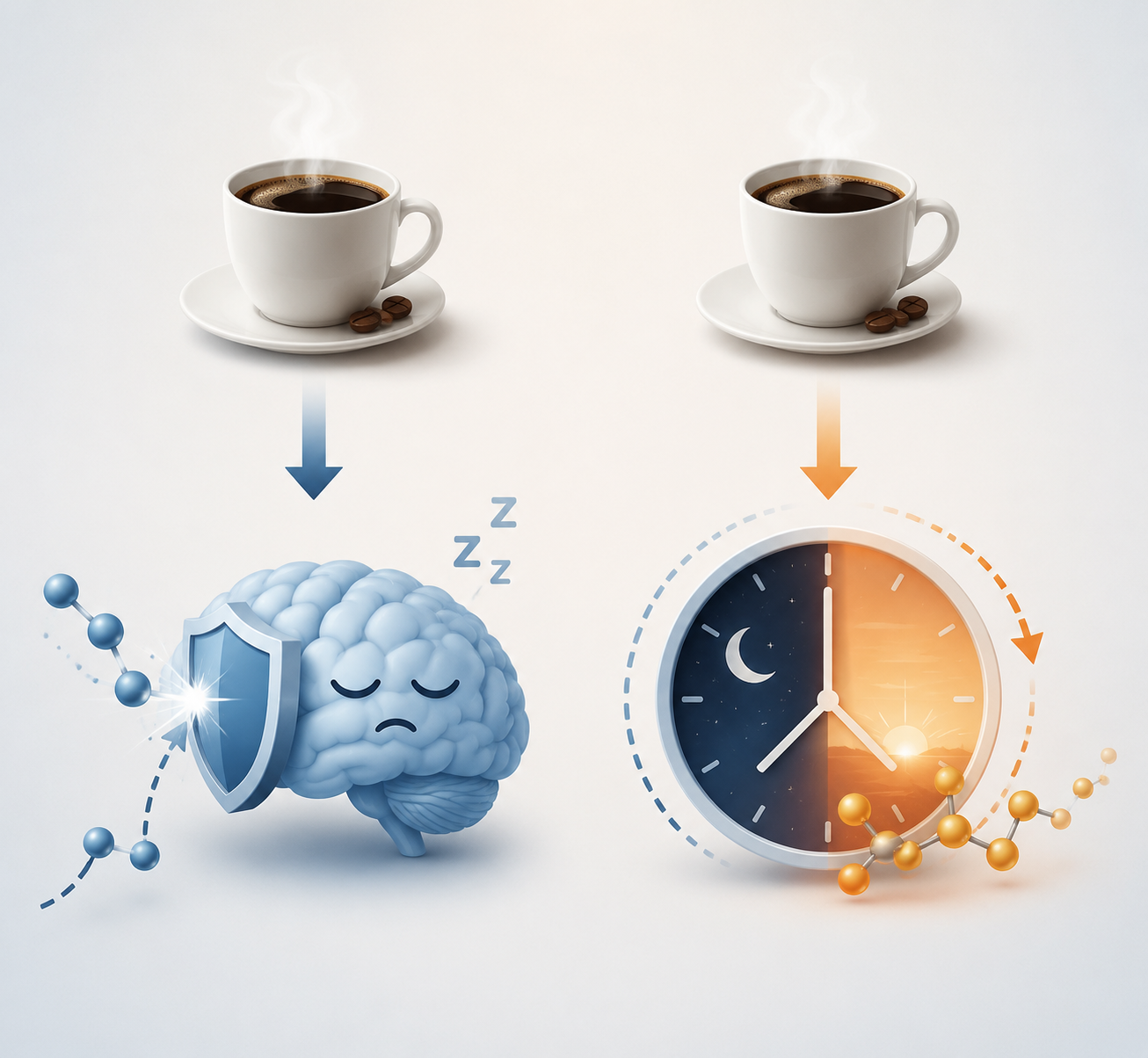
The familiar caffeine mechanism still matters. Caffeine blocks adenosine signaling, which is one way the brain tracks sleep pressure across the day. As wakefulness accumulates, adenosine helps make sleep feel increasingly necessary; caffeine interferes with that message. That is the everyday reason coffee can make an afternoon slump lift or a late work session feel less punishing. For the molecular version of that story, see adenosine and sleep pressure.
But sleep pressure and circadian timing are not the same system. One says, roughly, how long you have been awake and how much sleep need has built up. The other says what time your body thinks it is. Caffeine can blur the first signal while also shifting the second one later. That dual action is why a person can feel calm, even sleepy, and still have a poorer night.
A separate sleep-lab study helps explain why self-report is a shaky guide here. In Drake et al. 2013, 400 mg of caffeine taken even six hours before bedtime reduced objective total sleep time by more than an hour, yet participants did not reliably perceive how much their sleep had been disrupted.[2] That is not a character flaw. It is a measurement problem. You are inside the experience you are trying to judge.
This mismatch is especially relevant for people who do not get the classic “wired” feeling. Caffeine’s most obvious sensations can fade before its effects on sleep architecture or timing are finished. The absence of jitters is useful information, but it is not proof that your sleep is untouched.
The Problem With a Universal 2 PM Rule
The standard 2 PM rule has one advantage: it is easy to remember. It also has one obvious flaw: it ignores bedtime. For someone who sleeps at 9:30 PM, 2 PM is seven and a half hours before bed. For someone who usually sleeps at 1:00 AM, it is eleven hours before bed. Those are not the same experiment.
The Burke finding does not prove that everyone must stop caffeine three hours before bed. If anything, it argues against lazy certainty. Three hours before habitual bedtime was late enough to delay melatonin rhythm by about 40 minutes in a very small controlled sample, and the researchers also found substantial person-to-person variability in the phase-shifting response.[1] Some people’s clocks may be more sensitive than others.
That variability is where genetic language sometimes enters the conversation. Differences in caffeine metabolism and caffeine sensitivity are often discussed through genes such as CYP1A2 and ADORA2A. They may help explain why one person seems to tolerate caffeine better than another. But they should not be treated as a shortcut to a sleep prescription. Direct-to-consumer genetic testing is not a clinically validated way to choose a personal coffee cutoff for sleep optimization.
A Cleaner Way to Find Your Coffee Cutoff
Start with your actual habitual bedtime, not the clock time an article hands you. If you normally fall asleep around 11:30 PM, then “three hours before bed” means 8:30 PM. That is not necessarily a safe cutoff; it is a warning zone. The circadian evidence says caffeine that close to bedtime can matter even when it does not feel dramatic.
| What to choose | Why it matters |
|---|---|
| A caffeine cutoff relative to bedtime | It tests your body clock instead of copying someone else’s schedule |
| A consistent dose during the test | Changing both timing and amount makes the result harder to interpret |
| Several comparable nights | One bad night can come from stress, alcohol, illness, heat, or noise |
| Morning outcomes, not just sleep onset | Circadian delay may appear as grogginess or a later rhythm, not only insomnia |
For a simple self-test, pick a cutoff and keep the rest of the pattern boring. If you usually have an afternoon coffee and sometimes add an evening one, remove only the evening one for a set of comparable nights. Then watch what changes. Do you fall asleep earlier? Wake before the alarm more often? Feel less drugged in the first hour of the morning? Reach for caffeine later, or less urgently, the next day?
If nothing changes, move the cutoff later cautiously or accept that your current timing may be reasonable for you. If bedtime drifts earlier, mornings improve, or the next-day caffeine chase softens, the late cup was probably doing more than you thought. The point is not to win an argument against coffee. It is to stop treating a pleasurable habit as harmless or harmful without evidence from your own nights.
Wearables can help if they are used modestly. A sleep tracker cannot prove that caffeine delayed your melatonin rhythm, and it should not be treated like a lab test. But it can make patterns easier to see: later sleep onset on caffeine nights, shorter sleep duration, more variable wake time, or a gradual bedtime drift. The useful question is not whether the device’s sleep-stage labels are perfect; it is whether the same pattern keeps appearing when caffeine moves later. For that kind of cautious use, see whether a sleep tracking wearable can improve your sleep.
What to Track During the Test
- Last caffeine time, counted backward from your usual bedtime
- Approximate caffeine amount, kept as consistent as possible
- Time you felt ready for sleep, not just time you got into bed
- Wake time and how restored you felt in the first hour
- Whether caffeine use shifts later or increases the following day
Dose Still Counts
Timing is easier to discuss than dose, but the two travel together. A small coffee at a consistent hour is not the same test as a large late-afternoon drink plus a refill. If you are trying to find your cutoff, do not change the amount every night and then expect a clean answer. First stabilize the dose; then adjust the timing.
The practical starting point is conservative without being punitive: move caffeine earlier than the three-hour pre-bed window, especially if you wake unrefreshed or your bedtime has been sliding later. If that helps, keep the boundary. If it does not, test an earlier cutoff. If your sleep is solid and mornings are fine, you may not need the same restriction as someone who is clearly stuck in a late-caffeine, late-bedtime loop.
When the Usual Rules May Not Apply Cleanly
Shift workers, rotating-schedule workers, new parents, and people with irregular sleep windows have a harder problem than “stop at this hour.” Their circadian timing may already be under pressure from light exposure, work demands, and inconsistent sleep opportunity. In that situation, caffeine can still matter, but the cutoff should be tied to the intended sleep episode, not to a conventional afternoon rule. For a fuller treatment of that problem, see sleep hygiene for shift workers.
There is also a difference between an occasional late coffee and a repeating schedule. One evening espresso after dinner may cost you little or simply be worth it. A daily pattern that moves bedtime later, shortens sleep, and demands more caffeine the next morning is different. The harm is not moral; it is mechanical.
So When Should You Stop?
If you want the shortest useful answer: avoid caffeine in the three hours before your habitual bedtime, and treat that as the late edge of the testing zone rather than a guarantee of safety. If sleep is light, mornings are rough, or bedtime keeps drifting later, move the cutoff earlier and watch what happens across comparable nights.
The best coffee cutoff is not a universal hour on the wall. It is a personalized boundary that respects both sides of caffeine: the familiar adenosine effect that changes how sleepy you feel, and the quieter circadian effect that can delay when your body thinks night begins.
References
- Effects of caffeine on the human circadian clock in vivo and in vitro, Science Translational Medicine, 2015.
- Caffeine Effects on Sleep Taken 0, 3, or 6 Hours before Going to Bed, Journal of Clinical Sleep Medicine, 2013.
Comments
Join the discussion with an anonymous comment.