
Hot-weather sleep advice often starts after the room is already unbearable: strip down, open the window, point the fan harder, drink something cold, hope the sheet stops sticking to your legs. The trouble is that several of those moves can feel better for a few minutes while making the rest of the night harder.
The useful test is not whether a cooling trick feels dramatic at bedtime. It is whether it helps your body do the thing sleep requires: release heat. Before sleep, core body temperature normally drops by about 1.8°F, helped by blood vessels widening near the skin so heat can leave the body.[1] Hot weather works against that drop. In a 2025 Nature Communications study using 23 million sleep records from Chinese adults, each 10°C rise in temperature was associated with a 20.1% increase in the odds of sleep insufficiency, 9.67 fewer minutes of total sleep, and a 2.82% decline in deep sleep.[2] That dataset does not mean every U.S. sleeper loses the same number of minutes on every hot night, but it does show why heat is not a minor comfort issue.
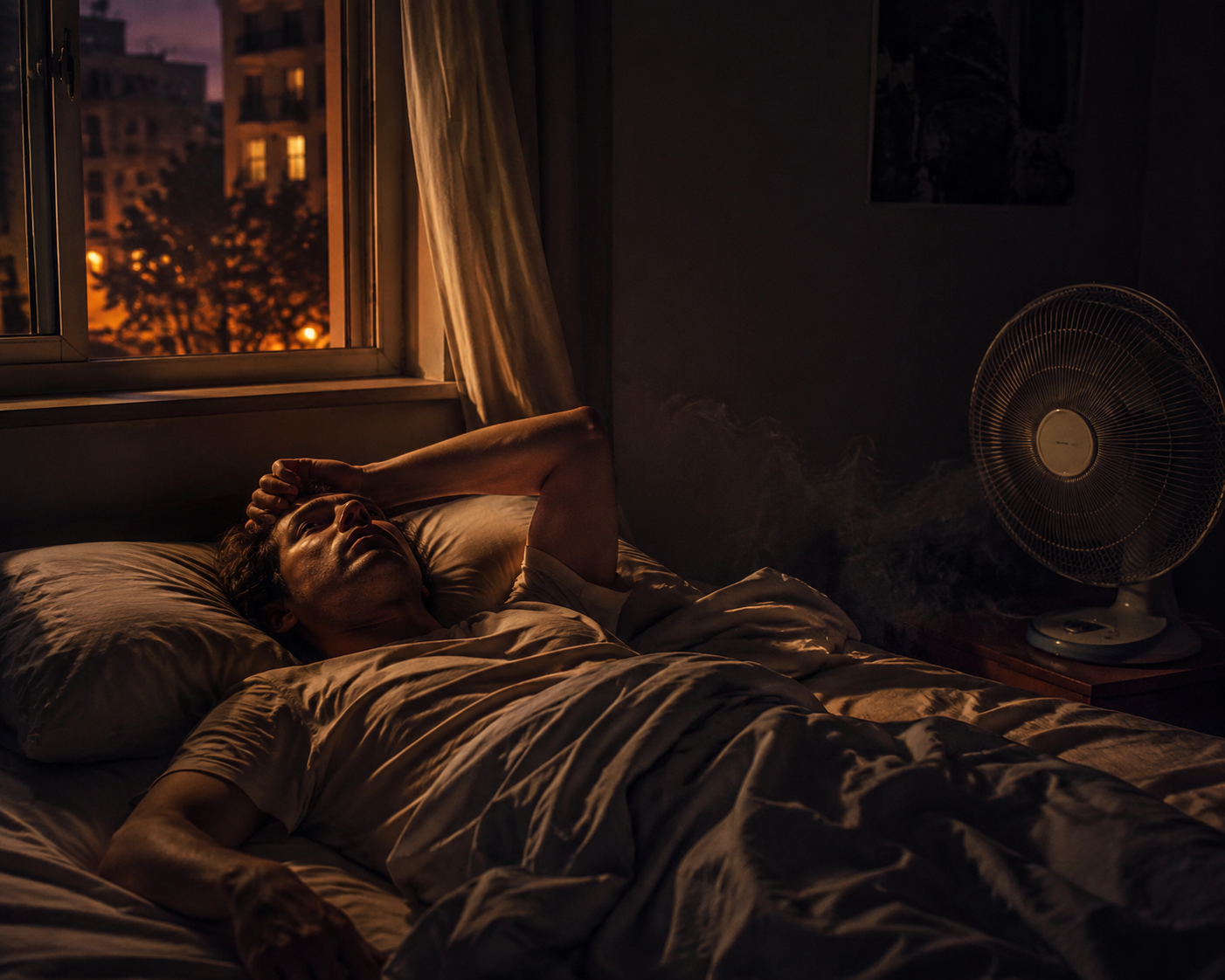
The six mistakes below are common because they are intuitive. Most of them are attempts to get immediate relief. The better replacements are less flashy: block heat earlier, let sweat evaporate, choose bedding that does not hold body heat, and avoid behaviors that raise core temperature when it should be falling.
| Common cooling mistake | What to do instead |
|---|---|
| Sleeping naked because fewer layers feel cooler | Wear very light, breathable sleepwear that helps wick sweat |
| Opening windows whenever the room feels stale | Keep windows closed when outside air is hotter; reopen when it is cooler |
| Waiting until bedtime to cool the bedroom | Block solar gain during the day with closed blinds or curtains |
| Eating heavy or spicy meals, or drinking alcohol, close to bed | Move heavier meals and alcohol earlier, and keep late food lighter |
| Collapsing onto heat-trapping bedding | Use breathable fibers, lighter covers, and bedding that allows airflow |
| Exercising hard right before bed | Finish vigorous workouts earlier, leaving time for temperature to fall |
Mistake 1: Sleeping Naked and Letting Sweat Sit on Your Skin
Sleeping naked seems like the obvious hot-night answer. If fabric feels like insulation, removing it should help. Sometimes it does feel better at first, especially in a dry room with moving air. But the cooling work is not done by bare skin alone. It is done by sweat evaporating from the skin.
When sweat pools on the body or gets trapped against the mattress, evaporation slows. Light sleepwear made from breathable fibers such as cotton or linen can pull moisture away from the skin and give it more surface area to evaporate. Sleep experts quoted in Tom’s Guide and Yahoo make the same basic point: the better choice is not more fabric, but the right kind of fabric.[3][4]
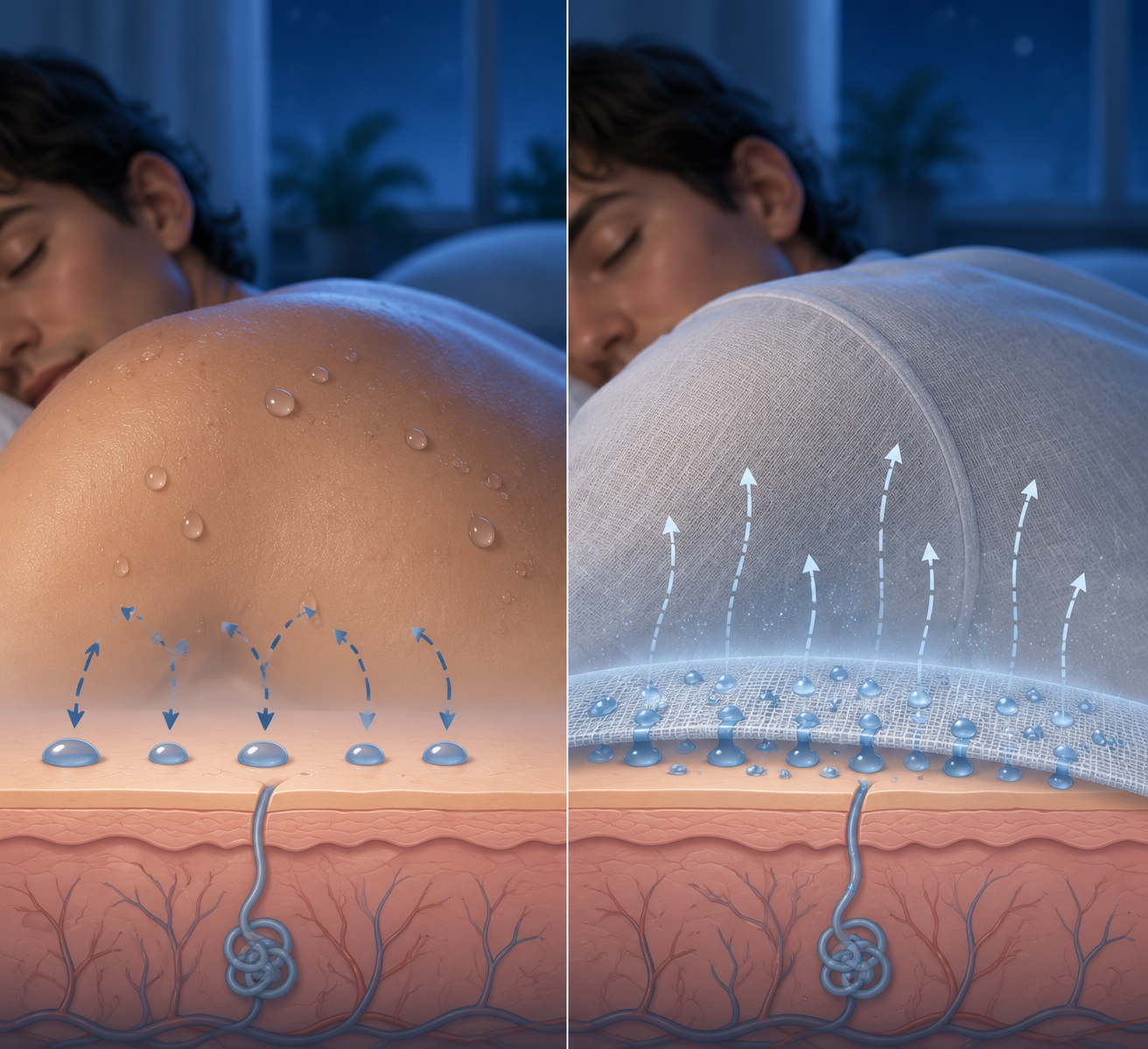
This is where personal preference matters, but only within the physics. Some people like loose cotton. Others prefer linen or lightweight bamboo. The fabric should feel thin, loose, and breathable, not clingy. If you wake up damp and sticky after sleeping naked, that is a sign the trick is failing at its real job.
Mistake 2: Opening Windows During the Day Because the Room Feels Stale
Opening a window is so automatic that it barely feels like a decision. A room feels stuffy, so you let air in. In a heatwave, that habit can turn the bedroom into a storage unit for afternoon heat.
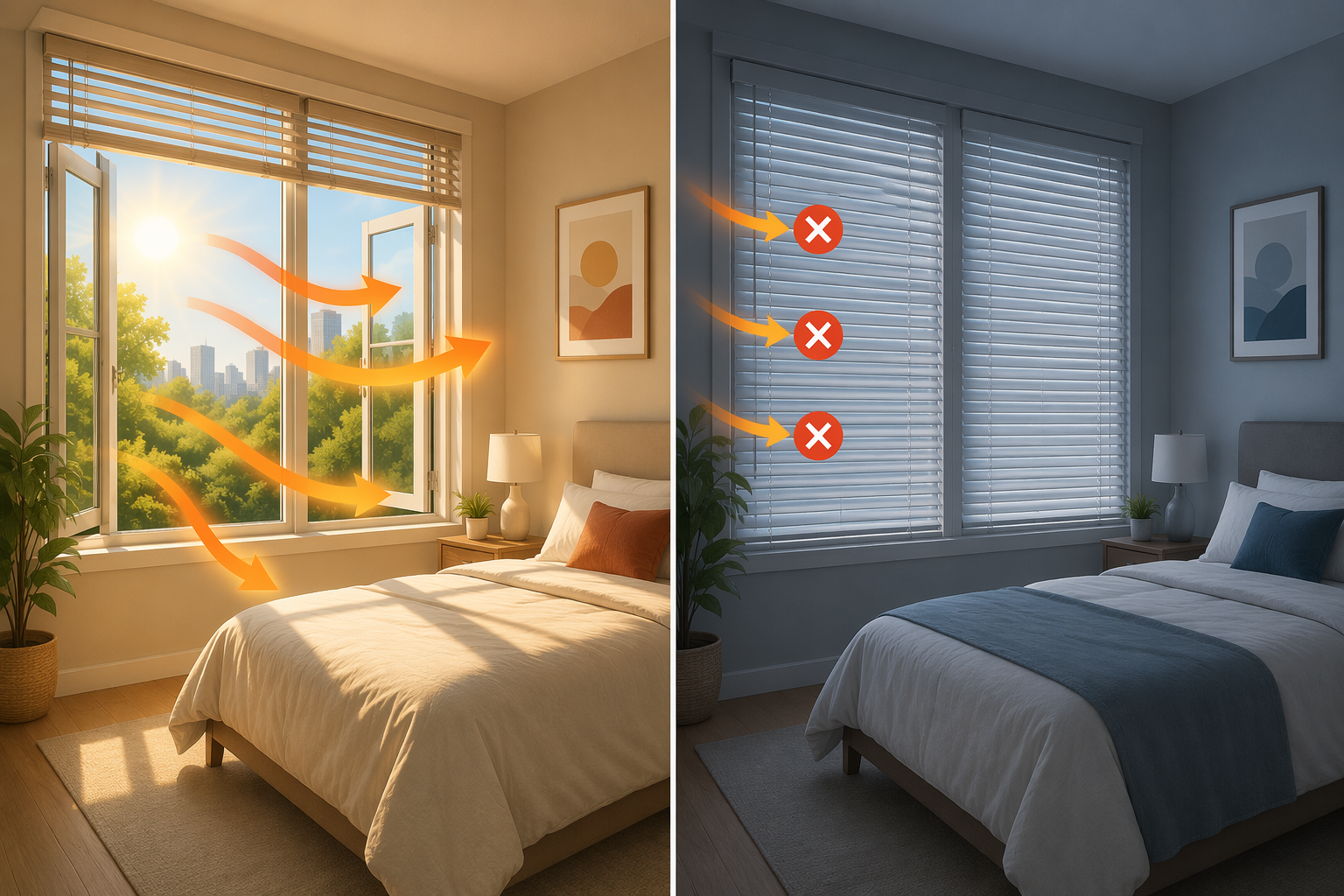
If the outdoor air is hotter than the indoor air, an open window imports heat. Several home-cooling and sleep sources give the same practical rule: keep windows closed during the hottest part of the day, then open them when the outside air is cooler, often overnight or early in the morning.[4][5][6] The exact timing depends on your home, shade, and local weather, but the comparison is simple: outside cooler than inside means ventilate; outside hotter than inside means shut it down.
A fan does not cancel this rule. A fan can help sweat evaporate and move air across the body, but if it is pulling hotter air into the room during peak heat, it is helping that heat settle in. Use the fan with ventilation when the outdoor air is cooler, or use it for air movement inside the room when the windows need to stay closed.
Mistake 3: Waiting Until Bedtime to Rescue the Room
The most annoying hot-weather sleep tip is also one of the most useful: start before bedtime. Once walls, floors, and bedding have absorbed a day’s heat, a few rushed bedtime tricks have to fight the whole room. Passive daytime cooling is less satisfying than an icy drink, but it prevents part of the problem from arriving.
Close blinds or curtains on sun-facing windows before the sun heats the room. Keep windows closed while outdoor air is hotter. Reopen them when the outdoor temperature drops below the indoor temperature. The Conversation, drawing on shading and ventilation research, identifies blocking solar gain as a central passive-cooling move; House Beautiful’s home-cooling guidance makes the same practical recommendation for keeping daytime heat out.[5][6]
This matters even if you use air conditioning part of the day. A shaded, closed room has less accumulated heat for AC, fans, or nighttime ventilation to fight later. The goal is not to create a perfect sleep lab. It is to avoid making the bedroom absorb heat all afternoon and then asking your body to solve it at midnight.
Mistake 4: Eating Heavy or Spicy Food, or Drinking Alcohol, Too Close to Bed
A late dinner can be harmless on a mild night and noticeably disruptive on a hot one. Heavy or spicy meals close to bedtime can raise core body temperature through diet-induced thermogenesis, the heat produced as the body digests and metabolizes food. The Conversation recommends avoiding heavy or spicy meals within 2 to 3 hours of bed for this reason.[5]
Alcohol is a separate problem. It may make you feel sleepy at first, but it disrupts thermoregulation and sleep architecture, and it is associated with more nighttime wakefulness.[7] On a hot night, that tradeoff is especially poor: the body is already struggling to cool, and alcohol makes the later part of sleep more fragile.
This does not require a joyless evening. It means putting the heaviest meal earlier when you can, keeping late food lighter, and treating alcohol as something that may relax the first hour while costing you the third.
Mistake 5: Keeping Heat-Trapping Bedding Because It Feels Soft
Hot sleep is not only about the air temperature. It is also about what surrounds your body after you lie down. Some bedding feels pleasant at first contact and then traps the heat your body is trying to lose.
Memory foam is a common offender because it can hold body heat. Synthetic bedding can also reduce breathability. Reviews of sleepwear and bedding fibers point toward natural fibers such as cotton, linen, and bamboo for better moisture handling and airflow, while home-design guidance often recommends lighter coverings, low-tog duvets, or no duvet in hot weather.[5][6]
Mattress construction can matter too. Innerspring and hybrid designs generally allow more airflow than dense foam, though this is not a reason to panic-buy a mattress during a heatwave. Start with the layers you can change tonight: remove the heavy duvet, use a breathable sheet, avoid synthetic layers that make you clammy, and keep a light cover nearby if you wake cool before morning.
Mistake 6: Doing a Hard Workout Right Before Bed
When the day is too hot to move, late exercise can seem like the only available slot. The problem is timing. Vigorous exercise raises core body temperature, and exercising within about 90 minutes of bedtime can delay the temperature drop that helps sleep begin.[8][7]
If evening is your only option, reduce the heat load: finish earlier when possible, keep intensity moderate near bedtime, cool down gradually, and avoid going straight from a hard workout into bed. A gentle walk or stretching session is a different sleep problem than intervals in a hot room.
Two Cooling Moves That Feel Less Obvious but Make Physiological Sense
Not every helpful hot-night habit feels cold. A warm bath or shower 1 to 2 hours before bed can trigger blood vessels near the skin to widen, which helps the body release heat after you get out. That post-bath cooling is the useful part, not the warmth itself.[1] If you want more body-focused strategies, this guide to how to sleep in heat without AC goes deeper on pulse-point cooling and cooling the body rather than pretending the whole home can be fixed at bedtime.
Cold can still help when used carefully. A cool cloth at the neck, wrists, or ankles may feel more targeted than blasting the whole room with moving hot air. What you want to avoid is the pattern that defines most backfiring tricks: a sharp sensation of relief followed by worse heat loss later.
What to Prioritize Tonight
If you can only make a few changes before bed, start with the ones that change the room’s heat load and the body’s ability to shed heat. Block sun before it enters. Ventilate only when the outdoor air is cooler than the indoor air. Wear a light breathable layer if sweat is sitting on your skin. Strip back heavy or synthetic bedding. Keep late meals, alcohol, and hard workouts from adding heat when your core temperature should be falling.
There is a ceiling to what these corrections can do. They can make hot-night sleep more reliable; they cannot make unsafe heat safe, cure chronic insomnia, or solve every summer sleep disruption. Wildfire smoke, prolonged heat exposure, and poor air quality create a broader sleep problem than bedding and window timing alone can handle, as covered in this guide to summer heat and wildfire smoke. If poor sleep continues after the heat problem passes, use a broader sleep-hygiene routine and consider evidence-based insomnia care such as CBT-I.
References
- Effects of thermal environment on sleep and circadian rhythm, Journal of Physiological Anthropology, 2012, https://pmc.ncbi.nlm.nih.gov/articles/PMC3427038/
- Rising ambient temperature causes sleep insufficiency in China, Nature Communications, 2025, https://www.nature.com/ncomms/
- Should you sleep naked in a heatwave? Experts reveal why it could make you hotter, Tom’s Guide, https://www.tomsguide.com/
- Sleeping naked during a heatwave could be making you hotter, Yahoo, https://www.yahoo.com/
- How to sleep in a heatwave: the science of keeping cool at night, The Conversation, https://theconversation.com/
- How to keep your house cool in a heatwave, House Beautiful, https://www.housebeautiful.com/
- Alcohol and Sleep, Sleep Foundation, https://www.sleepfoundation.org/nutrition/alcohol-and-sleep
- Exercise and sleep, Sleepstation, https://www.sleepstation.org.uk/articles/health/exercise-and-sleep/
Comments
Join the discussion with an anonymous comment.