
The easiest caffeine story to believe is the one your own bedtime tells you: you drank coffee after dinner, got into bed, fell asleep, and woke up convinced nothing happened. For many people, that is not a lie. It is just an incomplete measurement.
In a controlled sleep study, caffeine taken six hours before bedtime still reduced objectively measured total sleep time by more than an hour, even though participants’ own sleep reports often did not show that they felt disturbed by it.[1] That gap matters more than the familiar warning that caffeine can keep you awake. The quieter problem is that you may sleep through the disruption.
So when people ask how caffeine before bed affects sleep, the useful answer is not simply “it delays sleep.” It can do that. But the more revealing answer is that caffeine can change the kind of sleep your brain produces after you are already unconscious.
Falling asleep is not the same as getting deep sleep
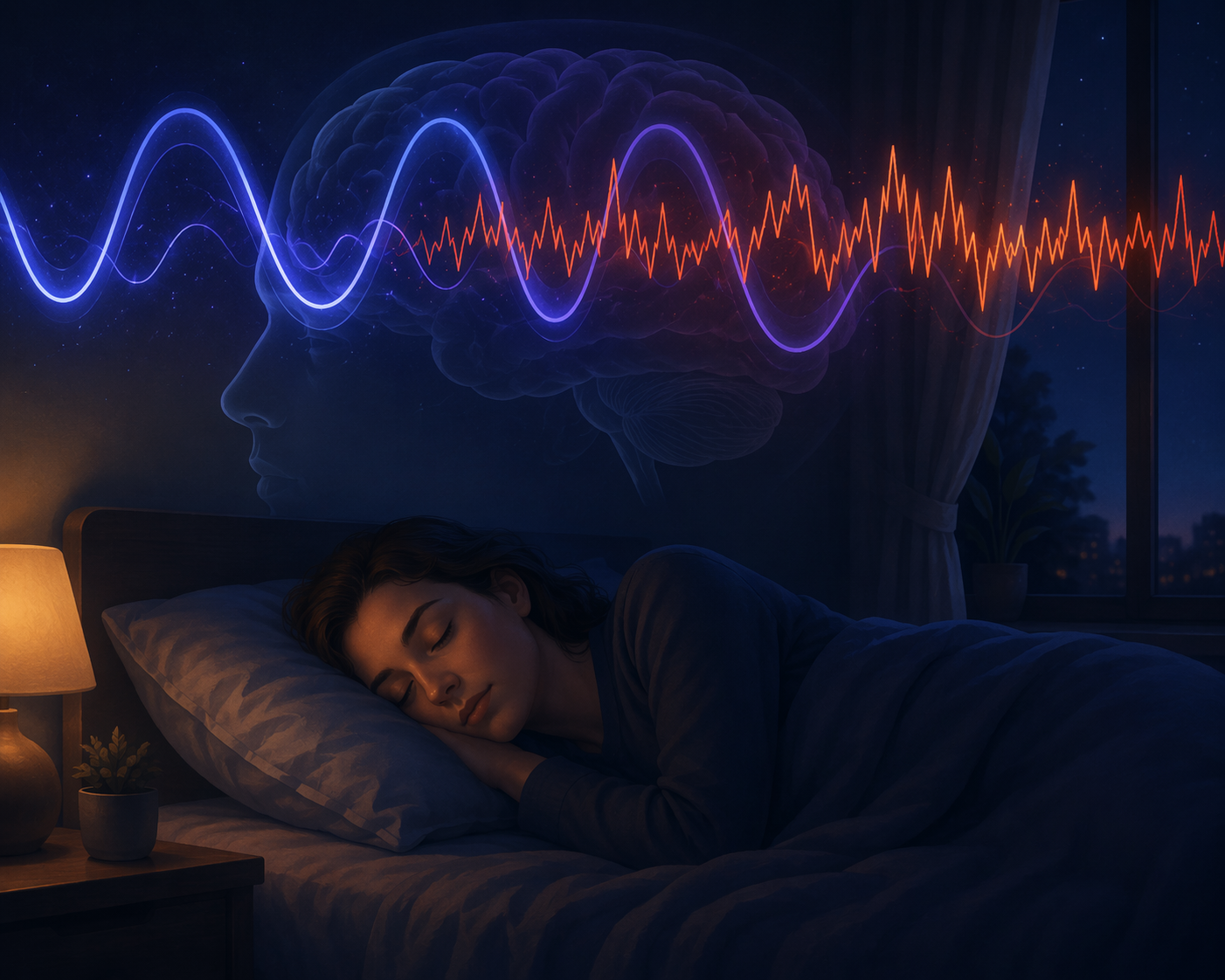
Sleep is not one uniform state. Across the night, the brain moves through lighter non-REM sleep, deeper slow-wave sleep, and REM sleep. The part most relevant here is slow-wave activity during non-REM sleep, especially delta activity, the low-frequency rhythm associated with the deepest, most restorative phases of sleep.
A 2025 EEG study gave this invisible effect a clearer shape. After caffeine, researchers found a 20–30% reduction in delta-band power during NREM sleep, along with an increase in beta-band power, a faster rhythm more associated with wakefulness.[2] In plain terms, the sleeper may look quiet from the outside while the sleeping brain looks less deeply asleep from the inside.
That distinction is why “I slept eight hours” can still coexist with “I woke up strangely unrefreshed.” Time in bed and total sleep time are useful, but they do not tell you how much slow-wave intensity your brain actually generated during the night. If caffeine suppresses delta activity, the night can appear successful on the calendar while being less restorative physiologically.
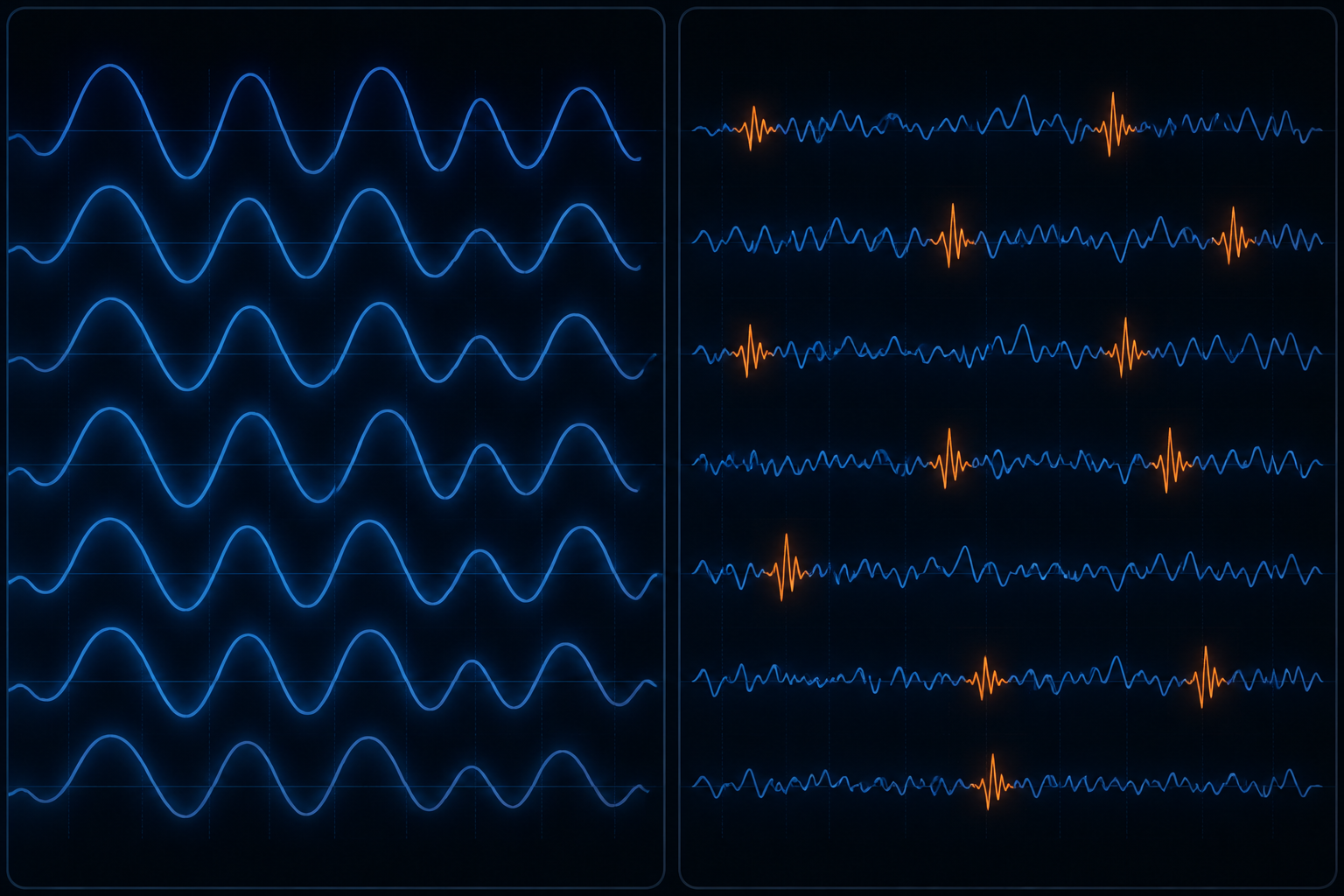
The beta finding is especially important because it points to a wake-leaning profile rather than a simple loss of minutes. Caffeine does not have to jolt you awake at 2 a.m. to leave a trace. It can make sleep shallower, more activated, and less dominated by the slow rhythms the brain normally leans on during recovery.
What the EEG adds that your memory cannot
Subjective sleep reports are not worthless. If caffeine makes you anxious, pushes bedtime later, or causes obvious awakenings, you will probably notice. The problem is narrower: people are not very good at sensing changes in sleep architecture. You do not wake up with a built-in readout that says delta power was down by a quarter.
That is why the six-hour caffeine study is so useful, even with its limits. The sample was small, and the dose was a fixed 400 mg, which is more than a modest cup of coffee for many people.[1] It should not be treated as proof that every person reacts the same way to every evening dose. But it does show that the strongest personal defense—“I would know if it hurt my sleep”—is not reliable enough on its own.
The newer EEG work pushes the same point from a different angle. Researchers reported not only less delta activity and more beta activity, but also increased entropy and Lempel-Ziv complexity during sleep, suggesting that the brain remained in a more excitable, wake-like regime.[2] Those complexity markers are intriguing, but they still need further validation before they should be treated as everyday clinical measures. The safer conclusion is already strong enough: caffeine can leave measurable fingerprints on sleeping brain activity that the sleeper may not perceive.
Why caffeine can do this after you feel tired
Caffeine’s main sleep effect runs through adenosine signaling. Adenosine is one of the body’s sleep-pressure messengers: as wake time accumulates, adenosine activity helps make sleep more likely. Caffeine binds to adenosine A1 and A2A receptors and blocks that signal, so the brain receives a distorted version of how much sleep pressure has built up.
That does not mean caffeine creates energy. It interferes with one of the signals that tells the brain to stand down. For a deeper primer on that mechanism, Restful Ground’s guide to adenosine and sleep pressure explains why tiredness is not just a feeling but a biochemical pressure that accumulates across the day.
The architecture finding fits that mechanism. If adenosine pressure helps the brain enter and sustain deeper non-REM sleep, then blocking that pressure late in the day can reduce the intensity of slow-wave sleep even when bedtime still happens on schedule. The result is not always insomnia. Sometimes it is a night that passes normally but recovers less.
Dose and timing change the risk
The blunt rule “no caffeine after 2 p.m.” is easy to remember and often too crude to explain real life. A small coffee at noon, a large cold brew at 4 p.m., an espresso after dinner, and a pre-workout drink before an evening gym session do not create the same sleep burden. The amount matters. The clock matters. So does the person drinking it.
| Caffeine pattern | More useful way to think about it |
|---|---|
| Small early-afternoon dose | Lower risk for many adults, especially if bedtime is late and sleep feels consistently restorative |
| Moderate caffeine within 8 hours of bed | Worth treating as a sleep-quality variable, not only a sleep-onset variable |
| High dose late in the day | More likely to reduce sleep duration or alter sleep architecture even if you can still fall asleep |
| Evening caffeine plus unrefreshing sleep | Strong reason to run a personal cutoff test before looking for more complicated explanations |
A practical cutoff of eight to ten hours before bedtime is a protective rule of thumb, not a law of nature. It is meant to create enough distance between caffeine and deep sleep for people who care about sleep quality, especially those who wake unrefreshed despite spending adequate time in bed.
The eight-to-ten-hour window also respects the fact that late caffeine is not only about the first half hour in bed. If your only test is “Did I fall asleep?” you may miss the more relevant question: “Did my brain produce the kind of non-REM sleep that usually makes morning feel restored?”
Some people really are less sensitive
There is a difference between doubting self-assessment and pretending everyone is identical. Individual variability is real. Roughly half of people are fast CYP1A2 metabolizers, and ADORA2A variants can influence caffeine sensitivity. Those differences help explain why one person feels wired after an afternoon latte while another can drink coffee after dinner and notice little.
But “less sensitive” is not the same as “physiologically unaffected.” A fast metabolizer may clear caffeine more efficiently. A person with lower subjective sensitivity may feel fewer obvious symptoms. Neither fact proves that delta activity, sleep continuity, or next-morning restoration is untouched. The only honest conclusion is more modest: caffeine risk is personal, but personal impressions do not capture the whole risk.
Age may also matter. In the 2025 EEG study, caffeine-related changes were more pronounced in younger adults ages 20–27 than in middle-aged adults ages 41–58.[2] That does not mean middle-aged adults are protected; it means the same caffeine exposure may not produce the same measurable sleep-brain response across age groups.
Where the evidence is strong, and where it is still narrow
The strongest practical evidence is not that one cup of coffee ruins everyone’s sleep. It is that caffeine can produce objective sleep disruption that people do not reliably perceive, and that EEG measures can reveal changes conventional sleep staging or morning memory may miss.
A 2026 review of 32 studies concluded that quantitative EEG measures are more sensitive than conventional sleep staging for detecting caffeine-related disruption, and that caffeine can suppress the slow-wave rebound normally seen after sleep deprivation.[3] That fits the larger pattern: the problem often shows up in the depth and dynamics of sleep, not only in whether sleep begins.
Still, the limits are worth keeping visible. The 2013 study used 12 participants and a 400 mg dose.[1] The 2025 EEG study included 40 participants, and its brain-criticality measures require more validation before they become routine sleep-health tools.[2] Review-level conclusions help connect the pattern, but they do not eliminate the need to think in terms of dose, timing, genetics, age, and the outcome you are actually trying to improve.
A better personal test than “Can I fall asleep?”
If sleep already feels good, your caffeine timing may not be the first thing to change. But if you regularly get enough hours in bed and still wake up flat, groggy, or oddly unrestored, evening caffeine deserves a clean trial before you assume your sleep problem is mysterious.
- Move your last caffeine dose to eight to ten hours before your usual bedtime.
- Keep the rest of your sleep schedule as steady as you reasonably can.
- Judge the result by morning restoration, daytime steadiness, and consistency across several nights.
- Do not use “I still fell asleep” as the main success measure.
That keeps coffee in its proper place: useful, pleasurable, and sometimes badly timed. The question is not whether caffeine affects you dramatically. It is whether it is quietly taking the deepest part of the night down a notch.
References
- Caffeine Effects on Sleep Taken 0, 3, or 6 Hours before Going to Bed, Journal of Clinical Sleep Medicine, 2013.
- Caffeine affects brain complexity during sleep and wakefulness, Communications Biology, 2025.
- Caffeine Disrupts Deep Sleep by Altering Brain Activity, Neuroscience News.
Comments
Join the discussion with an anonymous comment.