
The best beaches for sleeping relaxation vacation are not always the prettiest beaches, the emptiest beaches, or the ones that photograph best at sunset. A beach can look restful and still keep you awake with bar noise, floodlit walkways, warm rooms, thin curtains, or a hotel that treats sleep as an afterthought. If the point of the trip is to recover, the useful question is narrower: what conditions make sleep more likely after you arrive tired?
The strongest travel-sleep evidence does not hand us a ranked beach list. It gives us a better filter. In a 2020 study on environmental change and travelers’ sleep health, researchers found that insomnia detection was lower in hotels than at home among their sample, but the pattern was not universal: accommodation satisfaction, trip length, chronotype, and travel purpose all mattered. Hotel insomnia detection was 15.4% compared with 24.2% at home, accommodation satisfaction was protective against travel insomnia, and stays of seven days or more were strongly protective in the model. Morning-type travelers had elevated travel-insomnia risk, while evening-type travelers were more likely to recover from home insomnia while away.[1]
That study has limits: it was based in Guangdong Province, China, and most participants were under 45, so it should not be treated as a universal calculator for every traveler. But it does point in the right direction. Sleep on vacation is not produced by scenery alone. It is produced by a destination and room that reduce friction during the first nights away.
Use Five Criteria Before You Fall for the View
A sleep-first beach choice should start with five checks, in this order: natural soundscape, darkness, accommodation quality, morning light, and nighttime temperature. The order matters. The first three are the ones most likely to ruin a night quickly and the easiest to verify before booking.
| Criterion | What to Look For | Why It Matters for Sleep |
|---|---|---|
| Natural wave-dominated soundscape | Rooms away from bars, roads, generators, pools, and event lawns; shoreline where wave sound is audible but not violent | Consistent natural sound can mask small disruptions; human noise is harder to sleep through |
| Low light pollution | Dark beach areas, limited resort lighting, blackout curtains, no bright exterior lights facing the room | Darkness protects sleep onset and reduces unwanted nighttime waking |
| High accommodation satisfaction | Strong recent reviews for quiet rooms, comfortable beds, climate control, and responsive staff | In the travel-sleep study, accommodation satisfaction was associated with lower travel-insomnia odds |
| Morning sun exposure | Easy sunrise walks, east-facing access, outdoor breakfast areas, daylight before screens | Morning light helps anchor circadian timing after travel |
| Comfortable nighttime temperature | Reliable cooling, sea breeze, shoulder-season conditions, rooms that do not trap heat | Thermal comfort reduces one of the most common causes of restless sleep |
The Sound Should Be Waves, Not “Beach Energy”
A quiet beach is not automatically a silent beach. For sleep, silence is less important than predictability. Soft, repetitive wave sound can be useful because it behaves more like a natural noise blanket than an interruption. Dr. Michael Breus, writing for Sharecare, describes ocean waves as a natural white-noise-like sound and characterizes them as the only documented natural sound he associates with sleep aid; that is clinical commentary rather than a controlled beach-destination trial, so it should be used as a practical clue, not a law of nature.[2]
The booking mistake is choosing “oceanfront” without asking what else is oceanfront. A room above a tiki bar is technically close to the water. So is a room beside a pool deck with music, an event lawn, or a public access path. If you are traveling to sleep, scan reviews for the boring words: quiet, blackout, restful, no road noise, no nightlife nearby, slept well. The glamorous words are less useful.
This is where smaller, less nightlife-driven beach towns often beat famous resort strips. A destination with restaurants that wind down early and lodging set back from traffic may do more for your sleep than a more celebrated beach with a livelier evening economy. The question is not whether people call it relaxing at noon. It is whether the soundscape still behaves after 10 p.m.
Darkness Is a Destination Feature
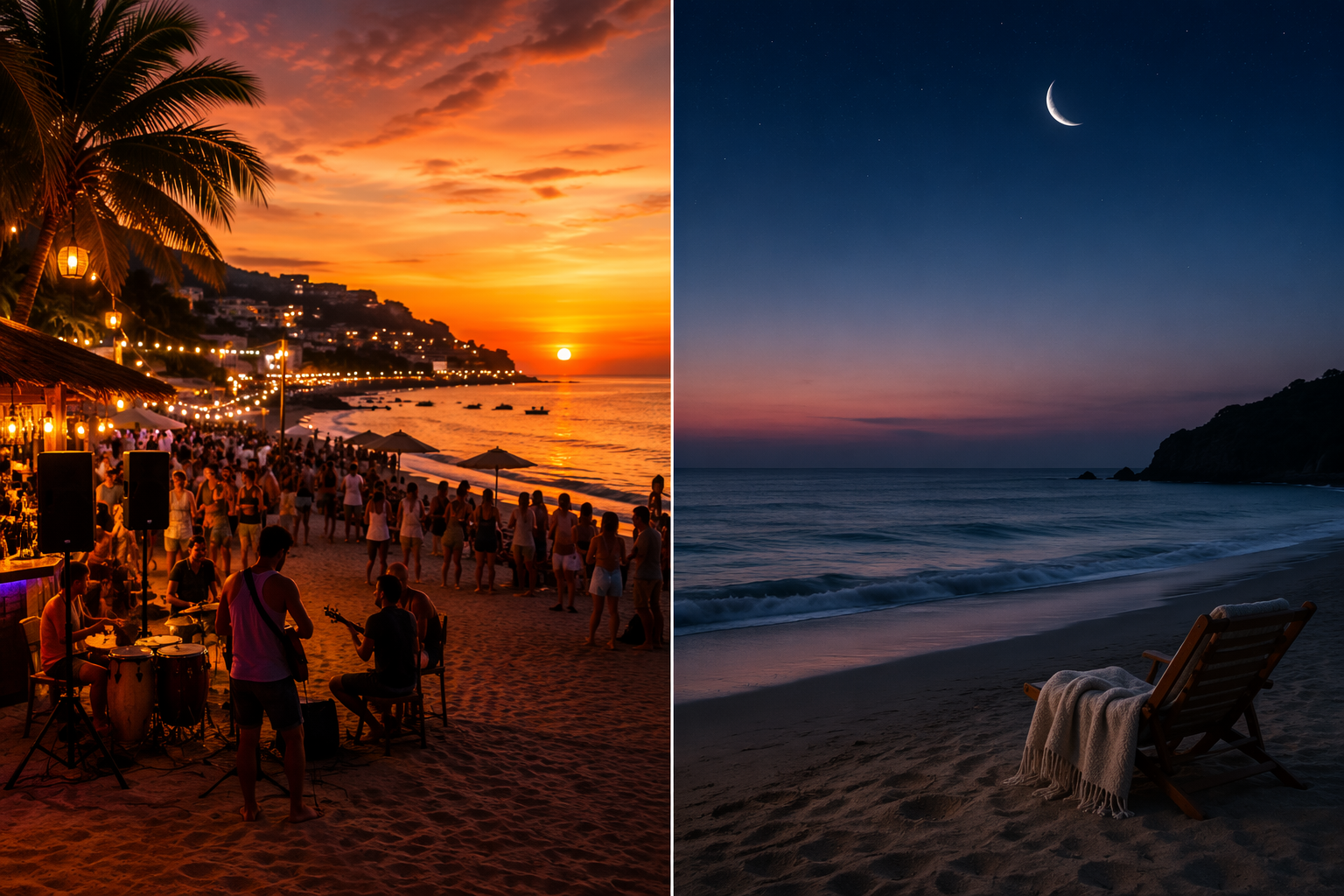
Light pollution is easy to ignore when browsing beach photos because most marketing images are taken in flattering daylight or golden hour. The problem starts later: glowing hotel corridors, decorative landscape lights, parking-lot lamps, balcony lights that stay on, and thin curtains that turn the room gray all night.
For a restorative sleep trip, darkness needs to be checked at two levels. First, the destination: barrier islands, less commercial beaches, and places with limited night entertainment usually have an advantage. Second, the room: blackout curtains, no glass door facing exterior lights, and a layout that lets you cool the room without opening yourself to noise or light. A dark beach with a badly lit room is still a bad sleep bet.
This is also why “secluded” beach lists can be useful only after filtering. Travel + Leisure’s list of secluded U.S. beaches is helpful for identifying lower-crowd candidates, but seclusion is not the same as sleep quality; a remote rental with poor curtains, bad climate control, or a noisy road nearby can still fail the night test.[3]
The Room Matters More Than the Brochure Admits
Accommodation quality is the least romantic criterion and one of the most important. In the Xiong et al. study, accommodation satisfaction was associated with lower odds of travel insomnia, and it was also associated with recovering from home insomnia while traveling. That does not prove that a better hotel cures sleeplessness, but it does make the practical point hard to dodge: room handling is part of the sleep environment.[1]
For sleep-first travel, “nice hotel” is too vague. Look for recent reviews that mention mattress comfort, quiet HVAC, working thermostats, blackout curtains, soundproofing, housekeeping consistency, and staff response when guests ask to change rooms. A beautiful property that cannot move you away from a wedding reception is not a sleep hotel. A plainer inn with thick curtains, steady cooling, and quiet hours may be the better restorative choice.
Trip length also deserves more respect than it gets. The same travel-sleep study found that stays of seven days or more were protective against travel insomnia in its model.[1] That fits the lived reality of the first-night effect: the first night away can be choppy even in a good room. If you are deeply sleep-deprived, a two-night beach escape may spend too much of its time on adjustment. A longer stay gives the destination a fair chance to work.
Morning Light Helps, Especially If Travel Scrambles Your Timing
Morning sun is not decorative in a sleep vacation. It is one of the simplest ways to tell the body what time it is. Dr. Breus points to full-spectrum sunlight as one reason people may sleep better on beach vacations, alongside ocean sound, activity, and cooler nighttime conditions.[2] National Geographic’s beach-and-brain coverage also summarizes research connecting coastal and blue-space exposure with restoration, including a study of 4,255 respondents in which coasts were rated as more restorative than woodlands or mountains, and a 2024 Environmental Research study of 18,838 adults across 18 countries linking blue- and green-space visits with lower insufficient sleep.[4]
Those findings should not be stretched into “the beach fixes sleep.” They are more useful as support for a modest decision: choose a beach where morning light is easy to get without effort. If sunrise requires driving, finding parking, or walking through a busy commercial strip, you are less likely to do it when groggy. A room or rental within a short, safe walk of the shore is better than a theoretically better beach you will not reach until late morning.
Chronotype changes the strategy. In the travel-sleep study, morning-type travelers had higher odds of travel insomnia, while evening-type travelers were more likely to recover from home insomnia during travel.[1] That does not mean morning people should avoid beach trips. It means they should be stricter about quiet evenings, early check-in, and east-facing morning routines. Evening types may benefit from the schedule break, but they still need to protect the room from late-night light and noise if the goal is deep sleep rather than simply staying up somewhere prettier.
Night Temperature Can Make a Beautiful Beach Useless
The wrong nighttime temperature is a quiet saboteur. A hot, humid room can keep sleep shallow even when the beach is calm. A chilly, drafty room can do the same. Beach destinations often sell the breeze, but the room still needs mechanical control: reliable air conditioning or heating, windows that close properly, and bedding that matches the season.
Shoulder seasons often make more sense for sleep than peak summer. The beach may be less crowded, nights may be more comfortable, and lodging staff may have more room to solve problems. This is not a universal rule; it depends on the coast, the property, and your temperature preferences. But if sleep is the goal, do not let the warmest swimming month automatically become the travel month.
Beach Examples That Pass More of the Sleep Test
The destinations below are not crowned winners. They are examples of how to read beach recommendations through a sleep lens. Travel publications regularly surface places such as Cannon Beach, Sanibel Island, Amelia Island, Jekyll Island, and Block Island for qualities like scenery, lower-key atmosphere, seclusion, or relaxing getaway appeal, but those publications are not sleep studies. Treat them as candidate generators, then verify the five criteria yourself.[3][5][6][7][8]
| Destination | Why It May Work for a Sleep-Focused Trip | What to Verify Before Booking |
|---|---|---|
| Cannon Beach, Oregon | Often valued for dramatic shoreline, cooler coastal atmosphere, and a quieter town feel than louder resort strips | Room heating, damp-weather comfort, road noise, and whether the room faces exterior lighting |
| Sanibel Island, Florida | Known as a calmer Gulf Coast option with nature-oriented appeal and beachcombing rather than nightlife as the main event | Summer heat and humidity, air-conditioning reliability, mosquito exposure, and post-sunset light around lodging |
| Amelia Island, Florida | A useful candidate for travelers who want a relaxed coastal setting with enough lodging choice to be selective about rooms | Distance from event spaces, pool noise, parking-lot lighting, and whether quiet-room requests are honored |
| Jekyll Island, Georgia | Barrier-island setting can suit travelers looking for slower evenings and darker-feeling coastal stretches | Seasonal humidity, room cooling, proximity to public access points, and night lighting near paths |
| Block Island, Rhode Island | Appeals as a lower-key island escape where the pace can support early nights and morning light routines | Ferry timing, minimum stay length, room size, noise from town areas, and shoulder-season lodging comfort |
Cannon Beach is the kind of place that can make sense for someone who sleeps better cool than warm. Its appeal is not just the view of Haystack Rock; it is the possibility of a quieter evening rhythm. But the Oregon coast can bring dampness and chill, so the room matters. A cozy, quiet room with good heat beats a postcard-facing room that feels clammy at midnight.
Sanibel Island and Jekyll Island are different sleep bets. They lean toward nature and slower coastal movement, which can help if your home life is overstimulating. They also demand more attention to heat, humidity, and insects. The Gulf or Southern barrier-island version of restorative is not “leave the windows open and drift off” unless the season and property actually support that.
Amelia Island and Block Island are useful because they remind us that sleep-friendly does not have to mean isolated. A destination can have restaurants, history, and charm and still work for rest if lodging is chosen away from the active edges. The sleep traveler’s job is to resist booking the liveliest location for convenience, then complaining that the beach did not feel restorative.
A Fast Booking Test for Restorative Beach Sleep
Before booking, run the destination through a plain test. If you cannot answer these questions from maps, reviews, property photos, and a direct message to the lodging, you do not yet know whether the beach is sleep-friendly.
- What will I hear in bed after 10 p.m.: waves, traffic, people, music, HVAC, elevators, or pool noise?
- Can the room become truly dark, including protection from exterior lights and hallway glow?
- Do recent reviews mention sleeping well, or only views, décor, and location?
- Can I get morning sunlight within a few minutes of waking without needing a plan?
- Will the nighttime temperature be comfortable in the season I am actually traveling, not just in the destination’s marketing photos?
- Am I staying long enough to get past the first-night adjustment, especially if I usually sleep poorly in new places?
Business travel was a strong travel-insomnia risk factor in the Xiong et al. model compared with leisure travel, which is a useful warning even for vacationers: a beach trip packed with obligations can start to behave less like recovery and more like a prettier work schedule.[1] If the goal is sleep recovery, leave space around arrival, keep the first evening uneventful, and do not make sunrise depend on discipline you will not have after a bad travel day.
A beach does not become restorative because a list says it is relaxing. It becomes a plausible sleep destination when the sound, darkness, room, morning light, and temperature all cooperate. Use those five factors before booking, and any beach recommendation becomes easier to judge.
References
- Effects of Environmental Change on Travelers’ Sleep Health, Frontiers in Psychology, 2020.
- Why do I sleep better on a beach vacation?, Sharecare.
- 15 Best Secluded Beaches in the U.S., Travel + Leisure.
- Going to the beach is good for your brain, according to science, National Geographic, May 2025.
- 53 Beach Vacations for 2026, Good Housekeeping.
- 22 best beaches in the US 2026, Lonely Planet.
- 16 Most Relaxing Getaways, U.S. News Travel.
- Top 8 Beach Getaways 2026, Flytographer.
Comments
Join the discussion with an anonymous comment.