
The most useful sentence in Chris Hemsworth’s public recovery routine does not come from Hemsworth at all. It comes from his trainer Luke Zocchi, writing in Centr’s own promotional material: “Recovery isn’t a reward after training. Recovery is part of training.”[1] That line has the sheen of app copy, and it should be read with that filter on. Centr is selling a training ecosystem, not publishing a sleep diary. Still, the claim is more interesting than the usual celebrity-fitness choreography because it asks a better question: if the training is hard enough, does sleep become the thing that makes the training possible?
That question matters for the phrase people actually search: chris hemsworth workout sleep quality. The public version of Hemsworth’s training is not a gentle wellness loop. Centr describes his gym work as 60-minute sessions built around compound lifts, supersets, minimal rest, and all major muscle groups, usually 5–6 days per week.[2] A routine like that can push the body toward adaptation, but it can also leave a person too wired, sore, underfed, or over-scheduled to sleep well. The recovery claim is credible only if the physiology can carry it.

The Routine Is Polished; the Principle Is More Useful
Centr’s version of Hemsworth’s evening recovery stack is almost too complete: sauna-to-cold contrast, foam rolling, a 1-1-1 journaling prompt, lights out by 10 PM, and a target of 7–9 hours of sleep.[1] It reads cleanly because it is meant to. There is no school pickup, no late work call, no shared bathroom, no child with a cough, no dinner dishes waiting beside the foam roller. Treating that sequence as documentary evidence of nightly adherence would be careless.
But dismissing the whole thing because it is polished would miss the better lesson. The routine has two layers. One layer is resource-dependent: sauna, cold exposure, trainer-supported scheduling, app programming, and the kind of household control that lets a 10 PM bedtime look simple. The other layer is physiological: hard exercise creates a recovery demand, and sleep is one of the main places the body organizes the response.
| Public-facing habit | What can transfer to an ordinary exerciser |
|---|---|
| Sauna-to-cold contrast | A deliberate downshift after training, not necessarily expensive temperature equipment |
| Foam rolling | A low-stakes transition ritual that may reduce perceived tightness and make bedtime less abrupt |
| 1-1-1 journaling | A short cognitive off-ramp: one win, one lesson, one thing for tomorrow |
| 10 PM lights out, 7–9 hours | A protected sleep window matched to training load rather than whatever time is left |
The difference matters. Copying the stack can turn recovery into another performance display. Translating the principle asks a less glamorous question: after a hard session, have you left the nervous system, joints, and endocrine system enough room to do the work you just demanded from them?
Why Deep Sleep Carries So Much of the Recovery Argument
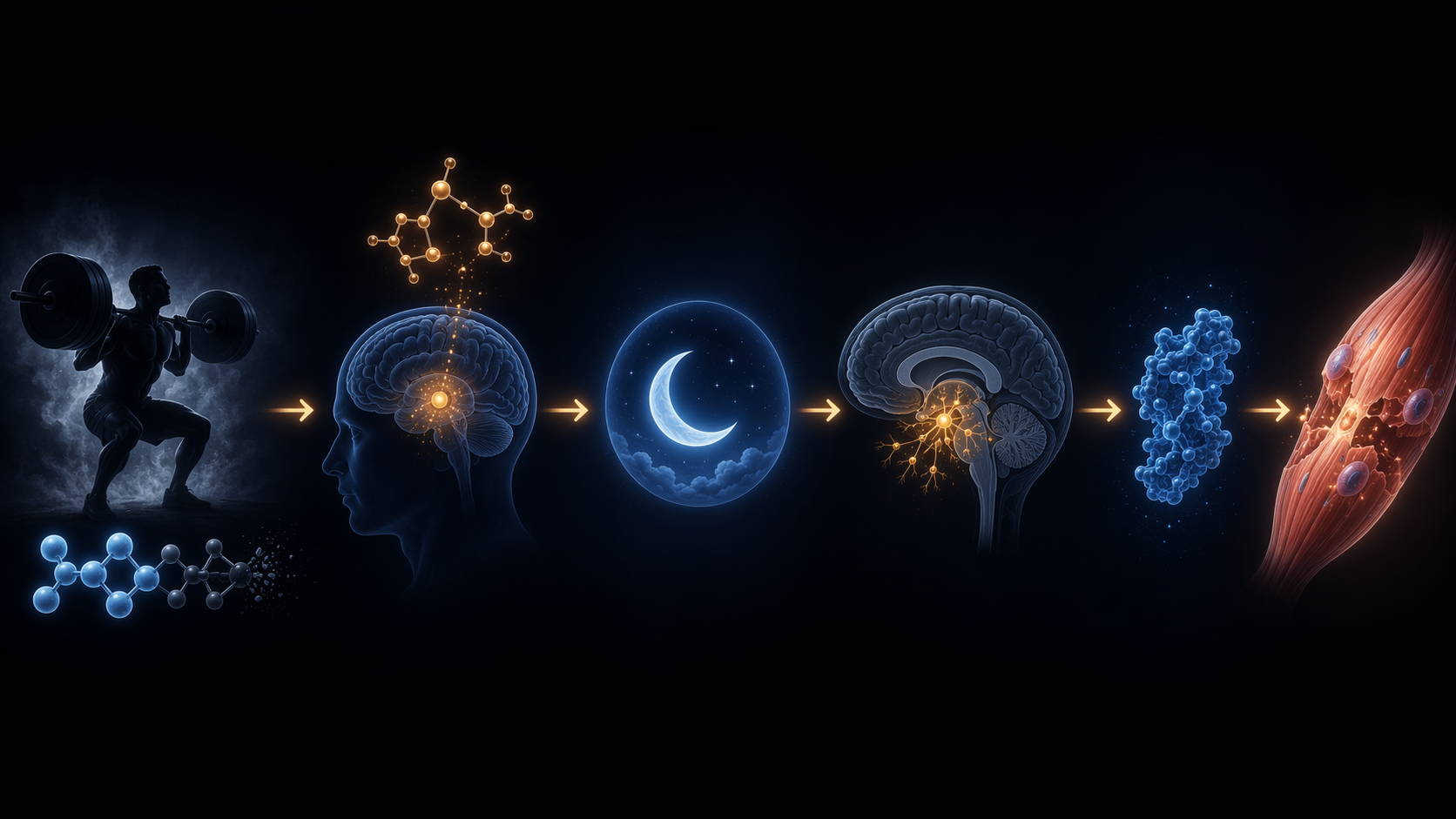
The strongest scientific support for the sleep-first philosophy sits in deep sleep, especially NREM stage 3. A 2025 UC Berkeley report on research published in Cell states that about 70% of daily growth hormone is secreted during NREM stage 3 sleep.[3] That does not mean one good night builds a superhero body, and it does not mean growth hormone is the only repair signal that matters. It does mean the body’s most concentrated growth-hormone release is tied to a sleep stage that many ambitious exercisers treat as negotiable.
Growth hormone is relevant because resistance training is partly organized damage. Heavy lifting creates mechanical tension and metabolic stress; adaptation depends on how well the body responds afterward. Deep sleep is not a passive blackout between workouts. It is a biological state in which repair signaling, energy regulation, and nervous-system recalibration are being coordinated while the person is unavailable for heroics.
The Berkeley finding adds a useful mechanistic detail. The researchers reported that growth hormone-releasing hormone neurons in the hypothalamus project to the locus coeruleus, a brainstem region involved in arousal, and that this circuitry links sleep depth with muscle and bone repair signaling.[3] That is exactly the kind of mechanism celebrity recovery content usually lacks: not just “sleep helps recovery,” but a plausible neural route by which sleep state and anabolic signaling talk to each other.
There is a boundary here. The circuitry work described by Berkeley involves mouse models, so it should not be overextended into a claim that Hemsworth’s exact bedtime routine has been validated in humans.[3] The human physiology point is narrower and sturdier: deep sleep is strongly linked to growth-hormone release, and hard-training adults who chronically cut sleep are probably cutting into a recovery window they cannot fully replace with supplements, gadgets, or cold water.
Hard Training Can Build Sleep Pressure, Until It Starts Getting in Its Own Way
The other useful pathway is adenosine. During waking activity, cells use ATP for energy. As ATP is broken down, adenosine accumulates, including in sleep-regulating areas such as the basal forebrain, and that accumulation contributes to homeostatic sleep pressure—the increasing drive to sleep the longer a person stays awake.[4] This is why the satisfying heaviness after a demanding training day is not merely psychological. The body has spent energy, and the chemistry of sleep pressure has a way of presenting the bill.
For a workout built around compound lifts, supersets, and minimal rest, the adenosine explanation is plausible but not personal proof. No public source measured Hemsworth’s adenosine levels after a session. What can be said is more modest: intense resistance training draws heavily on cellular energy systems, and adenosine is one of the signals by which prior wakefulness and energy use are translated into sleep pressure.[4] In many regular exercisers, that is the difference between a body that is ready to sleep and a mind that keeps negotiating with bedtime.
The catch is timing and arousal. A hard session can create sleep pressure, but if it ends too late, runs too hot emotionally, or leaves the person under-recovered and uncomfortable, it may also delay the descent into sleep. Soreness, elevated alertness, late caffeine, bright gym lighting, and the ordinary logistics of getting home and eating dinner can all compete with the biology that wants to shut down. This is where Hemsworth’s public routine is more useful as a sequence than as a shopping list: it gives the body a runway instead of asking it to drop from combat mode straight into deep sleep.
The Nervous System Needs a Handbrake, Too
Centr’s recovery material also includes a 5–10 minute post-workout guided meditation and box breathing pattern built around a 4-count inhale, hold, exhale, and hold.[1] This is the part that is easy to oversell because breathing practices are now asked to fix everything from stress to discipline to identity. Their more credible role is smaller and still useful: they can help move the body away from sympathetic drive and toward parasympathetic reactivation after effort.
After a demanding session, the body is not just “tired.” Heart rate, alertness, heat load, and stress hormones may still be elevated. A short breathing or meditation block gives the athlete a controlled transition: slower breathing, fewer inputs, and a defined end to the training state. The more defensible claim is that this may help reduce cortisol and support rest-and-digest tone, not that it guarantees better sleep every night. That distinction is important. A breathing drill cannot cancel an overloaded schedule, a punishing program, or five hours in bed.
Journaling can serve a similar transition, although through attention rather than physiology. The 1-1-1 version—one win, one lesson, one thing for tomorrow—has the tidy quality of a branded habit.[1] Still, as a bedtime tool, its virtue is that it is finite. It gives the mind a small container for unfinished business instead of letting tomorrow’s tasks roam loose at midnight.
Where the Hemsworth Version Stops Being Transferable
The least transferable part of the Hemsworth model is not the bedtime. It is the surrounding control. A person with a trainer, recovery tools, professionally designed programming, and app-based sleep content is working with a different set of constraints than a recreational athlete trying to lift before work or after putting children to bed. Centr has also promoted a Power Sleep Series connected to Hemsworth’s training ecosystem, which reinforces how thoroughly the routine lives inside a commercial wellness structure.[5]
That does not make it useless. It does mean the honest translation has to separate principle from replica. The principle is to make the sleep window visible when planning training load. The replica is a full evening protocol with contrast therapy, app programming, and a clean 10 PM lights-out target. One is a standard a normal person can adapt. The other is an aspirational model, and sometimes a marketing asset.
For someone training three to five days a week, the practical version is not complicated, but it is often inconvenient: avoid placing the hardest sessions where they reliably compress sleep; leave a decompression buffer after late workouts; protect enough time in bed for deep sleep to occur; and treat persistent irritability, poor performance, and heavy morning fatigue as recovery data rather than character flaws. None of this requires pretending to be Hemsworth. It requires admitting that the workout does not end when the last set ends.
What Is Actually Worth Borrowing
The strongest borrowed idea is structural: plan recovery before the body forces it. If a session is heavy, dense, or late, the recovery plan should be adjusted in the same way a lifter adjusts warm-up sets or rest intervals. That might mean moving the session earlier, lowering intensity, eating soon enough that hunger does not interrupt sleep, or replacing a screen-heavy collapse with ten minutes of quiet breathing and a written plan for tomorrow.
- Keep the non-negotiable: a sleep window long enough to support recovery after demanding sessions.
- Keep the transition: a short, repeatable wind-down that tells the nervous system training is over.
- Keep the feedback loop: use next-day mood, soreness, and performance to judge whether the load was absorbed.
- Let go of the spectacle: sauna, cold plunge, and celebrity-level scheduling are optional, not the mechanism.
The science does not prove that Chris Hemsworth follows the same routine every night, and it does not prove that his exact sequence is necessary. It does support the better part of the message. Hard training creates a biological need for recovery. Deep sleep is when a large share of growth-hormone signaling is organized. Adenosine helps convert energy use into sleep pressure. A realistic wind-down can help the body accept the signal instead of fighting it.
That is the rare celebrity fitness takeaway that survives contact with ordinary life. Hemsworth’s public routine is aspirational, polished, and resource-heavy. The principle underneath it is unusually sound: sleep is not the soft reward after serious training. It is part of the training load.
References
- Train Like Chris Hemsworth: Daily Rituals You Can Copy Tonight, Centr
- Chris Hemsworth Gym Workout: Exercises He Swears By, Centr
- Sleep strengthens muscle and bone by boosting growth hormone levels; UC Berkeley researchers discover how, UC Berkeley, September 8, 2025
- Adenosine and Sleep, Sleep Foundation
- Centr Launches Chris Hemsworth’s Power Sleep Series, Athletech News
Comments
Join the discussion with an anonymous comment.