
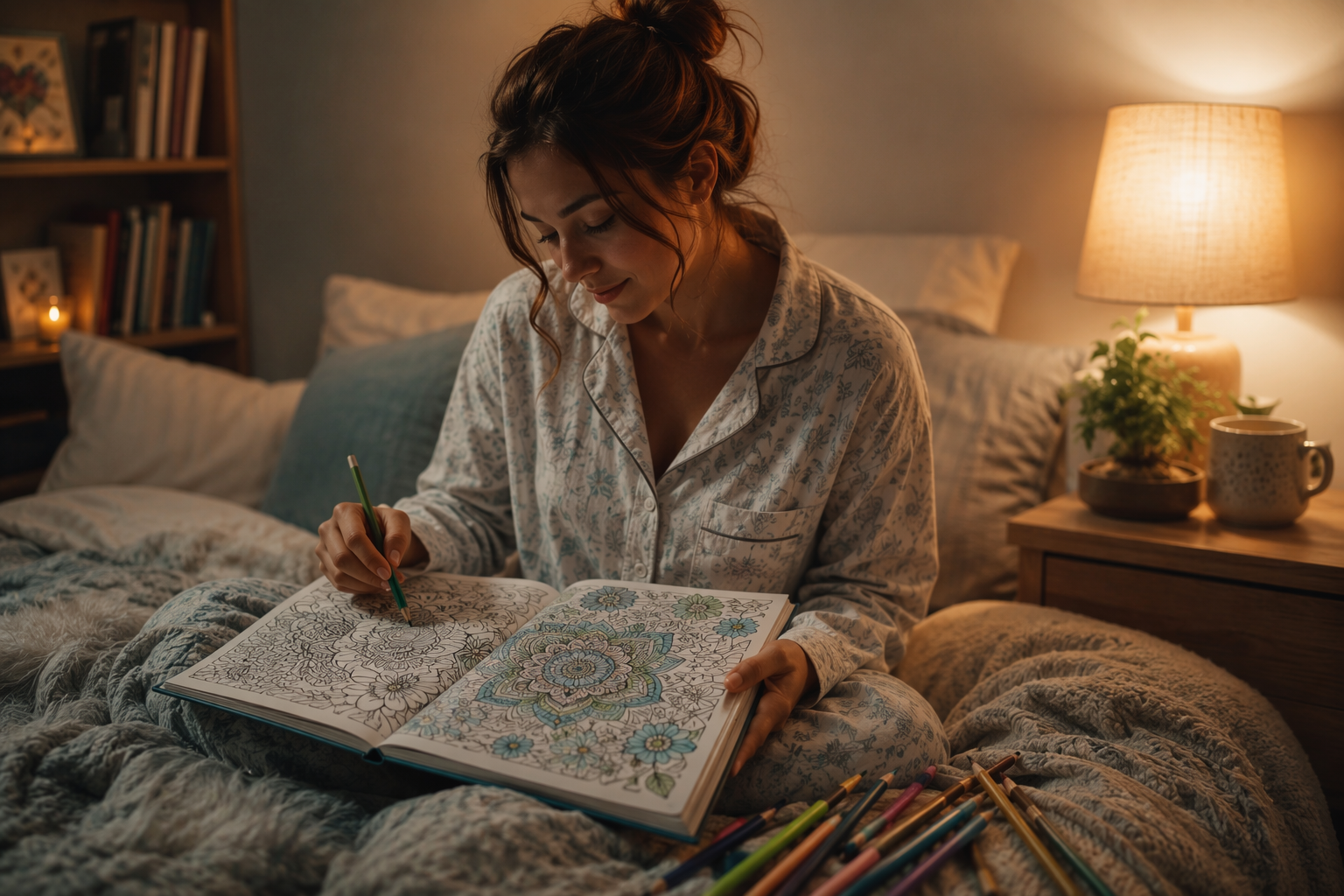
When chemotherapy leaves you tired but wired, the problem at bedtime is usually not lack of willpower. It is the mix of anxiety, racing thoughts, and a body that never really stood down after the infusion day. A screen-free task that gives your hands something steady to do can be useful here because it shifts attention without adding another pill or another bright screen to the mix.
That sleep problem is not just the cancer experience itself. In preclinical work discussed by Boyd and Mong, methotrexate chemotherapy fragmented non-REM sleep even without cancer present, which is a useful reminder that treatment can disturb sleep architecture on its own [4].
Why coloring therapy is worth considering
The cleanest chemotherapy-specific clue comes from Panahi and colleagues. In a randomized trial of 190 chemotherapy patients, 20 minutes of blue-environment color therapy lowered anxiety scores from 57.70 to 50.03, with a reported p value below .001 and 13.1% of the anxiety reduction attributed to the intervention [1]. That study tested a blue-themed environment, not active coloring, so it should be read as support for a calming color setting rather than proof that a coloring book works the same way.
The active-coloring evidence comes from a different line of research. Samuel and colleagues randomized 88 people with generalized anxiety disorder to a 3-week coloring program and found significant anxiety reductions on both the Hamilton Anxiety Rating Scale and the Self-Rating Anxiety Scale, with the intervention using 30 to 120 minutes per session, five times a week, a 32-page coloring book, and 24 colored pencils [2]. Akbulak and Can added a chemotherapy-relevant piece: 30 minutes of mandala coloring during chemotherapy premedication reduced anxiety in high-distress breast cancer patients during their first chemo session [3]. That last detail matters because the worst moments are often not bedtime itself, but the hour when the chair, the port, and the premedications make the body start bracing.
The broader arts-therapy literature points in the same direction. A 2024 systematic review of 17 randomized trials found that arts therapies improved sleep quality through emotional regulation and stress reduction [6]. Mayo Clinic Health System also describes coloring as something that "calms the brain and helps your body relax" and says it can improve sleep and fatigue while decreasing body aches, heart rate, respiration, and feelings of depression and anxiety [5]. A 2025 meta-analysis in breast cancer found that art therapy improved quality of life overall, with stronger effects when the intervention lasted at least 2 months [7].
How to use it on chemo days
A chemo-friendly routine does not need to look polished. The simplest version is a small coloring kit and a repeatable time slot. If bedtime is the main problem, try 15 to 30 minutes in the evening, ideally after the most stimulating parts of the day are done. If infusion-day anxiety is the issue, use the waiting period or premedication window the way the mandala study did [3].
| Part | Practical start | Why it helps |
|---|---|---|
| Timing | Evening wind-down or infusion premedication window | Gives the nervous system a repetitive cue that the day is ending |
| Length | Start with 15 to 20 minutes; build toward 30 minutes if it feels settling | Short sessions are easier to sustain on fatigue-heavy days |
| Frequency | Aim for several nights a week; the Samuel trial used 5 sessions weekly for 3 weeks [2] | A repeated routine is more likely to become a reliable bedtime cue |
| Materials | A coloring book or mandala pages, plus a small set of pencils | A low-friction setup is more likely to get used when energy is low |
| Palette | Start with blue and green tones, then add other soft shades as you like [1][2] | The goal is a calmer visual field, not a symbolic color message |
| Infusion-day adaptation | Bring a hard backing, keep the kit small, and stop if nausea or neuropathy flares | The practice should fit around treatment, not fight it |
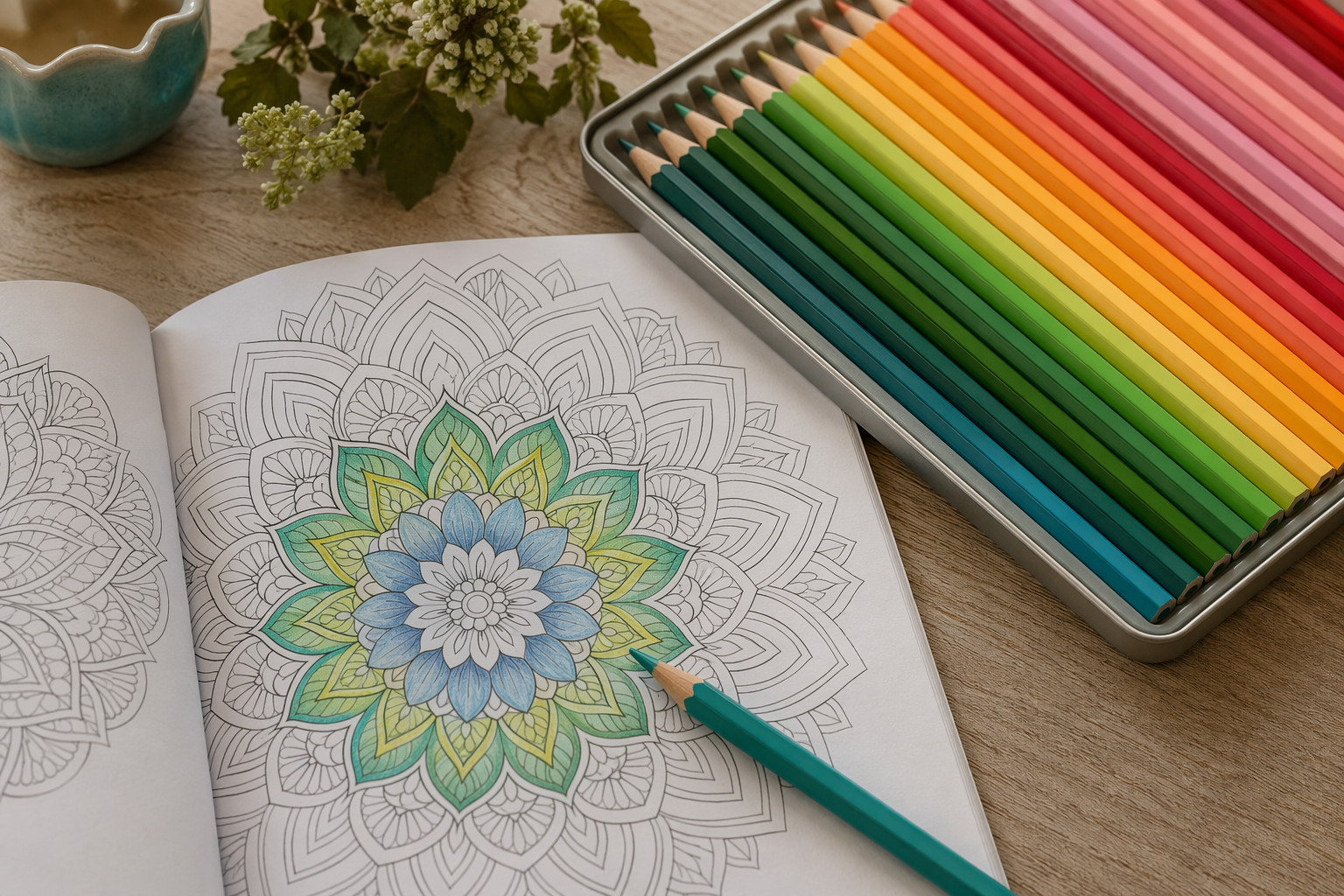
If you are choosing colors, blue and green are the safest starting point because they fit the color-therapy thread without turning the exercise into a theory lesson. They are a cue for calm, not a promise of sedation. The useful question is whether the session lowers pre-sleep activation enough that you stop scanning the room, the clock, and your own body for danger.
For some people, the best use is at home in dim light after dinner. For others, it is in the infusion chair while waiting for premeds to finish. The point is not to make art. It is to give the brain a task that is narrow enough to displace worry, repetitive enough to settle breathing, and quiet enough to keep the evening from becoming another screen marathon.
What coloring can and cannot claim
There is still no published randomized trial that tests coloring therapy for sleep during chemotherapy as a combined outcome. The case for trying it is assembled from separate but compatible findings: chemo can disturb sleep on its own [4], coloring can reduce anxiety in clinical populations [2], mandala coloring can help in a high-distress chemotherapy setting [3], and arts therapies more broadly appear to support sleep through emotional regulation and stress reduction [6].
That makes coloring therapy a reasonable, low-cost wind-down tool rather than a cure for chemotherapy insomnia. It is most worth trying when the main barrier is cognitive arousal: the mind that keeps replaying the day, rehearsing tomorrow, or refusing to stop checking whether sleep has started yet. In that setting, a quiet page and a few pencils may be enough to make bedtime feel less hostile.
References
- The Effect of Color Therapy on Anxiety in Chemotherapy Patients Attending the Oncology Department, PMC, 2025, https://pmc.ncbi.nlm.nih.gov/?term=The+Effect+of+Color+Therapy+on+Anxiety+in+Chemotherapy+Patients+Attending+the+Oncology+Department
- The effects of coloring therapy on patients with generalized anxiety disorder, PMC, 2022, https://pmc.ncbi.nlm.nih.gov/articles/PMC9773305/
- Mandala coloring during chemotherapy premedication, PubMed, 2023, https://pubmed.ncbi.nlm.nih.gov/35508427/
- Chemotherapy's hidden side effect: sleepless nights without cancer, PMC, 2025, https://pmc.ncbi.nlm.nih.gov/articles/PMC12246363/
- Coloring books can help you relax and improve your health, Mayo Clinic Health System, https://www.mayoclinichealthsystem.org/hometown-health/speaking-of-health/coloring-books-can-help-you-relax-and-improve-your-health
- The role of arts therapies in mitigating Sleep Initiation and Maintenance Disorders: a systematic review, PMC, 2024, https://pmc.ncbi.nlm.nih.gov/articles/PMC11137235/
- Art therapy and quality of life in breast cancer patients: a meta-analysis, PMC, 2025, https://pmc.ncbi.nlm.nih.gov/articles/PMC12078136/
Comments
Join the discussion with an anonymous comment.