
To fall asleep, your body usually needs its core temperature to drop by about 0.5–1°C. That drop is not decorative sleep trivia; it is part of the machinery of sleep onset. As evening circadian signals and melatonin widen blood vessels near the skin, heat moves away from the core and out through the hands, feet, and face. A heat wave makes sleep hard because it interferes with that transfer. The room may feel merely “too warm,” but physiologically the problem is more specific: the body is trying to dump heat, and the environment is refusing to take it.[1]
That is why some familiar advice lands badly. A trick can feel cold on the skin and still slow the core-temperature drop that sleep depends on. A bed can feel airy for ten minutes and then turn into a humid pocket that blocks sweat evaporation. A shower can be bracing and still push blood away from the skin at the wrong moment. The useful question is not “Does this feel cool?” It is “Does this help my body move heat out?”
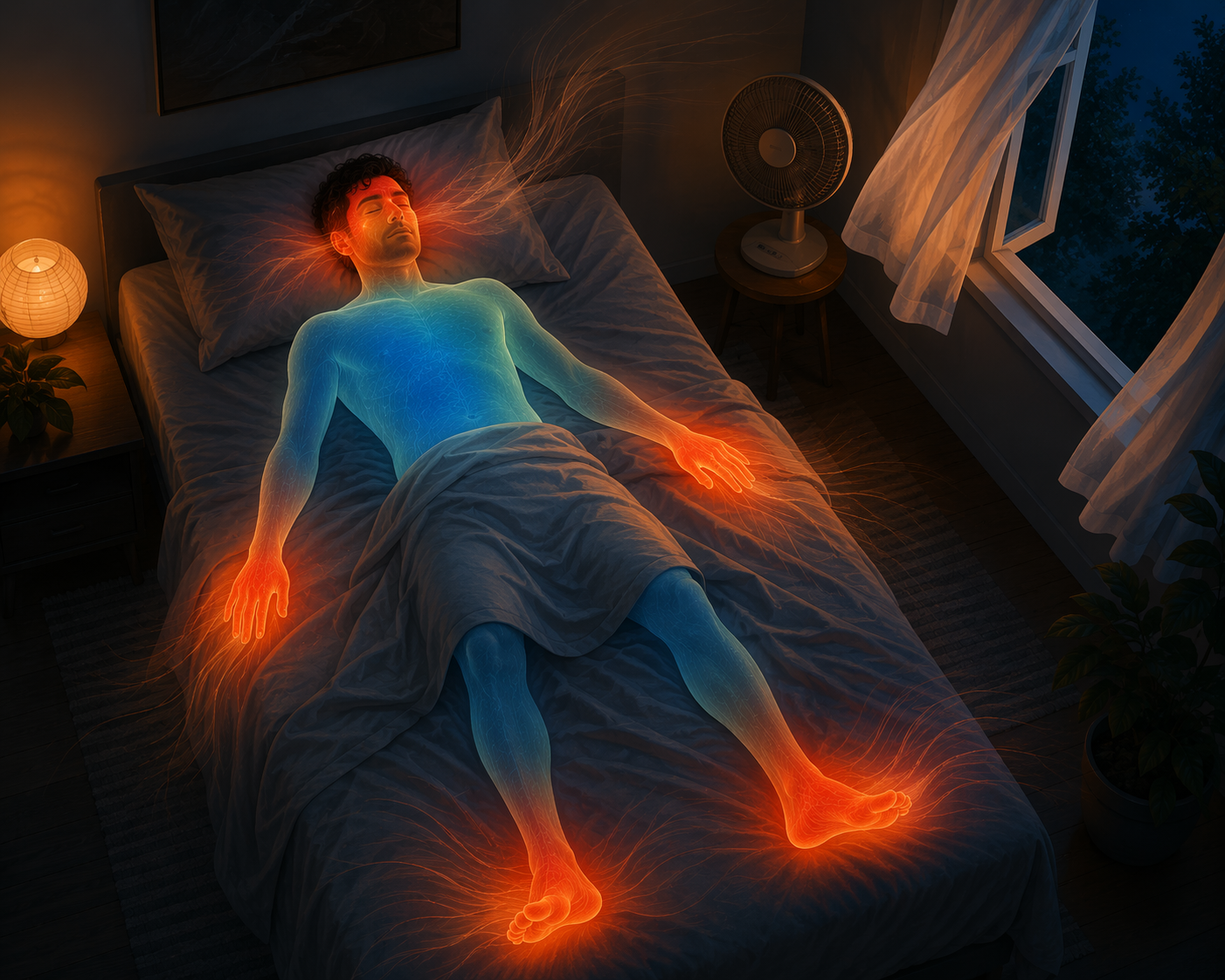
Heat Does Not Just Delay Sleep
The first casualty is often the beginning of the night. Heat exposure suppresses slow-wave sleep, especially in the first sleep segment, which is exactly where the body normally tries to get a large share of deep sleep. REM sleep is vulnerable too, partly because thermoregulatory responses are nearly absent during REM; during that stage, the body has less ability to adjust to a hot environment.[1]
There is also an unhelpful myth that the body simply “gets used to it” after a few miserable nights. The evidence is not that comforting. In the thermal-environment sleep review, Libert and colleagues’ work is summarized as showing no habituation after five consecutive hot nights.[1] A person may become more resigned to bad sleep. That is not the same as the sleeping brain and body becoming unaffected by heat.
This matters when deciding how to sleep during a heat wave because the goal is not merely to make the room feel less hostile. The goal is to protect the body’s pre-sleep cooling shift, keep sweat evaporation possible, and avoid adding little obstacles that trap heat around the skin.
The Warm Bath Is Not a Wellness Cliché Here
A warm bath or shower before bed sounds like the wrong move on a hot night until the timing is included. The point is not to climb into bed hot. The point is to warm the skin, increase blood flow toward the body surface, then leave enough time for the body to shed that heat. A 2019 meta-analysis found that passive body heating in water around 104–109°F, taken 90–120 minutes before bed, shortened sleep-onset latency by about 36%.[2]
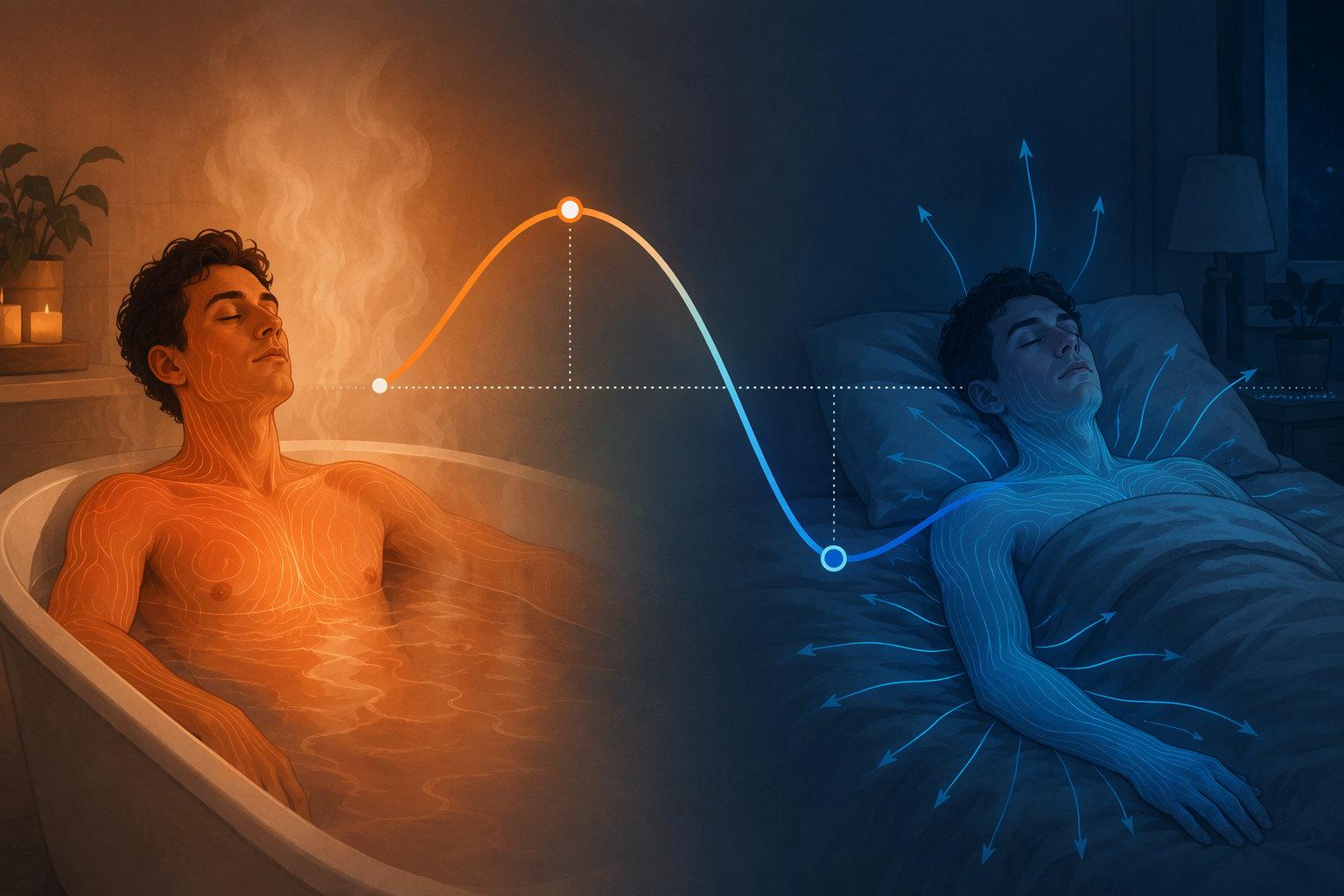
The timing is doing a lot of work. If the bath is too close to bedtime, the bed may inherit the heat. If it is early enough, the later drop is the useful part. This is one reason “take a cold shower” is less persuasive than it sounds. Cold water can trigger vasoconstriction, pulling blood away from the skin surface. That may feel refreshing, but it can also delay the heat loss the body is trying to use for sleep onset.[2]
A practical version does not need ceremony: a warm shower, enough time afterward to cool down, and bedding that does not trap the heat you just moved toward the skin. The intervention works only if the exit route remains open.
Cool the Feet Because the Feet Are Part of the System
Foot cooling deserves more respect than it usually gets. The feet are one of the body’s heat-exchange zones, and warming-induced distal vasodilation is part of the normal pathway into sleep. If the bedroom is hot, giving that pathway some help can be more rational than trying to shock the whole body cold.
The lower-tech options are often enough: a brief cool foot bath, socks chilled in the refrigerator rather than frozen stiff, or keeping the feet lightly uncovered while the rest of the body remains comfortable. Practical hot-weather sleep guidance has described foot cooling, including a foot bath around 20°C, as a way to target distal heat loss.[2]
There is a difference between “cool” and “numb.” If a method makes the feet painfully cold, causes shivering, or makes the body clamp down on skin blood flow, it has stopped serving the thermoregulation goal. The useful version is gentle enough to increase comfort without provoking a defensive cold response.
Clothing and Bedding Decide Whether Sweat Can Do Its Job
Sleeping naked is not automatically the superior heat-wave choice. It can help if clothing would otherwise trap heat, but sweat evaporation also needs surface area and airflow. Light, loose cotton sleepwear can sometimes manage moisture better than bare skin pressed against a sheet, especially if the sheet itself becomes damp.
The more obvious offenders are tight synthetics and heavy bedding. They create a small, humid microclimate around the body, and that is exactly where heat dissipation can stall. Once sweat sits without evaporating, the body has paid the discomfort cost without getting the cooling benefit.
A bed microclimate around 32–34°C with 40–60% relative humidity is often described as the comfort zone for the immediate space around the sleeping body.[2] That number is not the same as the room thermostat; it is the temperature and humidity trapped under covers and against skin. Natural-fiber bedding such as cotton or linen helps because it is more likely to let moisture move instead of sealing it in.
For a broader room-cooling plan, it can help to pair this with practical bedroom changes such as blocking daytime sun, venting heat after outdoor temperatures fall, and reducing heat generated indoors. Those tactics belong to the room; sleepwear and sheets belong to the last few inches around the body. Both matter, but the bed microclimate is where many otherwise sensible cooling plans quietly fail. For more room-level tactics, see the best ways to cool a bedroom without AC.
Fans Help Until They Don’t
A fan can be useful because moving air helps sweat evaporate and can strip away the warm layer of air sitting near the skin. That is real cooling support, not just noise and wishful thinking. But fans are not harmless under every condition.
The safety caveat is the outdoor and indoor temperature threshold. Guidance summarized in hot-weather sleep coverage warns that fans tend to help below about 35°C, or 95°F, but above that point they may accelerate heat gain, especially for older adults and people who are dehydrated.[2] A fan blowing very hot air over a body that cannot sweat effectively is not a cooling device in any meaningful sense.
Below that threshold, the details matter. Aim air across the body rather than blasting the face all night if dryness is a problem. Pair the fan with breathable bedding so evaporated moisture can leave the bed rather than recirculate in a damp pocket. If the room is hotter than the body can safely manage, the better answer is not a stronger fan; it is a cooler environment, hydration, or a cooling center if home conditions are unsafe.
Do Not Worship One Bedroom Temperature
Bedroom temperature recommendations vary for good reasons: buildings differ, bedding differs, humidity differs, and people differ. WIRED’s heat-wave sleep coverage notes a commonly recommended range of about 15–19°C, while other sleep-health sources often give nearby but not identical Fahrenheit ranges.[3] Treating one number as universally correct is tidy, but it is not how sleeping bodies behave.
The better target is a condition: the room and bed should allow the body to lose heat without shivering, sweating into a swamp, or waking repeatedly to uncover and recover. Air temperature is one input. Humidity, airflow, mattress heat retention, sheets, pajamas, hydration, age, medications, and illness can all change the outcome.
This is also why an air conditioner setpoint that works in one home can fail in another. A cool room with a heat-trapping foam mattress and synthetic sheets may still feel oppressive. A slightly warmer room with dry moving air and breathable bedding may be easier to sleep in. The thermostat is useful; it is not the whole thermoregulatory environment.
A Better Way to Troubleshoot a Hot Night
When a heat wave ruins sleep, start with the body’s heat-loss route rather than a random list of hacks. The body needs warm blood to reach the skin, moisture to evaporate, and the bed to stop trapping heat. Anything that supports those conditions is worth keeping. Anything that blocks them should be treated skeptically, no matter how clever it sounds.
- Keep: a warm bath or shower 90–120 minutes before bed, if it leaves time for the post-warming cool-down.
- Keep: gentle foot cooling that improves comfort without causing painful cold or shivering.
- Keep: loose, breathable sleepwear and cotton or linen bedding that let sweat evaporate.
- Use with judgment: fans when temperatures are below the danger threshold and sweat evaporation is still helping.
- Discard: cold shocks, tight synthetics, heavy bedding, and anything that feels cool briefly while trapping moisture or provoking vasoconstriction.
This does not make summer sleeping easy. It just makes the decision-making less superstitious. During a heat wave, the most reliable strategies are the ones that help the body do the job it was already trying to do: move heat from the core to the skin, release it into the environment, and preserve the temperature drop that lets sleep begin.
References
- Effects of Thermal Environment on Sleep and Circadian Rhythm, PMC, 2012.
- Eight ways to sleep well in hot weather, The Conversation, 2025.
- Sleep Disruption Heat Wave, WIRED, 2025.
Comments
Join the discussion with an anonymous comment.