
If you put on one song after dinner and move around the living room for a few minutes, is that a real sleep hygiene practice or just a pleasant mood break? The best answer in 2026 is: probably closer to both than either side would like to admit.
A March 2026 meta-analysis in Frontiers in Public Health pooled 10 randomized controlled trials with 711 participants and found that dance interventions produced a statistically significant improvement in overall sleep quality, with a standardized mean difference of 0.48 and a 95% confidence interval from 0.14 to 0.82.[1] That is a real signal, not just wellness decoration. It is also not a magic switch.
The cleaner version of the result came from studies using the Pittsburgh Sleep Quality Index, or PSQI. In that PSQI-only analysis, the effect was smaller, with an SMD of 0.36, and heterogeneity was low, with I² at 21.7%.[1] In plain English: across the more comparable studies, dance seemed to modestly improve how people rated their sleep, and the studies were not wildly disagreeing with one another.
The important catch is where the improvement showed up. The same meta-analysis found a statistically significant improvement in subjective sleep quality, with an SMD of 0.47, but not in objective sleep domains such as sleep latency, sleep duration, or sleep efficiency.[1] So if you are asking whether a dance break can improve sleep quality, the evidence is strongest for feeling more satisfied with your sleep, not for reliably falling asleep faster or adding measurable sleep time.
What the Meta-Analysis Actually Supports
This distinction matters because sleep quality is not one thing. A person can sleep the same number of hours and still wake with less dread about the night. They can have roughly the same bedtime and wake time but feel less tense, less disappointed, or less preoccupied with whether they have “performed” sleep correctly. Those changes can be meaningful, especially for adults whose sleep complaints are frustrating but not clinically disabling.
At the same time, subjective improvement should not be quietly upgraded into objective sleep repair. If a wearable is showing the same total sleep time, or if sleep onset still varies from night to night, that does not necessarily mean the dance did nothing. It may mean the main benefit is landing in the part of sleep health that PSQI-style questionnaires are better at catching: satisfaction, restfulness, and the felt burden of the night.
| Question | What the 2026 evidence suggests |
|---|---|
| Does dance improve overall sleep quality? | Yes, modestly, across 10 RCTs with 711 participants. |
| Is the strongest signal subjective or objective? | Subjective. People reported better sleep quality, while latency, duration, and efficiency did not show significant improvement. |
| Does this prove a short home dance break works? | No. Most trials studied structured dance programs, not one-song home breaks. |
| Is it reasonable to try? | Yes, for subclinical sleep complaints, especially if it lowers stress or improves mood. |
That makes dance a slightly unusual sleep hygiene candidate. Much of sleep hygiene is framed as subtraction: remove caffeine too late, remove bright light too close to bed, remove irregular timing, remove stimulating habits. Dance adds something. It asks for a few minutes of movement, rhythm, music, and emotional discharge. For a tired person, that difference is not cosmetic.
Why Feeling Better About Sleep Still Counts
The temptation is to treat subjective sleep quality as the soft endpoint and objective sleep metrics as the serious endpoint. That split is too neat. People do not only suffer because sleep is short; they suffer because the night becomes loaded. They monitor it, negotiate with it, resent it, and wake already judging it. A practice that reduces that emotional charge may improve sleep quality even before it changes the clock.
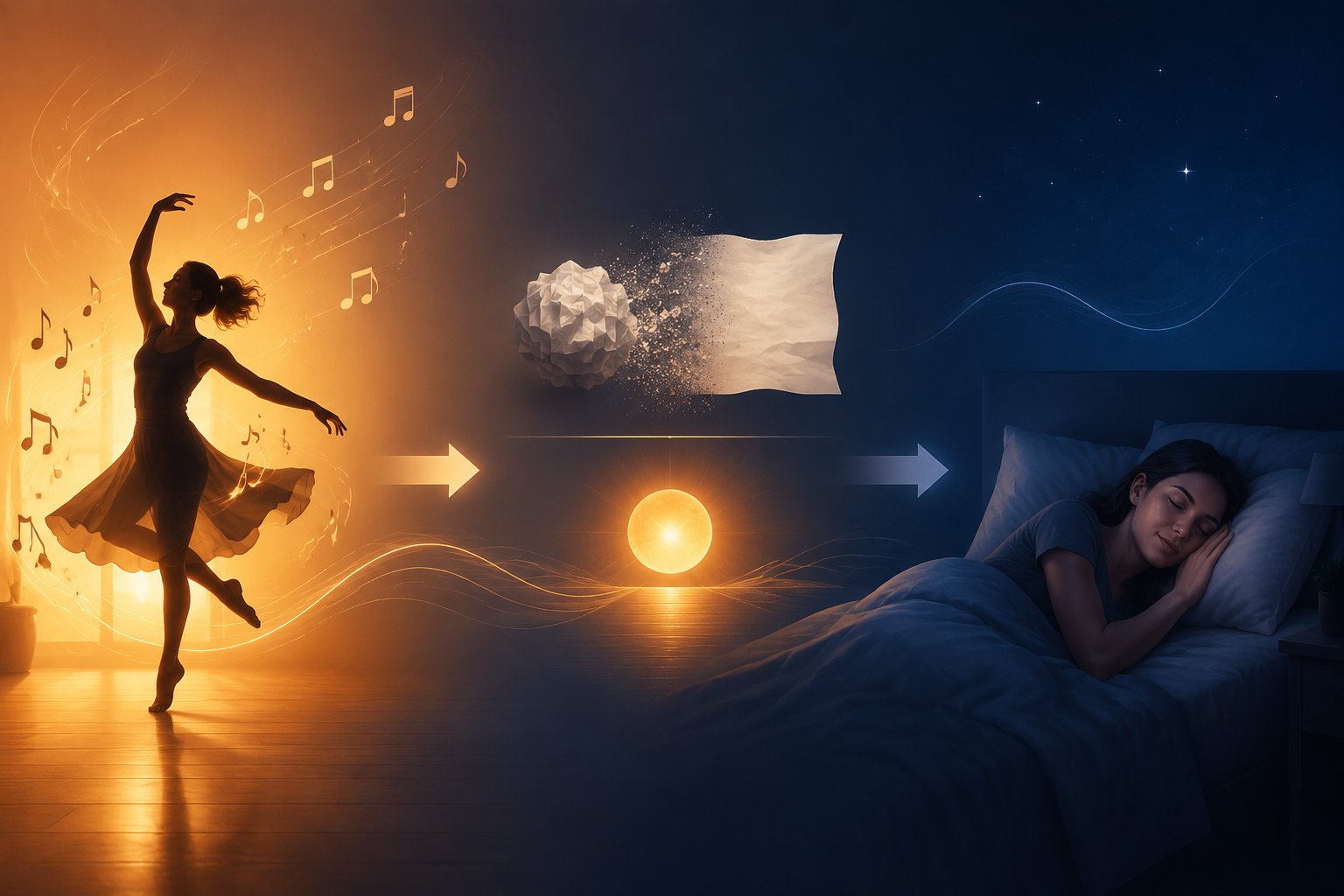
The 2026 meta-analysis authors proposed that dance may work through both affective-social and physiological-circadian pathways.[1] The first pathway is the one that best fits the outcome pattern. Dance can reduce stress, lift mood, pair movement with music, invite creative expression, and, in group settings, add social connection. None of that requires dance to be intense enough to function like a conventional workout.
A 2023 Frontiers in Public Health study on square dancing among middle-aged and older Chinese women gives some useful context. In that study, sleep improvements were explained through a chain of increased social support, reduced depressive symptoms, and better sleep.[2] That does not prove that a solo kitchen dance break works the same way. It does support a more humane hypothesis: dance may help sleep partly because it changes the emotional and social state a person carries toward bed.
That is also why the activity may appeal to people who do not want to become “exercisers” before they are allowed to rest better. A dance break can be light, private, imperfect, and unserious. It does not have to produce a training effect to interrupt rumination or loosen the body after a day of sitting, caregiving, commuting, or screen work.
There is a small danger here, though. Enjoyable interventions are easy to oversell because they feel kinder than the usual discipline-heavy advice. The evidence does not say that dancing reliably fixes insomnia, normalizes sleep architecture, or outperforms established treatments. It says dance interventions modestly improve sleep quality ratings, with the clearest gain in subjective satisfaction.
The Dose Signal Is Useful, Not a Prescription
If you are looking for the studied version of dance for sleep, it was usually not one spontaneous song in the living room. The more promising pattern in the 2026 subgroup analysis leaned toward group-based aerobic dance, more than twice weekly, around 60 minutes per session, sustained over 12 to 16 weeks.[1] That is closer to a class or structured program than a tiny bedtime ritual.
But even that pattern needs restraint. The subgroup differences did not remain statistically significant after Holm adjustment, so they should be read as suggestive rather than as confirmed dosing guidelines.[1] It would be too tidy to tell readers that the “right” sleep dose is exactly an hour of dance three times a week for three or four months. The data cannot hold that much certainty.
The gap matters because “dance break” implies something shorter, easier, and more home-based than what most trials tested. A short dance break is a reasonable adaptation from the evidence, not the thing the evidence directly proves. The honest move is to treat it as a low-risk experiment for mood and tension, not as a guaranteed sleep intervention.
- If you want to stay close to the research, consider a structured dance class or online session several times a week.
- If you want the lowest barrier version, try one or two songs in the evening and judge whether your body feels less tense afterward.
- If dancing energizes you too much near bedtime, move it earlier in the evening rather than forcing it into a pre-sleep slot.
- If tracking sleep makes you anxious, pay attention to next-morning restfulness and bedtime tension, not only wearable scores.
Evening Movement Is Not Automatically the Enemy
Some people avoid any evening movement because they have absorbed a simple rule: exercise wakes you up. For intense training close to bed, that caution may be reasonable for some sleepers. But brief, moderate movement is not automatically disruptive.
One relevant piece of context comes from a 2024 randomized trial reported by CNN, based on a BMJ Open study. Participants who took 3-minute resistance exercise breaks every 30 minutes across 4 evening hours added 27.7 minutes of sleep without disrupting sleep quality.[3] This was not a dance study, so it should not be borrowed as proof that evening dancing extends sleep. It does, however, make the fear of any short evening movement look too broad.
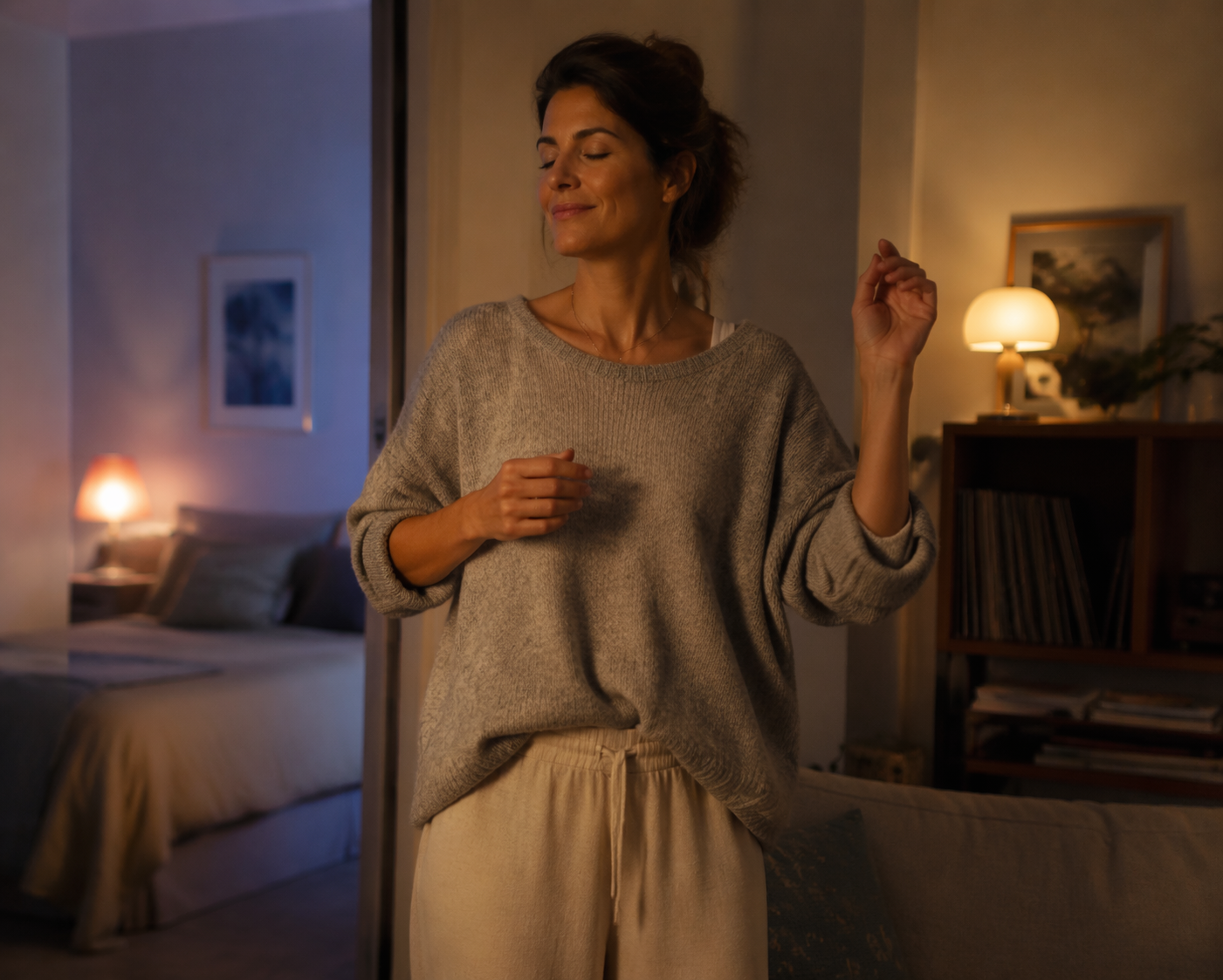
For a dance break, the practical timing question is less about obeying a universal cutoff and more about your own arousal pattern. Gentle swaying to one song after dinner is a different stimulus from a high-intensity cardio routine at 10:45 p.m. The version most likely to fit sleep hygiene is the one that leaves you calmer, warmer, and less mentally clenched.
Why Dance May Be Easier to Keep Than Exercise Advice
Generic exercise advice often fails at the point of identity. People hear “exercise for sleep” and picture a program, a schedule, a shower, better shoes, and a version of themselves with more evening energy than they currently have. Dance can sometimes sidestep that. Music supplies momentum before motivation arrives.
A University of Sydney report in February 2024 argued that dancing may be especially useful for mental health because it combines aerobic movement, music synchronization, creative expression, and social interaction.[4] That is not the same as proving dance is superior to every other exercise form for sleep. It does help explain why dance might be well matched to the subjective sleep-quality signal: it works on mood and connection, not just muscles.
This may be particularly relevant because the 2026 sleep meta-analysis was not evenly representative. Seven of the 10 randomized trials studied women only, and most studies focused on older adults.[1] That makes the evidence encouraging for the populations actually studied, while leaving real uncertainty for men, younger adults, shift workers, parents of infants, and people trying short solo dance breaks at home.
For older adults, the social and affective pieces may be especially important, but they also make generalization tricky. A group dance class can provide rhythm, movement, routine, and companionship at the same time. A five-minute solo dance in a bedroom has some of those ingredients and not others. If you want more context on why older adults often need more tailored guidance than standard sleep hygiene scripts provide, see why sleep hygiene advice often fails older adults.
How to Try a Dance Break Without Turning Sleep Into Another Test
The least helpful way to use this evidence is to turn a dance break into another bedtime performance metric. The better experiment is simple: choose music that reliably softens your mood, move at an easy or moderate intensity, and stop while it still feels pleasant. The goal is not to hit a target heart rate. It is to arrive at bedtime with less accumulated tension.
- Use one to three songs as a short evening reset, especially after work, dinner, or a long screen stretch.
- Keep the intensity low enough that you can breathe comfortably and wind down afterward.
- Favor music that makes you feel settled, relieved, or gently happy rather than keyed up.
- Notice whether bedtime feels less tense over one or two weeks, rather than judging a single night.
- Skip or modify dancing if pain, balance issues, dizziness, or medical restrictions make it unsafe.
A dance break fits best beside other behavioral supports: consistent wake time, light management, caffeine timing, and a wind-down routine that does not make the bed feel like an exam room. It can also sit among other home remedies for insomnia with scientific backing, as long as its benefit is described at the right size: modest, plausible, and more subjective than objective.
If you have chronic insomnia, though, this is not the main treatment lane. Difficulty falling asleep, staying asleep, or waking too early for months, especially when it impairs daytime functioning, deserves a clinical approach. Cognitive behavioral therapy for insomnia remains the more appropriate reference point; a dance break may be supportive, but it is not a substitute for CBT-I.
The Calibrated Answer
A dance break is worth trying if your sleep complaints are mild to moderate, your body can do it safely, and the idea feels more inviting than another rigid nighttime rule. The strongest evidence says dance interventions can modestly improve sleep quality, especially how satisfied people feel with their sleep.[1] It does not say a short home dance break will reliably shorten sleep latency, lengthen sleep duration, or improve sleep efficiency.
That is still enough to take it seriously. Not every useful sleep hygiene practice has to look like discipline. Some of them may look like one song, a little less tension, and a bedtime that feels less like a test.
References
- Dance interventions and sleep quality meta-analysis, Frontiers in Public Health, March 2026.
- Square dancing, social support, depressive symptoms, and sleep study, Frontiers in Public Health, 2023.
- Resistance exercise breaks in the evening may add sleep without disrupting sleep quality, CNN reporting on BMJ Open study, August 2024.
- Dancing may be better than other exercise for improving mental health, University of Sydney, February 2024.
Comments
Join the discussion with an anonymous comment.