
The hard part of an air quality alert often starts after the practical advice has already been followed. The windows are closed. The curtains are drawn. The outdoor air has been “kept out” as much as the room allows. Then bedtime arrives, the bedroom feels stale, and sleep comes in pieces.
That is the central problem behind the sleep impact of an air quality alert: the same sealed-room strategy that reduces outdoor pollution can also change the bedroom environment in ways that disturb sleep. Opening the window may bring in fine particles, ozone byproducts, smoke, or trapped urban pollution. Keeping it shut may allow carbon dioxide and indoor particles to build. On high-AQI nights, sleep hygiene is no longer only about screens, caffeine, or a consistent bedtime. The air in the room becomes part of the sleep routine.
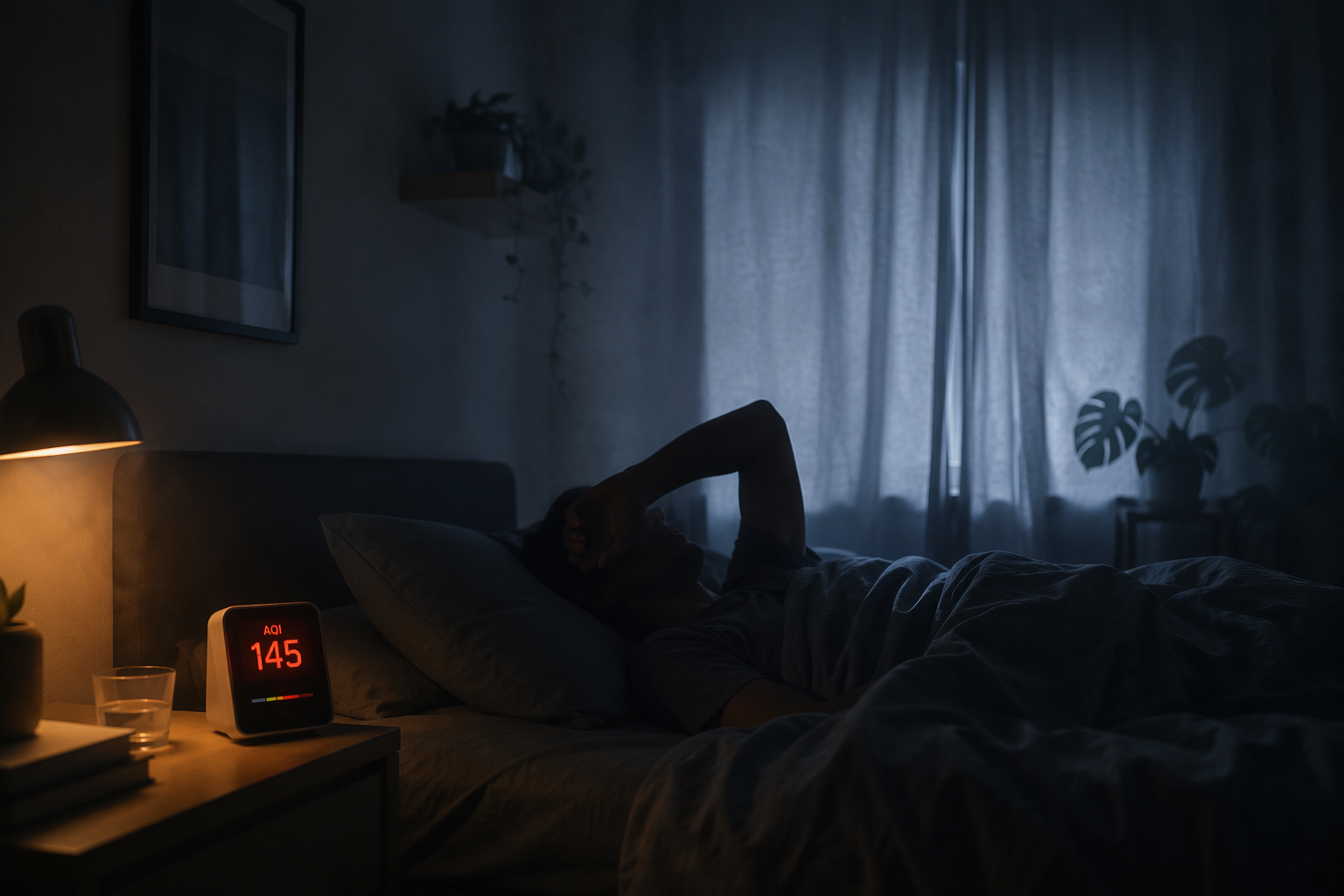
The pattern is measurable, not just a vague sense that bad-air nights feel worse. In a panel study of Chinese cities, a one-standard-deviation increase in AQI was associated with an 11.6% increase in sleeplessness signals on social media, which makes air pollution visible as a sleep disruption, not merely a daytime breathing concern.[1] In the Multi-Ethnic Study of Atherosclerosis, people in the highest quartile of PM₂.₅ exposure had 50% higher odds of low sleep efficiency, while those in the highest quartile of NO₂ exposure had 60% higher odds.[2] A systematic review published in 2020 found that 21 of 22 studies reported positive associations between air pollution and adverse sleep outcomes.[3]
Those studies are not identical, and they do not prove that every restless night during an alert has the same cause. MESA involved older urban adults, and its findings should not be stretched into a perfect prediction for every U.S. sleeper. A Taipei study found an odds ratio of 1.61 for insomnia per μg/m³ increase in PM₂.₅, but that result also comes from a specific urban population.[4] Still, the direction of the evidence is consistent enough to treat AQI above 100 as a sleep-relevant event, especially for people who already notice fragmented sleep when smoke, ozone alerts, or winter inversions arrive.
Why Different Alerts Can Lead To The Same Bad Night
AQI is a public-facing index that translates pollutant levels into a health-risk category. For sleep, the exact alert label matters less than what the alert changes in and around the bedroom. Wildfire smoke can raise fine-particle exposure. Summer ozone alerts can coincide with hot evenings when people want ventilation. Winter inversions can trap pollution near the ground and keep outdoor air poor for days. The National Weather Service advises people to limit outdoor exposure during air quality alerts, especially when air is unhealthy for sensitive groups or worse.[5]
At night, that advice collides with ordinary sleep needs. Bedrooms need to be cool, quiet, and low in irritants. They also need enough air exchange to avoid feeling heavy and stale. During an alert, those goals can pull against each other. The answer is not to ignore official guidance, and it is not to treat discomfort as a personal sleep-hygiene failure. The practical question is narrower: which exposure is most dangerous tonight, and how can the bedroom be controlled without creating a different sleep stressor?
The First Pathway: Irritated Airways And Micro-Arousals
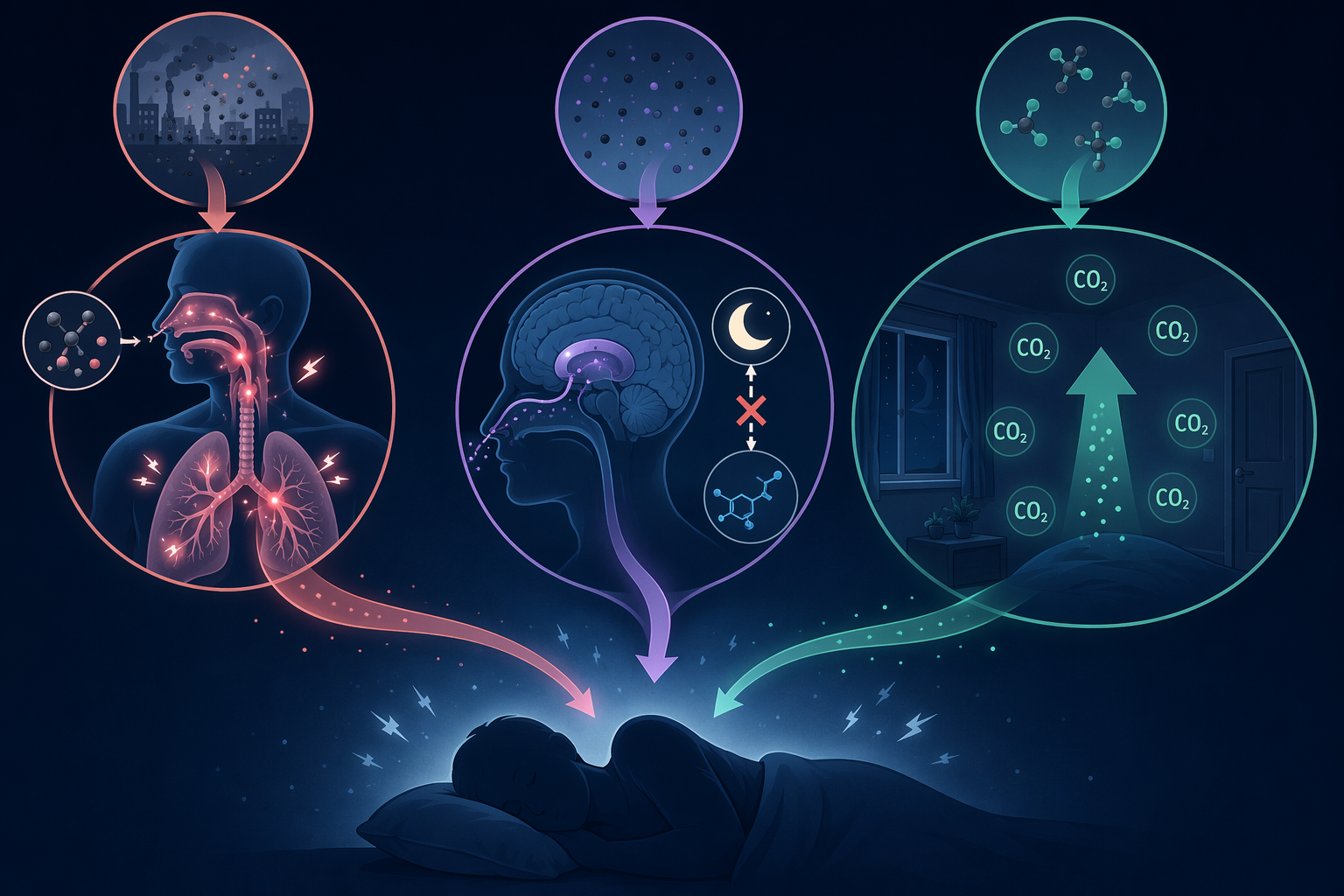
The strongest and most practical explanation starts in the airway. Fine particles and traffic-related gases can irritate the nose, throat, and lower respiratory tract. That irritation does not have to wake a person fully to matter. Sleep can fragment through brief arousals: a shift in breathing, a lighter sleep stage, a small awakening that is forgotten by morning but still leaves the person foggy.
This matters for people who snore, have allergies, live with asthma, or have any tendency toward sleep-disordered breathing. Polluted air can make the upper airway more reactive and sleep more fragile. The MESA findings are especially relevant here because the study examined ambient pollution in relation to sleep apnea and sleep efficiency, not only self-reported tiredness.[2] That does not mean pollution is the only cause of poor sleep efficiency. It means that on high-pollution nights, the airway can become one more reason the sleeper keeps surfacing from deeper sleep.
This is also why “I never woke up coughing” is not enough to clear the air as a suspect. A sleeper can have a worse night without dramatic symptoms. More nasal resistance, throat irritation, or unstable breathing can show up as restlessness, morning headache, dry mouth, or the feeling of having slept lightly all night.
The Second Pathway: Fine Particles And The Brain, With Some Caution
There is a second possible pathway that deserves attention, but it should be handled more carefully. Fine particles may affect the central nervous system through inflammatory and oxidative-stress pathways, and researchers have discussed possible effects on neurotransmitters and sleep-wake regulation, including serotonin and melatonin-related processes.[6] This is biologically plausible, and it helps explain why pollution research does not stop at the lungs.
The direct human sleep evidence for this brain-and-hormone pathway is thinner than the evidence for airway irritation and sleep fragmentation. Some mechanistic support comes from animal or laboratory work rather than from people sleeping in ordinary bedrooms during real alerts. So the useful takeaway is not that every high-AQI night “shuts down melatonin.” The safer conclusion is that pollution may affect sleep through both respiratory and neurological routes, while the respiratory route is currently easier to defend with human sleep data.
The Third Pathway: The Closed-Bedroom Tradeoff
Closing the bedroom window is usually the right first move when outdoor air is unhealthy. It reduces direct intake of polluted air and gives filtration a chance to work. But closed does not mean clean. Indoor PM₂.₅ in sealed urban homes can still reach 40–70% of outdoor levels, which is enough to matter during a severe smoke day or inversion.[6] Particles enter through leaks, door gaps, vents, older window frames, and the normal imperfections of a building.
The other side of the tradeoff is carbon dioxide. In a closed bedroom with two adults, CO₂ can exceed 1,000 ppm within hours, and bedroom environmental research has linked elevated CO₂ and ventilation conditions with worse sleep quality and obstructive sleep apnea severity.[7] CO₂ is not the same pollutant problem as smoke or PM₂.₅, but it can make sleep feel shallow, stale, and unrestorative. This is the part most generic alert advice leaves the sleeper to solve alone.
The point is not to throw the window open whenever the room feels stuffy. During a high-AQI event, that can trade one problem for a worse one. The point is to manage the bedroom as a small exposure zone: reduce outdoor infiltration, remove indoor sources, filter continuously, and use ventilation only when outdoor conditions and the room’s CO₂ burden justify it.
A Bedtime Protocol For AQI Above 100
Start before the room already feels bad. A workable protocol begins 30–60 minutes before bed, because filtration and room decisions need a little time. The goal is not to make the whole home perfect. It is to make the sleep space meaningfully cleaner than the air outside and less contaminated than the rest of the home.
| Bedtime decision | What to do | Why it matters |
|---|---|---|
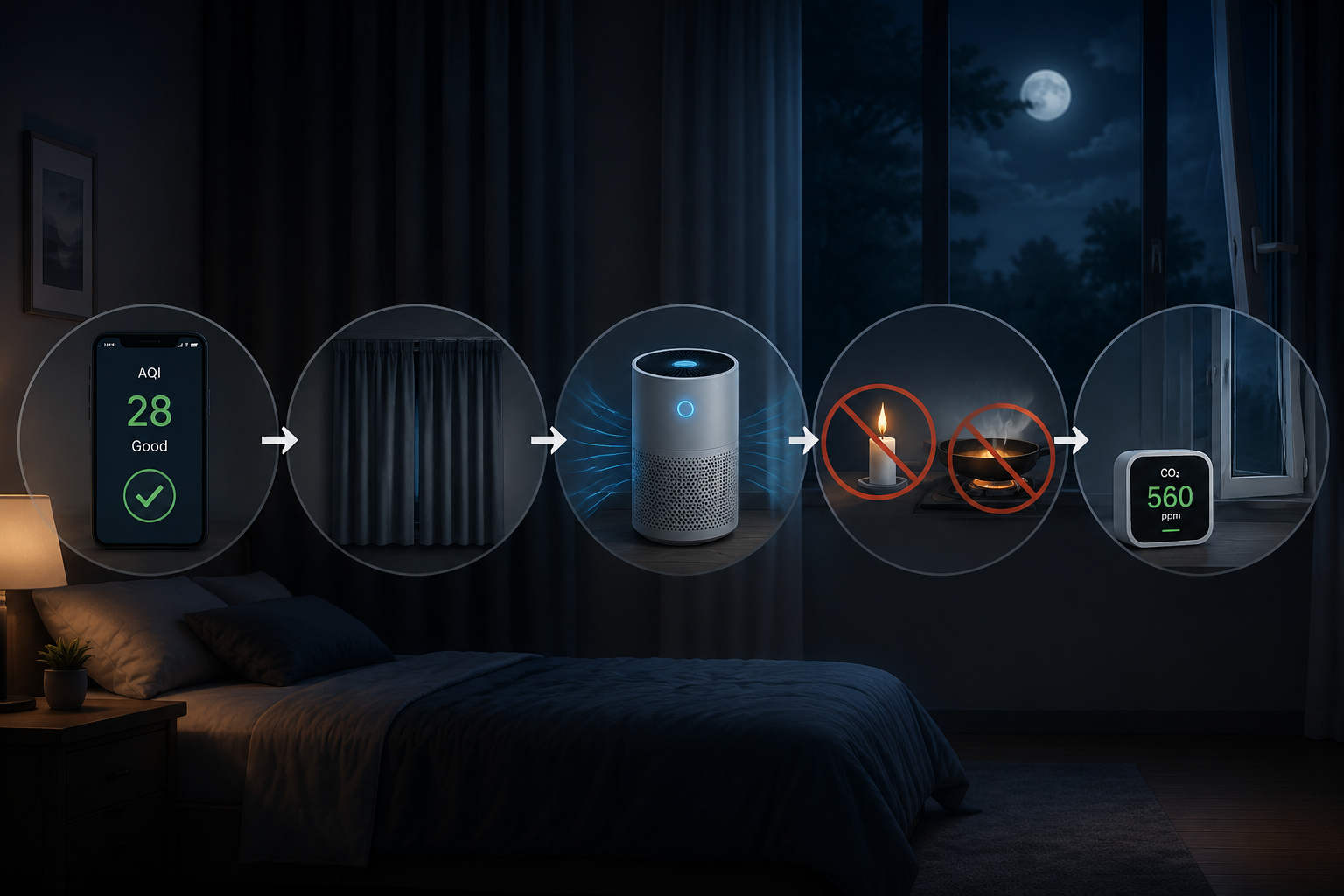
| Check the AQI and alert type | Look at the current AQI and the main pollutant if your app or local agency shows it. | Smoke, ozone, and inversion events may require the same closed-room strategy, but they affect ventilation choices differently. |
| Choose the cleanest room | Use the bedroom with the fewest exterior leaks, least odor, and best access to filtration. | A smaller, more sealable room is easier to control overnight. |
| Seal obvious outdoor pathways | Close windows, shut exterior doors, draw curtains, and block large drafts if you can do so safely. | Closed windows reduce exposure but do not eliminate infiltration. |
| Filter before sleep | Run HEPA filtration with activated carbon for at least 30 minutes before bed. | HEPA targets particles; activated carbon helps with some gases and odors. |
| Stop indoor particle sources | Skip candles, incense, frying, smoking, fireplaces, and unnecessary combustion. | Indoor PM₂.₅ can undo the benefit of closing the room. |
| Manage CO₂ deliberately | Use a CO₂ monitor if available; ventilate only when outdoor air is acceptable or briefly when the tradeoff is justified. | A sealed room can become stale enough to fragment sleep. |
Check The Alert Before You Touch The Window
AQI apps are imperfect, but they are better than guessing from smell or visibility. Smoke may be obvious. Ozone often is not. Winter inversion pollution may look like haze or just feel like a long run of stale outdoor air. If the AQI is above 100, treat the evening as an exposure-control night: outdoor exercise moves earlier or indoors, windows stay closed by default, and the bedroom gets prepared rather than opened at the last minute.
If your source shows the main pollutant, use it. PM₂.₅ pushes filtration to the front of the plan. Ozone pushes caution around evening ventilation, especially if levels remain elevated. Smoke events deserve the strictest particle control, but this guide is broader than wildfire smoke alone: the same sleep disruption can show up during ozone alerts and inversion days.
Pick One Room And Make It Boring
Choose the room that gives you the most control. Usually that means a bedroom with one exterior wall rather than several, windows that close tightly, no fireplace, no attached garage odor, and enough space for a purifier to move air freely. Keep the bedroom door closed once the room is being cleaned. This is not about being fussy; it prevents the cleaner air you just made from mixing with cooking particles, hallway drafts, or smoke odor from another room.
Avoid adding “comfort” sources that make the air worse. Candles, incense, frying, smoking, fireplaces, and gas combustion can raise indoor particles or gases at exactly the wrong time. If dinner involves high-heat cooking, use ventilation earlier if outdoor air allows, then shift back to closed-room filtration before bed. A bedroom purifier cannot fully compensate for a home that is still generating particles.
Run Filtration Before You Need Sleep
A portable purifier is useful only when it is matched to the problem. HEPA filtration is for particles such as smoke and PM₂.₅. Activated carbon is for some gases and odors; it is not magic, and it becomes less useful as the carbon saturates. In a closed room, HEPA plus activated carbon filtration has been reported to reduce bedroom PM₂.₅ by about 70–90% within 30 minutes, though those performance claims come from a mix of peer-reviewed research and commercial testing rather than one uniform evidence base.[6]
Run the unit on a higher setting before bed if noise allows, then choose the highest overnight setting you can sleep through. Put it where air can circulate, not wedged behind a chair or trapped under a desk. If the room has a strong outdoor leak, move the purifier closer to the breathing zone without blasting air directly at your face. The point is not a perfect laboratory clean room; it is a lower-particle sleeping zone for the hours when your airway is most vulnerable to irritation.
Handle CO₂ Without Undoing The Clean-Air Work
CO₂ is where many alert-night plans fall apart. A person follows the guidance, closes the room, runs the purifier, and then wakes at 2 a.m. feeling hot and air-hungry. If outdoor AQI is still high, opening the window wide may pull in the pollutant you were trying to avoid. If outdoor AQI has improved, a short ventilation window may help. The decision should be based on both outdoor AQI and the bedroom’s stale-air burden, not on discomfort alone.
A CO₂ monitor is useful if you have one, especially in small bedrooms with two sleepers. Without one, use the practical signs: a room that becomes noticeably stuffy within an hour, morning headaches that cluster on closed-window nights, or sleep that improves when the door is left slightly open to a cleaner interior space. If the rest of the home is cleaner than outside air, cracking the bedroom door may reduce CO₂ buildup with less pollution penalty than opening a window. If the home interior is smoky, odor-filled, or affected by cooking particles, keep the door closed and prioritize filtration.
When The Alert Ends But The Insomnia Does Not
Most alert-related sleep disruption should ease when the air improves and the bedroom is no longer being managed like a sealed shelter. If sleep stays broken after AQI returns to normal, the problem may no longer be only particle exposure, stale air, or airway irritation. Wildfire smoke in particular can leave people on edge after the smoke clears, especially if the event involved evacuation fear, property threat, or repeated nighttime alerts. For that pattern, the psychological side of smoke-related insomnia is covered separately in why wildfire smoke keeps your brain on high alert at night.
For the night of an AQI alert, the cleanest decision standard is this: do not choose between polluted outdoor air and a stale sealed room as if those are the only options. Check the AQI, close the obvious pathways, clean one sleep room early, stop indoor particle sources, and manage CO₂ without reflexively opening the window during the worst air. That turns the bedroom from a passive container into a controlled exposure zone for the hours that matter most.
References
- Air pollution as a cause of sleeplessness: Social media evidence from a panel of Chinese cities — ScienceDirect, 2019
- The association of ambient air pollution with sleep apnea: the multi-ethnic study of atherosclerosis — PMC, 2019
- Air pollution exposure and adverse sleep health across the life course: A systematic review — PMC, 2020
- Association between ambient air pollution exposure and insomnia among adults in Taipei City — Nature, 2022
- During an Air Quality Alert — National Weather Service
- The Effect of Air Pollution and Climate Change on Sleep — PMC
- Effects of bedroom environmental conditions on the severity of obstructive sleep apnea — PMC
Comments
Join the discussion with an anonymous comment.