
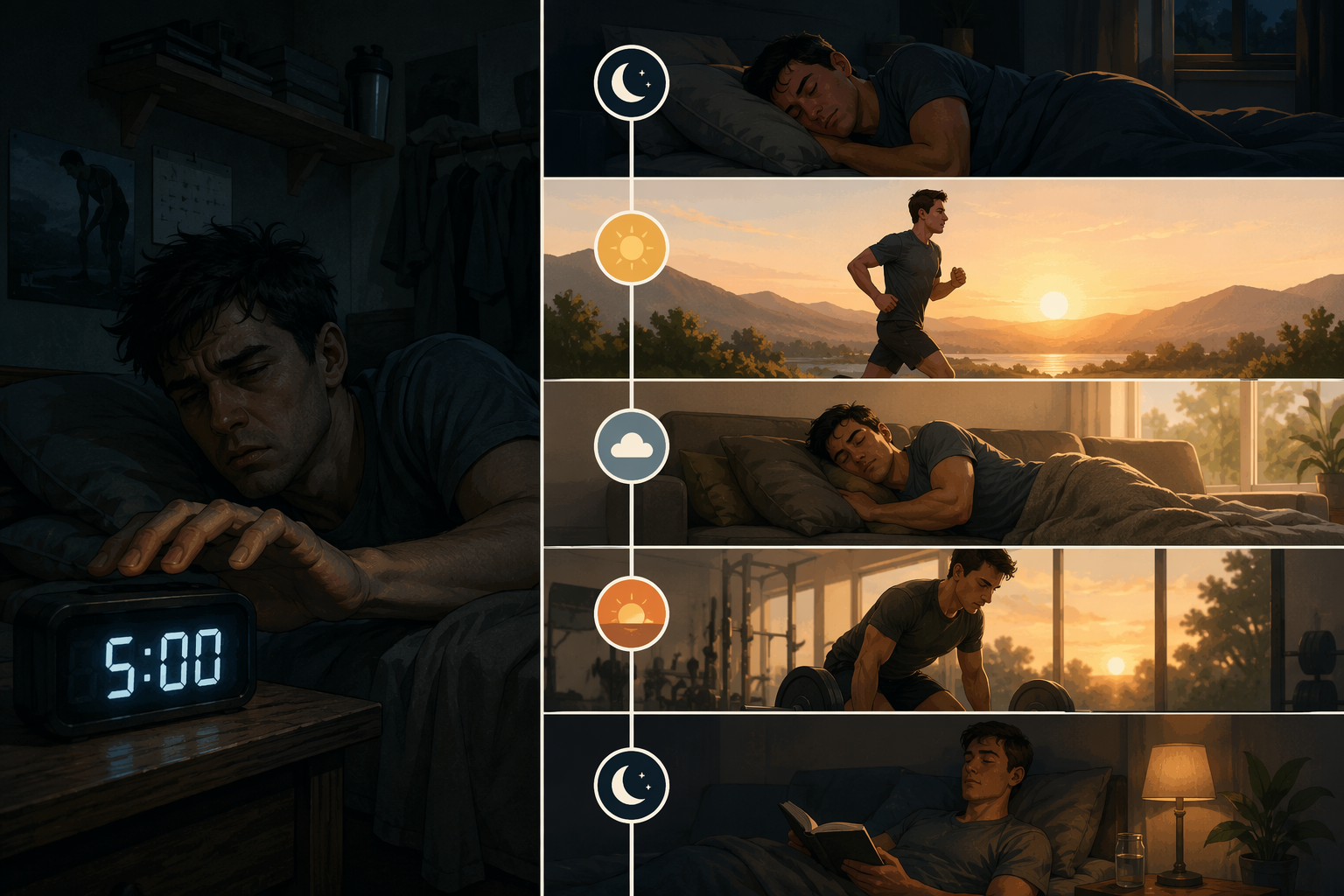
The hardest part of a two-a-day is often already lost before the first interval starts. A 5:30 a.m. swim or track session does not simply add a workout to the day; it cuts into the last, easiest-to-ignore part of the night unless bedtime moves earlier enough to cover it. That is where athletes trying to recover from double training sessions tend to get it wrong: they plan the training split, then hope sleep will stretch around it.
The better question is not “How do I sleep more?” It is “Where does sleep have to go for this training day to be recoverable?” For most amateur and semi-elite endurance athletes, the answer has three pieces: move bedtime in proportion to the morning start, protect a short early-to-mid afternoon nap between sessions, and keep the evening workout far enough from bedtime that the nervous system can actually come down.
The morning session has to be paid for the night before
Early training has a blunt arithmetic problem. If the alarm moves from 6:45 to 4:50, the body does not receive credit for discipline. It receives less sleep, unless lights-out moves by roughly the same amount. In swimmer data summarized by the Gatorade Sports Science Institute, athletes averaged only 5.4 hours of sleep before morning training days, and the problem was not that they made no attempt to go to bed earlier; they did not shift bedtime enough to match the earlier wake time.[1]
That matters because two-a-day athletes are already living close to the edge. Doherty and colleagues reported that 64–65% of athletes were classified as poor sleepers using a PSQI score of 5 or higher, while elite athletes in double-session programs averaged about 6.5–6.8 hours of sleep despite commonly needing closer to 8–10 hours during heavy training.[2] The PSQI threshold should not be treated as a perfect verdict on every athlete’s sleep health; some sport-sleep researchers argue for higher cutoffs in athletes. Still, the pattern is useful: ambitious training weeks often assume a sleep supply that the actual calendar does not provide.
A realistic target for a heavy two-a-day block is usually closer to nine hours in bed than seven. Sleep-extension work in collegiate basketball players used 9–10 hour sleep opportunities and found improvements including a 9% increase in free throw accuracy and faster sprint times.[3] That study is motivating, but it was small and unblinded, so it should not be sold as a guarantee that every runner, cyclist, swimmer, or triathlete will get a measurable performance bump. The more dependable lesson is simpler: when training load is high, the sleep opportunity has to be deliberately enlarged.
Work backward from the alarm, not forward from habit
Start with the wake-up time required by the first session, then build the night around it. If the alarm is 5:00 a.m. and the athlete wants an eight-hour sleep opportunity, lights-out is 9:00 p.m. If the target is nine hours, lights-out is 8:00 p.m. That may be socially awkward, logistically hard, and sometimes impossible. It is still the correct math.
The usual failure is a partial adjustment: bedtime moves from 10:45 to 10:15, the athlete feels responsible, and the morning still begins with a sleep deficit. Thirty minutes earlier does not cover a wake time that moved 90 minutes earlier. That gap becomes the second coffee, the flat evening run, the unnecessary snack because fatigue feels like hunger, or the scrolling that eats the nap window.
| Morning alarm | Minimum sleep opportunity | Lights-out target | What to notice |
|---|---|---|---|
| 6:00 a.m. | 8 hours | 10:00 p.m. | Manageable for many athletes if dinner and wind-down are not delayed |
| 5:00 a.m. | 8 hours | 9:00 p.m. | Requires an evening session that ends early enough to eat, shower, and downshift |
| 4:45 a.m. | 9 hours | 7:45 p.m. | Often unrealistic without changing the training schedule or protecting a nap |
That table is not meant to shame anyone into a 7:45 p.m. bedtime. It is meant to expose the trade. If the morning session is fixed and bedtime cannot move, then recovery has to be found elsewhere in the day or the training load is being carried on borrowed sleep.
Use the space between sessions as a recovery block, not just a gap
The hours between a morning and evening session look generous on paper. In real life, they get spent on commuting, work, school, meals, laundry, family logistics, and the small administrative jobs that appear whenever the athlete finally sits down. If a nap is going to happen, it needs a scheduled slot, not a vague hope after lunch.
The most useful nap for a two-a-day schedule is short: about 20–30 minutes, placed in the early-to-mid afternoon. Waterhouse and colleagues found that a 30-minute post-lunch nap after partial sleep deprivation restored 20-meter sprint performance and alertness to baseline in athletes.[4] That does not make a nap a substitute for a full night of sleep. It does make it a practical way to protect the second session when the first one started before the rest of the world was awake.
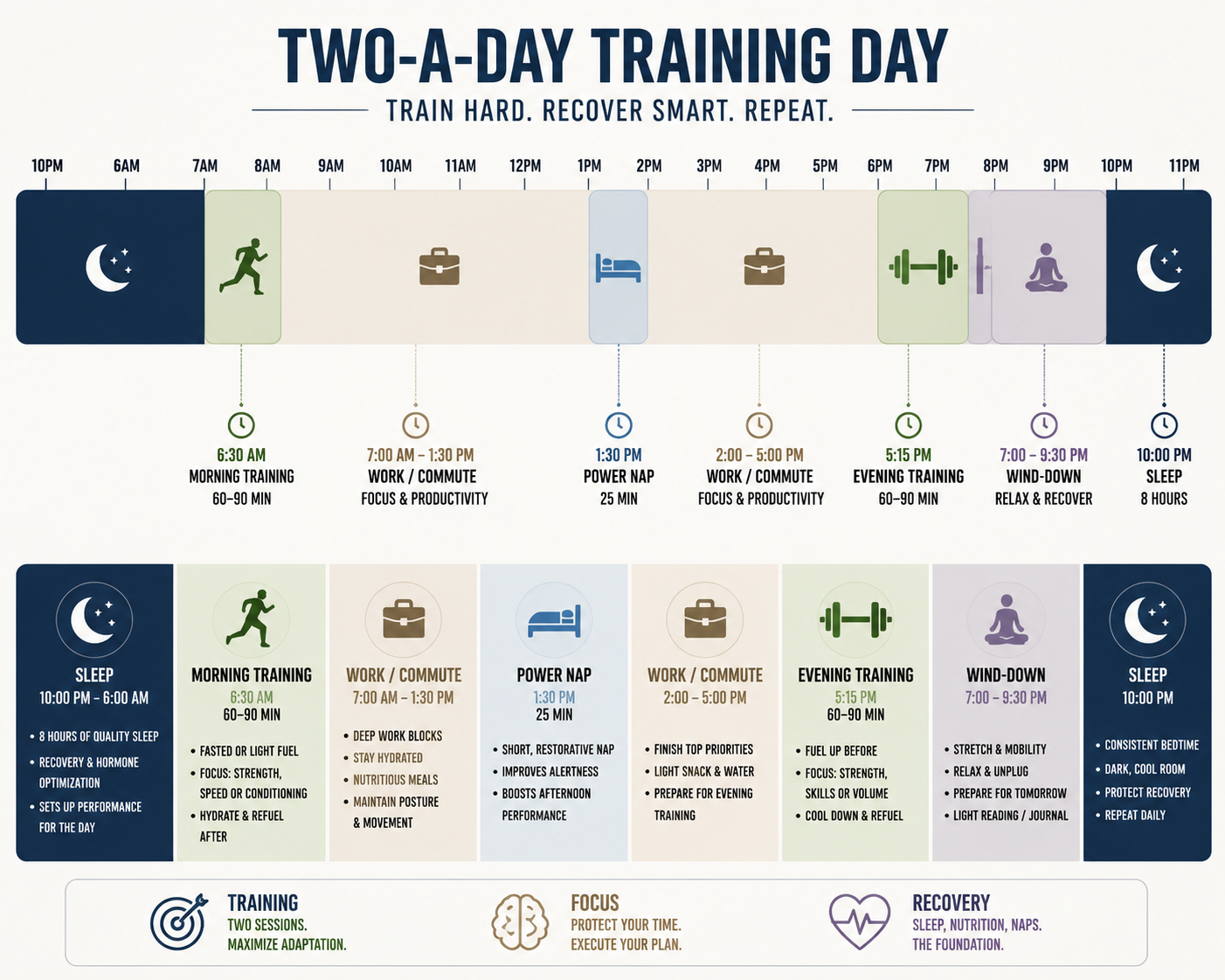
Keep the nap short because the goal is to take the edge off sleep pressure without waking up heavy and disoriented. Place it early enough that it does not compete with bedtime. For many athletes, the workable window is after lunch and before the late-afternoon slide into the evening session. A 25-minute alarm, a dark room or eye mask, and a phone out of reach are not lifestyle extras here; they are how the nap avoids turning into either a 90-minute accident or 25 minutes of notifications.
A between-session protocol that survives a normal day
- Within the first hour after the morning session, eat and rehydrate enough that the afternoon nap is not interrupted by hunger or a caffeine crash.
- Set the nap window before the day starts, ideally early-to-mid afternoon rather than late afternoon.
- Use 20–30 minutes as the default nap length; go longer only when the schedule intentionally allows a full sleep cycle and bedtime will not be pushed later.
- Treat the wake-up from the nap as part of the plan: light exposure, a small snack if needed, and enough time to feel normal before the second session.
- Do not use the nap to justify repeatedly cutting nighttime sleep. It is a bridge between sessions, not a repair shop for a broken week.
This is where the amateur athlete has the least professional infrastructure. A funded athlete may have a dorm room, treatment table, meal support, and a quiet block after training. A working triathlete may have a commute, eight hours at a desk, and a locker-room shower before a meeting. The recommendation has to fit that reality. Even a car-seat nap in a safe, shaded place during a lunch break may be more useful than another recovery product bought because the actual recovery window was never protected.
Evening training is not automatically the enemy
A common fear is that any evening workout will ruin sleep. The evidence is more forgiving than that. A review by Vitale and colleagues concluded that exercise ending two to four hours before bedtime generally does not impair sleep for most people, while very high arousal or competition-level intensity can be different because of elevated physiological activation.[5]
That gives a useful rule for two-a-day athletes: the evening session should end two to four hours before the planned bedtime unless the session is unusually intense, emotionally charged, or race-like. A steady aerobic ride that ends at 6:45 p.m. before a 10:00 p.m. bedtime is a different sleep problem from a track session that ends at 8:45 p.m., includes maximal efforts, and leaves the athlete replaying splits in bed.
The cool-down is part of the sleep schedule. So is the shower, dinner, gear prep, and the boring transition away from training brain. If the workout ends at 7:00 p.m. but the athlete is still eating a huge dinner, answering messages, and analyzing power files at 9:45, the session did not really end at 7:00 in any recovery-relevant way.
When the second session runs hot
Some evening sessions cannot be made sleepy. Group rides surge. Swim sets turn into lane races. Track workouts get competitive. In those cases, the athlete needs more buffer, not more optimism. Move the hard session earlier when possible, make the evening workout the lower-arousal session, or accept that bedtime may need to shift and the next morning cannot be treated as fully recovered.
This is also where coaches can prevent damage before it becomes an athlete’s private problem. If Tuesday has a pre-work threshold swim and a late interval run, the issue is not whether the athlete is tough enough. The issue is whether the schedule leaves enough time to sleep, work, eat, downshift, and train again without stacking fatigue that no single recovery habit can erase.
Sleep planning is a training variable
Sleep hygiene advice gets ignored when it sounds like a poster in a clinic: keep a routine, limit screens, make the room dark. Those basics matter, but for two-a-day athletes they only become useful when they are attached to the training calendar. A bedtime routine is not a virtue signal. It is the mechanism that makes a 9:00 p.m. lights-out possible after a 5:00 a.m. alarm.
There is some evidence that education alone can help when it changes behavior. O’Donnell and Driller reported that sleep-hygiene education improved total sleep time in elite female netballers.[6] The practical takeaway is not that a lecture fixes recovery. It is that athletes and coaches often under-plan sleep, and even simple changes can matter when they move bedtime, protect the nap, or reduce the post-training delay before sleep.
For athletes training twice daily, the sleep plan should be written with the same seriousness as the workout plan. If the morning session is non-negotiable, bedtime has to be negotiated. If bedtime cannot move enough, the nap becomes more important. If the evening session ends too close to bed, the next morning’s quality is no longer mysterious.
A practical two-a-day sleep template
Use this as a logic check, not a perfect day. The point is to see where recovery breaks before the athlete is standing on deck, in the garage, or at the track wondering why the body feels flat.
| Schedule point | Default target | Adjustment if it fails |
|---|---|---|
| Night before | Set lights-out by counting backward from the morning alarm and aiming for 8–10 hours in bed | If bedtime cannot move, reduce load, move the session, or protect a nap rather than pretending the deficit is harmless |
| Morning session | Keep logistics simple enough that wake time is not earlier than necessary | Pack gear and food the night before instead of stealing more sleep in the morning |
| Between sessions | Place a 20–30 minute nap in the early-to-mid afternoon | Use a quiet location, alarm, and post-nap reset; do not let the nap drift late |
| Evening session | End training two to four hours before bedtime | Add more buffer after competition-like intensity or move high-arousal work earlier |
| Wind-down | Eat, shower, prepare gear, and get out of analysis mode before bed | Treat delayed dinner, late caffeine, and post-workout screen time as schedule problems |
A recoverable two-a-day does not require pretending life is a training camp. It requires being honest about the day’s bottlenecks. If the athlete cannot move bedtime, protect a nap window, or contain the evening session, the recovery problem is not mysterious. It is built into the schedule.
References
- Sleep and Athletes, Gatorade Sports Science Institute.
- The Sleep and Recovery Practices of Athletes, Sports, 2021.
- The effects of sleep extension on the athletic performance of collegiate basketball players, Sleep, 2011.
- The effects of a 30 min nap after sleep deprivation on alertness and performance in athletes, British Journal of Sports Medicine, 2007.
- Sleep Hygiene for Optimizing Recovery in Athletes: Review and Recommendations, International Journal of Sports Medicine, 2019.
- Sleep-hygiene education improves sleep indices in elite female athletes, International Journal of Exercise Science, 2017.
Comments
Join the discussion with an anonymous comment.