
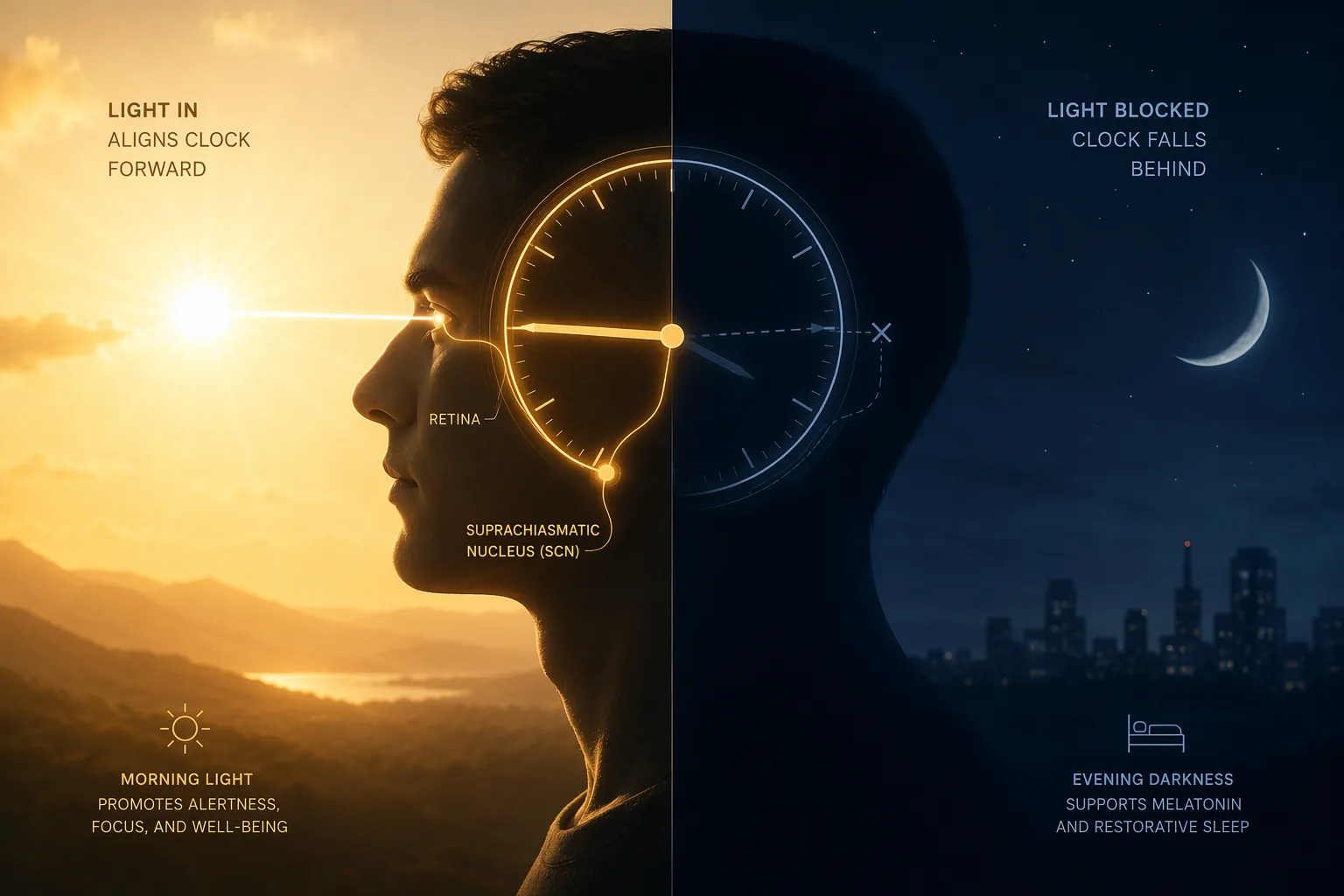
The useful answer to daylight saving time sleep disruption is not simply “go to bed earlier.” The body clock does not read the clock on the wall. It reads light, especially light reaching the retina in the morning, late afternoon, evening, and the first part of the biological night.
That is why the adjustment plan has to change depending on the direction of the time change. In spring, the clock has to move earlier, so the goal is a phase advance: more bright light early in the day, less light at night. In fall, the clock has to move later, so the useful signals are almost the opposite: reduce early morning light and allow more light in the evening.
The most practical numbers come from a 2024 Scientific Reports modeling study by Xu and colleagues. The study simulated 200 virtual individuals under specific assumptions, including self-selected bedtimes and fixed work schedules, so the results are not guaranteed personal outcomes. They are still unusually helpful because they translate vague light advice into timing and intensity targets: 200 lx, 800 lx, 10,000 lx, 2,000 lx, and less than 35 lx are very different mornings and evenings in the real world.[1]
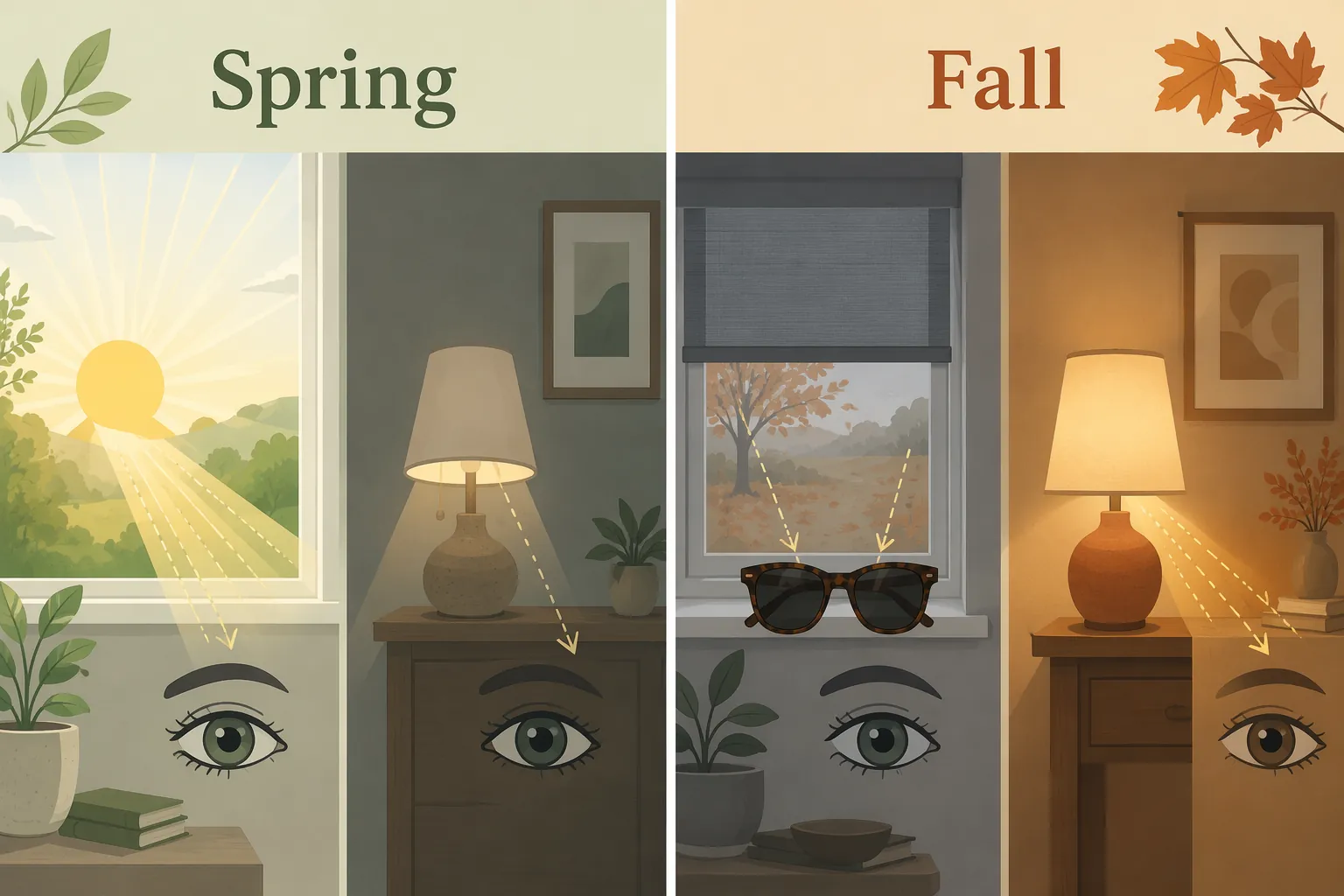
The Whole Protocol at a Glance
| Transition | Clock direction needed | Light to seek | Light to reduce | Modeled adjustment effect |
|---|---|---|---|---|
| Spring forward | Advance earlier | Bright morning and daytime light; a 30-minute morning walk at about 10,000 lx for the four days after the transition | Evening light, especially keeping it below about 35 lx near bedtime | A morning walk reduced modeled adjustment from 10.1 ± 3.5 days to 6.5 ± 2.8 days; raising daytime light from about 200 lx to 800 lx reduced full adjustment from 13.5 ± 4.4 days to 7.9 ± 2.4 days[1] |
| Fall back | Delay later | Evening light; a 30-minute evening walk at about 2,000 lx | Morning light after waking; CAT3 sunglasses for the first 2 hours after waking | An evening walk reduced modeled adjustment from 7.9 ± 1.9 days to 2.7 ± 0.9 days; morning sunglasses reduced it to 3.5 ± 0.8 days[1] |
This table is the protocol in compressed form. The rest of the article is for the parts that are easy to get wrong: when the light matters, how bright it needs to be, and why spring and fall should not be treated as the same sleep problem.
Spring: Move the Clock Earlier With Morning Bright Light
The spring transition is the harder one for many adults because it asks the body to do something specific: fall asleep, wake up, and feel alert earlier than its recent light history prepared it to do. The lost hour matters, but the stronger problem is that the circadian clock has not yet been advanced.
In the Xu model, typical indoor office lighting of about 200 lx at the eye was associated with full spring adjustment taking 13.5 ± 4.4 days. Raising daytime light exposure to 800 lx shortened that to 7.9 ± 2.4 days.[1] That difference is the practical clue: spring adjustment improves when the day becomes visibly brighter to the circadian system, not merely when bedtime is moved by willpower.
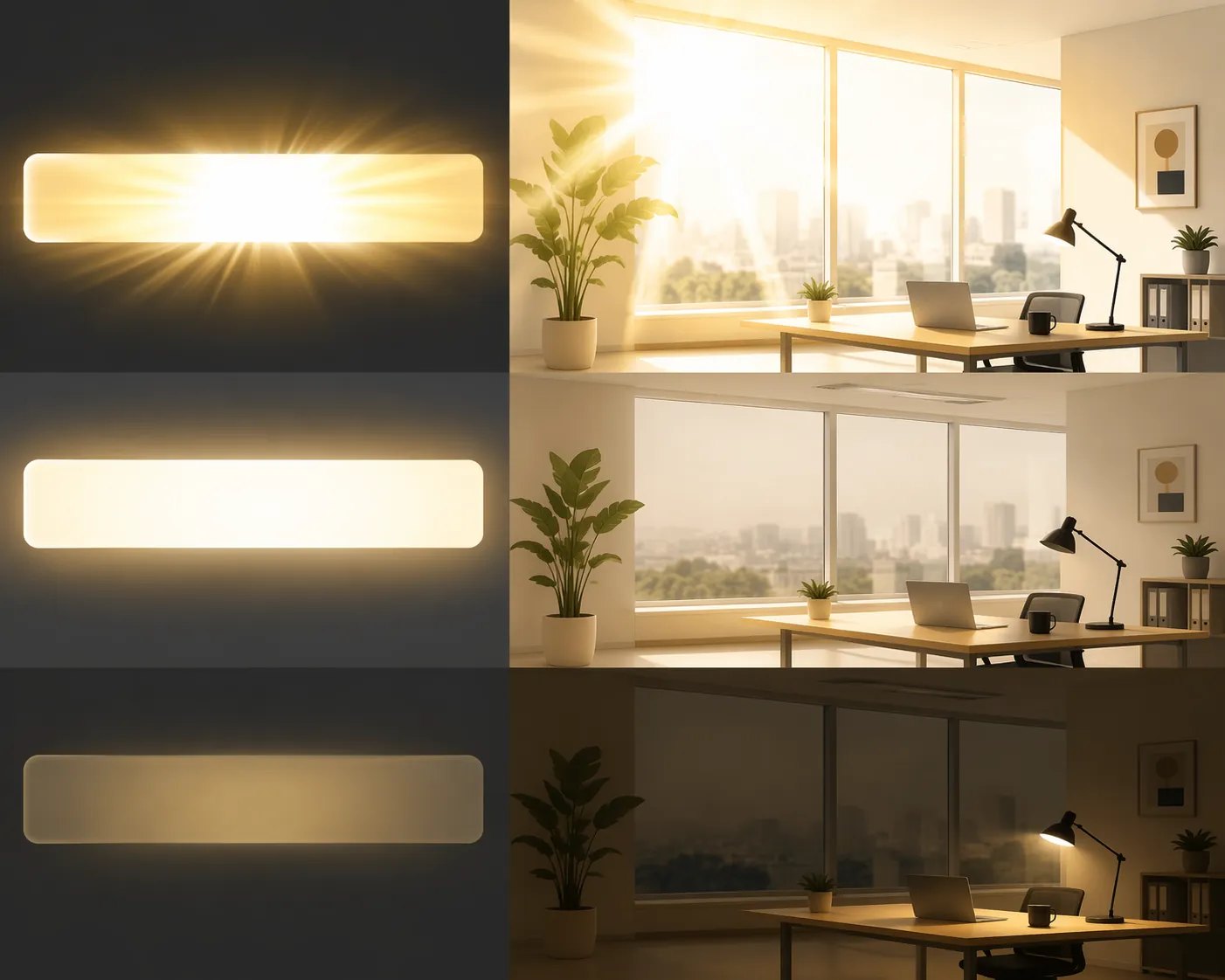
For most people, the simplest spring action is a morning outdoor walk. In the model, a 30-minute morning walk at about 10,000 lx on the four days after the spring transition reduced adjustment time from 10.1 ± 3.5 days to 6.5 ± 2.8 days.[1] The walk is not magic because it is exercise. It is useful because outdoor morning light is often far brighter than indoor light, even when the sky does not look dramatic.
- On the first four mornings after spring daylight saving time begins, get outside as soon as your schedule realistically allows.
- Aim for 30 minutes of outdoor light; walking is convenient, but the key variable is light at the eye.
- If outdoor light is impossible, make indoor daytime light as bright as practical, with the model’s useful comparison being about 800 lx rather than a dim 200 lx office-like setting.
- Keep evenings deliberately dim, especially in the hour or two before bed.
The evening part is not optional. A bright morning signal pushes the clock earlier, but bright evening light pushes against that advance. Xu and colleagues modeled spring evening light targets below about 35 lx; that is dimmer than many living rooms and much dimmer than a phone held close to the face in a lit room.[1] The exact lux at your retina will depend on distance, lamp direction, screen brightness, room reflectance, and whether light is pointed toward your eyes. The operational rule is simpler: after dinner, stop trying to make the house feel like daytime.
A spring evening can still be livable. Use lamps away from eye level, lower screen brightness, avoid bright overhead lighting, and make the last hour before bed boring in lighting terms. If you need to prepare children, finish work, or commute late, the goal is not perfect darkness. It is to stop sending the clock a strong “stay later” signal exactly when you are asking it to move earlier.
If You Can Start Before the Spring Change
A short runway helps, especially for later chronotypes. Harvard Medical School’s sleep guidance includes gradually shifting sleep and wake timing before daylight saving time, getting morning light, and avoiding caffeine, alcohol, heavy meals, and bright screens close to bedtime.[2] Those are useful baseline steps. The sharper version is to pair any earlier bedtime attempt with the light pattern that makes an earlier bedtime biologically more plausible: brighter mornings, brighter daytime, dimmer evenings.
If you start three or four days ahead, move wake time a little earlier only if you can also expose yourself to light soon after waking. Otherwise, the earlier alarm can become a sleep-debt tool rather than a circadian-shifting tool. For a person with a dark apartment and a desk far from a window, the morning may need planning: shoes by the door, a short outdoor errand, breakfast near a bright window, or a brighter work setup.
Fall: Do Not Use the Spring Protocol Backward by Accident
The fall transition looks easier because the clock says you gained an hour. For some people, it is easier. But the circadian task is still real: the body has to delay, not advance. This is where generic DST advice often becomes too blunt. Bright early morning light after the fall change can pull the clock earlier, which is the opposite of the delay many people need.
In the Xu model, a 30-minute evening walk at about 2,000 lx reduced fall adjustment time from 7.9 ± 1.9 days to 2.7 ± 0.9 days.[1] That does not mean everyone should flood their evening with bright light until midnight. It means that, during the fall transition, a controlled light signal in the evening can help delay the clock toward the new schedule.
There is a second fall lever: protect the clock from early morning light. The same modeling study found that wearing CAT3 sunglasses for the first 2 hours after waking reduced fall adjustment time to 3.5 ± 0.8 days.[1] CAT3 sunglasses are dark sunglasses commonly used for bright outdoor conditions; the point is not the label as much as the timing and reduction of morning retinal light.
- For the first several mornings after the fall change, reduce bright light exposure soon after waking if your schedule allows.
- Use dark sunglasses outdoors in the first 2 hours after waking, especially if you are commuting into bright morning light.
- Add a 30-minute evening walk or other safe evening light exposure rather than forcing yourself into a spring-style dim evening too early.
- Still protect the final pre-sleep period from excessive brightness; the evening light signal is meant to shift timing, not erase sleepiness indefinitely.
The fall plan is especially relevant for people who wake early after the clock change and cannot get back to sleep. Their body may be treating the new 5:30 a.m. as the old 6:30 a.m. Bright light immediately after waking can strengthen that early signal. Sunglasses, dim indoor lighting, and delaying bright exposure can give the clock less reason to lock onto the old pattern.
Chronotype Changes the Runway
Morning types are not better sleepers, and evening types are not failed morning types. They are different timing profiles. That difference matters because the same DST transition can ask more from one chronotype than another.
In the Xu model, evening chronotypes, represented with an intrinsic circadian period around 24.3 hours, needed up to about 2 weeks for full spring adjustment. Morning types, represented around 24.1 hours, approached full re-entrainment within a week.[1] That gap is not a moral lesson. It is a scheduling problem with biology underneath it.
| If this describes you | Spring adjustment emphasis | Fall adjustment emphasis |
|---|---|---|
| You naturally fall asleep late and struggle with early alarms | Start the light plan earlier if possible; prioritize outdoor morning light and strict evening dimming | Use evening light carefully, but avoid letting it drift into very late bright-light exposure |
| You naturally wake early and get sleepy early | You may re-entrain faster, but still protect evenings from bright light | Be more careful with bright light immediately after waking, because it may reinforce early waking |
| Your work or caregiving schedule fixes your wake time | Treat the first morning light exposure as a scheduled event, not a vague wellness habit | Control commute light when possible with sunglasses or delayed bright exposure |
| Your home is dark in the morning | Get outside or use the brightest available daytime environment soon after waking | A dark home may help the fall morning reduction, but evening light timing still matters |
The later your natural timing, the less useful it is to hear “just go to bed earlier” without a morning-light plan. An earlier bedtime attempted under bright evening light and dim morning light asks the clock to move one way while the environment pushes it the other way.
What Counts as Bright or Dim Enough?
Lux targets can sound more precise than everyday life allows. Most people are not going to measure retinal light before breakfast. Still, the numbers are useful because they separate three very different environments: a dim room, a bright indoor workspace, and outdoors.
| Target from the model | Practical interpretation | Where it fits |
|---|---|---|
| About 200 lx at the eye | Typical indoor office-like light in the model | Too weak to be the main spring adjustment tool for many people |
| About 800 lx | Brighter daytime indoor light | Helpful in spring when outdoor morning light is limited |
| About 10,000 lx | Outdoor morning light level used for the modeled spring walk | Best matched by going outside soon after waking |
| Less than about 35 lx | Very dim evening light target | Spring evenings, especially close to bedtime |
| About 2,000 lx | Outdoor or strong evening light level used for the modeled fall walk | Fall evening delay signal |
A window helps, but it is not the same as being outside. Distance from the window, shade, weather, building orientation, and glass all change the signal. A ceiling light helps, but it may not reach the eye with the same strength as outdoor light. The model’s value is not that every household must hit exact lux numbers; it is that intensity and timing are not interchangeable.
Where Bedtime, Melatonin, and Sleep Hygiene Fit
Bedtime still matters. Caffeine timing still matters. Alcohol, late heavy meals, overheated bedrooms, and doom-scrolling still make sleep worse for many people. Harvard’s general daylight saving time guidance reasonably includes gradual schedule shifts and attention to these behaviors.[2] But these are support beams, not the steering wheel.
Melatonin may be relevant for some adults during DST transitions, especially when timing is the issue rather than total sleep opportunity. It also has timing, dose, medication-interaction, pregnancy, pediatric, and medical-condition considerations, so it belongs in a separate decision rather than being casually added to every DST plan. If you use melatonin, treat it as a timed circadian signal, not just a sedative.
Temperature and bedroom comfort can reduce wakefulness once you are in bed, but they do not replace the morning and evening light signals that move the clock. A cooler, darker, quieter bedroom is useful. It just cannot, by itself, tell the circadian system that sunrise has moved.
The Policy Evidence Is Real, But This Is a Personal Protocol
The clinical concern about DST is broader than one bad Monday. The American Academy of Sleep Medicine position statement argues for permanent standard time and states that the human circadian system does not fully adjust to daylight saving time even after several months.[3] That matters because it keeps the problem from being trivialized as a one-night inconvenience.
A Stanford Medicine report on modeling work by Zeitzer and Weed similarly supports the health logic of permanent standard time over permanent daylight saving time, while also depending on assumptions about consistent, circadian-friendly light habits and a 10 p.m. to 7 a.m. sleep schedule that may not match the average American routine.[4] These policy findings are important, but they do not tell a parent, nurse, teacher, warehouse worker, or late chronotype what to do on the first Tuesday after the clock changes.
For that Tuesday, the useful question is narrower: what light signal can you control next? In spring, that usually means getting bright light early and cutting light late. In fall, it may mean blocking light early and adding light earlier in the evening. The direction changes because the circadian task changes.
A Realistic Four-Day Light Plan
The four days after the transition deserve special attention because Xu and colleagues modeled specific post-transition walk interventions across that window.[1] If your week is messy, do not abandon the plan because you miss one ideal exposure. Protect the strongest signals first.
| Day | Spring priority | Fall priority |
|---|---|---|
| Day 1 | Get outside in the morning for about 30 minutes if possible; keep evening light very low | Reduce bright light for the first 2 hours after waking; plan a safe evening light exposure |
| Day 2 | Repeat morning outdoor light; raise daytime indoor brightness if the morning was dim | Use sunglasses or dim indoor light early; avoid treating early waking as a cue to start a bright day |
| Day 3 | Keep the morning signal consistent; do not let a late bright evening undo it | Continue evening light, but taper brightness before the actual bedtime window |
| Day 4 | Hold the pattern rather than chasing a much earlier bedtime by force | Hold the delay-supporting pattern; watch for too much late-night brightness |
If you can only change one thing in spring, change the first strong light exposure of the day. If you can change two things, add evening dimming. If you can only change one thing in fall, prevent bright light from anchoring an unwanted early wake time, especially in the first 2 hours after waking. If you can change two things, add a controlled evening light exposure.
What to Expect
The Xu estimates are model predictions, not clinical guarantees. The simulated individuals had defined assumptions, and real people have shift work, insomnia, school drop-offs, pets, commute light, medications, weather, blackout curtains, and apartments that face the wrong direction. A light plan can be correct and still be imperfectly executable.
That said, the size of the modeled differences is large enough to be worth taking seriously. Under modeled spring conditions, brighter daytime light and morning outdoor light shortened adjustment from well over a week toward roughly a week or less. Under modeled fall conditions, evening light or morning light reduction shortened adjustment to only a few days for many simulated individuals.[1]
So the practical answer is precise: do not spend the DST transition only chasing an earlier bedtime. Decide whether the clock needs to advance or delay, then change the timing and intensity of light. Spring asks for bright mornings and dim evenings. Fall asks for protected mornings and controlled evening light. The exact result depends on chronotype, schedule constraints, and how closely your actual mornings and evenings can match the light targets.
References
- Improving adjustment to daylight saving time transitions with light, Scientific Reports, 2024.
- Tips to Help Adjust to Daylight Saving Time, Harvard Medical School Division of Sleep Medicine.
- Daylight saving time: an American Academy of Sleep Medicine position statement, Journal of Clinical Sleep Medicine, 2020.
- Daylight saving time, Stanford Medicine, 2025.
Comments
Join the discussion with an anonymous comment.