
If you are under a tornado watch at night, it is safe to sleep only if three things are true: you are in a sturdy structure with adequate shelter, you have at least two independent ways to be awakened, and severe weather is not already happening around you. If any one of those fails, stay awake or relocate before you sleep.
That is the practical answer to how to sleep during a tornado watch at night. A watch means conditions are favorable for tornadoes; it does not mean a tornado is imminent. But nighttime changes the standard because you may not see the storm, hear the warning, or have time to make a slow decision in the dark.
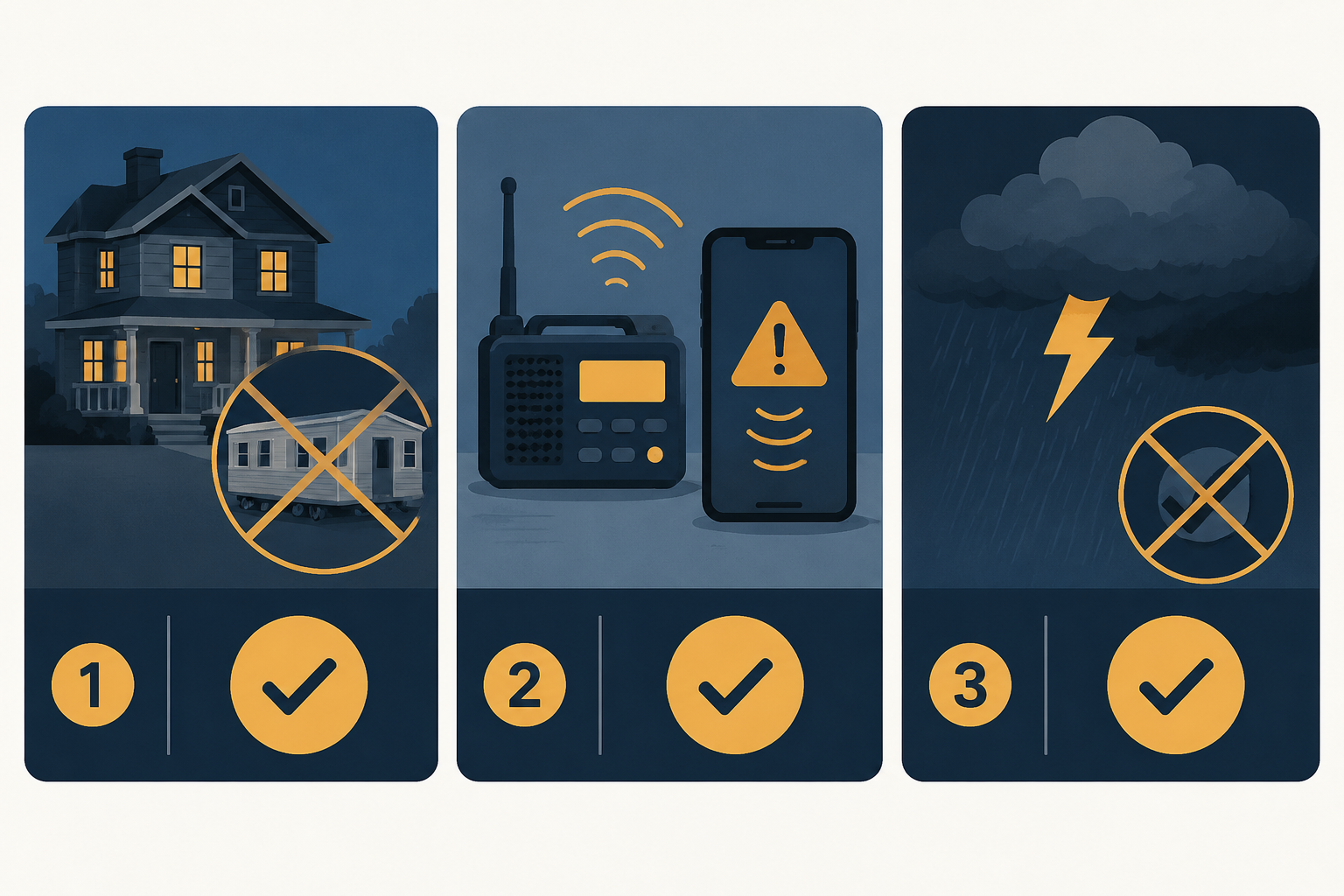
The Three-Part Test Before You Go to Bed
| Question | Sleep is reasonable only if... | If not... |
|---|---|---|
| Where are you sleeping? | You are in a sturdy building and can reach a safe room quickly. | Stay awake or move to a safer building before sleeping. |
| What will wake you? | You have at least two independent alerts, ideally a battery-backed NOAA Weather Radio plus smartphone Wireless Emergency Alerts. | Do not rely on outdoor sirens or a phone alone. |
| What is happening now? | No severe weather is already present and no local official is telling you to stay awake or shelter. | Stay awake, monitor trusted local information, and be ready to shelter. |
The point is not to prove that sleeping is brave or that staying up is overreacting. The point is to know whether you can be awakened in time and reach adequate shelter. If the answer is yes, sleep can be the safer choice than sitting exhausted in front of looping radar all night. If the answer is no, fatigue is not the deciding factor.
Why Nighttime Tornado Watches Deserve Stricter Rules
Nighttime tornadoes are often described as roughly twice as deadly as daytime tornadoes, a pattern tied to visibility, people being asleep, and the difficulty of receiving and acting on warnings after dark.[1] That does not mean every nighttime watch should keep every person awake. It means the margin for a sloppy setup is smaller.
There is also a reason this does not have to become a fatalistic all-nighter. National Weather Service material from the Norman, Oklahoma office notes that 97% of EF3 to EF5 tornadoes are preceded by a warning, with an average lead time of 16 minutes.[2] Sixteen minutes is not much if you are trying to find shoes, wake children, locate a flashlight, decide where to go, and argue about whether the siren was real. It is enough to matter if the alert wakes you and the shelter decision has already been made.
That is why the decision belongs less to mood and more to setup. A person asleep in a basement bedroom with a weather radio and a phone alert is not in the same position as a person in a mobile home with one half-charged phone under a pillow.
First: Where Are You Sleeping?
Housing type is the first filter because it determines whether a warning gives you a usable action. In a sturdy house, apartment building, dorm, hotel, or other substantial structure, the safe move is usually to get to the lowest available level, into an interior room, and away from windows. The CDC tells people to go to a basement or inside room without windows, and to protect themselves from flying debris if a tornado is approaching.[3]
A mobile home is different. The National Weather Service and CDC guidance are blunt on this point: mobile homes do not provide safe protection from tornadoes, even weaker ones, and residents should go to a sturdier shelter when a tornado threat exists.[3] If you are in a mobile home during a nighttime tornado watch, the safe sleep plan is not “turn up the phone volume.” It is to identify and move to a sturdy building before sleeping, or stay awake until the threat has passed.
This is the part people are tempted to soften because relocating at night is inconvenient. It may mean waking a child, calling a neighbor, going to a community shelter, or driving before storms arrive. But the inconvenience is the point: it is much easier to move before the storm is on you than to improvise after a warning wakes you from deep sleep.
If You Are in a Sturdy Building
- Choose the lowest floor you can safely use.
- Sleep as close as practical to your safe room, especially if children, older adults, pets, or mobility limitations are involved.
- Avoid sleeping beside large windows or exterior glass if another reasonable sleeping spot is available.
- Know the exact route from bed to shelter before you turn off the light.
If You Are in a Mobile Home
- Do not plan to sleep there during the watch.
- Move before storms arrive, not after a warning is issued.
- Use a community shelter, neighbor’s sturdy home, public building, or other pre-identified safe structure if available.
- If no safe option is obvious, stay awake and follow local emergency guidance rather than assuming the home itself is adequate.
Second: What Will Actually Wake You?
A nighttime tornado watch becomes sleep-compatible only when the alert system is strong enough to wake a sleeping person. One alert is fragile. Two independent alerts are better because they fail in different ways.
The strongest basic setup is a NOAA Weather Radio with battery backup, paired with smartphone Wireless Emergency Alerts. The weather radio is dedicated to weather warnings and does not depend on your phone settings, app permissions, or a drained battery. The phone adds a second path, especially if you are away from home or the radio is not close enough to wake you.
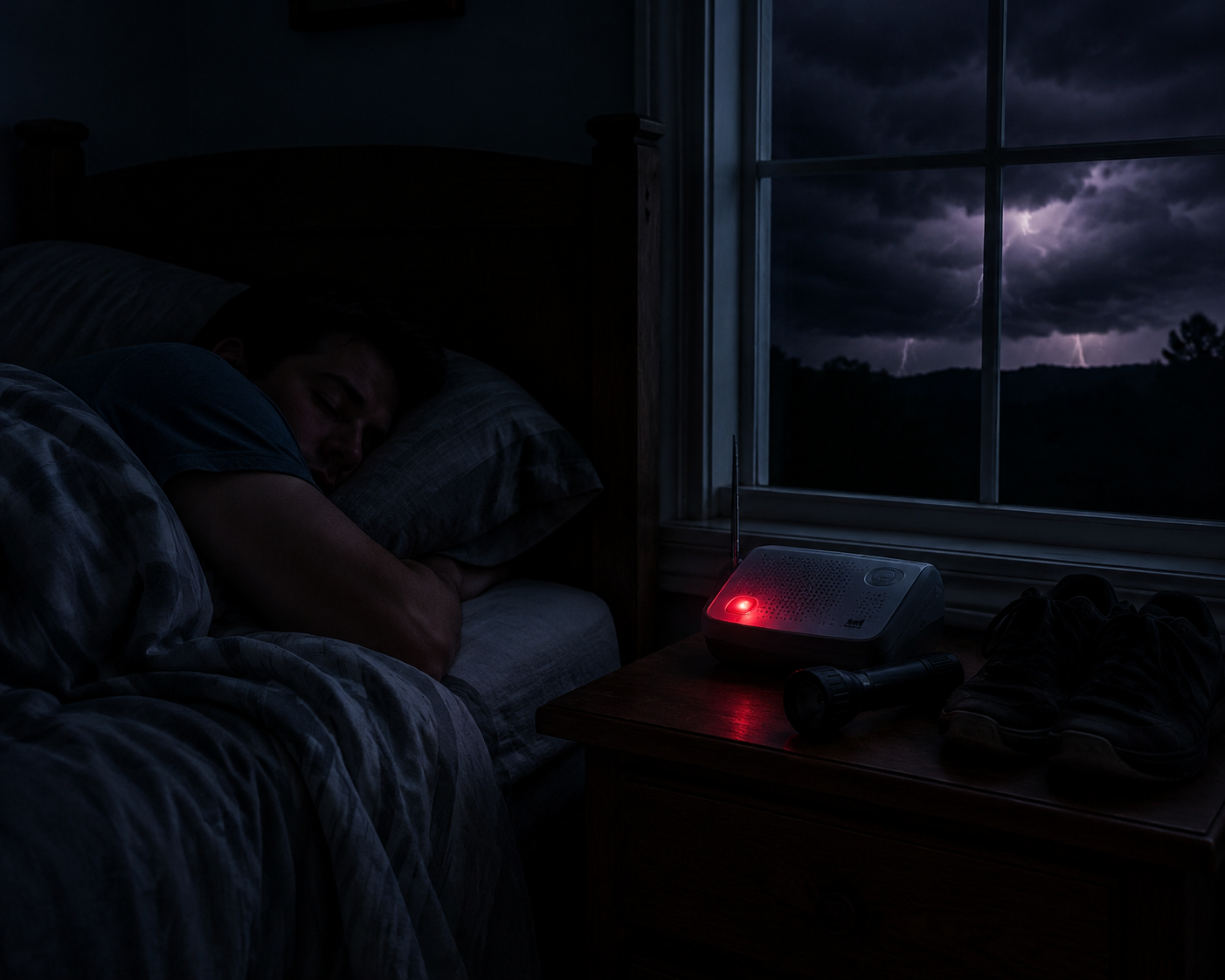
A smartphone alone is not enough for a nighttime tornado plan. Severe storms can disrupt communications, phone batteries run down, alerts can be silenced by settings, and people sleep through sounds they thought were loud. The CDC recommends having a battery-operated radio and flashlight as part of tornado preparation, and National Weather Service guidance emphasizes multiple ways to receive warnings.[2][3]
Outdoor sirens are also not a sleep plan. They are designed to warn people who are outdoors, not to reliably wake people inside a bedroom with walls, rain, air conditioning, fans, or closed windows between them and the siren. If you hear one indoors, take it seriously. But do not make it the thing your life depends on.
Before You Sleep, Set the Alerts Deliberately
- Put the NOAA Weather Radio close enough to wake you and confirm it has battery backup.
- Keep your phone charged or plugged in, with emergency alerts enabled.
- Turn off sleep modes or focus settings that could suppress emergency sounds.
- Use a local trusted source for updates before bed, such as your local National Weather Service office or emergency management channel.
- If another adult is in the home, agree on who grabs children, pets, medications, or keys if a warning arrives.
Do this once, calmly, before you lie down. Rechecking every five minutes may feel responsible, but it can turn into its own form of sleep loss. If the housing is adequate, alerts are redundant, and storms are not already on top of you, the system should do the waking.
Third: What Is Happening Outside Right Now?
Current conditions can override an otherwise good plan. If thunder, lightning, hail, damaging winds, a sudden change in storm intensity, or local reports of rotation are already near you, do not treat the watch as a distant background concern. Stay awake and monitor trusted local information until the immediate threat has moved through or official guidance changes.
The same rule applies if a tornado warning is issued, if local emergency management tells residents to shelter, or if your local National Weather Service office is urging people in your area to remain alert. A general framework does not outrank live local instructions.
A watch on a quiet evening with storms still west of you is one situation. A watch with hail hitting the siding and warning polygons close by is another. The word “watch” is the same; the sleep decision is not.
If You Pass the Test, Set Up the Room Before Sleeping
Once the three conditions are favorable, the rest is preparation. You are not trying to make the bedroom cozy first and safe second. You are arranging the night so that a warning leads to movement, not confusion.
- Sleep on the lowest floor available when possible.
- Keep shoes beside the bed so you are not walking through broken glass or debris barefoot.
- Put a flashlight within reach, not across the room.
- Clear the path from bed to the safe room.
- Place helmets, blankets, or a mattress near the shelter area if you have them available.
- Keep essential medication, glasses, mobility aids, and pet leashes where they can be grabbed quickly.
The CDC advises covering yourself with something such as a blanket or mattress if a tornado is approaching, because flying and falling debris are major hazards.[3] That instruction is easier to follow if the covering is already near the safe room, not buried in a closet.
What to Do If a Warning Wakes You
Do not spend the first minute debating whether the warning is for “your side of town.” Get to the shelter location first. Once you are there, you can check the warning details if it is safe to do so.
- Wake the people you are responsible for.
- Put on shoes if they are beside the bed.
- Move to the basement or an interior room on the lowest floor, away from windows.
- Cover your head and body with a helmet, blanket, mattress, or other available protection.
- Stay sheltered until the warning expires or a trusted local source says the immediate threat has passed.
If you are in a mobile home and a warning wakes you, the best time to relocate has already passed. Follow local emergency guidance and use the safest available option, but do not use that scenario as the plan. The plan is to leave before sleeping when a nighttime watch is in effect.
Where Anxiety Fits, and Where It Does Not
Storm anxiety is real, and National Weather Service resources acknowledge that severe weather can create intense stress for people who have lived through dangerous events or repeated warnings.[2] But anxiety is not the safety test. A calm person in a mobile home still needs to move. An anxious person in a sturdy home with redundant alerts may be physically safe enough to sleep, even if the nervous system takes longer to settle.
Once the tornado-specific decision is handled, broader sleep tools can help. If storms keep your body on high alert, the explanation of how severe weather disrupts sleep can make the reaction feel less mysterious. If the issue is thunder, noise, and startle responses after the tornado risk is no longer the main concern, sleeping during a thunderstorm calls for a different set of tactics.
If disaster-related hypervigilance follows you beyond one storm system, resources on sleep after earthquake anxiety or anxiety keeping you up at night may be useful. If it becomes a recurring sleep-onset pattern, CBT-I for sleep anxiety is worth understanding. None of that replaces shelter, alerts, or local warnings tonight.
The Decision for Tonight
Sleep during a tornado watch at night only if you are in adequate housing, you have redundant alerts that can wake you, and severe weather is not already present. Then prepare the room: lowest practical sleeping location, shoes and flashlight beside the bed, clear path to shelter, and something ready to cover your body if a warning arrives.
If you are in a mobile home, if your only alert is a phone you might not hear, if storms are already severe nearby, or if local officials tell you to stay alert or shelter, do not go to sleep as if this is an ordinary watch. Stay awake or relocate before sleeping.
References
- Nighttime Tornadoes Are An Even Bigger Threat. Here's Why. Weather.com.
- Storm Stress and Anxiety National Weather Service.
- Preparing for a Tornado CDC.
Comments
Join the discussion with an anonymous comment.