
There is a particular kind of insomnia that feels almost insulting: you are depleted, heavy, and done with the day, yet the moment you lie down your body behaves as if something is still happening. Your mind scans. Your chest stays alert. Small sounds feel sharper. Sleep may come in fragments, or not at all.
That contradiction is at the center of how emotional breakdowns affect sleep. The problem is not simply that you “had a stressful day.” After a period of overwhelming emotional distress, the systems that normally help the brain evaluate threat, inhibit alarm, lower arousal, and allow sleep can remain in emergency mode.
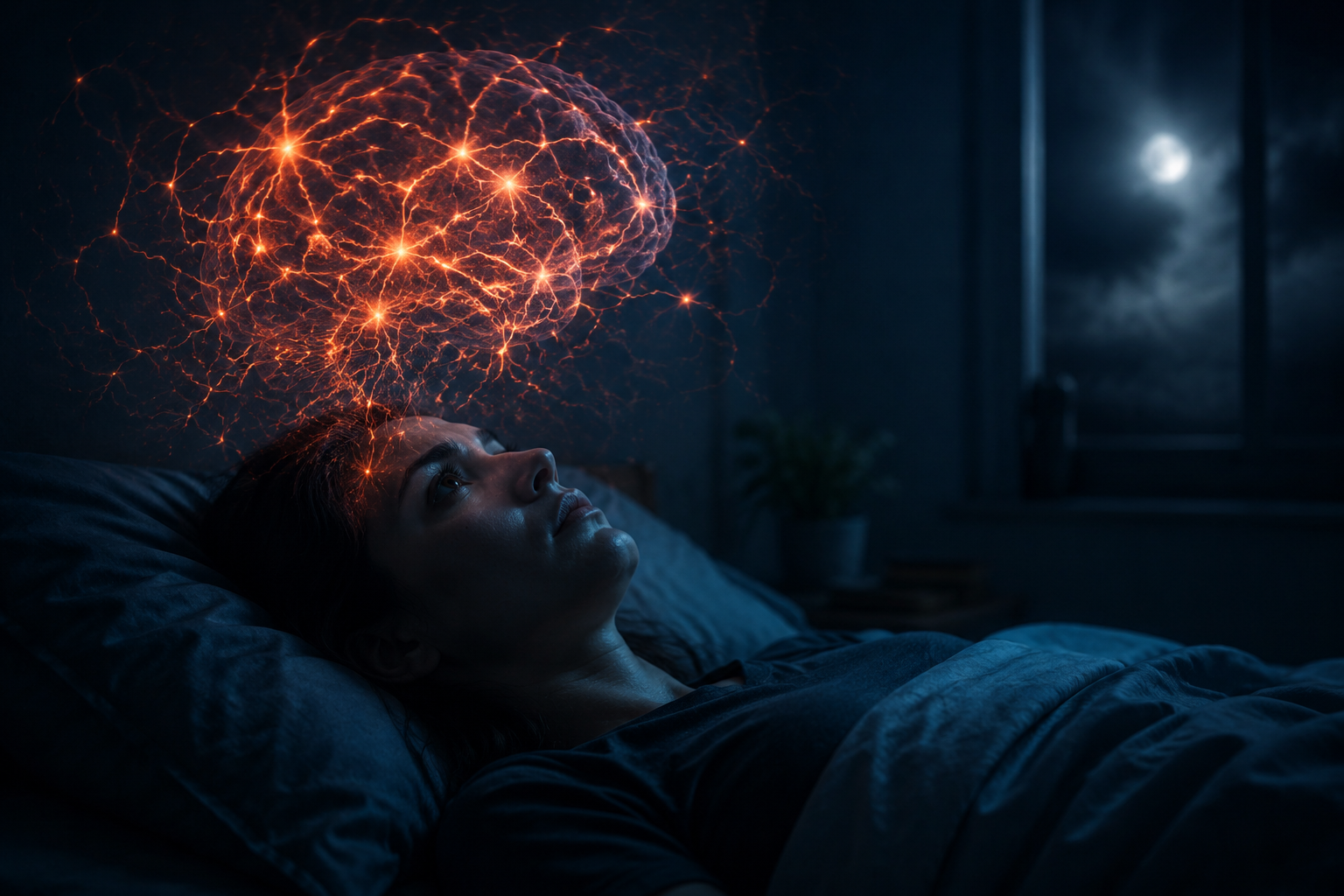
One boundary matters before going further: “emotional breakdown” is not a formal clinical diagnosis. Cleveland Clinic describes “nervous breakdown” as a nonmedical term people use when stress becomes so intense that they cannot function normally in daily life.[1] Here, the phrase refers to a period of overwhelming emotional distress with impaired regulation — the kind of state in which crying, panic, shutdown, agitation, or inability to manage ordinary demands may spill past the person’s usual capacity.
That imprecision does not make the sleep disruption imaginary. It means the cause can vary — grief, conflict, trauma exposure, accumulated strain, financial shock, burnout, illness, or another mental health condition — while the sleep problem may still travel through a recognizable biological pathway.
The brain’s brake weakens first
Sleep requires a degree of permission. The brain has to decide, in effect, that it is safe enough to stop monitoring the room, the phone, the future, the argument, the memory, the inbox, or the body itself. That decision depends partly on regulatory regions in the prefrontal cortex — the front part of the brain involved in judgment, inhibition, planning, and top-down emotional control.
A major synthesis in Nature Reviews Neuroscience describes how sleep loss disrupts prefrontal cortex function and weakens its regulatory influence over emotion-related regions, including the amygdala.[2] This is one reason the night after an emotional collapse can feel so different from ordinary tiredness. The very system you would normally recruit to tell yourself, “This can wait until morning,” may be less available.
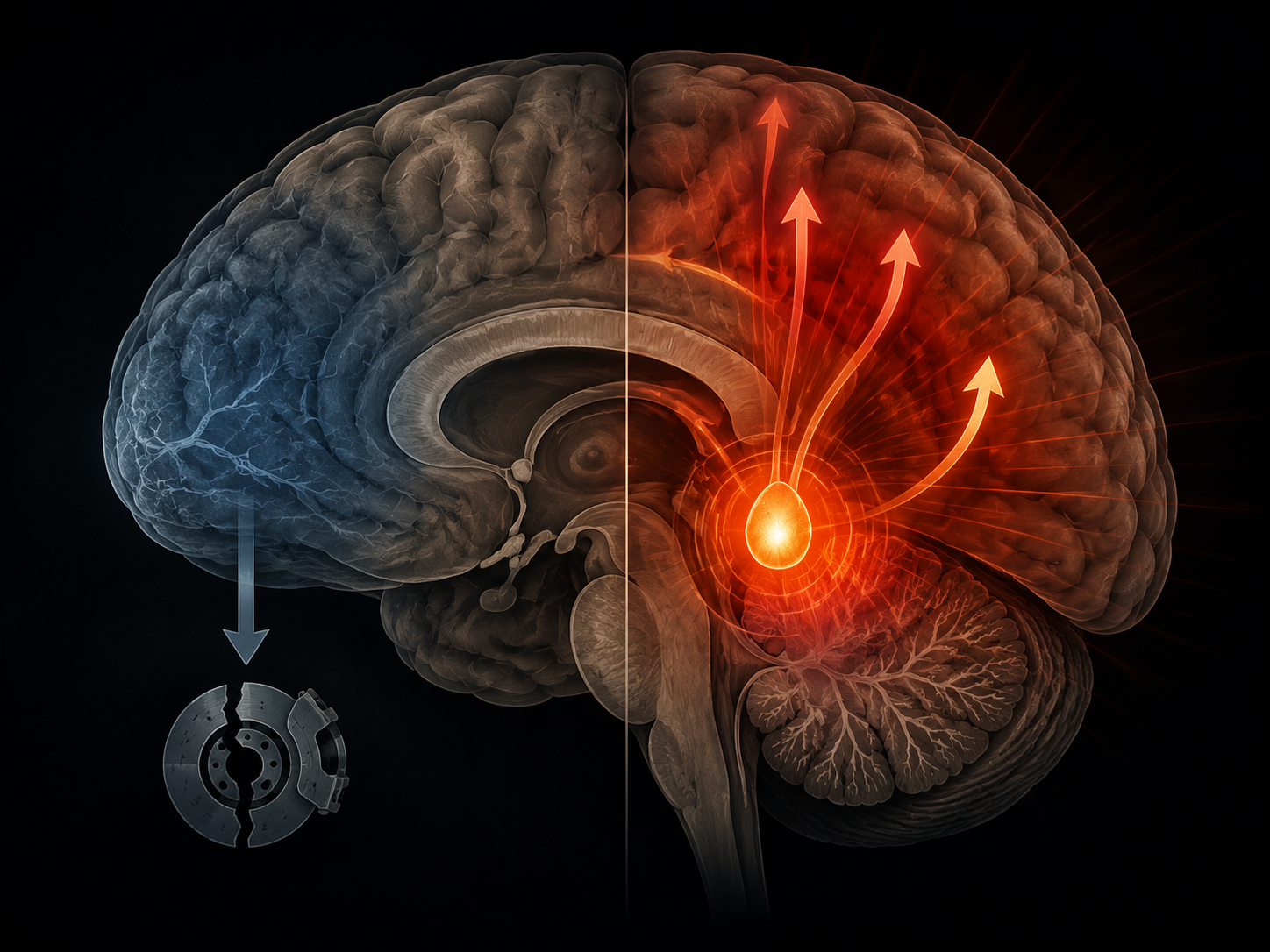
This matters because many people interpret post-breakdown insomnia as a failure of discipline. They assume that if they were calmer, stronger, or more rational, they would sleep. But if prefrontal regulation is compromised, the instruction to “just stop thinking about it” is asking a weakened control system to overpower a threat system that is already loud.
The result can be a strange split: part of you knows you need rest, knows tomorrow will be harder without it, knows the immediate danger has passed. Another part keeps behaving as if vigilance is still required. That split is not weakness. It is what it feels like when cognitive understanding and bodily threat detection are no longer moving together.
The amygdala turns the volume up on threat
The amygdala is often described too simply as the brain’s fear center. It is better understood here as part of a threat-detection and emotional salience system. When it is highly reactive, neutral or mildly unpleasant cues can feel charged. A text notification may jolt the body. A memory may arrive with physical force. A minor uncertainty may feel as if it requires immediate solving.
Krause and colleagues’ review connects sleep disruption with heightened amygdala reactivity and reduced prefrontal regulatory control.[2] For a person trying to sleep after an emotional breakdown, that combination is especially punishing: the alarm is louder, and the brake is weaker.
This is why bedtime can become the worst part of the day. During daylight, tasks and other people can provide structure. At night, the environment becomes quiet, external demands decrease, and the mind has fewer competing inputs. The nervous system may use that opening not to rest, but to review danger: what happened, what could happen, what should have been said, what tomorrow may bring.
The person lying there may experience this as racing thoughts, but the phrase can make it sound purely mental. Often the body is racing too. Muscles stay guarded. The stomach tightens. The heart may feel more noticeable. The bed becomes a place where the brain is asked to surrender consciousness while the threat system is still collecting evidence.
This overlaps with the hypervigilance seen after acute stress and trauma-adjacent events. If the sleep disruption began after a specific frightening incident, guidance on car accident stress and insomnia may feel more directly applicable. The mechanism is similar: a body trying to protect you can become too activated to let sleep arrive.
The stress system keeps sending wake-up chemistry
The next layer is the hypothalamic-pituitary-adrenal axis, usually shortened to the HPA axis. This system helps coordinate the hormonal stress response. When the brain appraises threat, the HPA axis can contribute to the release of cortisol, a hormone that helps mobilize energy and maintain alertness.
Cortisol is not “bad.” You need it. The problem is timing and persistence. Sleep onset requires a shift toward parasympathetic settling — the body’s quieter rest-and-digest mode. If the stress system remains active, the body receives signals that are closer to “stay ready” than “power down.”
Sleep reactivity research has examined why some people are especially prone to insomnia when stressed. Kalmbach and colleagues describe a stress-diathesis model in which individuals with higher sleep reactivity are more likely to develop insomnia symptoms after stress exposure.[3] That does not mean the insomnia is inevitable, and it does not mean every poor sleeper has the same biology. It does mean that stress can interact with a person’s vulnerability in a way that makes sleep collapse feel sudden.
This helps explain why the first night after an emotional breakdown may be so destabilizing. You can remove the obvious triggers, turn off the lights, and lie down at the correct time, yet the body may still be metabolically prepared for defense. The bed is quiet, but the physiology is not.
This is also where ordinary sleep hygiene advice can feel both relevant and insufficient. A dark room, consistent wake time, lower evening stimulation, and reduced alcohol or caffeine can remove extra burdens from the system. But they do not instantly persuade an activated HPA axis that the emergency is over. Treating the problem only as a bedtime routine issue misses the larger state the body is in.
Calming signals drop while alerting signals stay high
At the neurotransmitter level, the same pattern appears in a more chemical language: the brain has to balance signals that promote quieting with signals that promote vigilance. GABA is one of the brain’s main inhibitory neurotransmitters, helping reduce neural excitability. Norepinephrine is tied to alertness and arousal.
A Mission Connection overview, citing Krause and related sleep-loss research, describes sleep deprivation as associated with reduced GABA activity and elevated norepinephrine, a combination that can leave the brain less able to shut down and more biased toward alertness.[4] Because this is a clinical-site summary rather than an independent experimental paper, it should be treated as a secondary explanation, not as a stand-alone proof of every individual case.
Still, the clinical usefulness is clear. The person who says, “My body will not let me go unconscious,” is often describing a real arousal state. They may be tired enough to cry, yet not neurochemically quiet enough to sleep. The body can be exhausted and activated at the same time.
Then the bad night makes the next day more fragile
The first bad night is only half the trap. The next day, the sleep-deprived brain has to handle ordinary stress with a reduced margin. That is when small things become inexplicably large: a minor delay, a short email, a child’s noise, a bill, a question from a coworker, a mistake that normally would be annoying but manageable.
Minkel and colleagues tested this experimentally across two studies with a combined sample of 53 participants. After one night of total sleep deprivation, participants reported greater subjective stress, anger, and anxiety in response to mild daily hassles, with large effect size increases reported in the Cohen’s d = 0.61–0.91 range.[5] The sample was modest, so the finding should not be inflated beyond what it shows. But it gives quantitative shape to an experience many people recognize: after poor sleep, the threshold for distress drops.
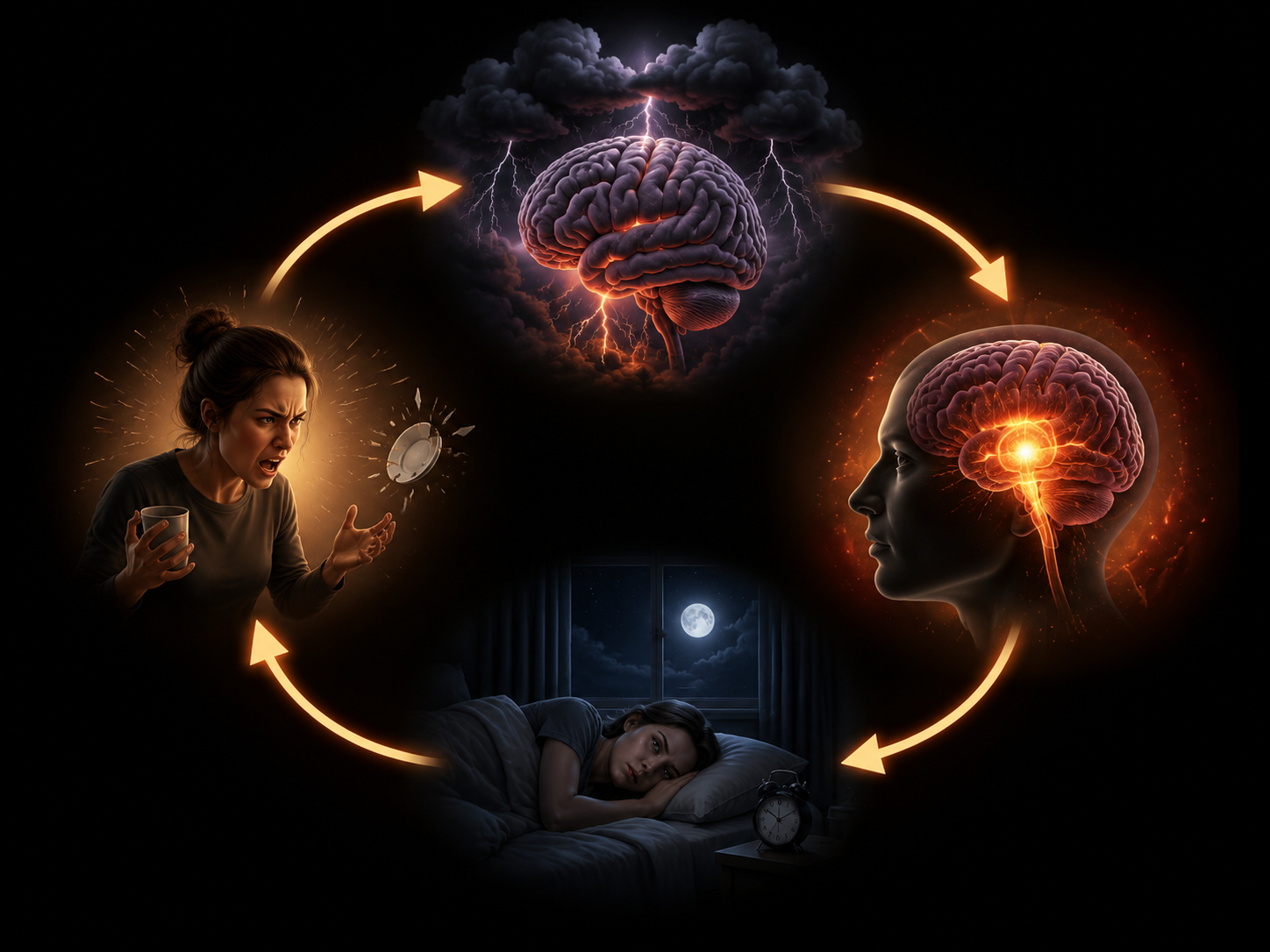
That lowered threshold matters because it feeds the original problem. A harder day produces more emotional activation. More activation makes the next night harder. The person may then begin fearing the bed itself: not because the mattress changed, but because night has become the place where exhaustion meets alarm.
This loop can also distort self-judgment. Someone who slept two hours may look at their reaction the next day and conclude, “I am falling apart.” Sometimes a more accurate reading is narrower and less frightening: a sleep-deprived nervous system is responding to mild stressors as if they are heavier than they are.
| Part of the cascade | What changes | How it can feel at night |
|---|---|---|
| Prefrontal regulation weakens | The brain has less top-down control over emotional alarm | You know you need sleep, but cannot talk your body into safety |
| Amygdala reactivity rises | Threat detection becomes louder and more easily triggered | Neutral thoughts, sounds, or memories feel urgent |
| HPA-axis arousal persists | Stress chemistry stays active when the body needs downshifting | The room is quiet, but your body feels on duty |
| Calming and alerting signals are imbalanced | Inhibitory quieting is less available while arousal remains high | You are exhausted but wired |
| Sleep loss lowers the stress threshold | The next day’s mild hassles produce stronger negative emotion | Small problems feel too large, which fuels another activated night |
Frightening sleep-loss effects exist, but they are an upper end of the range
When sleep deprivation becomes severe, the mind can do frightening things. Waters and colleagues reviewed evidence that 24 to 48 hours of sleep deprivation can produce perceptual distortions and psychotic-like experiences even in people without underlying psychiatric conditions.[6] That finding is important because it validates how strange and alarming sleep loss can become.
It should also be held carefully. A narrative review of extreme deprivation is not a prediction that a person with one terrible night is heading toward psychosis. It is a severity gradient. As wakefulness stretches and sleep becomes more fragmented, the brain’s reality-testing, sensory processing, and emotional regulation can become less stable. If someone is going days with little or no sleep, feels unsafe, is experiencing hallucinations, or is thinking about self-harm, that moves beyond self-explanation and into urgent clinical support.
Why willpower fails as a sleep strategy
The cruel feature of this state is that the harder someone tries to force sleep, the more sleep becomes a performance demand. Monitoring begins: How long have I been awake? How ruined will tomorrow be? Why is this happening again? That monitoring adds another layer of arousal to a system that is already overactivated.
This does not mean behavior is irrelevant. It means recovery has to begin with the correct target. If the nervous system is still acting as though danger is present, the first task is reducing hyperarousal, not scolding the person for failing to sleep on command.
For some people, that next step may involve trauma-informed care, medical evaluation, therapy, CBT-I, medication review, or structured changes to the sleep window and wake time. If the breakdown followed a specific emotional shock such as fraud, loss, or betrayal, a more event-specific recovery approach — such as sleeping again after a grandparent scam — may be more useful than a generic list of bedtime tips.
The explanation matters because it changes the sentence a person uses for the experience. Not “I am failing at sleep.” More accurate: “My nervous system is still in emergency mode, and that has specific sleep consequences.” That sentence does not solve the insomnia by itself. It does remove some of the fear and self-blame that keep the alarm running.
References
- Nervous Breakdown — Cleveland Clinic.
- The sleep-deprived human brain — Nature Reviews Neuroscience, 2017.
- Sleep System Sensitization: Evidence for Changing Roles of Etiological Factors in Insomnia — Sleep, 2016.
- Nervous Breakdown and Sleep Deprivation — Mission Connection Healthcare.
- Sleep deprivation and stressors: Evidence for elevated negative affect in response to mild stressors when sleep deprived — Emotion, 2012.
- Severe Sleep Deprivation Causes Hallucinations and a Gradual Progression Toward Psychosis With Increasing Time Awake — Frontiers in Psychiatry, 2018.
Comments
Join the discussion with an anonymous comment.