
Why Sleep Latency Matters — and What It Tells You
Sleep latency is the time it takes you to transition from full wakefulness to sleep. For most healthy adults, this window falls between 10 and 20 minutes. If you are consistently falling asleep in under 10 minutes, it may indicate that you are carrying a significant sleep debt — your body is so exhausted that it shuts down the moment your head hits the pillow. On the other end, lying awake for more than 20 to 30 minutes on a regular basis suggests that something is interfering with the natural sleep-onset process.
Understanding your personal sleep latency is the first step in choosing the right intervention. A person who falls asleep in 5 minutes does not need a technique to fall asleep faster — they need to address sleep deprivation. A person who lies awake for 45 minutes with a racing mind needs a different approach than someone whose body feels tense and restless. The techniques below are ranked by the strength of their research support, but the best choice for you depends on the specific barrier you face.
Tier 1: CBT-I Components (Stimulus Control and Sleep Restriction)
The strongest evidence for reducing sleep latency belongs to two core components of Cognitive Behavioral Therapy for Insomnia (CBT-I): stimulus control and sleep restriction. When used together, these techniques produce improvements in 70% to 80% of patients with primary insomnia, including measurable reductions in time to fall asleep and increases in total sleep time. The American College of Physicians recommends CBT-I as the first-line treatment for all adults with chronic insomnia.
Stimulus control targets a specific problem: your brain has learned to associate the bed with wakefulness, frustration, and rumination rather than sleep. The protocol is straightforward but requires discipline. You use the bed only for sleep and sex. If you are unable to fall asleep within approximately 20 minutes, you get out of bed, go to another room, and do something relaxing in dim light until you feel sleepy again. This breaks the conditioned arousal response and rebuilds the mental link between bed and sleep.
Sleep restriction works by temporarily limiting the time you spend in bed to match your actual average sleep duration. This creates a mild sleep debt that makes falling asleep faster and more consistent. Over several weeks, the time in bed is gradually increased as sleep efficiency improves. The result is a reset of your sleep drive and a reduction in the time spent lying awake at night.
Tier 2: Relaxation Techniques (PMR, 4-7-8 Breathing, Guided Imagery)
Relaxation techniques work by activating the parasympathetic nervous system — the branch of your autonomic nervous system responsible for rest and digestion. When you are stressed or anxious, your sympathetic nervous system (fight-or-flight) dominates, keeping your heart rate elevated, your muscles tense, and your mind scanning for threats. Relaxation techniques shift the balance back toward calm.
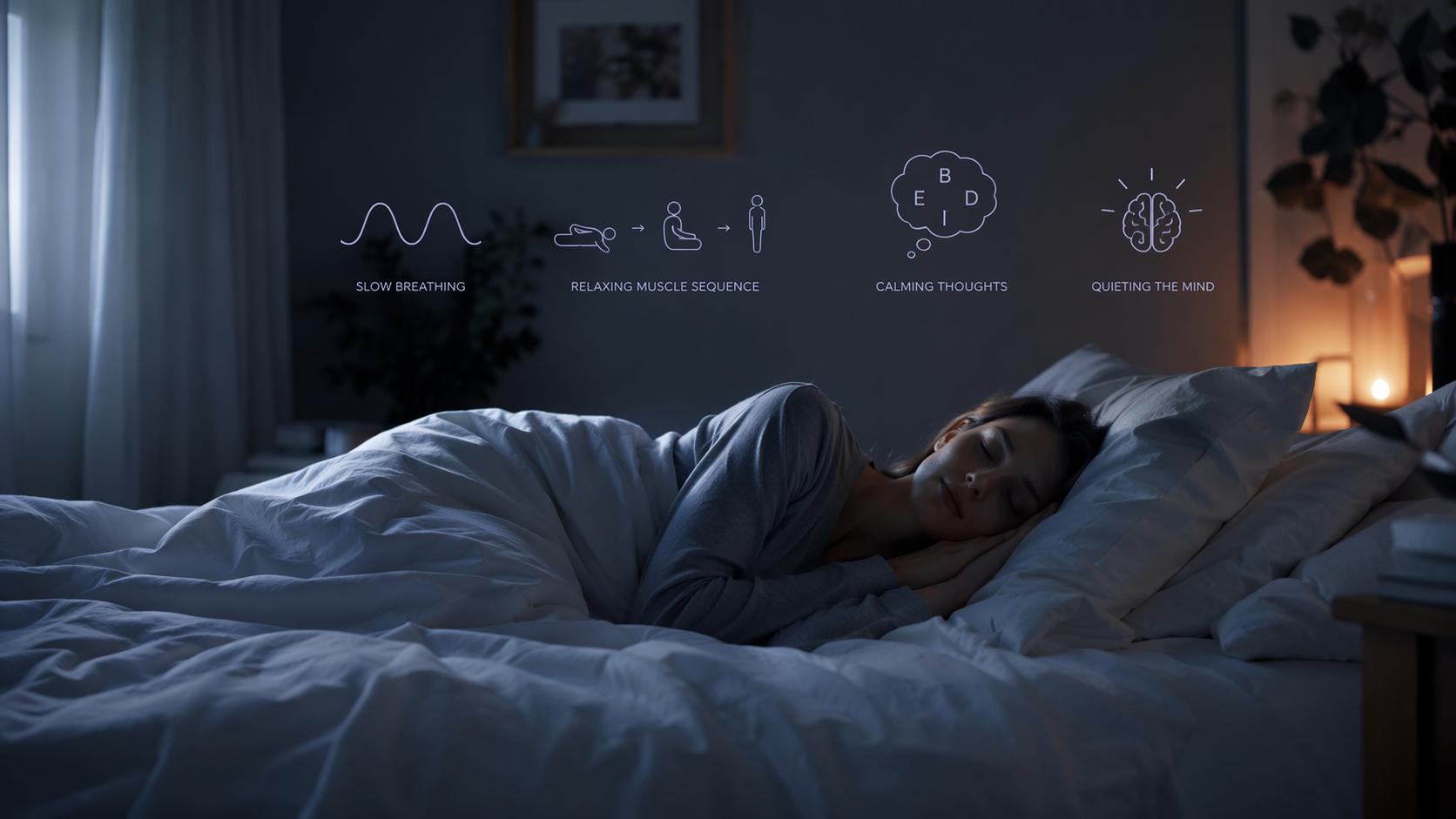
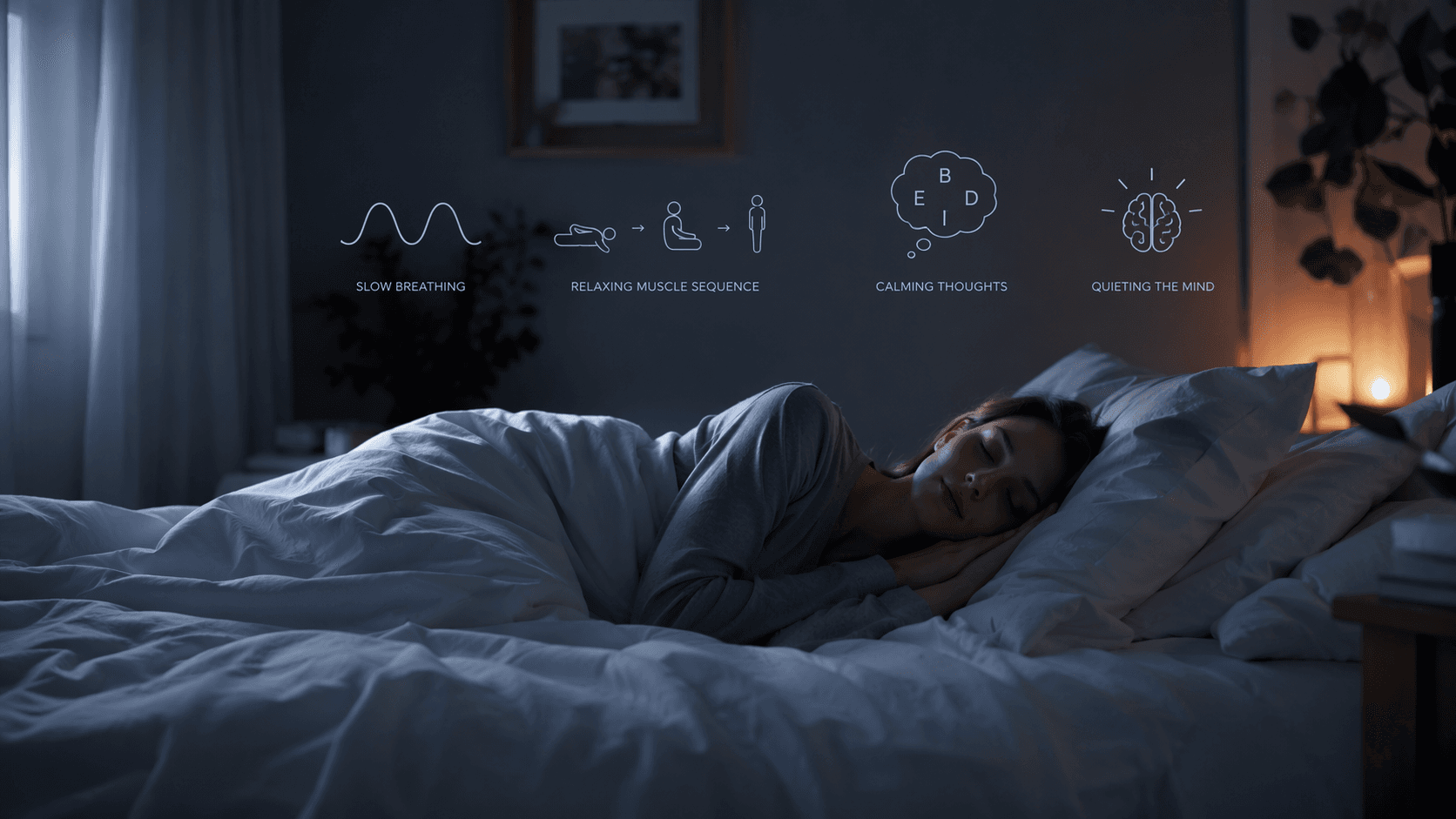
Progressive Muscle Relaxation (PMR) involves systematically tensing and then releasing each muscle group in your body, starting at your toes and working upward. The contrast between tension and relaxation helps you recognize what physical tension feels like and consciously release it. The 4-7-8 breathing technique — inhale for 4 seconds, hold for 7 seconds, exhale for 8 seconds — extends the exhale phase, which stimulates the vagus nerve and slows heart rate. Guided imagery directs your attention to a calming scene (a beach, a forest, a quiet room), which displaces the racing thoughts that keep you awake.
A 2021 study by Toussaint et al., referenced by Verywell Health, confirmed the effectiveness of PMR, deep breathing, and guided imagery for reducing stress and improving sleep. Each technique targets a different barrier, so choosing the right one matters.
| Technique | Best For | Typical Time to Effect |
|---|---|---|
| 4-7-8 Breathing | Anxiety, racing heart, general stress | 2–5 minutes |
| Progressive Muscle Relaxation (PMR) | Physical tension, restless legs, jaw clenching | 5–10 minutes |
| Guided Imagery | Racing thoughts, rumination, overthinking | 5–10 minutes |
| Meditation / Mindfulness | Chronic stress, generalized anxiety | 10–15 minutes |
| Peaceful Music / White Noise | Environmental noise, general relaxation | 15–20 minutes |
Tier 3: Cognitive Shuffling — Mimicking Natural Sleep Onset
Cognitive shuffling is a relatively new technique developed by cognitive scientist Dr. Luc Beaudoin. It is based on the observation that as we naturally drift toward sleep, our thoughts become less linear and more fragmented — a state sometimes called microdreams. Cognitive shuffling deliberately mimics this mental state by forcing your brain to generate a rapid sequence of unrelated, emotionally neutral images.
The method is simple. Pick an emotionally neutral word with 5 to 12 letters — examples include blanket, garden, kitchen, or piano. For each letter in the word, think of as many words as you can that start with that letter, and briefly visualize each one for about five to eight seconds. If your word is B-E-D, you might think: basket, balloon, butterfly, then elephant, envelope, engine, then dolphin, door, daisy. The goal is not to complete the exercise perfectly but to keep your mind occupied with random, low-stakes imagery that prevents it from circling back to anxious thoughts.
Beaudoin published his third study on cognitive shuffling in 2016, recruiting 154 college students who were randomly assigned to a standard treatment, a cognitive shuffling exercise (SDIT), or both. The group that used cognitive shuffling experienced improvements in sleep quality, difficulty falling asleep, and presleep arousal — and the benefits lasted throughout the semester. Practitioners typically report falling asleep within 5 to 15 minutes, though results vary by individual.
Tier 4: Paradoxical Intention — The Counterintuitive Approach
Paradoxical intention flips the script entirely: instead of trying to fall asleep, you try to stay awake. The logic is rooted in the Attention-Intention-Effort (AIE) model, which explains that the harder you try to sleep, the more anxious you become about your inability to sleep, which in turn keeps you awake. By removing the goal of falling asleep, you eliminate the performance anxiety that fuels the cycle.
The American Academy of Sleep Medicine has classified paradoxical intention as a well-established treatment for insomnia. A 2022 systematic review and meta-analysis of 10 trials examining paradoxical intention as a sole intervention found that, compared with passive control conditions, it significantly improved sleep onset latency, difficulty falling asleep, number of awakenings, and restedness. When compared with active treatments (such as relaxation or sleep hygiene), it showed moderate improvements specifically in difficulty falling asleep and number of awakenings.
The technique is simple: lie in bed with your eyes open and tell yourself, "I am going to stay awake as long as possible." Do not engage in any stimulating activity — just lie still and resist the urge to close your eyes. The paradox is that by surrendering the effort to sleep, you often fall asleep faster than when you were trying.
Tier 5: Anecdotal but Low-Risk Methods (Military Method, Acupressure)
The military method is a relaxation protocol reportedly used by the U.S. military to help soldiers fall asleep in under two minutes, even in stressful conditions. It combines progressive muscle relaxation, controlled breathing, and mental visualization — systematically relaxing your face, shoulders, arms, chest, legs, and feet, then imagining a calm scene. While the method is widely shared online and has many anecdotal success stories, it has not been rigorously studied in controlled trials.
Acupressure involves applying gentle pressure to specific points on the body — most commonly the wrist (Pericardium 6 point) or the space between the eyebrows (Yintang point). A 2019 meta-analysis suggested that acupressure may slightly decrease the time it takes to fall asleep, but the effect size was small and the quality of the included studies was mixed. The mechanism is not well understood, though it may involve stimulation of the vagus nerve or release of endorphins.
These methods belong in the lowest evidence tier not because they are harmful — they are very low risk — but because the research supporting them is thin or absent. They are worth trying if the higher-tier methods do not fit your situation or if you are simply curious. Just do not expect the same level of reliability as CBT-I or relaxation techniques.
When Techniques Aren't Enough: The Path to CBT-I and Professional Help
Self-directed techniques are powerful tools, but they have limits. If you have been consistently experiencing sleep latency of more than 30 minutes for at least three months, and it is accompanied by significant daytime impairment — fatigue, difficulty concentrating, irritability, reduced performance at work or school — you may have chronic insomnia disorder. In that case, self-help techniques alone are unlikely to resolve the problem.
The gold-standard treatment for chronic insomnia is CBT-I, delivered by a trained clinician. Unlike the self-directed techniques described above, clinician-led CBT-I includes structured cognitive restructuring, personalized sleep restriction protocols, and ongoing accountability. The 70% to 80% efficacy rate cited earlier comes from clinical settings where patients work with a trained therapist over multiple sessions.
You should also consider professional evaluation if you suspect an underlying condition such as sleep apnea (loud snoring, gasping for air, morning headaches), restless legs syndrome (uncomfortable leg sensations that improve with movement), or a circadian rhythm disorder (your sleep schedule is consistently misaligned with your desired bedtime). These conditions require specific medical treatment, not behavioral techniques.
Quick-Reference Comparison Table
The table below summarizes all five tiers so you can quickly identify the technique that matches your specific barrier.
| Technique | Evidence Tier | Mechanism | Best For | Typical Time to Effect | Key Caveat |
|---|---|---|---|---|---|
| Stimulus Control & Sleep Restriction (CBT-I) | 1 — Strongest | Breaks conditioned arousal; resets sleep drive | Chronic insomnia, conditioned wakefulness | 2–4 weeks for measurable change | Requires consistency; sleep restriction may cause daytime drowsiness initially |
| PMR, 4-7-8 Breathing, Guided Imagery | 2 — Good | Activates parasympathetic nervous system; reduces cortisol | Anxiety, physical tension, racing thoughts | 2–10 minutes per session | Best results when practiced regularly, not just on bad nights |
| Cognitive Shuffling | 3 — Emerging | Mimics natural sleep-onset microdreams; displaces rumination | Racing mind, overthinking at bedtime | 5–15 minutes | Limited to one 2016 study with 154 participants; promising but preliminary |
| Paradoxical Intention | 4 — Supported but niche | Reduces sleep performance anxiety (AIE model) | Sleep performance anxiety, trying too hard to sleep | Varies; often works immediately | Not suitable for physical tension or environmental barriers |
| Military Method, Acupressure | 5 — Anecdotal | Relaxation response; possible vagal stimulation | General difficulty falling asleep, curiosity | Varies widely | Limited or no formal research; low risk but low reliability |
Comments
Join the discussion with an anonymous comment.