
The Subjective-Objective Gap: What a 2026 RCT Reveals About Sleep Hygiene Education
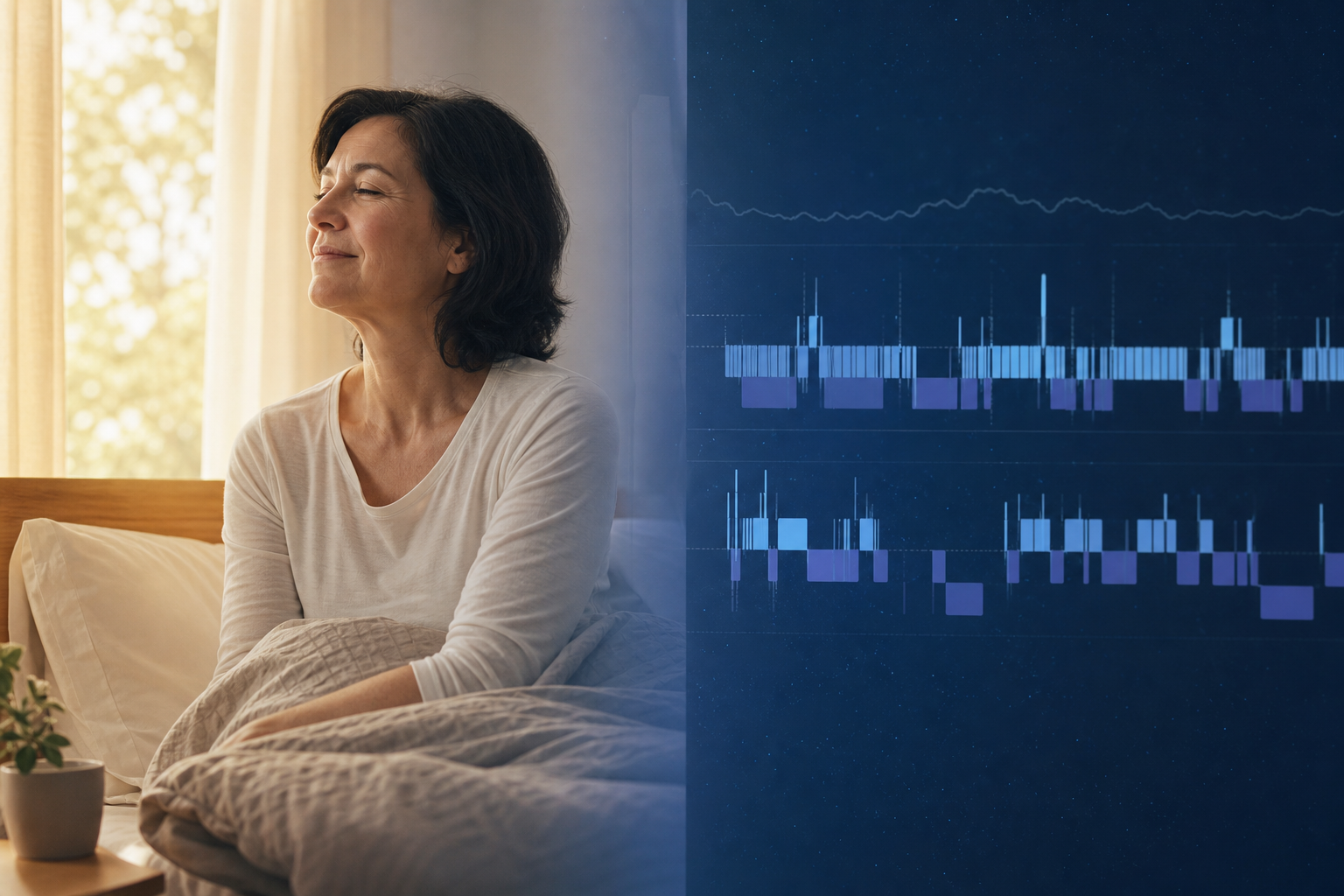
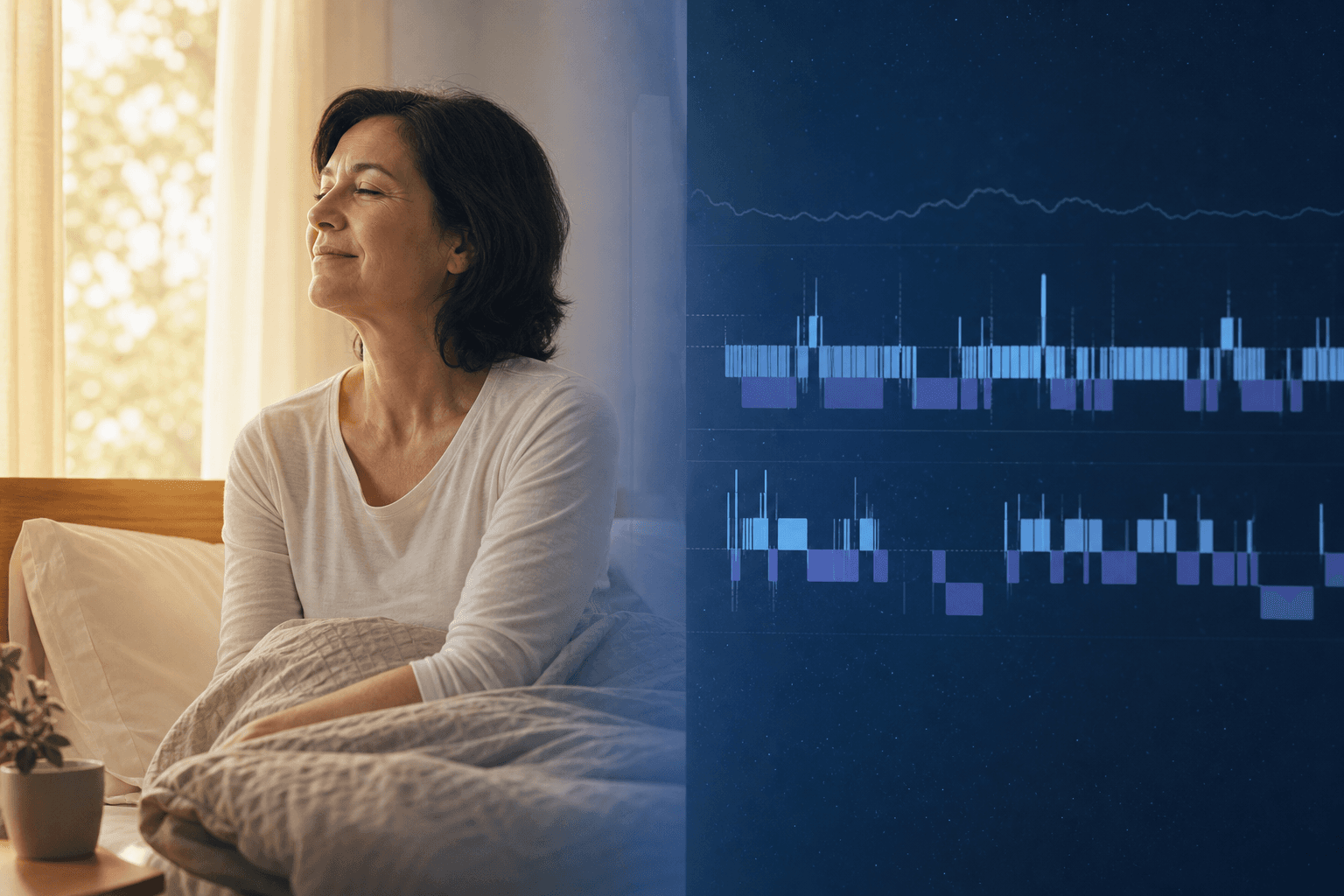
If you have ever followed standard sleep hygiene advice — consistent bedtime, cool room, no screens before sleep — and felt genuinely better during the day, only to check your wearable and see the same fragmented sleep architecture as before, you are not imagining things. A 2026 randomized controlled trial published in Frontiers in Sleep (Pfeiffer et al., n=119) provides the clearest evidence yet that sleep hygiene education produces a measurable split between how people feel about their sleep and what their sleep architecture actually looks like on a tracker.
This gap matters because it changes how you should interpret your own sleep data. If your Pittsburgh Sleep Quality Index (PSQI) score has improved but your Fitbit still shows sleep efficiency hovering around 87% with minimal deep sleep, the problem may not be that you are doing sleep hygiene wrong. The problem may be that sleep hygiene, on its own, does not remodel sleep architecture — it remodels your perception of sleep.
Study Design and Participants
The trial enrolled 119 adults aged 50 to 80 years (mean age 66.5 ± 7.2 years) and ran for six weeks. Participants were randomized into three groups: a video-only education group, a video-plus-daily-automated-text-message group, and a control group that received no intervention. The video was an 8-minute sleep hygiene education module covering standard recommendations — consistent sleep schedule, bedroom environment optimization, caffeine and alcohol timing, and relaxation strategies.
| Characteristic | Value |
|---|---|
| Total participants | 119 |
| Age range | 50–80 years (mean 66.5 ± 7.2) |
| Female | 64.7% |
| White | 96.6% |
| College degree or higher | 74% |
| Intervention duration | 6 weeks |
| Education format | 8-minute video + optional daily text messages |
| Objective measurement device | Fitbit Inspire HR 2 |
The sample was predominantly female, White, and well-educated — a limitation that the authors acknowledge. Generalizing these findings to more diverse populations requires caution. The study also relied on a single consumer wearable for objective sleep staging, which classifies sleep stages using accelerometry and heart rate variability rather than the electroencephalography (EEG) used in clinical PSG.
Subjective Improvements: Sleep Quality, Daytime Sleepiness, and Stress
The subjective improvements were statistically significant and clinically meaningful. In the video-plus-text group, the PSQI — a widely used self-report questionnaire that measures sleep quality over the previous month — dropped from 7.63 to 6.51 (p=0.017). A PSQI score above 5 is considered indicative of poor sleep quality, so this shift moved the group closer to the threshold but did not cross it.
| Subjective Measure | Video + Text Group (Baseline → 6 Weeks) | p-value |
|---|---|---|
| PSQI (Pittsburgh Sleep Quality Index) | 7.63 → 6.51 | 0.017 |
| ESS (Epworth Sleepiness Scale) | 6.98 → 5.27 | < 0.001 |
| SHI (Sleep Hygiene Index) | 12.44 → 10.46 | 0.022 |
| PSS (Perceived Stress Scale) | 20.95 → 19.24 | 0.02 |
The Epworth Sleepiness Scale (ESS) showed an even larger shift — from 6.98 to 5.27 (p < 0.001) — indicating that participants felt significantly less daytime sleepiness after the intervention. The Sleep Hygiene Index (SHI) also improved from 12.44 to 10.46 (p=0.022), confirming that participants adopted better sleep practices.
Notably, perceived stress — measured by the Perceived Stress Scale (PSS) — decreased from 20.95 to 19.24 (p=0.02) only in the video-plus-text group. The video-only group did not show a significant PSS reduction. This suggests that the daily text message reinforcement, not just the educational video, drove the stress reduction. Feeling that someone is supporting your sleep efforts may be as important as the content of the advice itself.
The self-perceived ability to change sleep behaviors also diverged sharply between groups. The video-plus-text group rated their agency at 5.2 out of 10, the video-only group at 4.3, and the control group at just 2.2. Education alone — even without objective sleep changes — empowers people to feel more in control of their sleep.
Objective Non-Changes: Total Sleep Time, Efficiency, Deep Sleep, and REM
While participants felt better, their sleep architecture — as measured by the Fitbit Inspire HR 2 — remained essentially unchanged. Total sleep time in the video-plus-text group actually decreased slightly from 414.65 minutes to 406.40 minutes (p=0.365), a non-significant change. The control group showed a similarly non-significant increase from 398.33 to 402.63 minutes (p=0.562).
| Objective Parameter | Video + Text Group (Baseline → 6 Weeks) | p-value |
|---|---|---|
| Total sleep time (minutes) | 414.65 → 406.40 | 0.365 |
| Sleep efficiency (%) | 86.98 → 86.93 | 0.869 |
| Deep sleep (minutes, video-only group) | 56.16 → 57.68 | 0.519 |
| REM sleep (minutes, video-only group) | 75.54 → 75.85 | 0.920 |
Sleep efficiency — the percentage of time in bed actually spent asleep — stayed remarkably stable across all three groups, hovering around 87%. Deep sleep minutes and REM sleep minutes also showed no significant change. Total time awake during the night remained unchanged as well.
This pattern is consistent with prior sleep intervention research. Multiple studies have found that educational and behavioral interventions improve self-reported sleep quality without altering the underlying sleep architecture measured by PSG or validated actigraphy. The 2026 RCT confirms that this gap is not a measurement artifact — it is a genuine feature of how sleep hygiene education works.
Why the Gap Exists: Perception vs. Sleep Architecture
The subjective-objective gap is not a failure of measurement. It is a predictable consequence of how the brain evaluates sleep. When you learn that your bedroom should be cooler, that caffeine has a half-life of several hours, and that a consistent wake time anchors your circadian rhythm, you gain a framework for understanding your sleep. That framework reduces anxiety about sleep — and reduced anxiety is itself a powerful driver of perceived sleep quality.
The PSS reduction in the video-plus-text group supports this interpretation. Participants who received daily text reinforcement experienced a measurable drop in perceived stress. Lower stress means less cognitive arousal at bedtime, which means falling asleep feels easier and nighttime awakenings feel less distressing — even if the actual number of awakenings and the time spent awake remain unchanged.
This mechanism is well-documented in the sleep literature. The bidirectional link between sleep anxiety and insomnia means that worrying about sleep makes sleep worse, and worse sleep generates more worry. Sleep hygiene education interrupts this cycle at the cognitive level — it gives people a sense of agency and reduces the catastrophic thinking that amplifies perceived poor sleep.
What This Means for Your Sleep Strategy
The practical takeaway is not that sleep hygiene is useless — it is that sleep hygiene has a specific job, and that job is not remodeling sleep architecture. Sleep hygiene reduces cognitive arousal, improves perceived sleep quality, and gives you a sense of control. Those are real benefits. But if your goal is to increase deep sleep, reduce nighttime awakenings, or improve sleep efficiency below 85%, sleep hygiene alone is unlikely to deliver those changes.
Here is a practical framework for deciding what to do next:
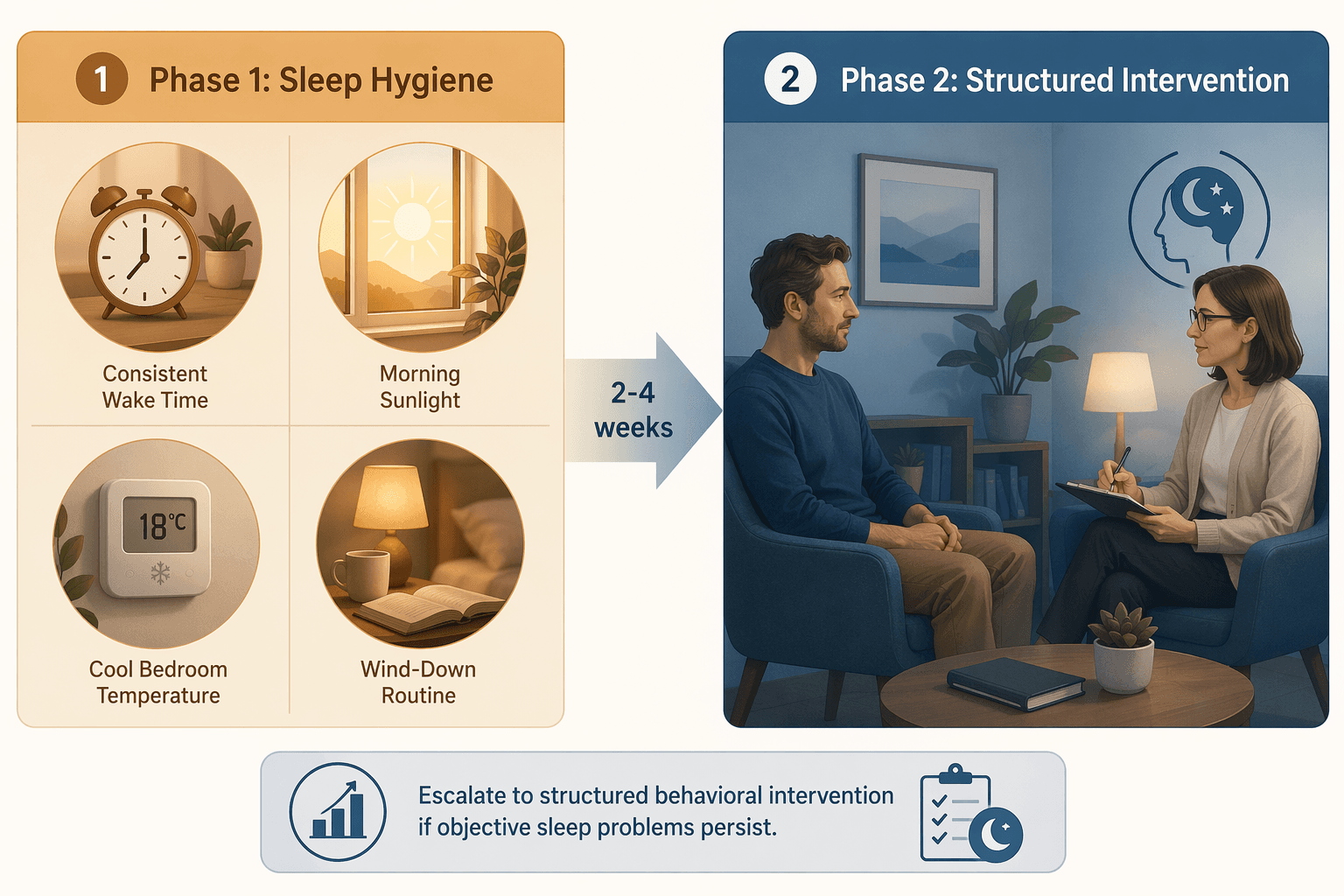
- Start with sleep hygiene for 2 to 4 weeks. Follow the standard recommendations: consistent wake time seven days a week, morning sunlight exposure within 30 minutes of waking, bedroom temperature between 65°F and 68°F, no caffeine after 2 p.m., no alcohol within three hours of bedtime, and a 30- to 60-minute device-free wind-down routine. Track your subjective sleep quality with a simple daily rating (1 to 10) and note how you feel during the day.
- After 2 to 4 weeks, assess your results. If your subjective sleep quality has improved and your daytime functioning is good, you may not need to do anything else. The sleep hygiene is working — for your perception and your quality of life.
- If your subjective sleep quality has not improved, or if you still feel exhausted despite adequate time in bed, escalate to a structured behavioral intervention. The AASM-recommended first-line treatment for chronic insomnia is Cognitive Behavioral Therapy for Insomnia (CBT-I). CBT-I includes stimulus control, sleep restriction, cognitive restructuring, and relaxation training — components that directly target the sleep architecture that hygiene alone cannot reach.
- If you have a co-occurring condition such as anxiety, depression, or chronic pain, CBT-I for comorbid insomnia is specifically designed to address sleep disruption in the context of other health issues. Do not assume that treating the primary condition will automatically fix the sleep — comorbid insomnia often requires its own targeted intervention.
CBT-I produces improvement in 70% to 80% of insomnia patients, according to Sleep Foundation reporting on AASM guidelines. That is a dramatically higher success rate than sleep hygiene alone, and the improvements are durable — CBT-I teaches skills that remain effective long after the treatment period ends.
When to Escalate Beyond Sleep Hygiene
Sleep hygiene is a starting point, not a ceiling. The following signals indicate that it is time to move from self-directed sleep hygiene to a structured intervention or clinical evaluation:
- Persistent sleep efficiency below 85% on your tracker, despite consistent sleep hygiene for 4 weeks or more.
- Frequent nighttime awakenings (more than three per night, or more than 30 minutes total awake time) that do not resolve with hygiene changes.
- Excessive daytime sleepiness — falling asleep unintentionally during quiet activities, needing naps to function, or scoring above 10 on the Epworth Sleepiness Scale.
- Subjective improvements that plateau or reverse after an initial positive response to sleep hygiene.
- Symptoms suggestive of an underlying sleep disorder: loud snoring with witnessed pauses (sleep apnea), irresistible urge to move legs at night (restless legs syndrome), or difficulty staying awake while driving.
If any of these apply, the next step is not more sleep hygiene — it is a structured behavioral intervention or a clinical sleep evaluation. The insomnia self-care evidence spectrum provides a detailed breakdown of which interventions are supported by RCT evidence and which are not, helping you make an informed decision about what to try next.
It is also worth considering whether your sleep regularity — the consistency of your sleep-wake timing from day to day — might matter more than the total hours you spend in bed. Emerging research suggests that sleep regularity may be a stronger predictor of health outcomes than sleep duration. If your sleep hygiene is solid but your schedule varies wildly between weekdays and weekends, regularity may be the missing piece.
The bottom line is straightforward: sleep hygiene education improves how you feel about your sleep, and that improvement is real and valuable. But if your goal is to change what your sleep architecture looks like on a tracker — to increase deep sleep, reduce awakenings, or push sleep efficiency above 90% — you need tools that go beyond hygiene. Understanding what counts as a good night's sleep across multiple dimensions can help you set realistic targets and recognize when your sleep is actually fine — even if your tracker says otherwise.
Comments
Join the discussion with an anonymous comment.