
The most useful way to think about screen time effects on sleep in children is not as one big warning label. The same tablet at 8:30 p.m. can cause trouble in three different ways: it can take up time that used to belong to sleep, it can leave a child too activated to settle, and it can send light signals that push the body clock later.
Those mechanisms overlap, but separating them matters. If the problem is displacement, the fix is mainly about protecting time. If the problem is arousal, the fix is about the kind of content and the emotional state it leaves behind. If the problem is circadian disruption, the fix has to deal with evening light and timing, not just the number of minutes on a device.
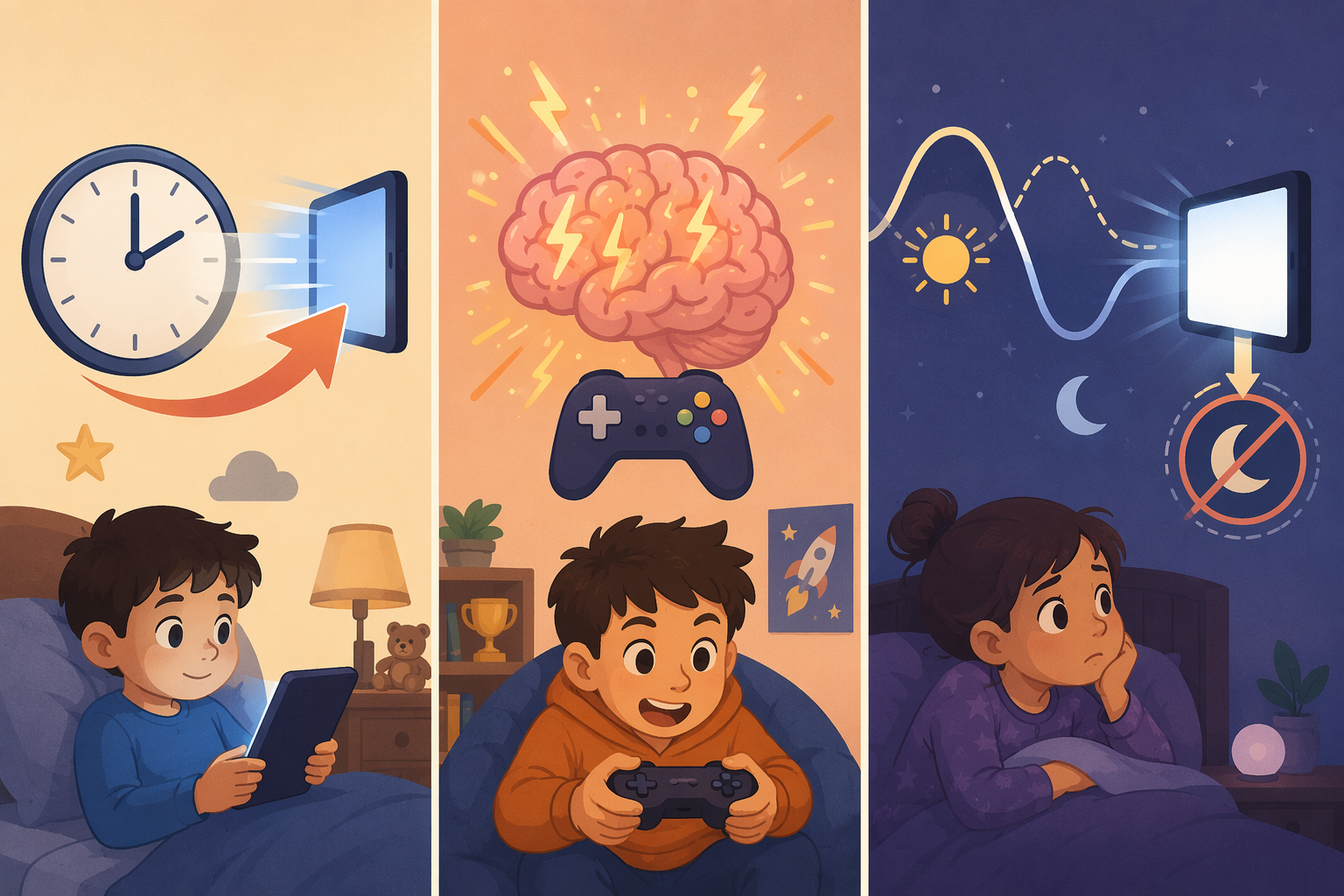
First, Screens Take the Place of Sleep
Before getting to blue light or melatonin, there is the plain scheduling problem. A show runs long. A game needs one more round. A group chat keeps moving. The child is not necessarily wide awake because of a complicated biological reaction; bedtime simply got pushed back.
That pattern shows up in studies of children. A Finnish study of 736 preschool children found that each additional hour of screen time was associated with about 10 minutes less sleep. A Hong Kong study of 2,903 children found a similar pattern, with each additional hour associated with 11 minutes less sleep for boys and 6 minutes less sleep for girls.[1]
Ten minutes can sound small until it becomes the normal price of an evening routine. It is not just the lost sleep at the end. Screen time can also crowd out the slower activities that make sleep easier: reading with a parent, getting ready without a fight, dimming the room, or having enough unscheduled time for a child to stop negotiating with the day.
This is why a household can reduce total screen time and still miss the sleep problem. A half hour at 4 p.m. and a half hour in bed are not the same exposure. Bedtime device access has stronger sleep associations than screen use that happens earlier. A JAMA Pediatrics meta-analysis reported that bedtime device use was associated with higher odds of inadequate sleep and daytime sleepiness, with odds ratios of 2.17 and 2.72 respectively.[1]
Content Changes the Sleep Cost
The scheduling explanation is easy to see, but it does not explain the child who puts the device down on time and still cannot fall asleep. That is where content matters. A sleepy nature video, a competitive game, a suspenseful show, and a social feed do not ask the same thing from a child's nervous system.
A National Sleep Foundation consensus report on children's screen use and sleep reviewed 574 manuscripts with a panel of 16 experts and concluded that screen use can affect sleep through displacement, psychological stimulation, and light exposure.[2] That distinction is important because “screen time” often hides the most relevant detail: what the child was doing.
Gaming is the clearest example. In the research summarized by the National Sleep Foundation, problematic gaming had a stronger association with sleep disruption than general technology use: an odds ratio of 2.60 for problematic gaming compared with 1.33 for general technology use.[2] That does not mean every game has the same effect, or that a calm game at 6 p.m. is equivalent to a competitive match at bedtime. It means the level of engagement matters.
The body can stay mobilized after the screen is gone. A child may still be replaying a loss, anticipating the next level, worrying about a message, or carrying the emotional charge of a video into the dark. For some kids, the problem is not that they refuse sleep. It is that the last activity of the day asked them to be alert, reactive, and socially available.
This is the reason “no screens before bed” sometimes works and sometimes looks like an overbroad rule. The better question is what kind of screen use is entering the sleep window. Interactive, competitive, emotionally intense, or socially unresolved content is more likely to create a settling problem than passive, low-stakes content. Even then, passive video can still displace sleep if it keeps running.
For families dealing specifically with games, the difference between content types is practical, not academic. A useful rule is to move high-arousal games earlier and reserve the last part of the evening for activities that do not create a new problem to solve. The same logic is explored in more detail in before-bed gaming's sleep effects, where the game itself matters as much as the clock.
Evening Light Is a Timing Signal, Not Just Brightness
The blue-light version of the story is often told too loosely, but the underlying mechanism is real. Evening light reaches the eye and helps tell the brain whether it is still daytime. When that signal arrives late, melatonin can be suppressed and the internal clock can shift later. In a child, that can mean the body is being asked to wake up at the same school-day time after being nudged toward a later biological night.
Children may be especially sensitive to this signal. In one small study, Higuchi and colleagues found that children had 88% melatonin suppression under equivalent light exposure, compared with 46% in adults.[1] The size of that difference is hard to ignore, but the study should not be stretched into a universal household threshold. It tells us children may be more light-sensitive than adults, not that every child will respond by the same amount to every screen.
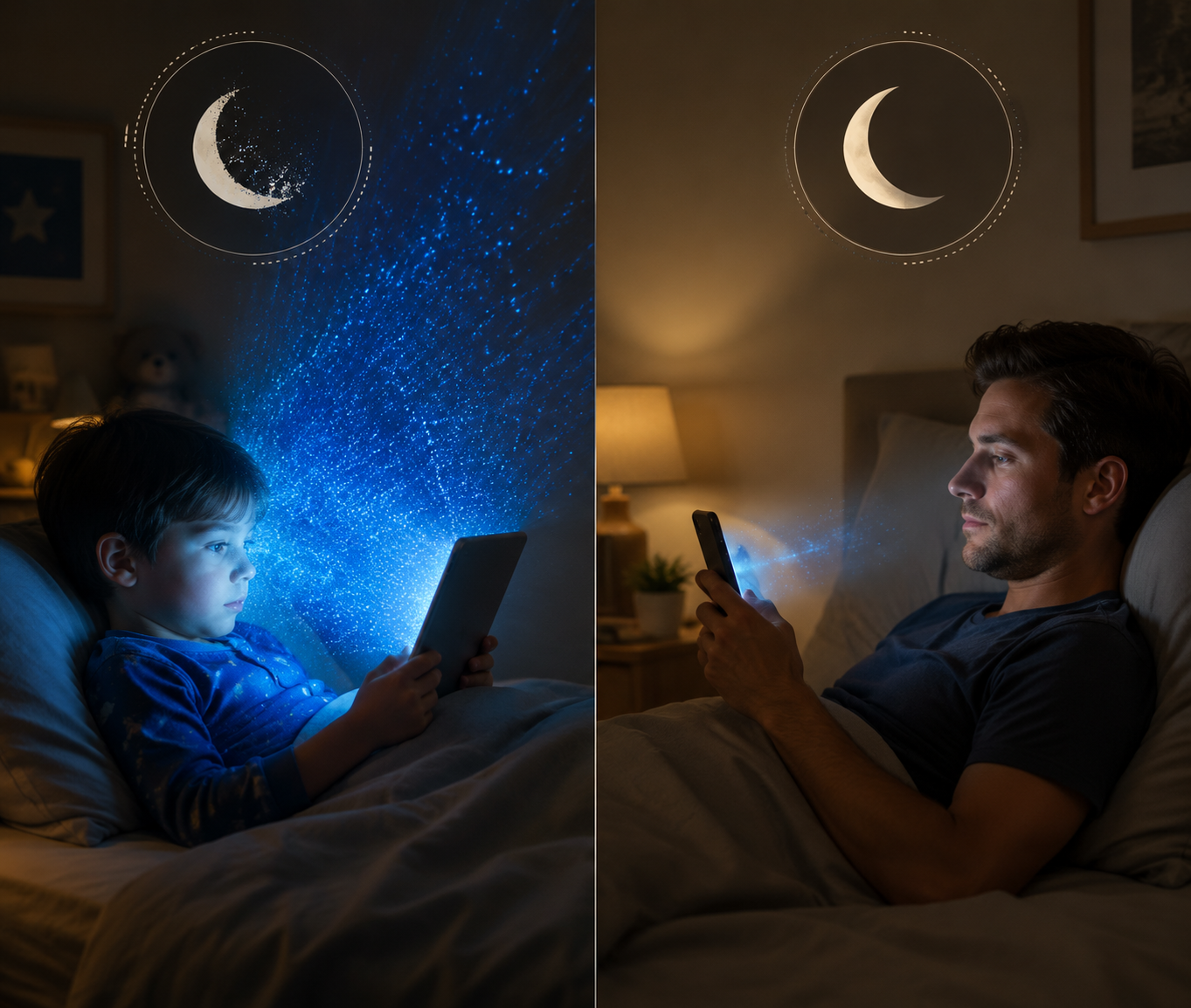
Preschool data points in the same direction. Hartstein and colleagues studied 36 preschool children and found 69% to 99% melatonin suppression from light exposure in the hour before bedtime.[1] Again, the sample was small. The value of the finding is not that it gives parents a perfect cutoff line. It sharpens the basic point: a young child's evening light environment can matter more than adult intuition would predict.
That also explains why blue-light fixes can disappoint. A warmer screen setting or blue-light glasses may reduce one part of the signal, but they do not solve displacement, arousal, or the fact that a bright object is still being held close to the face at bedtime. The evidence around blue-light glasses for sleep is better treated as partial context than as permission to keep the same bedtime routine unchanged.
The circadian issue is also age-aware. Preschoolers may be particularly vulnerable to evening light exposure. Teens bring another problem: puberty naturally shifts the circadian system later, so late-night screens can stack on top of an already delayed sleep tendency. School start times, homework, and social availability then compress the sleep window from the other side.
This is where the language of circadian hygiene is more useful than another lecture about willpower. The bedtime problem is not only whether a child obeys a rule. It is whether the evening environment is giving the body a believable nighttime signal.
Teens Add a Mental Health Context, but It Still Does Not Prove a Single Cause
Teen screen use deserves attention because it is common and it travels with other risks. CDC NHIS-Teen data published in 2025 found that 50.4% of U.S. teens reported 4 or more hours of daily screen time for non-schoolwork. Teens in that group were 2.5 times as likely to report symptoms of depression as teens with less screen time.[3]
That finding is serious, but it is not proof that screen time caused the depression symptoms, and the CDC source itself describes the data as cross-sectional.[3] For sleep, the teen context still matters because depression symptoms, late-night social media, irregular schedules, and insufficient sleep can reinforce one another. The mechanism has to be handled carefully rather than turned into a single-cause story.
The same caution applies to newer bedtime-screen findings in young adults. A 2025 report on a Norwegian student study said each additional hour of screen time in bed was linked with a 63% higher insomnia risk, but that study involved people aged 18 to 28, not younger children.[4] It is useful as a warning about in-bed screen use; it should not be presented as direct evidence for preschoolers or elementary-age children.
The Three Pathways Can Feed Each Other
In real homes, these pathways rarely stay separate. A child who sleeps poorly may be more irritable the next day, harder to move through homework, and more likely to be handed a screen during the crankiest part of the evening. That screen then pushes the routine later, keeps the brain active, or adds more evening light.
A 2024 preschool study described this kind of bidirectional loop: more screen time was linked with poorer sleep quality, and poorer sleep quality was linked with more screen use.[5] That does not mean every family is trapped in the same cycle. It does mean the tired-child, more-screen, later-bedtime pattern is plausible enough to look for before blaming only discipline or only devices.
| What You See | Likely Pathway | More Targeted Response |
|---|---|---|
| The device simply runs past bedtime | Time displacement | Protect the sleep window first; move screens earlier or make the endpoint non-negotiable |
| The child stops on time but stays wired | Psychological and physiological arousal | Change the content type, especially competitive games, social media, suspense, or emotionally charged videos |
| The child seems sleepy until using a bright device late | Circadian disruption | Dim the evening environment, increase distance from bright screens, and move light-heavy use earlier |
| The next day starts tired and the evening needs more screens to get through | Feedback loop | Intervene earlier in the day, not only at bedtime |
Match the Rule to the Mechanism
A generic limit is sometimes enough when the only problem is time. If the tablet ends at 7:30 p.m. and bedtime becomes possible again, the mechanism was probably displacement. No deeper explanation is needed.
If the device ends on time and the child is still arguing, replaying, worrying, or buzzing, the screen rule has to change content, not just duration. Move the most activating activities earlier. Do not make the final digital activity of the day one that depends on winning, responding, scrolling, or being socially present.
If the problem is late biological timing, the room matters too. Dim lights earlier, keep bright screens out of the last part of the evening when possible, and avoid treating night mode as a full solution. Light, distance, duration, and timing all change the circadian signal.
For many families, the useful question is not “How much screen time is allowed?” It is “Which sleep pathway is this screen habit using?” Once that is clear, the intervention gets less vague: protect the schedule, lower the arousal, or reduce the evening light signal.
References
- Screen time and sleep in children — PMC / Canadian Family Physician, 2024
- Effects of Screen Use on Children's Sleep — National Sleep Foundation, 2024
- CDC NHIS-Teen (2025) — screen time and health outcomes — CDC, 2025
- Screen time in bed linked to worse sleep — BBC, April 2025
- Too much screen time can reduce sleep quality in preschool-age children — ScienceDaily, Dec 2024
Comments
Join the discussion with an anonymous comment.