
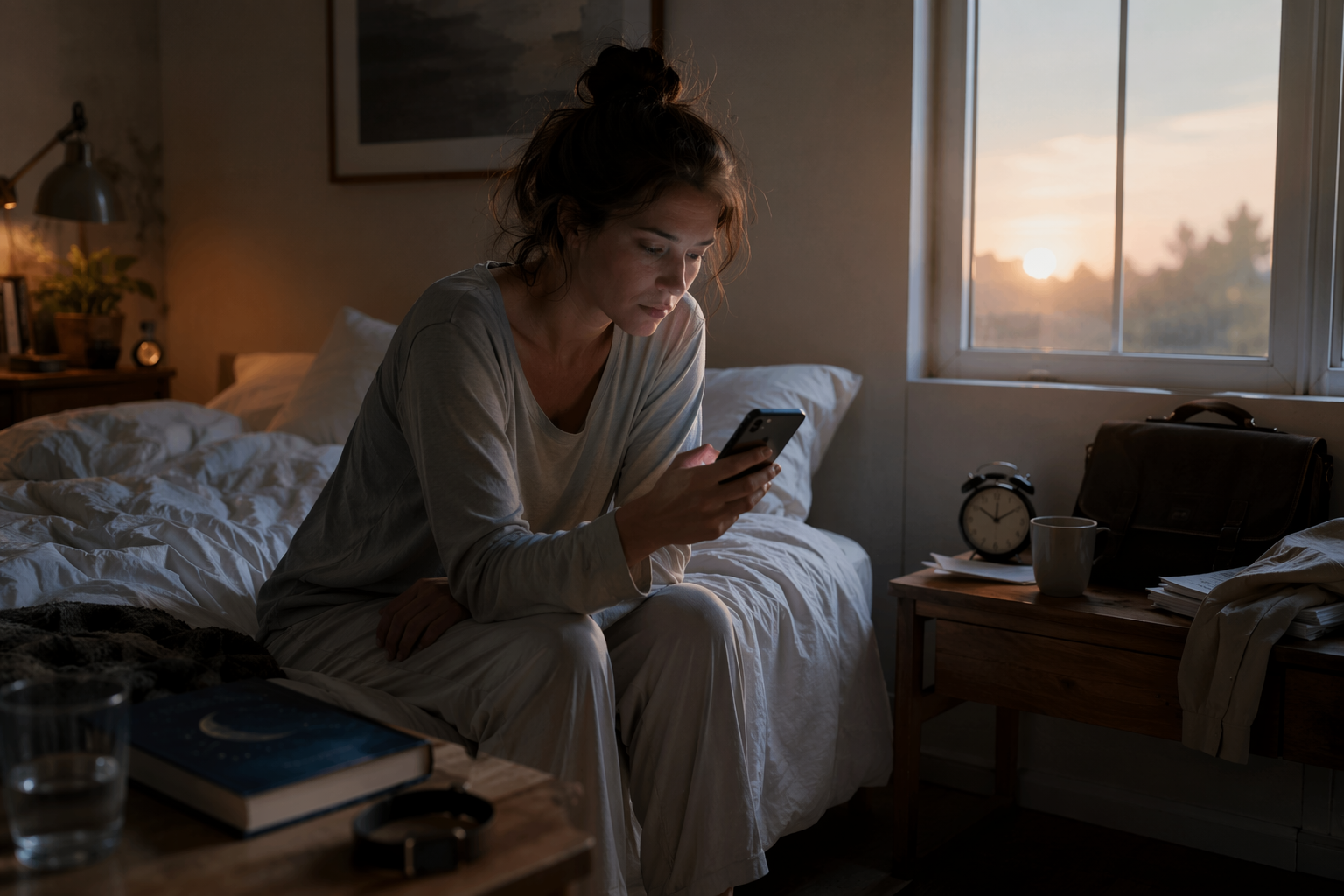
Most people looking for good sleep habits are not hearing the concept for the first time. They already know the usual advice: keep a steady bedtime, stop scrolling, cut back on late caffeine, make the bedroom darker, wind down, get up at the same time. The harder question is why that familiar advice so often dissolves by Wednesday night.
That gap is now visible in the numbers. In Resmed’s 2026 Global Sleep Survey, 84% of respondents said consistent, quality sleep extends lifespan, and 53% ranked sleep as the most important health behavior. Yet more than half reported getting good sleep four nights a week or less. In the U.S., 76% ranked sleep as important, while only 62% said they take action to improve it. The survey is commercially commissioned and self-reported, so it should not be treated as the final word on sleep behavior. But its scale — 30,000 people across 13 markets, fielded from December 2025 to January 2026 — captures something ordinary sleep advice often misses: awareness is not the bottleneck for many adults.[1]
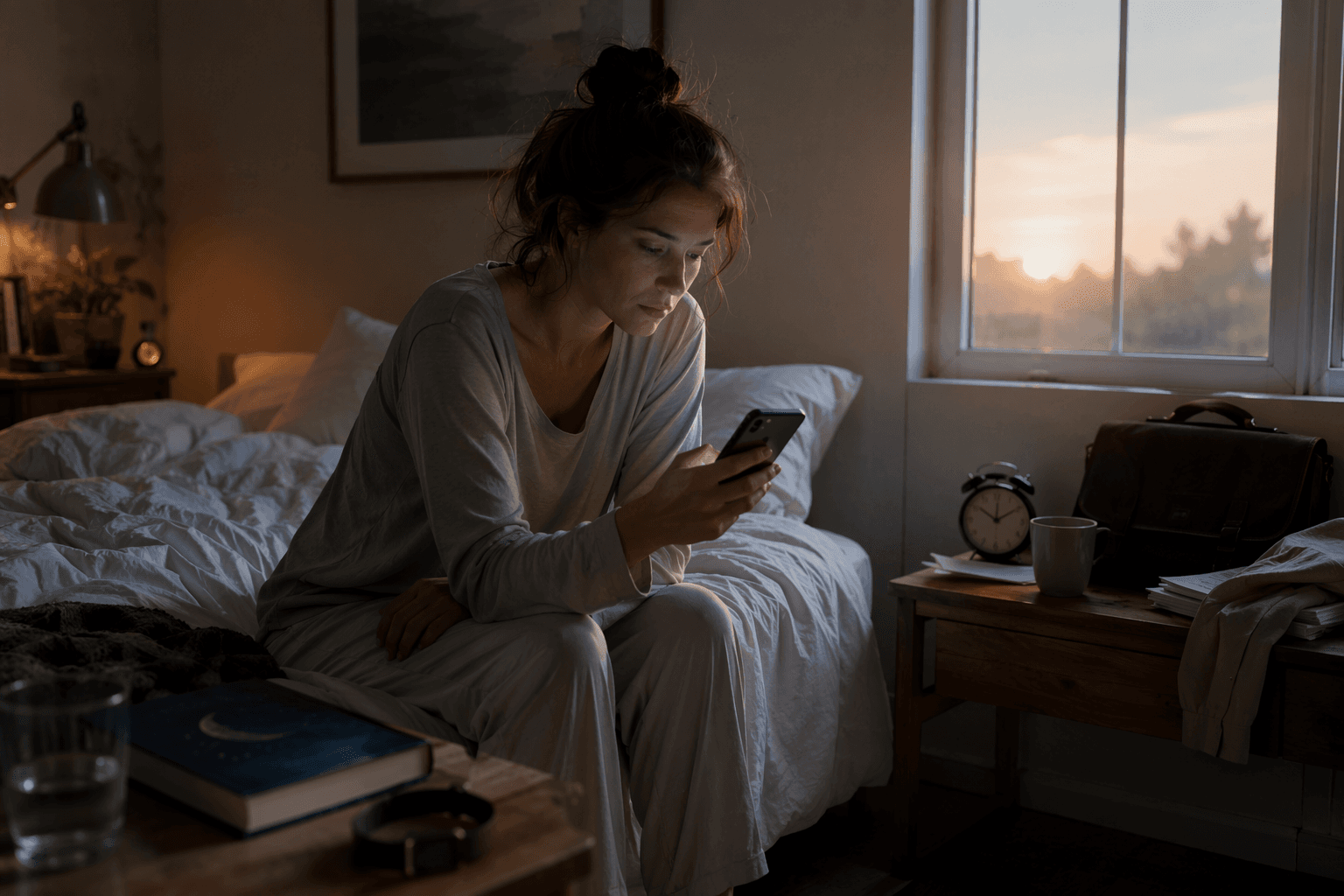
Public-health data points in the same direction. CDC analysis from the 2024 National Health Interview Survey found that 30.5% of U.S. adults slept fewer than seven hours in a 24-hour period. It also found that 15.4% had trouble falling asleep most days or every day, and 18.1% had trouble staying asleep most days or every day.[2] These are not niche problems caused by a few people refusing to learn the rules. They are common problems happening inside work schedules, family routines, stress loops, late-night phones, and mornings that arrive whether the night went well or not.
The problem with treating every sleep habit as equal
A flat sleep-hygiene checklist sounds helpful until it reaches the person who can change only one thing this week. If “avoid caffeine,” “buy blackout curtains,” “keep the room cool,” “stop alcohol,” “meditate,” “exercise,” “wake up earlier,” and “put your phone away” are all presented with the same urgency, the reader is left with a second job: deciding what matters most while already tired.
The evidence does not support that flatness. A 2024 bibliographic review in Sleep Medicine Reviews found that sleep hygiene is not one neat intervention but a broad set of more than a dozen components, with uneven representation and evidence weight across the literature. Sleep timing appeared in 45% of reviewed studies, caffeine in 51%, alcohol in 46%, light in 42%, and temperature in 34%. The review searched literature through December 2021, so it is not a complete account of every newer study, but it is useful for one practical reason: it helps sort the usual advice by priority instead of volume.[3]
For readers who want the evidence-definition angle in more detail, Restful Ground’s deeper guide to what sleep hygiene actually means covers the broader concept. Here, the more useful question is narrower: when you cannot do everything, what deserves protection first?
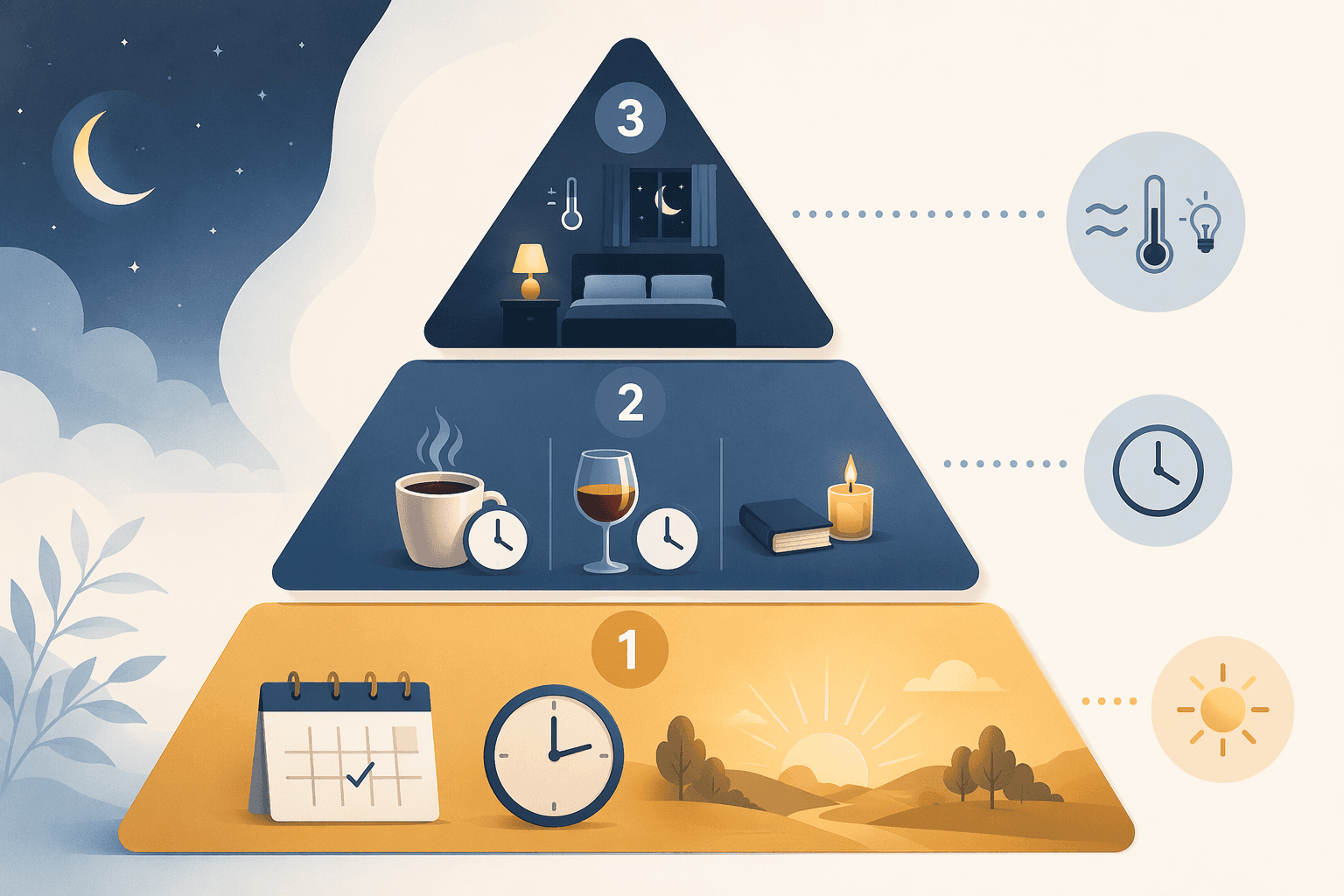
| Priority tier | Habits to focus on | Why they come here |
|---|---|---|
| Tier 1 | Consistent sleep-wake timing and morning light exposure | These are the main anchors for circadian timing and should be protected before fine-tuning the bedroom. |
| Tier 2 | Caffeine timing, alcohol timing, and a repeatable pre-bed routine | These habits reduce common sleep disruptors and create a more predictable transition into sleep. |
| Tier 3 | Bedroom light, noise, temperature, and comfort adjustments | These can help, especially when a clear environmental problem exists, but they work best as supports rather than the foundation. |
Start with the anchors your body can learn
The first priority is not a perfect bedtime ritual. It is a repeatable time signal. A consistent wake time and regular exposure to morning light give the body information it can use: this is when the day begins, this is when alertness should rise, this is the rhythm to prepare for tomorrow.
That is why schedule consistency and morning light belong in Tier 1. They are not glamorous, and they rarely make a bedroom look better in a photo, but they address the timing system underneath many sleep complaints. If a person goes to bed at wildly different times, sleeps in hard after bad nights, works late under bright indoor light, then tries to fix the problem with a lavender spray, the effort is being spent too far downstream.
For a conventional daytime schedule, the first move is usually to choose a wake time that can survive most weekdays and weekends. It does not need to be punishingly early. It needs to be stable enough that the body receives a similar morning signal repeatedly. Then add light soon after waking: open the curtains, step outside, sit near a bright window, or pair light exposure with an existing task such as feeding a pet or walking to transit.
The word “consistent” can become unfair when someone works nights, rotates shifts, or has caregiving demands that move sleep around. In those cases, the goal is not to mimic a standard office schedule. It is to create the most stable anchor available within the real schedule. People dealing with recurring night work or rotating shifts may need a different framework entirely; Restful Ground’s guide to shift work disorder symptoms, causes, and treatment is the more relevant route when the clock itself is the obstacle.
Tier 2 is where many “bad habits” need timing, not shame
Caffeine and alcohol are easy to moralize and more useful to schedule. The bibliographic review found caffeine and alcohol among the most frequently represented sleep-hygiene components, appearing in 51% and 46% of reviewed studies, respectively.[3] That does not mean every person must eliminate both. It does mean they deserve attention before smaller refinements if sleep is not improving.
A practical caffeine rule starts with the back half of the day. If sleep onset is the problem, move the last caffeinated drink earlier before trying more elaborate fixes. The right cutoff varies by person, but the test should be clean enough to notice: hold the cutoff steady for several days rather than changing caffeine, bedtime, screens, and room temperature all at once.
Alcohol needs a similarly plain treatment. It may feel like it helps with falling asleep, but it can interfere with sleep continuity later in the night. If the main complaint is waking at 2 or 3 a.m., alcohol timing and amount belong near the top of the troubleshooting list, not as an afterthought once the bedroom has been redesigned.
A pre-bed routine also belongs in Tier 2, but only if it is small enough to repeat. A routine that requires an hour, silence, a special product, and a perfectly cooperative household may be pleasant on Sunday and useless by Tuesday. A stronger version is boring by design: the same few cues, in the same order, at roughly the same time. Plug in the phone outside arm’s reach, lower the lights, wash up, read something undemanding, set the alarm, get into bed. The point is not to manufacture serenity. It is to stop asking the brain to improvise the landing every night.
The barriers are not imaginary
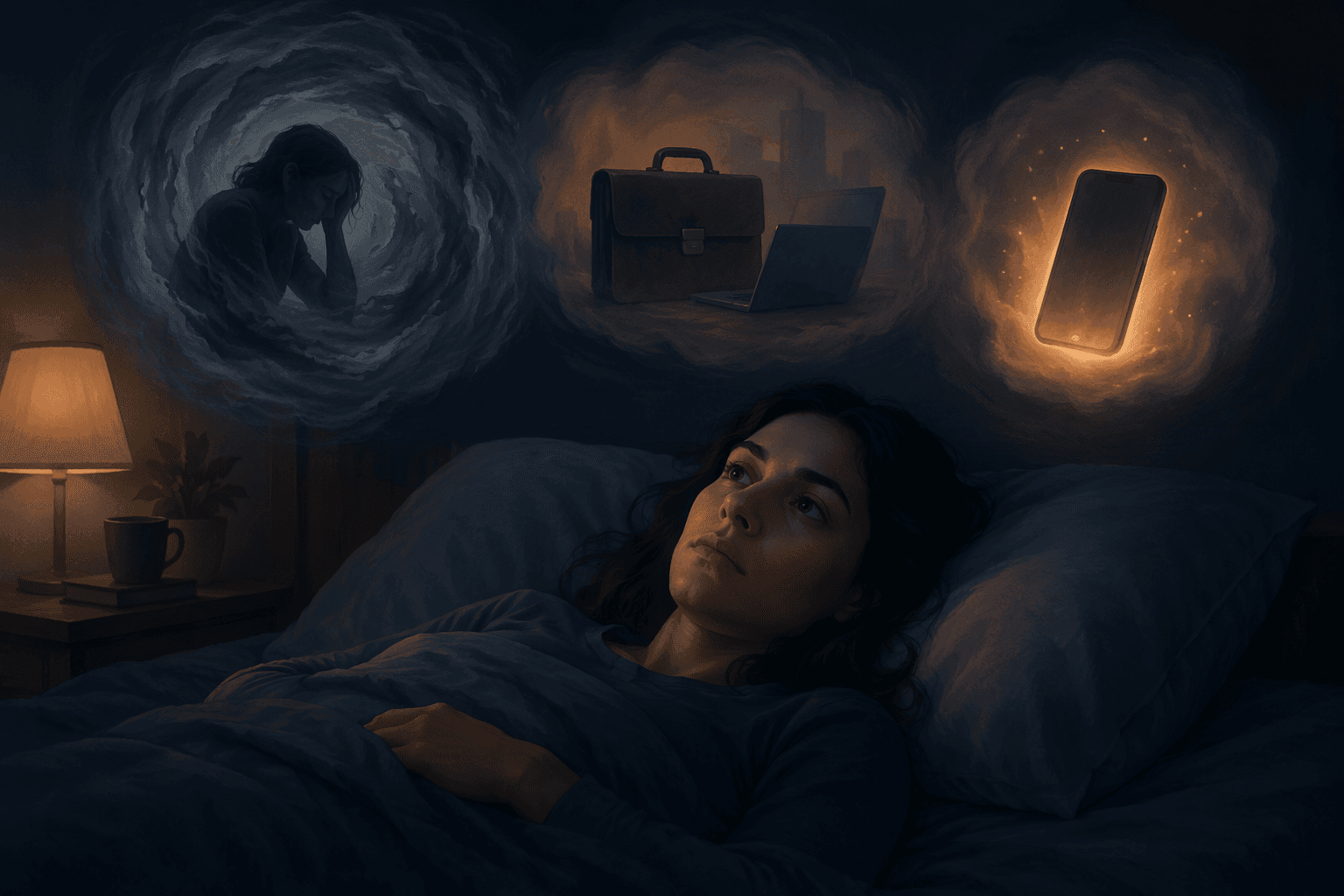
The habits that matter most are also the ones most likely to collide with adult life. In the Resmed survey, the top reported barriers to sleep were stress or anxiety at 39%, work at 22%, and screen use at 21%.[1] Those categories are broad, self-reported, and not proof that any single factor caused a specific sleep problem. Still, they name the places where sleep advice commonly becomes too neat.
Stress does not respect bedtime because bedtime is often the first quiet part of the day. Work does not remain politely at the desk when messages, deadlines, and next-morning obligations follow someone into the evening. Screens are not just “blue light”; they are also unfinished conversations, news, entertainment, shopping, work access, and the easiest distraction from feeling wired.
That means implementation has to be planned, not wished into place. If stress is the main barrier, the useful habit may be a 10-minute worry capture before the wind-down routine: write down the open loops, identify the next action if there is one, and stop trying to solve the whole week in bed. If work is the barrier, the useful habit may be a shutdown cue: close the laptop, write tomorrow’s first task, and move the device out of the bedroom. If screen use is the barrier, the useful habit may be physical distance rather than willpower: charge the phone across the room or outside the bedroom, and use a separate alarm if needed.
None of these removes stress from a life. They lower the number of decisions required at the moment when self-control is usually weakest.
Tier 3 still matters, just later than it is usually sold
Bedroom environment advice is not useless. Light, temperature, noise, mattress comfort, and bedding can all become real barriers. The problem is proportion. Environmental fixes are often easier to market than schedule consistency, so they can appear more central than they are.
The bibliographic review found light represented in 42% of reviewed studies and temperature in 34%.[3] That is enough to take them seriously, especially when the problem is obvious: a streetlight hitting the pillow, a partner’s television, an overheated room, loud traffic, or bedding that makes temperature swings worse. But for many people, these changes work best after the timing anchors are in place.
A useful Tier 3 pass is specific: remove the light that actually reaches your eyes, reduce the noise that actually wakes you, adjust the temperature problem that actually makes you throw off the covers, and fix comfort issues that repeatedly pull attention back to the body. For a fuller breakdown, Restful Ground’s sleep environment optimization guide goes deeper without making the room the whole story.
A 14-day sequence that does not ask you to fix everything
A two-week plan can be useful if it is treated as sequencing, not a challenge to win. Sleep Foundation presents sleep hygiene as a set of practical behaviors and uses a 14-night framework for building better sleep routines.[4] The version below keeps the same incremental spirit but prioritizes the highest-evidence anchors first.
| Days | Primary focus | What to do |
|---|---|---|
| Days 1–3 | Choose the wake anchor | Pick a wake time you can keep on most days. Do not overhaul bedtime yet; observe when sleepiness naturally arrives. |
| Days 4–5 | Add morning light | Get light soon after waking. Pair it with something already happening, such as coffee, breakfast, a commute, or a short walk. |
| Days 6–7 | Stabilize the evening edge | Choose a realistic latest time for work email, chores, or high-stimulation tasks. Make the cutoff visible. |
| Days 8–9 | Set caffeine timing | Move the last caffeinated drink earlier and keep that cutoff steady long enough to judge the effect. |
| Days 10–11 | Check alcohol and late meals | If sleep is fragmented, especially in the second half of the night, adjust alcohol timing or amount before adding new fixes. |
| Days 12–13 | Build a short wind-down cue | Use the same small sequence each night: lower lights, prepare for morning, move the phone, and do one low-stimulation activity. |
| Day 14 | Make one environment change | Fix the most obvious bedroom disruption first: light, noise, temperature, or comfort. Do not buy your way through the whole list. |
The order matters more than the calendar. If the wake anchor takes a full week, take the week. If morning light is easy but caffeine timing is hard, spend the effort there. The plan is not a personality test. It is a way to stop scattering attention across ten half-changed habits.
How to know whether the plan is working
Do not judge the first night too heavily. A habit can be correct and still not produce immediate sleep, especially if stress is high or the previous week was irregular. Track a few plain signals instead: whether the wake time held, whether morning light happened, whether caffeine stayed within the chosen window, whether the phone was moved before bed, and whether sleep felt more predictable by the end of the second week.
If sleep remains very short, severely disrupted, or unsafe because of sleepiness during the day, habit changes are not a substitute for medical care. The same is true when loud snoring, gasping, restless legs, panic symptoms, medication effects, or persistent insomnia are part of the picture. Good sleep habits can support treatment; they should not be used to delay it.
The habits that stick are usually protected, not perfected
The most useful sleep plan is not the longest one. It protects the anchors that carry the most weight, then adds supports where they solve a real problem. Start with sleep-wake regularity and morning light. Then look at caffeine, alcohol, and the transition into bed. Then tune the room.
Good sleep habits fail when they are handed to tired people as a pile of equally urgent tips. They become more durable when the first job is clear, the barriers are expected, and everything else is allowed to be support.
References
- Resmed 2026 Global Sleep Survey, Resmed
- CDC NCHS Data Brief No. 559, 2024, CDC, 2024
- Sleep hygiene bibliographic review, Sleep Medicine Reviews 2024, Sleep Medicine Reviews, 2024
- Sleep Foundation — 14-nights-to-better-sleep framework, Sleep Foundation
Comments
Join the discussion with an anonymous comment.