
When you search “help me sleep,” the problem usually is not one problem. It might mean you cannot fall asleep. It might mean you fall asleep and wake at 3 a.m. It might mean you technically sleep, but not enough to function. The first useful move is sorting the problem instead of throwing every sleep tip at the same exhausted brain.
That sorting matters because sleep trouble is common enough to deserve more than vague reassurance. A 2025 systematic review estimated that 852 million adults globally have insomnia, or 16.2%, based on 18 studies with 262,582 participants across 31 countries; the country coverage is limited, so the number should not be treated as a perfect world census, but it is still a useful scale check.[1] In the United States, 30.5% of adults slept less than 7 hours in 2024, 15.4% had trouble falling asleep most days, and 18.1% had trouble staying asleep most days.[2]
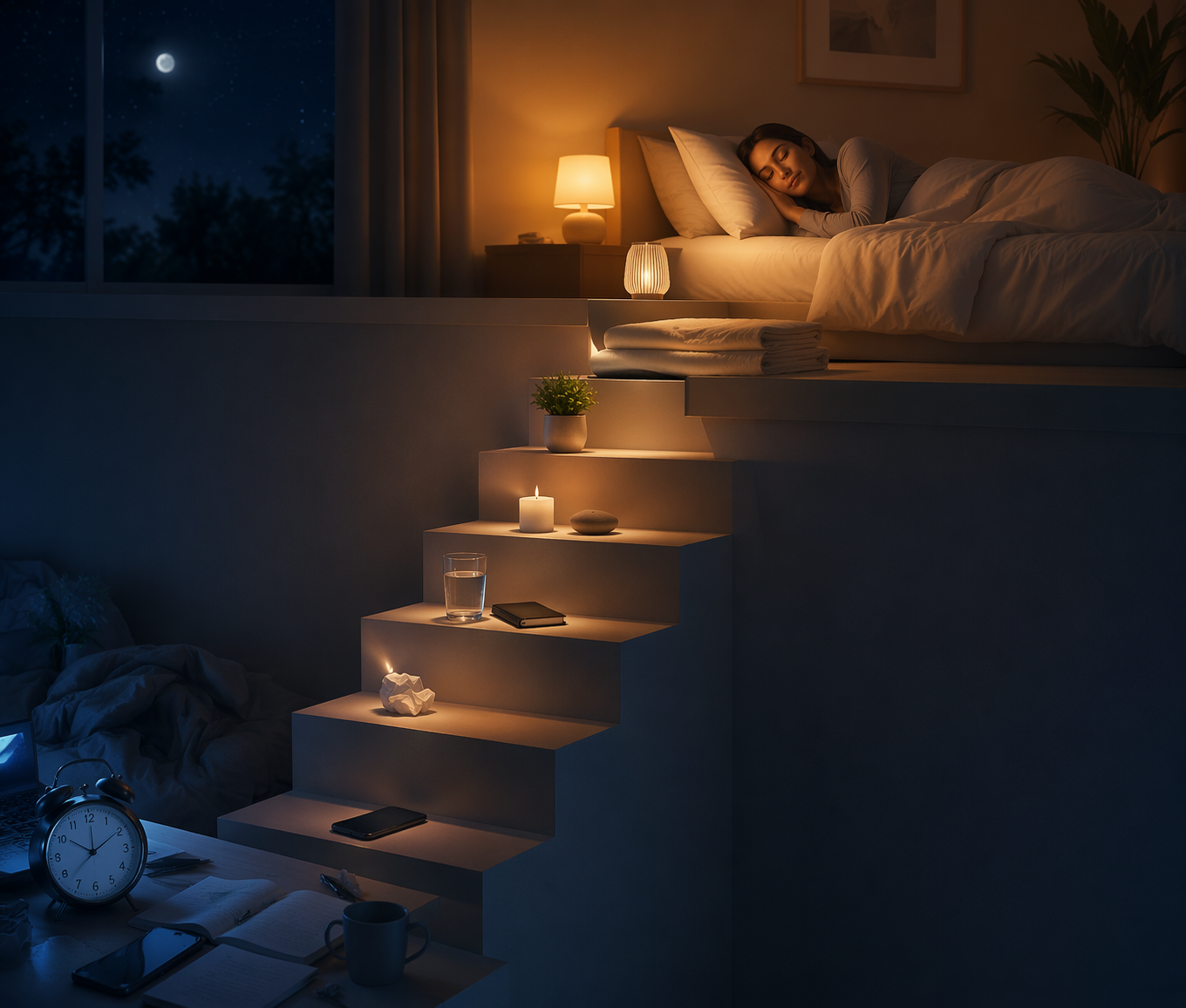
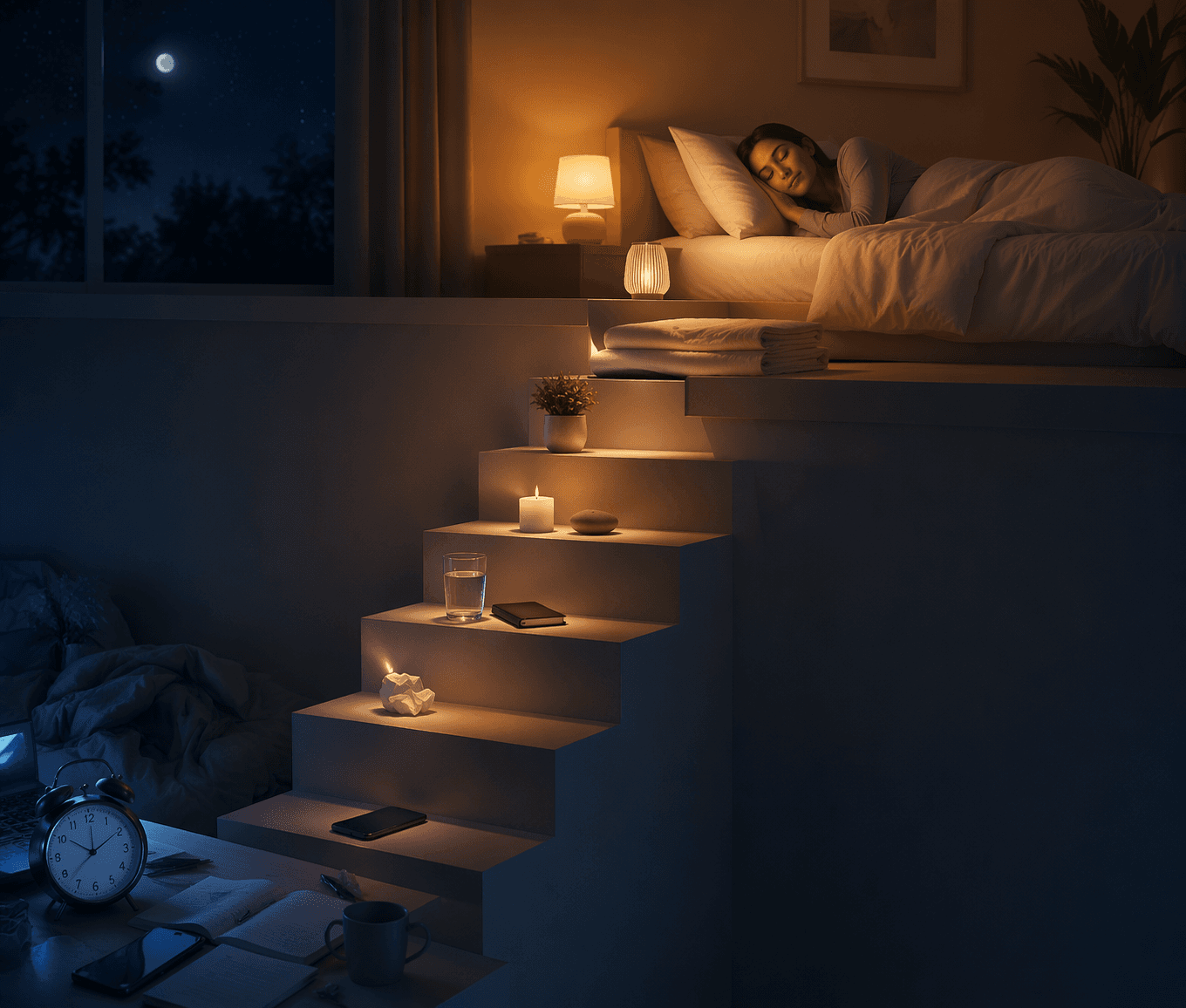
If your first question is whether your pattern is mostly trouble falling asleep, staying asleep, or waking too early, start with trouble falling asleep vs. staying asleep. If your real question is “what should I try tonight, and when should I stop treating this like a bedtime habit problem?” the ladder below is the more useful map.
| Level | Use this when | What changes |
|---|---|---|
| 1. Sleep hygiene foundation | Your schedule, light, caffeine, bedroom, or screen habits are inconsistent | You remove common sleep-disrupting inputs |
| 2. Relaxation and comfort tools | You are tired but physically keyed up, tense, or mentally activated | You give the nervous system a repeatable downshift |
| 3. Stimulus control + sleep restriction | The bed has become a place for waiting, worrying, checking the clock, or trying harder | You retrain the bed-sleep association and reduce excessive time awake in bed |
| 4. CBT-I | Insomnia is chronic, impairing, or not improving with earlier steps | You use the full first-line behavioral treatment for chronic insomnia |
Use this as a way to reduce random trial-and-error, not as a nightly performance chart. Sleep can become harder when every night turns into a test you pass or fail. The point is to choose the next reasonable move, then give it enough consistency to learn whether it helps.
Level 1: Put the basic conditions in place
Sleep hygiene is the foundation: not glamorous, not a cure-all, and still worth doing. The core pieces are a consistent sleep-wake schedule, morning light exposure, a caffeine cutoff about 6–8 hours before bed, a cool bedroom around 65°F, and reducing screens for the last 30–60 minutes before bed.
If you already know your sleep hygiene is chaotic, fix that first. A person drinking late coffee, sleeping in dramatically on weekends, scrolling in bright light until midnight, and working from bed has too many competing signals for the brain to read the night clearly. For a deeper walk-through, use sleep hygiene fundamentals or an evidence-ranked sleep tips guide rather than trying to rebuild everything from memory at 11 p.m.
The catch is important: sleep hygiene alone often fails when insomnia has become chronic. That does not mean you failed at relaxing. It means the problem may have moved from “my evening habits are interfering with sleep” to “my bed and brain have learned a wakeful pattern.” That is where many people get stuck, because they keep polishing the routine instead of escalating the method. The hidden limits of sleep hygiene are usually most obvious in the person who is doing all the “right” things and still spending long stretches awake in bed.
Level 2: Add one relaxation method, not five
Relaxation techniques are useful when your body is acting as if bedtime is a meeting, a deadline, or a minor emergency. They are not all supported by the same level of evidence, and they should not be presented as magic switches. Still, they can give you something concrete to do tonight without turning sleep into a medication decision.
Progressive muscle relaxation
Progressive muscle relaxation, or PMR, asks you to tense and then release muscle groups in sequence. A 2022 randomized controlled trial from UC Irvine found that PMR increased slow-wave sleep time during a daytime nap by 125% compared with passive relaxation, with slow-wave sleep averaging 18.57 minutes versus 9.22 minutes in a 50-person sample.[3] That does not prove PMR cures chronic insomnia, but it is a concrete signal that the technique can change sleep physiology in a measurable way.
A simple version: start at your feet, tense for a few seconds, release, then move upward through calves, thighs, abdomen, hands, shoulders, jaw, and forehead. The release matters more than doing it beautifully. If counting every muscle group makes you more alert, use fewer regions.
4-7-8 breathing
The 4-7-8 pattern — inhale for 4, hold for 7, exhale for 8 — is low-burden and may help some people downshift. The main caveat is the evidence base. A 2022 study of 43 healthy adults aged 19–25, 83.7% female, found increased parasympathetic activity and reductions in systolic blood pressure, heart rate, and LF/HF ratio after 4-7-8 breathing.[4] That is promising for arousal reduction, but it is not the same as proving the method works for older adults or people with clinical insomnia.
Try it for a few rounds if breath-holding feels comfortable. If it makes you air-hungry or annoyed, stop. A relaxation technique that creates effort is no longer relaxing.
Body scan, autogenic training, and comfort tools
Body scan meditation and autogenic training can be reasonable alternatives if muscle tensing or breath counting does not suit you. The practical rule is to choose one method and repeat it for several nights, rather than sampling a new technique every time you get scared that the last one did not work fast enough.
Weighted blankets belong in this middle zone as a comfort tool, not as a core insomnia treatment. In a 2020 randomized controlled trial reported by the American Academy of Sleep Medicine, 120 adults with insomnia and psychiatric comorbidity used weighted chain blankets or control blankets; 60% of the weighted-blanket group achieved at least a 50% reduction in insomnia severity, compared with 5.4% of controls, and 42.2% achieved remission.[5] The psychiatric-comorbidity sample matters. Those results may not translate cleanly to every person with primary insomnia.
The military sleep method can also sit here, but with the volume turned down. It combines muscle relaxation, breathing, and imagery, which are all plausible relaxation ingredients. The popular claim that it works for 96% of people is not backed by peer-reviewed evidence, and desperate people should not be sold certainty they have to blame themselves for missing.[6]
Level 3: When the bed has become the problem
There is a particular kind of insomnia where bedtime becomes rehearsed failure. You get into bed tired, then your mind checks whether sleep is coming. You notice it is not. You calculate tomorrow. The bed stops feeling like a place where sleep happens and starts feeling like a place where you monitor sleep.
This is where stimulus control is different from another bedtime tip. The goal is to rebuild the association between bed and sleep, rather than bed and frustration. Core stimulus-control instructions include going to bed only when sleepy, getting out of bed if you are awake for about 20 minutes, using the bed mainly for sleep and sex, and keeping a fixed wake time regardless of how the night went.[7]
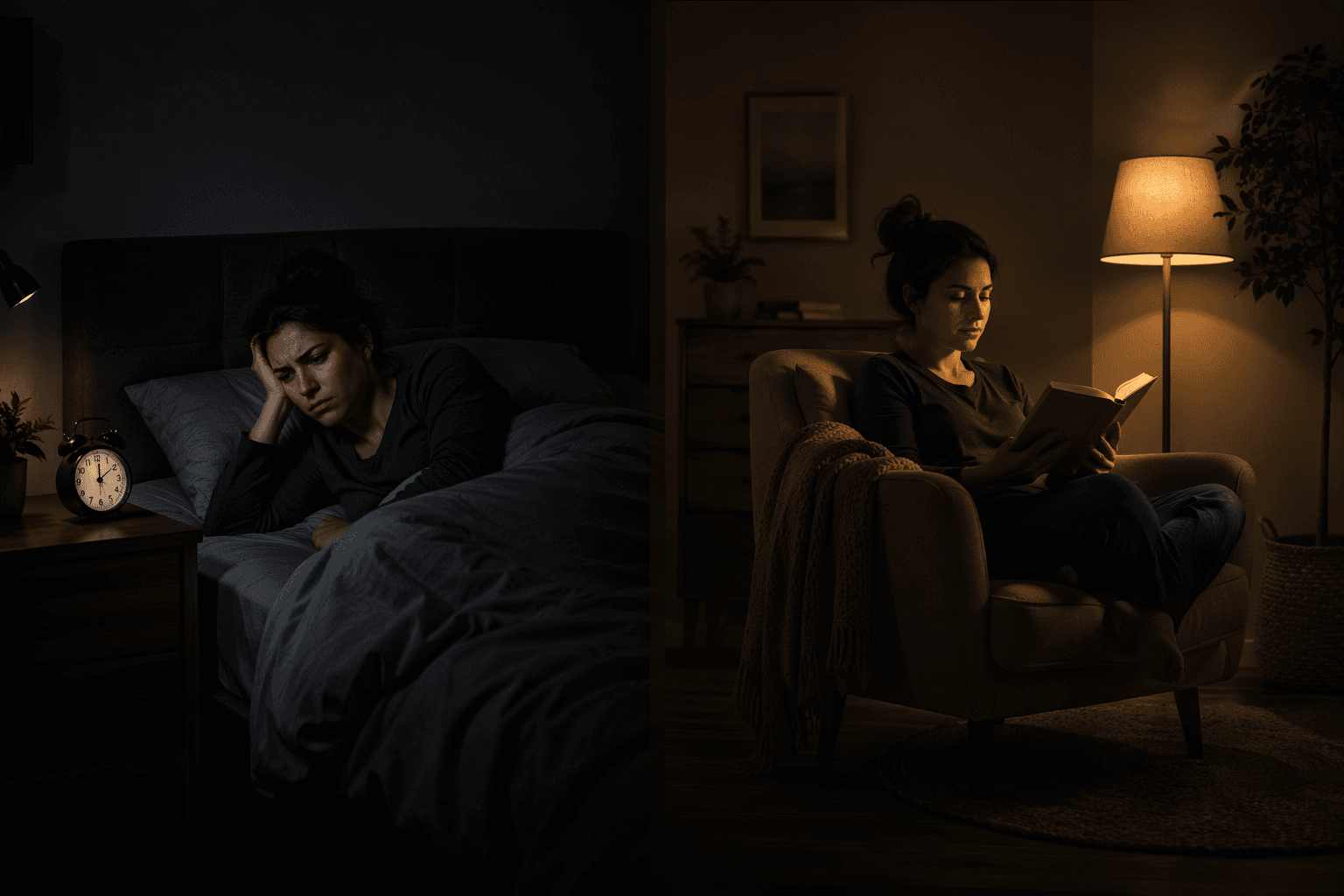
The “about 20 minutes” part is not an invitation to stare at the clock. If you can tell you are awake, frustrated, or trying hard, leave the bed. Sit somewhere dim and boring. Read something quiet. Do not turn the departure into a punishment lap around the house. Return when sleepy.
This can feel insulting the first few nights. A person who has been awake since 2:40 a.m. does not want one more instruction. But the logic is not “try harder.” It is the opposite: stop letting the bed become the place where you practice being awake.
Sleep restriction is not punishment
Sleep restriction is badly named for ordinary ears. It does not mean proving you can survive on less sleep or turning insomnia into a productivity challenge. It means temporarily limiting time in bed so it more closely matches your current sleep ability, then gradually expanding the window as sleep becomes more consolidated. It is one of the behavioral components used in CBT-I.[7]
A hypothetical example: if someone spends 8.5 hours in bed but sleeps roughly 5.5 broken hours, a clinician or CBT-I program may temporarily set a shorter sleep window, keep the wake time fixed, and adjust based on sleep efficiency and daytime safety. That is different from simply deciding, alone and angrily, to restrict sleep because last night went badly.
This is also the point to be careful with over-tracking. A sleep diary can help guide behavioral treatment; a wearable score can become another source of dread. If the data makes you more afraid of your bed, the tool is no longer serving the treatment.
For the larger framework behind this escalation, see why sleep hygiene alone is not enough in a CBT-I framework. Level 3 is often the bridge between ordinary lifestyle cleanup and formal insomnia treatment.
Level 4: When to stop optimizing bedtime and look for CBT-I
CBT-I, or cognitive behavioral therapy for insomnia, is not generic talk therapy with a sleep theme. It is a structured insomnia treatment that usually includes sleep education, stimulus control, sleep restriction, cognitive work around sleep-related fear, relaxation training, and relapse planning. Cleveland Clinic describes a typical course as 6–8 sessions and reports that 70–80% of people with chronic insomnia show significant improvement, citing multiple meta-analyses.[7]
Chronic insomnia is usually defined by trouble sleeping at least 3 nights per week for at least 3 months, along with daytime impairment or distress.[8] If that describes you, the answer is not to keep adding more herbal tea, more sleep sounds, more rules, and more guilt. It is reasonable to look for CBT-I or clinical guidance.
CBT-I is treated as a first-line approach for chronic insomnia by major medical organizations, including the American Academy of Sleep Medicine and the American College of Physicians, and Harvard Health describes CBT-I strategies as preferable to relying on sleep medication for long-term insomnia management.[7][9] That does not make medication immoral or never useful. It does mean that if you want help sleeping without pills, CBT-I is not the fringe option. It is the main behavioral treatment.
Escalate sooner if sleep disruption is causing real daytime consequences: drowsy driving risk, work errors, mood deterioration, caregiving strain, school impairment, or fear of bedtime that keeps growing. A parent, shift worker, caregiver, or student may not have room to turn insomnia recovery into a full wellness project. That is exactly why structured treatment can be kinder than endless advice.
For more detail on the diagnostic line, use a chronic insomnia disorder guide. If menopause is part of the picture, there is also a focused resource on CBT-I for menopause-related insomnia.
Where to place yourself tonight
If sleep trouble is occasional and your basics are messy, start with Level 1 and choose one relaxation method from Level 2. If your basics are already solid and you are still lying awake in bed for long stretches, move to stimulus control rather than adding more bedtime accessories. If the pattern has lasted 3 or more nights per week for 3 or more months, or it is damaging your daytime life, look for CBT-I or talk with a clinician instead of endlessly optimizing the hour before bed.
Natural does not always mean harmless, especially when supplements, alcohol, sedating antihistamines, or multiple remedies get mixed into the same night. If you are experimenting beyond behavioral changes, review home remedies for insomnia safety before stacking more interventions on top of a tired nervous system.
References
- Global prevalence of insomnia: A systematic review and meta-analysis, Sleep Medicine Reviews, 2025.
- QuickStats: Percentage of Adults Aged ≥18 Years Who Had Short Sleep Duration, Trouble Falling Asleep, or Trouble Staying Asleep, by Sex — National Health Interview Survey, United States, 2024, CDC National Center for Health Statistics, 2024.
- Progressive muscle relaxation increases slow-wave sleep during a daytime nap, Journal of Sleep Research, 2022.
- Effects of 4-7-8 breathing on heart rate variability and blood pressure in healthy young adults, 2022.
- Study shows weighted blankets can decrease insomnia severity, American Academy of Sleep Medicine, 2020.
- What Is the Military Sleep Method?, Cleveland Clinic.
- Cognitive Behavioral Therapy for Insomnia, Cleveland Clinic.
- Types of Insomnia, Sleep Foundation.
- Awake at 3 a.m.? Strategies to help you to get back to sleep, Harvard Health Publishing.
Comments
Join the discussion with an anonymous comment.