
If the question is how often to shower for better sleep hygiene, the useful answer is narrower than most bedtime-routine advice makes it sound: use a warm shower as a timing tool, not as a nightly purity test. A warm shower about 1 to 2 hours before bed, with 90 minutes as a sensible starting point, is the part most likely to help sleep onset. Showering every day is not required for that effect, and for many adults, every other day is enough if skin feels better that way.
The strongest synthesis comes from a 2019 systematic review and meta-analysis of 13 studies on before-bed passive body heating. Warm water in the range of 104 to 109°F, used for about 10 minutes or longer and timed 1 to 2 hours before bedtime, was associated with faster sleep onset by about 10 minutes, or roughly a 36% reduction, along with better perceived sleep quality.[1]
The Sleep Move Is Timing, Not Daily Showering
A shower right before bed feels like the obvious choice because it puts the routine close to sleep. The evidence points a little earlier. The body needs time after warm water exposure to release heat through the skin, and that cooling phase is the part that appears to support falling asleep.
| Routine choice | Best starting point | Why it matters |
|---|---|---|
| Water temperature | Warm, about 104 to 109°F | Warm enough to raise skin temperature without leaving you overheated |
| Duration | About 10 minutes | Long enough to create a thermal signal without turning the shower into a long hot soak |
| Timing | About 90 minutes before bed | Falls inside the 1-to-2-hour window linked with faster sleep onset |
| Frequency | Most nights if comfortable; every other day for many adults | The sleep effect depends more on timing than on daily washing |
That 10-minute reduction in sleep onset is modest, which is why it is worth taking seriously. It is not a promise that a shower will override caffeine, stress, pain, late-night light, or an irregular schedule. It is a small mechanical assist for the last part of the evening, when the body is already supposed to be moving toward sleep.
Why Warm Water Can Make You Sleepier Later
The mechanism is not that warm water knocks you out. It is that warm water changes where heat goes. When the skin warms, blood vessels near the surface dilate. More warm blood reaches the hands, feet, arms, and legs, where heat can leave the body more easily. Afterward, core body temperature can decline, and that decline is one of the body’s circadian signals that sleep is approaching.[2]
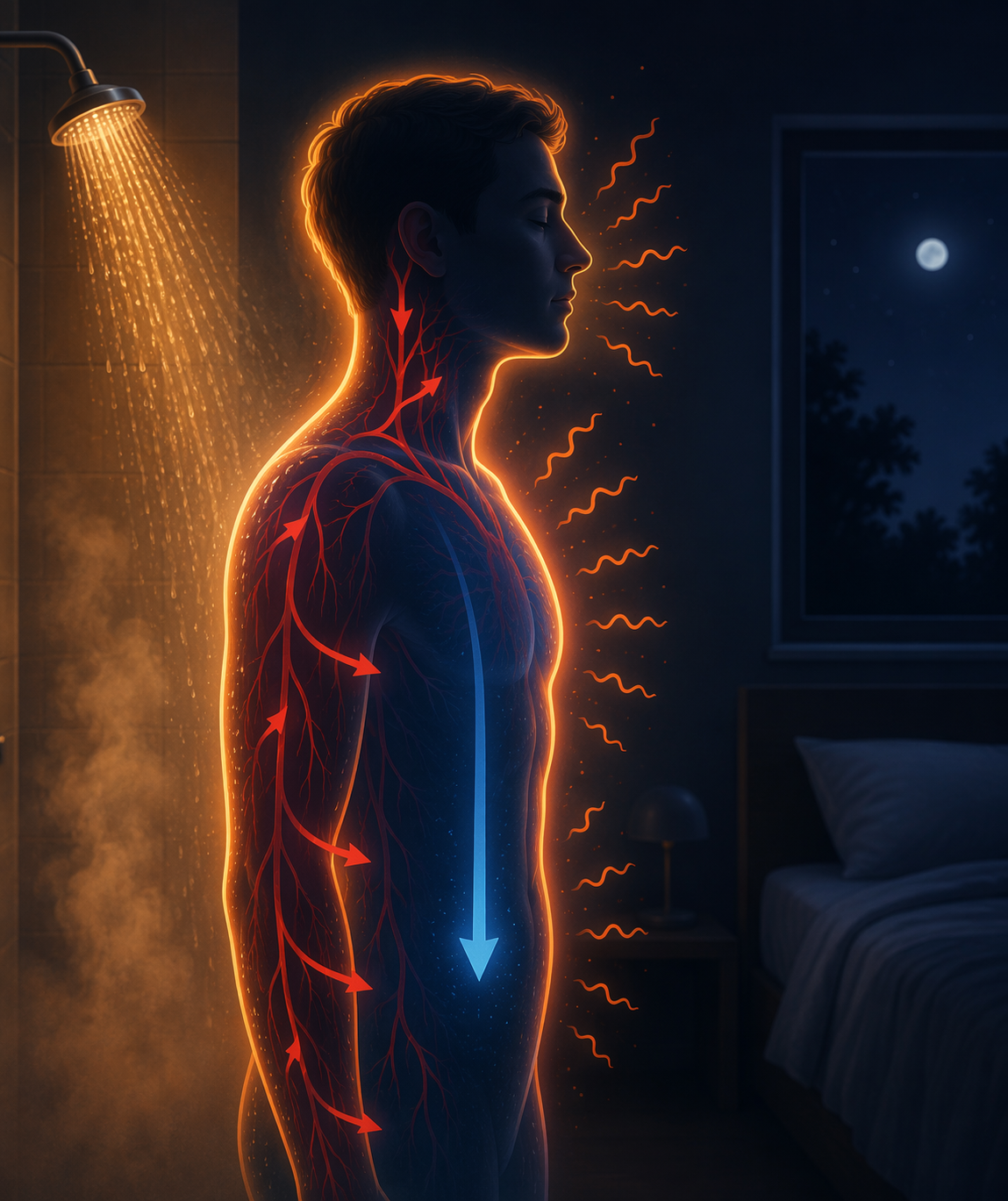
This is also why hotter is not automatically better. A shower that leaves the bathroom steamy, the skin flushed, and the body still hot when the lights go out may push the routine in the wrong direction. The goal is to start the heat-loss process early enough that bedtime arrives during the cooling-down phase, not while you are still radiating heat into the sheets.
It helps to treat 90 minutes as a calibration point rather than a command. Someone who runs warm, lives in a hot apartment, or uses heavier bedding may need the shower earlier. Someone who takes a brief warm rinse and cools quickly may do fine closer to the 60-minute mark. The research window is useful because it gives the routine room to breathe.
What the Bathing Studies Can and Cannot Tell Shower People
One caution matters: much of the strongest evidence is about baths or passive body heating, not the exact U.S. habit of a quick standing shower. The 2019 meta-analysis still includes showers in its question and supports warm water before bed, but the bath evidence carries much of the weight.[1]
A 2023 field study from Japan makes the temperature pathway easier to see, though it should not be treated as a universal rule for every household. In 23 adults, longer bathing of about 16 minutes raised sublingual temperature by about 0.9°C, and sleep onset was shorter after the longer bathing condition than after shower-only nights: 12.3 minutes compared with 20.3 minutes.[3]
That study reflects a bathing culture where tub bathing is more ordinary than it is for many U.S. adults, and the sample was small. Its value here is not to tell everyone to add a bath. It shows the same practical point: when warm water exposure changes body temperature enough, sleep onset can shift.
So How Often Should You Shower?
For sleep hygiene, the answer is: often enough to use the warm-water timing effect when it helps, but not so often that skin irritation starts waking you up. Many adults can start with a warm shower every other night, or most nights if their skin tolerates it. Daily showering is a hygiene preference for some people, not a requirement for the sleep benefit.
Dermatology guidance leaves room for that flexibility. Cleveland Clinic describes daily showering as general guidance, while also noting that daily showers are not necessary for everyone and recommending warm rather than hot water, with showers kept short.[4] BBC Future reports an even looser basic-hygiene threshold, noting that showering twice weekly can be sufficient for basic cleanliness, while also pointing out that people still sweat into bed overnight regardless of shower timing.[5]
The practical middle ground is not glamorous, but it survives a real week. Shower after sweaty workouts, humid commutes, sunscreen, heavy outdoor exposure, or anything that leaves you uncomfortable in bed. On quieter days, especially in dry weather or if your skin is already tight or itchy, skipping the full shower can be the more sleep-friendly choice.
The Skin Problem Hiding Inside “Better Sleep Hygiene”
A bedtime shower can calm the evening down. Too much hot water and soap can do the opposite. Dry skin, tightness, and itching are not side issues if they show up after lights out. They become sleep interruptions.
This is where the word “hygiene” can mislead people. More washing can feel more disciplined, but better sleep hygiene is not the same as maximizing every clean-feeling behavior. If a nightly hot shower leaves the shins itchy, the hands cracked, or eczema-prone skin angry, the routine has started to work against itself.
On off nights, targeted washing is usually enough for many adults: face, armpits, groin, and anywhere visibly sweaty or soiled. That keeps the social and comfort parts of cleanliness intact without putting the whole skin barrier through another round of hot water. People dealing with nighttime itch may also need to look beyond bathing habits; skin inflammation can create its own sleep loop, as discussed in how to break the summer rash itch-scratch cycle at night.
A Routine That Adjusts Instead of Breaking
Start with the version most supported by the evidence: a warm, not hot, shower for about 10 minutes, roughly 90 minutes before bed. Try it on the nights when sleep onset is the main problem, not only on nights when you are already exhausted.
- If you feel pleasantly cooler by bedtime and fall asleep more easily, keep the timing.
- If you feel hot in bed, move the shower earlier, lower the water temperature, or shorten it.
- If your skin feels dry or itchy, skip 1 to 2 full showers per week and use targeted washing instead.
- If exercise, heat, sweat, or odor make you uncomfortable, shower even if it is technically an off night.
- If hot weather is the bigger problem, pair shower timing with room cooling and lighter bedding rather than relying on bathing alone.
Sleep Foundation survey data offers a useful warning about timing. Only 25.3% of U.S. adults reported showering right before bed, and 58.7% of those adults still took 20 minutes or more to fall asleep, which suggests that simply placing a shower at the very end of the night is not the same as using the warm-water effect well.[6]
That does not make a late shower wrong if the goal is to rinse off, feel clean, or remove allergens and sweat. It just separates two jobs that often get blended together. A cleaning shower can happen when cleanliness is needed. A sleep-supporting shower needs enough lead time for the body to cool.
When to Shift the Plan
The same routine will not feel right in July, after a late workout, during a dry winter week, and after a day spent mostly indoors. Adjust the lever that matches the problem.
| What is happening | Change first |
|---|---|
| You are alert and warm in bed | Move the shower earlier or make it less hot |
| You fall asleep faster but wake itchy | Reduce full-shower frequency and protect skin comfort |
| You skip showers and feel unclean in bed | Use targeted washing or a quick warm rinse |
| Hot weather keeps you overheated | Combine the shower with cooling changes in the bedroom |
| Your schedule runs late | Take a shorter warm shower earlier than ideal, or skip the sleep-timing goal that night |
For hot sleepers, the shower is only one part of heat management. Room temperature, bedding, humidity, and airflow can easily overwhelm a well-timed rinse. If that is the pattern, the better companion habit is body-heat dissipation, not a stricter bathing rule; the same principle runs through cooling mistakes that make hot-weather sleep worse.
The Calibrated Answer
For better sleep hygiene, shower every other day if that keeps you clean and your skin comfortable, and use a warm shower about 90 minutes before bed on the nights when you want the sleep-onset benefit. Shower most nights if your skin likes it and your life calls for it. Skip a night or two when dryness, irritation, or late timing would make the routine more disruptive than helpful.
The timing is the sleep lever. The frequency is the skin-comfort lever. Better sleep hygiene comes from coordinating the two, not from turning a warm shower into another rule to fail at 11 p.m.
References
- Before-bedtime passive body heating by warm shower or bath to improve sleep: A systematic review and meta-analysis, Sleep Medicine Reviews, 2019
- Sleep and thermoregulation, PMC, 2020
- Effects of bathing-induced changes in body temperature on sleep, PMC, 2023
- How Often Should You Shower?, Cleveland Clinic
- Is it better to shower in the morning or at night?, BBC Future
- Are We Showering the Right Way For Better Sleep?, Sleep Foundation
Comments
Join the discussion with an anonymous comment.