
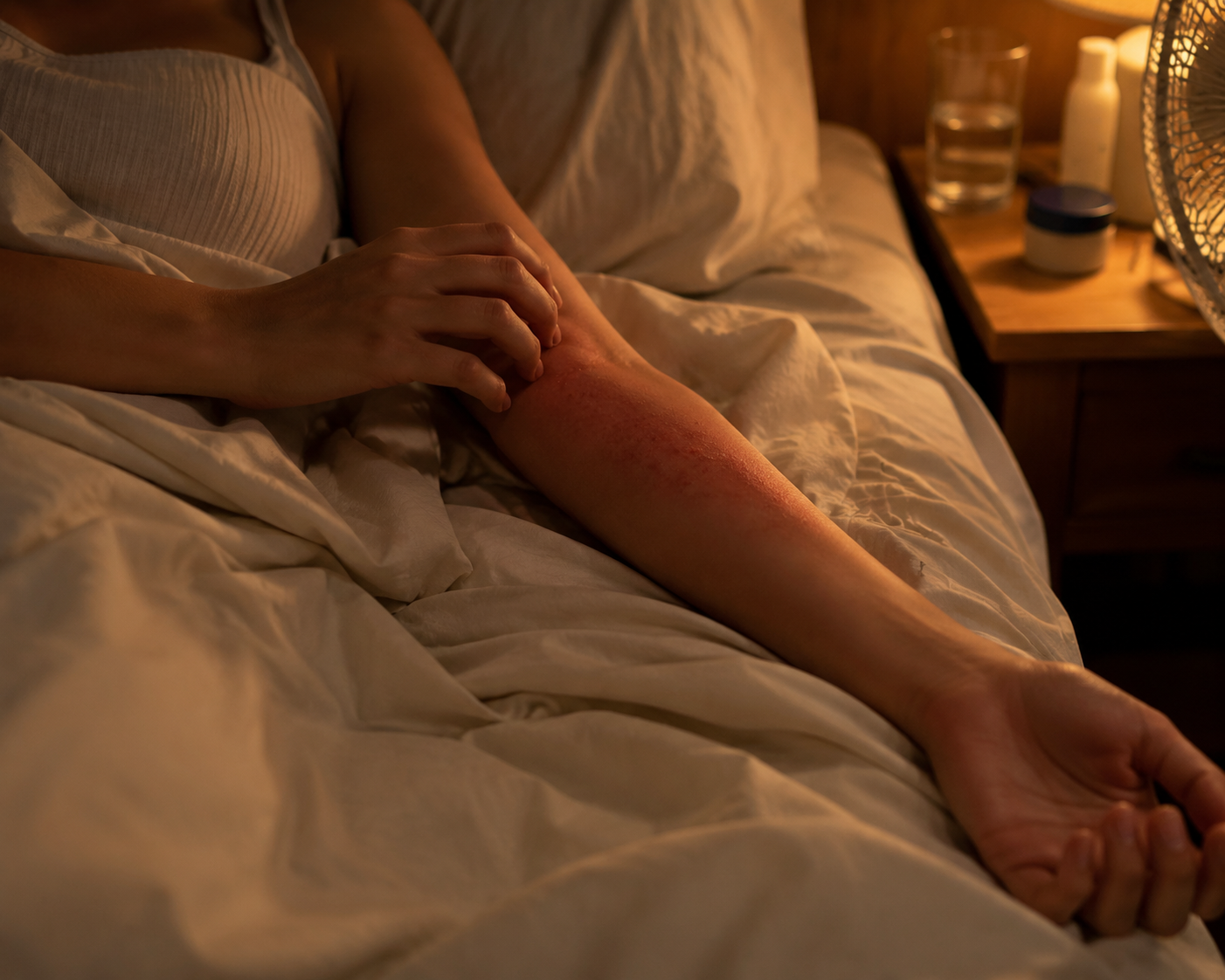
The maddening part of a summer rash is that it can be almost manageable at 8 p.m. and impossible at 2 a.m. The room is warm, the fan is doing something but not enough, and the first scratch feels like a small rescue. Then the skin stings, the sheet catches the irritated patch again, and sleep has to start over.
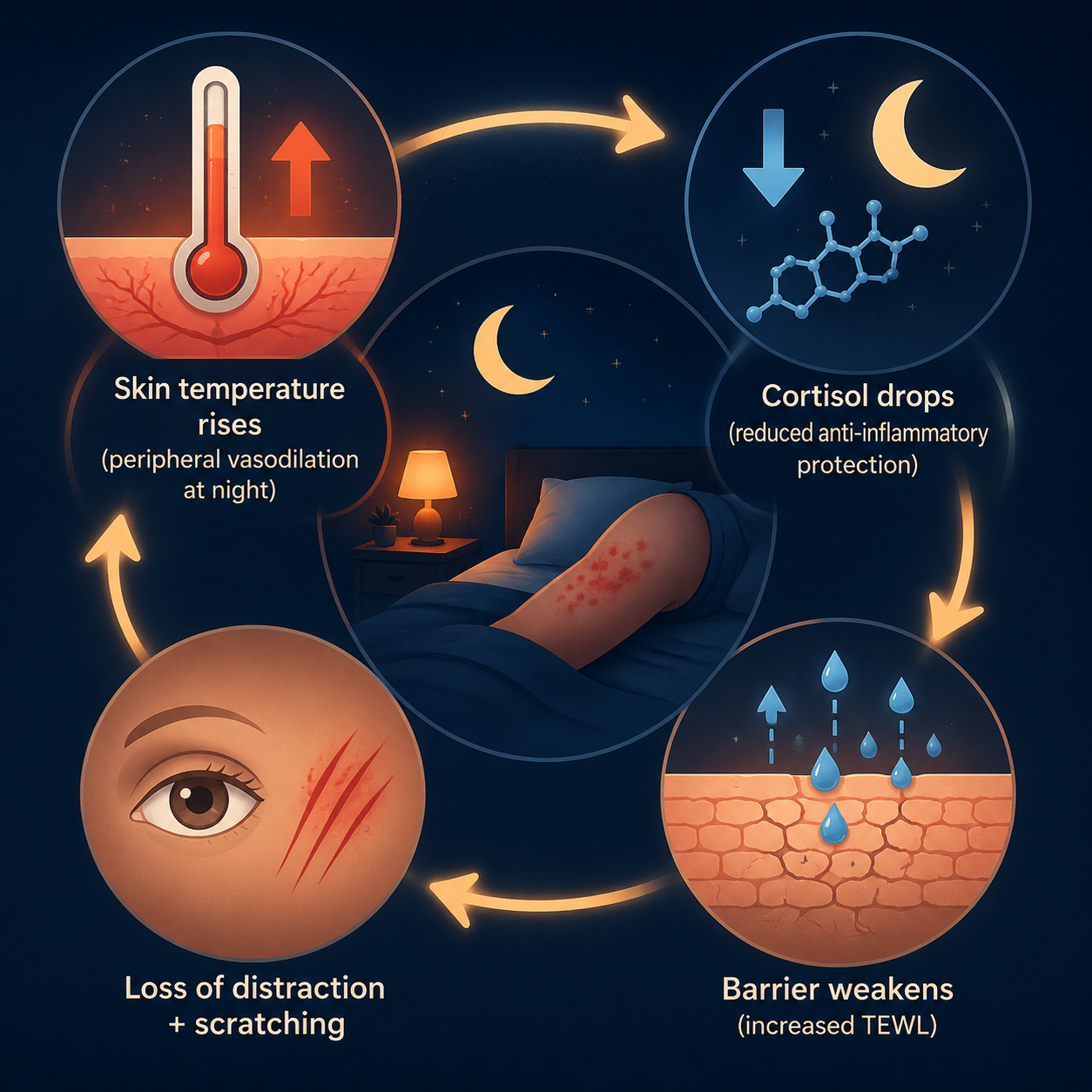
That night-and-day difference is not just mood or impatience. Nocturnal itch has a physiology of its own: skin temperature rises as the body shifts heat toward the surface, cortisol falls to its evening low, transepidermal water loss increases, and the quiet bedroom removes the daytime distractions that were helping your brain ignore the signal.[1] Good summer skin rash sleep remedies work better when they interrupt one of those drivers before scratching takes over.
Why the Same Rash Feels Louder at Night
Several common summer rashes can flare into the same nighttime problem, even though they are not the same condition. Heat rash often improves when sweat ducts stop being blocked and the skin cools. Eczema flares are more tied to barrier failure and inflammation. Hives may involve histamine. Contact dermatitis depends heavily on finding and removing the trigger. At bedtime, however, they can all meet the same sleep problem: warm skin, leaky barrier, friction, sweat, and a brain with nothing else to attend to.
The circadian piece matters because sleep preparation naturally changes heat distribution. As the body cools internally, blood flow to the skin increases, raising skin temperature. In itch-prone skin, that surface warmth can amplify the signal instead of soothing it.[1] This is why a bedroom that feels merely “a little too warm” can become a problem only after you are under covers and trying not to move.
Inflammation also loses some of its overnight restraint. Cortisol, one of the body’s anti-inflammatory hormones, reaches its nightly low in the evening, which may make pruritus worse when the skin is already irritated.[1] At the same time, transepidermal water loss rises at night, weakening barrier function and making it easier for irritants and itch-provoking substances to bother the skin.[1]
The scale is real, though the numbers need careful handling. A review on nocturnal pruritus cited Temple Itch Center data in which 76% of 150 chronic itch patients reported nocturnal pruritus; that figure is useful as a signal, but it was institutional data cited in a review rather than a standalone published study.[1] Stronger published scale data exist for atopic dermatitis: a 2025 meta-analysis of 32 studies and 85,921 participants found a pooled sleep-disturbance prevalence of 43.4%, with a 95% confidence interval of 39.7% to 47.1%.[2] That does not mean every summer rash behaves like eczema. It does mean itch-related sleep disruption is not a fringe complaint.
The Itch-Scratch Cycle Usually Starts With an Arousal
People often imagine scratching as the thing that wakes them. Sleep studies discussed in the nocturnal pruritus review complicate that sequence: scratching primarily occurs in lighter N1 and N2 sleep and usually follows arousal rather than preceding it.[1] In practical terms, the rash may not be dragging you straight out of deep sleep. A small arousal happens first, then the brain notices the skin, then the hand moves.
That sequence changes the target. The goal is not heroic willpower after you are half-awake and itchy. The goal is to reduce the number of arousals that arrive with warm, dry, rubbed, inflamed skin waiting for attention. By morning, the harm is often mechanical as much as inflammatory: more broken skin, more stinging, more visible scratch marks, and a rash that has been kept active by the attempt to sleep through it.
Match the Remedy to the Nighttime Driver
A single “stop itching” remedy is tempting at midnight, but the better question is narrower: which driver is dominant tonight? Heat, water loss, friction, histamine, an ongoing irritant, or plain sleep fragmentation may each need a different move.
| Nighttime driver | What it feels like | Best first move |
|---|---|---|
| Heat load | Itch rises after getting under covers or sweating | Cool the skin and ventilate the room before adding more products |
| Barrier water loss | Skin feels tight, dry, stingy, or rough | Moisturize damp skin and reduce overnight friction |
| Sweat and trapped fabric | Rash worsens where clothing, elastic, or bedding presses | Switch to loose cotton and lighter bedding |
| Possible histamine component | Raised, shifting welts or hive-like itching | Consider appropriate antihistamine use and medical guidance |
| Contact trigger | Rash matches a product, plant, detergent, adhesive, or garment area | Remove the trigger rather than repeatedly sedating the itch |
If Heat Is Driving the Itch, Cool the Skin Before You Sedate the Brain
Cooling is not one tip; it is a sequence. Start with the room, then the skin, then the fabric touching the rash. A cool, well-ventilated sleeping area is part of heat rash prevention guidance, and Harvard Health describes cooling measures such as a fan or air conditioning, a cool shower, and cool compresses as first steps; it also notes that heat rash typically resolves within 1 to 2 days once the skin is cooled.[3][4]
- Ventilate early: cool the room before bedtime rather than waiting until you are already itchy under covers.
- Use a cool compress on the rash for a short period before bed; do not leave damp fabric trapped against the skin all night.
- Choose loose sleepwear so sweat can evaporate instead of pooling under elastic, waistbands, bra bands, or tight sleeves.
- Reduce bedding weight first; adding more topical products while staying overheated often misses the main trigger.
Warm baths need a caveat. A 2019 meta-analysis found that a warm bath or shower at 40°C to 42.5°C, taken 1 to 2 hours before sleep, improved sleep efficiency in general populations, likely by promoting distal vasodilation and later body cooling.[5] That evidence was not specific to adults with inflamed summer rashes. If hot water makes the rash sting, redden, or throb, the sleep finding is not a reason to force it. A cooler rinse may be the better match for irritated skin.
This is still sleep hygiene, but not the vague version where every discomfort gets the same advice. The useful version asks what the environment is doing to the body. For broader context, what sleep hygiene actually means is less about moral discipline and more about reducing predictable triggers before the night becomes unstable.
If the Skin Feels Dry or Stingy, Protect the Barrier
Barrier care is not cosmetic when itch is breaking sleep. Because transepidermal water loss increases at night, going to bed with underprotected irritated skin can mean the rash becomes drier, more permeable, and easier to provoke as the hours pass.[1] The practical window is after bathing or rinsing, while the skin is still slightly damp.
The American Academy of Dermatology advises applying fragrance-free moisturizer within 5 minutes of bathing, while the skin is still damp, and wearing light, loose cotton clothing for eczema-prone skin.[6] Those details matter for summer sleep: fragrance can irritate, damp skin helps seal in water, and loose cotton reduces friction while allowing heat and sweat to escape.
- After a cool or lukewarm rinse, pat rather than rub the rash.
- Apply a plain, fragrance-free moisturizer to damp skin within a few minutes.
- Keep the layer comfortable, not greasy enough to trap heat under bedding.
- Put loose cotton between the rash and scratchy sheets, seams, or elastic.
- Avoid trying a new scented cream, oil, detergent, or fabric spray on a night when the skin is already reactive.
Fabric choice is not a cure, but it can remove a repeated insult. Sleep Foundation guidance for hot sleepers favors breathable materials such as percale-weave cotton or bamboo-derived Tencel or viscose, while noting that synthetic fibers tend to trap heat.[7] For a rash, the point is not luxury bedding. It is fewer sweaty, abrasive contacts during light sleep.
If Hives Are Part of the Picture, Antihistamines Are a Narrow Tool
Some nighttime itching has a histamine component, especially when the rash looks like raised welts that move or change shape. In that situation, an antihistamine may be relevant. Cigna notes that if itching affects sleep, a doctor may recommend a sedating antihistamine for short-term use.[8] The phrase “short-term” is doing real work.
Diphenhydramine can make people sleepy, but sleepiness is not the same as fixing the rash or protecting sleep architecture. Baylor College of Medicine warns that antihistamines such as diphenhydramine have no long-term benefit as sleep aids and that tolerance can develop within days.[9] They can also be risky for some adults, especially older adults or people taking interacting medications. If you are weighing diphenhydramine against melatonin or another over-the-counter product, use a sleep-aid decision guide such as which OTC sleep aid is right for your sleep problem rather than treating every sleepless night as the same problem.
Melatonin May Help Sleep Timing, Not Rash Itch Itself
Melatonin is easy to overstate here. One randomized clinical trial in children with atopic dermatitis found that 3 mg of melatonin at bedtime shortened sleep-onset latency by 21.4 minutes compared with placebo.[10] That is not adult summer-rash evidence, and it does not show that melatonin directly calms heat rash, hives, or contact dermatitis. It suggests a possible sleep-onset role in a pediatric eczema population.
For an adult whose main problem is delayed sleep timing, melatonin might be a separate conversation. For someone waking because hot, irritated skin is being rubbed under sheets, it is unlikely to be the first lever. The evidence nuances are better handled in when melatonin actually works for insomnia, especially if other medicines, pregnancy, chronic conditions, or older age are involved.
A Practical Bedtime Flow
The most useful routine is short enough to do when you are tired. It should lower heat load, seal water into the skin, and remove friction before the first long stretch of sleep.
- Cool the room early: run the fan or air conditioning before bed, open ventilation if conditions allow, and lighten bedding.
- Rinse or compress: use cool to lukewarm water if sweat, sunscreen, pollen, or heat is sitting on the rash.
- Moisturize damp skin: choose fragrance-free moisturizer and avoid new scented products during a flare.
- Dress for evaporation: loose cotton sleepwear is usually kinder than tight synthetic fabric.
- Keep a middle-of-the-night plan visible: cool compress, sip of water, re-cover lightly, hands off the rash as much as possible.
The middle-of-the-night plan matters because decision-making is worse when you are half-awake. If you wake scratching, do not start with a hot shower, a new product, or an online medication experiment. Cool the area briefly, uncover or change the fabric trapping heat, and reapply a small amount of bland moisturizer if the skin feels dry and tight. If heat is the main problem during an outage or weak air-conditioning night, the temperature-management ideas in how to sleep during a power outage are more relevant than adding another sedating product.
When the Rash No Longer Belongs in Self-Care
Self-care is reasonable for a mild heat-related rash that improves as the skin cools, or for a familiar eczema pattern that responds to the usual barrier routine. It is less reasonable when the rash is spreading, painful, blistering, oozing, crusting, warm to the touch, associated with fever, or repeatedly breaking sleep despite several nights of careful cooling and barrier protection.
Contact dermatitis also needs suspicion rather than endurance. If the rash maps to a watchband, adhesive, new detergent, plant exposure, sunscreen, insect repellent, athletic gear, or a waistband, the main remedy is removing the trigger. A sedating antihistamine might help someone get through a bad night, but it will not solve a trigger that goes back on the skin every morning.
The realistic goal is not to make irritated skin silent on command. It is to reduce the conditions that make an arousal turn into scratching: excess warmth, water loss, friction, sweat trapping, and medication choices that solve the wrong problem. A better night is one with fewer awakenings, less scratching after those awakenings, and a morning rash that has not been made worse by the work of trying to sleep.
References
- Nocturnal Pruritus: The Battle for a Peaceful Night's Sleep, International Journal of Molecular Sciences, 2016.
- Prevalence of sleep disturbances in patients with atopic dermatitis: A systematic review and meta-analysis, 2025.
- Heat rash: How to spot it and what to do, Harvard Health Publishing.
- Heat rash, Mayo Clinic.
- Before-bedtime passive body heating by warm shower or bath to improve sleep: A systematic review and meta-analysis, Sleep Medicine Reviews, 2019.
- Eczema types: Atopic dermatitis self-care, American Academy of Dermatology Association.
- Best Sheets for Hot Sleepers, Sleep Foundation, 2026.
- Itching Relief, Cigna.
- Trouble sleeping? Experts say skip antihistamines, Baylor College of Medicine.
- Melatonin Supplementation for Children With Atopic Dermatitis and Sleep Disturbance: A Randomized Clinical Trial, JAMA Pediatrics, 2016.
Comments
Join the discussion with an anonymous comment.