

Start with the kind of awake you are
Most lists of ways to go to sleep treat wakefulness as one blunt problem. That is how you end up doing a breathing exercise when your shoulders are clenched like a fist, or trying to “clear your mind” when the real issue is that your bed has quietly become the place where you rehearse tomorrow.
Before choosing a technique, do a fast read of the barrier in front of you. This is not a diagnosis. It is a practical sorting tool for a night when you need something more useful than another reminder to relax.
| What it feels like | Likely barrier | Try first |
|---|---|---|
| Your mind is on alert, you feel pressure to sleep, or you keep checking whether the technique is working | Anxious arousal | 4-7-8 breathing, box breathing, or paradoxical intention |
| Your jaw, shoulders, stomach, hands, or legs feel tight even when you are lying still | Physical tension | Progressive muscle relaxation |
| Thoughts keep jumping: conversations, tasks, regrets, ideas, plans | Cognitive momentum | Guided imagery or a cognitive redirect |
| You are awake in bed long enough that the room itself starts to feel irritating or charged | Bed-conditioned wakefulness or environmental friction | Stimulus control: leave bed after about 15–20 minutes awake |

Mixed nights are normal. You may start with a tense body, then become anxious because you are still awake, then develop a fresh batch of racing thoughts about how awful tomorrow will be. In that case, begin with the most obvious barrier, give the technique a fair but brief attempt, and switch if the problem changes.
A little delay is not failure
It is easy to turn a normal sleep-onset window into a nightly performance review. Sleep does not usually arrive the second your head touches the pillow. A typical sleep latency is about 10 to 20 minutes, so a short stretch of wakefulness is not automatically a problem and does not need to be treated like an emergency.[1]
That distinction matters because panic about not sleeping can become its own wake-up signal. If you have been in bed for ten minutes and are simply drifting, do less. If you are alert, irritated, rehearsing, bracing, clock-watching, or awake long enough that bed no longer feels neutral, choose the intervention that matches the barrier.
If the problem is an anxious mind, lower the pressure to sleep
An anxious mind usually does not need a more elaborate bedtime ritual. It needs fewer alarms going off inside the body. The giveaway is a monitoring loop: Am I sleepy yet? Why am I not asleep? How many hours are left? Is this breathing pattern working? That kind of attention keeps sleep in the spotlight, which is exactly where sleep performs badly.
Use breathing when your body is acting as if something is wrong
The 4-7-8 pattern gives the mind a simple job and slows the rhythm of breathing: inhale for 4 counts, hold for 7, and exhale for 8. Sleep Foundation and Cleveland Clinic both include it among techniques used to fall asleep faster, while noting the basic structure of the method.[1][3]
- Place the tip of your tongue near the ridge behind your upper front teeth if that feels comfortable.
- Inhale quietly through your nose for 4 counts.
- Hold for 7 counts without straining.
- Exhale slowly for 8 counts.
- Repeat for a few rounds, keeping the counts gentle rather than heroic.
If holding the breath makes you feel more keyed up, use box breathing instead: inhale, hold, exhale, hold for equal counts. The point is not to win at breath control. The point is to give anxious arousal a steadier rhythm to follow.
Try paradoxical intention when trying harder is the problem
Paradoxical intention sounds like sleep advice that has lost a bet: instead of trying to fall asleep, you gently try to stay awake. Verywell Health describes the method as a way to reduce the performance anxiety that can keep people awake.[2]
In practice, that does not mean blasting yourself with stimulation or scrolling under the covers. It means lying quietly with your eyes open or softly resting and dropping the command to sleep. You are removing the test. For some anxious sleepers, that matters more than adding another calming technique to be judged and graded in real time.
If the problem is a tense body, start below the neck
Some sleepless nights are not mainly philosophical. Your mind may not be spinning that dramatically, but your body is still gripping the day. The jaw is set. The shoulders are up. The hands are curled. The stomach is guarded. Telling yourself to calm down from the neck up misses the part that is actually making noise.
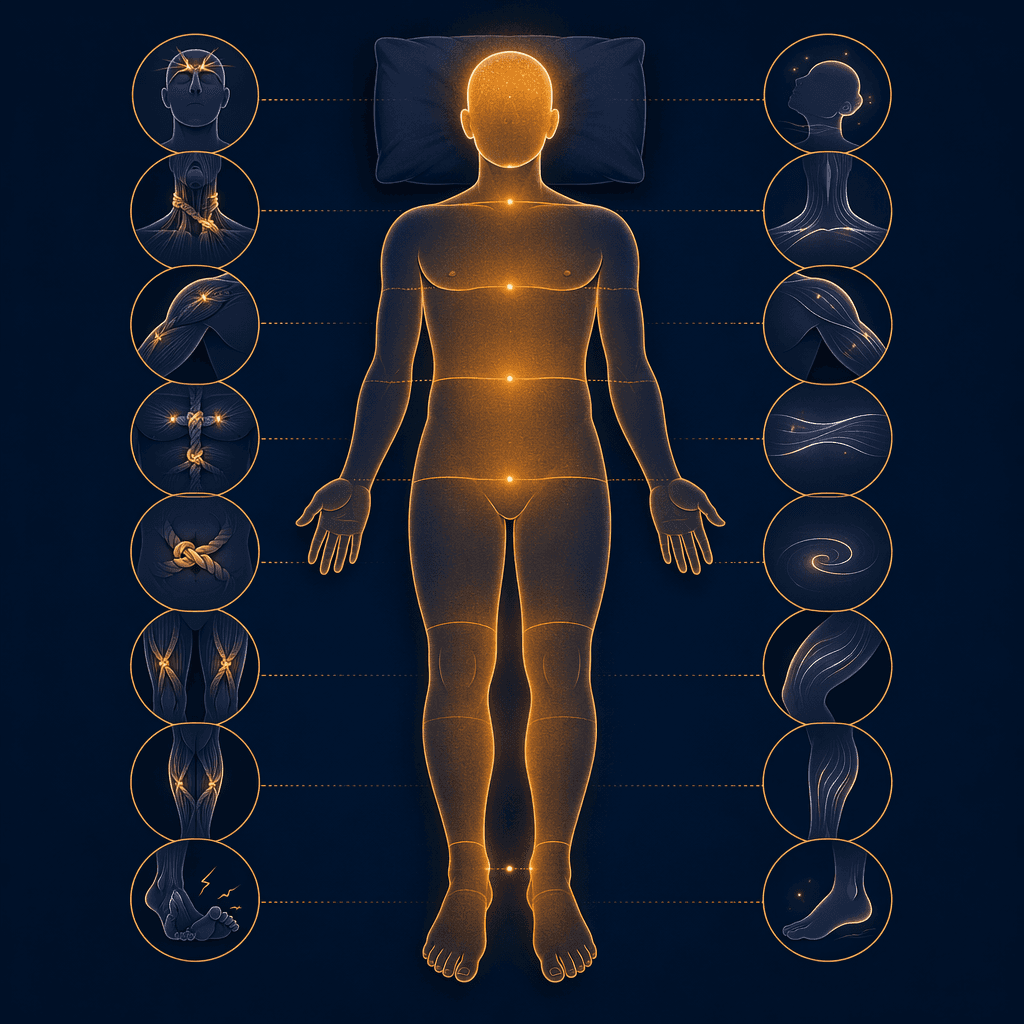
Progressive muscle relaxation is the best fit here because it asks the body to notice the difference between tension and release. It is not just a cozy suggestion; Sleep Foundation identifies progressive muscle relaxation among relaxation techniques for falling asleep, and the research brief notes its use in VA/DoD insomnia guidance as an evidence-based relaxation technique.[1]
- Start at your feet. Gently tense the muscles for a few seconds.
- Release completely, then notice what changes. Do not rush past the release.
- Move upward: calves, thighs, hips, abdomen, hands, arms, shoulders, neck, jaw, and face.
- Keep the effort moderate. This is not strength training in bed.
- Skip any injured or painful area and simply soften around it.
The useful part is the contrast. Many people are carrying tension they cannot feel until they deliberately tighten and release. Once the body has a clear physical cue for “letting go,” the mind often has less to manage.
The military method belongs in the same neighborhood, though it is usually presented as a compact routine: relax the face, drop the shoulders, release the arms, breathe steadily, relax the legs, and use a simple mental image or phrase. Sleep Foundation and Healthline both describe versions of the method as a relaxation sequence, not a guaranteed off-switch.[1][5]
If thoughts are racing, redirect attention instead of trying to erase it
Racing thoughts are not always the same as anxiety. Sometimes they are momentum. Your brain has been problem-solving, planning, remembering, comparing, and narrating all day; then bedtime arrives and you expect silence on command. That demand often creates a second layer of frustration.
Guided imagery works better for this pattern than vague “think positive thoughts” advice because it gives attention somewhere specific to land. Sleep Foundation and Verywell Health both include guided imagery among techniques used when you cannot sleep.[4][2]
- Choose a low-stakes scene: a quiet path, a familiar beach, a cabin, a garden, a slow train ride.
- Add sensory details one at a time: temperature, texture, sound, light, smell.
- When a real-life thought interrupts, label it briefly — planning, remembering, worrying — and return to the next detail in the scene.
- Keep the scene boring enough to be safe. This is not the time for an elaborate plot.
The goal is not to force thinking off. That tends to make thought louder. The goal is to make the next thought less compelling than the one your brain keeps throwing at you. If your mind wants a task, give it a soft, repetitive one.
For thoughts that are sticky because they feel urgent or threatening, a cognitive technique may fit better than imagery. A brief mental label can help: “This is tomorrow-planning,” “This is replaying,” “This is threat scanning.” You are not debating the thought at 1 a.m. You are changing your relationship to it enough that it does not get the whole room.
If bed has become the awake place, leave it
This is the advice people often hate until it works: if you have been awake in bed for about 15 to 20 minutes, get up. Cleveland Clinic and Sleep Foundation describe this stimulus-control approach as a way to keep the bed from becoming associated with wakefulness.[3][4]
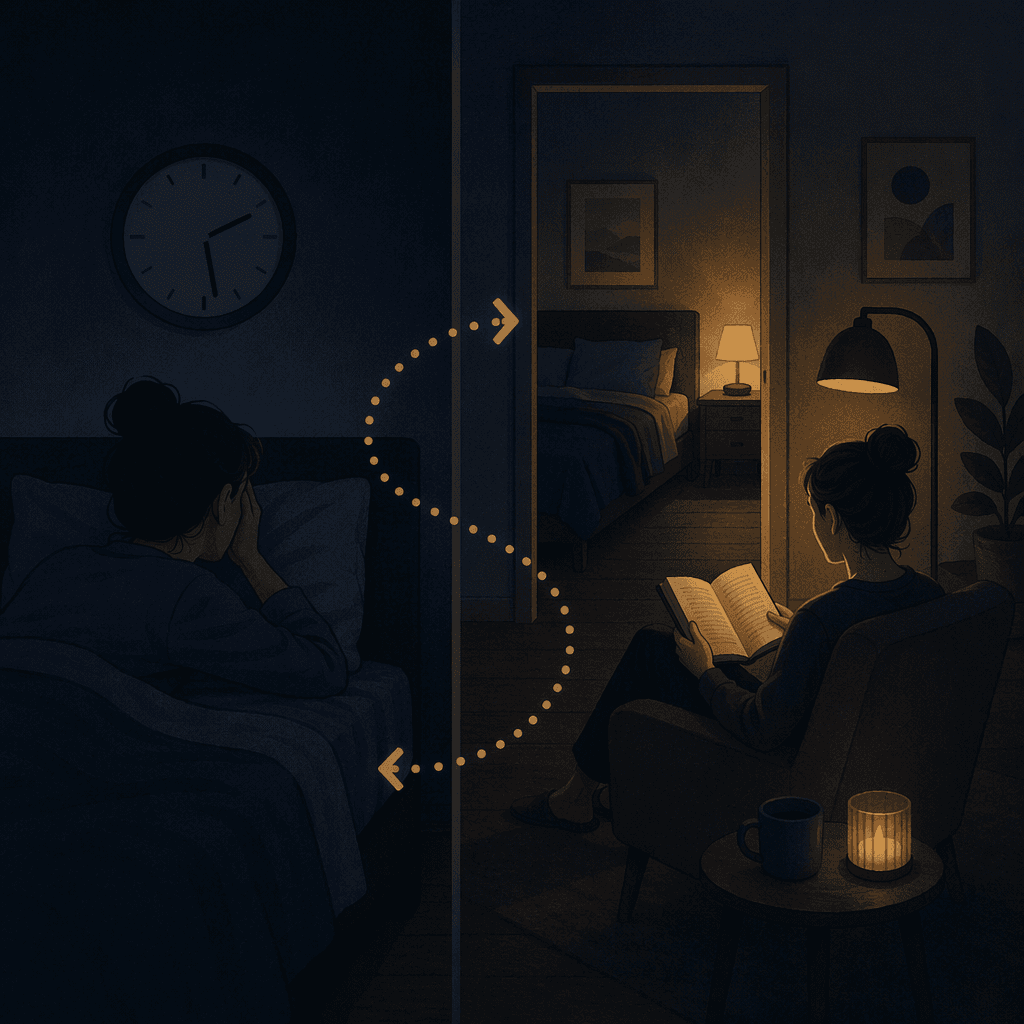
The mechanism is simple and slightly unforgiving. If you spend long stretches awake, frustrated, and alert in bed, the bed can start cueing that state. Then bedtime is no longer just bedtime. It is the opening bell for monitoring, math, irritation, and dread.
Leaving bed is not a punishment. It is a reset.
- Get up without turning the moment into a production.
- Keep lights dim.
- Do something quiet and uninteresting: read a dull book, sit calmly, fold a small amount of laundry, listen to something low-key.
- Avoid checking work, arguing online, cleaning the kitchen with the energy of a new identity, or anything that rewards being awake.
- Return to bed when sleepy, not merely when annoyed.
Do not stare at the clock to measure the 15 to 20 minutes exactly. If watching the time makes you more alert, use the feel of it: you are clearly awake, sleep is not approaching, and bed is starting to feel like the wrong place to be.
Use sleep hygiene as support, not as the whole answer
Sleep hygiene matters. It is just routinely oversold as if every sleepless person is one lavender spray away from repair. If your main barrier is anxiety, tension, racing thought, or bed-conditioned wakefulness, a cleaner routine can help the terrain, but it may not interrupt the thing currently keeping you awake.
Still, the basics are worth checking because they can make every technique harder or easier. Mayo Clinic advises paying attention to caffeine timing, noting that caffeine’s effects can take hours to wear off and suggesting avoiding it in the 6 to 8 hours before bedtime.[6]
That cutoff is a guideline, not a moral law. People metabolize caffeine differently. If you are sensitive, even an early afternoon coffee may interfere; if you are less sensitive, the same timing may not explain your sleep problem. The useful question is whether your pattern changes when you move caffeine earlier or reduce it.
Exercise timing has similar nuance. Mayo Clinic includes regular physical activity among sleep-supporting habits while cautioning against being active too close to bedtime.[6] For many people, vigorous late exercise is more likely to be activating; gentle stretching or quiet evening movement is a different category.
A warm bath or shower can also help some people, especially when timed before bed rather than taken as a last-second scramble. Healthline discusses warm bathing among sleep-onset tips, but the practical point is not that water is magic; it is that a predictable wind-down cue may help the body shift states.[5]
What to do when you cannot tell which barrier it is
When everything feels tangled, choose the least stimulating sequence and stop auditioning techniques every two minutes. A reasonable order is: progressive muscle relaxation if the body feels activated, then a breathing pattern if anxiety is high, then guided imagery if thoughts keep pulling you back. If bed itself starts to feel charged, leave bed and use stimulus control.
The main mistake is stacking techniques in a way that becomes another test: three rounds of breathing, two minutes of imagery, a body scan, a podcast, a supplement search, a clock check, then panic. At that point, the activity level is the problem. Pick one intervention that fits the strongest signal and give it enough quiet to work.
When quick techniques are no longer the right tool
There is a clear boundary here. If trouble sleeping keeps happening several nights a week, lasts for more than a month, and comes with daytime impairment, the conversation has moved beyond quick ways to go to sleep and into clinical insomnia territory.[4]
That is not a personal failure, and it is not proof that you are bad at sleep. Chronic insomnia affects a meaningful minority of adults; a CBT-I primer published on PubMed Central cites prevalence estimates of about 6% to 10%.[7]
At that point, the evidence-supported next step is cognitive behavioral therapy for insomnia, or CBT-I. Sleep Foundation describes CBT-I as a first-line treatment for chronic insomnia and reports that it can be effective for 70% to 80% of people with primary insomnia.[8]
A breathing trick can interrupt a rough night. Progressive muscle relaxation can unclench a body that stayed on duty too long. Guided imagery can redirect a mind that will not stop producing tabs. Stimulus control can retrain the bed to mean sleep again. But if the same barrier keeps returning, night after night, the right answer is not an endlessly longer list. It is a more formal treatment path.
References
- How to Fall Asleep Fast: Science-Backed Tips for Better Sleep — Sleep Foundation — https://www.sleepfoundation.org/sleep-hygiene/how-to-fall-asleep-fast
- How to Fall Asleep Fast: 6 Proven Tips Backed by Science — Verywell Health — https://www.verywellhealth.com/how-to-fall-asleep-fast-8667514
- 10 Tips To Help You Fall Asleep Fast — Cleveland Clinic — https://health.clevelandclinic.org/how-to-fall-asleep-fast
- What to Do When You Can't Sleep — 9 Techniques to Try — Sleep Foundation — https://www.sleepfoundation.org/insomnia/treatment/what-do-when-you-cant-sleep
- 19 Simple Tips to Help You Fall Asleep Quickly — Healthline — https://www.healthline.com/nutrition/ways-to-fall-asleep
- Sleep tips: 6 steps to better sleep — Mayo Clinic — https://www.mayoclinic.org/healthy-lifestyle/adult-health/in-depth/sleep/art-20048379
- Cognitive Behavioral Therapy for Insomnia (CBT-I): A Primer — PMC — https://pmc.ncbi.nlm.nih.gov/articles/PMC10002474/
- Cognitive Behavioral Therapy for Insomnia (CBT-I): How It Works — Sleep Foundation — https://www.sleepfoundation.org/insomnia/treatment/cognitive-behavioral-therapy-insomnia
Comments
Join the discussion with an anonymous comment.