
Merino wool bedding is easy to damage in exactly the ways that matter for sleep. The point of buying it is usually not that it looks delicate on a bed; it is that wool can help buffer temperature swings, move moisture vapor away from the body, remain breathable, and create a lower-allergen sleep surface. In University of Sydney sleep research summarized by Woolmark, participants sleeping in or on wool had 25% more REM sleep in one study, and wool sleepwear was associated with faster sleep onset: 12 minutes versus 22 minutes for cotton and 27 minutes for polyester.[1] IWTO also summarizes wool’s sleep relevance through moisture and temperature regulation, including merino wool’s ability to absorb up to 30% of its weight in moisture vapor while still feeling dry to the touch.[2]
Those findings do not mean every person will sleep better on wool, or that washing technique alone decides sleep quality. They do mean the care routine is not a cosmetic detail. Heat, alkaline detergent, heavy agitation, residue, and machine drying can work against the fiber properties that made the bedding useful in the first place.
Start With the Care Label, Then Use the Gentlest Wool-Safe Routine It Allows
For sleep-focused care, the safest answer is not a universal machine setting. It is a hierarchy: first the product’s care label, then a cold-water wool routine only if the label allows washing and agitation. Some manufacturers permit a wool or delicate cycle with low spin; others discourage machine agitation or spinning altogether. Treat that difference as material, not as fine print.
| Care choice | Sleep-relevant property it protects |
|---|---|
| Cold water, no warmer than 30°C / 86°F | Helps limit shrinkage, felting, lanolin loss, and changes to moisture handling |
| Wool or delicate cycle only, if the label allows it | Protects loft, breathability, and the structure that lets air and vapor move |
| Low spin, within the manufacturer’s limit | Removes excess water without over-compressing or distorting the fibers |
| pH-neutral wool-specific detergent | Avoids alkaline residue that can interfere with the fiber surface |
| No fabric softener | Avoids coating the fiber and reducing moisture movement |
| Flat air-dry, away from direct sunlight | Preserves shape, loft, and surface performance without heat stress |
| No tumble dryer | Avoids heat and mechanical action that can shrink, felt, or distort wool |
A practical machine-wash version, when the label allows it, is: close zippers or fasteners, wash the bedding separately or with only similar wool items, choose cold water up to 30°C / 86°F, select wool or delicate, keep spin low, use a small amount of pH-neutral wool detergent, skip softener, remove promptly, reshape while damp, and dry flat with airflow. Woolroom, Woolmark, and IVAN vanlife all give versions of this cold, gentle, wool-detergent approach, including limits such as 30°C / 86°F and low spin where permitted.[4][5][6]
Cold Water Protects More Than Size
Shrinkage is the obvious fear, but it is not the only reason to keep merino wool bedding out of warm or hot water. Hot water above 30°C / 86°F can wash out natural lanolin, reducing wool’s inherent antimicrobial and moisture-regulating performance.[7] That matters at night because wool’s value is partly its ability to take up moisture vapor before the bed starts feeling clammy.
Merino’s moisture behavior is not the same as a towel soaking up visible water. The sleep-relevant function is vapor movement: sweat vapor and humidity move into and through the fiber before they pool against the skin. British Wool and Bangor University research, summarized by Woolmark and IWTO, found wool duvets transmitted significantly more moisture than feather, down, or synthetic fills and maintained more stable overnight temperatures.[1][2] That is one reason wool belongs in a conversation about bedding materials and sleep quality, not just laundry.
For someone who bought merino because they sleep hot, sweat at night, or wake up damp during seasonal heat, preserving that vapor movement is the point. Cold water is the boring setting that helps keep the fiber’s sleep function intact.
Use Wool Detergent, Not Regular Laundry Detergent With Better Branding
Merino wool needs a pH-neutral wool-specific detergent because many regular detergents are too alkaline for wool fibers.[4] The issue is not fragrance preference or a luxury-care ritual. Detergent residue and harsh alkalinity can alter the fiber surface, which is where moisture handling and the dry-to-the-touch feel begin to suffer.
Use less detergent than instinct suggests, especially in a high-efficiency washer. More soap does not make wool more hygienic; it makes rinsing harder. If residue remains, the bedding may feel heavier, less breathable, or oddly coated. Fabric softener creates a similar problem by intentionally coating fibers, so it has no useful role in a merino bedding wash.
Bleach, enzyme-heavy stain products, and aggressive odor removers deserve the same suspicion. If a stain needs treatment, use the mildest wool-safe approach that the care label permits, and test an inconspicuous area first. The goal is not to make wool behave like cotton; it is to clean it without flattening the properties that help regulate the sleep surface.
Agitation and Spin Decide Whether the Bedding Keeps Its Loft
Wool felts when moisture, heat, friction, and pressure push the scales on the fiber surface to lock together. Bedding does not need to become visibly ruined for the sleep feel to change. A comforter that loses loft can trap air differently. A sheet that becomes harsher or denser can feel warmer, less flexible, and less pleasant against damp skin.
If your label allows machine washing, choose the wool cycle over a generic normal cycle. If there is no wool cycle, use delicate only if the manufacturer permits it. Keep spin low; Woolroom’s care guidance includes a maximum of 800 RPM for merino wool items.[4] A faster spin may remove water efficiently, but it can also compress and strain a large wet item, especially a filled duvet or comforter.
For hand washing, avoid scrubbing, twisting, or wringing. Press water through the fabric, let it soak briefly if the label permits soaking, then press water out with towels. The same principle applies: move soil out without forcing the fibers to grind against themselves.
Drying Is Where Good Washing Often Gets Undone
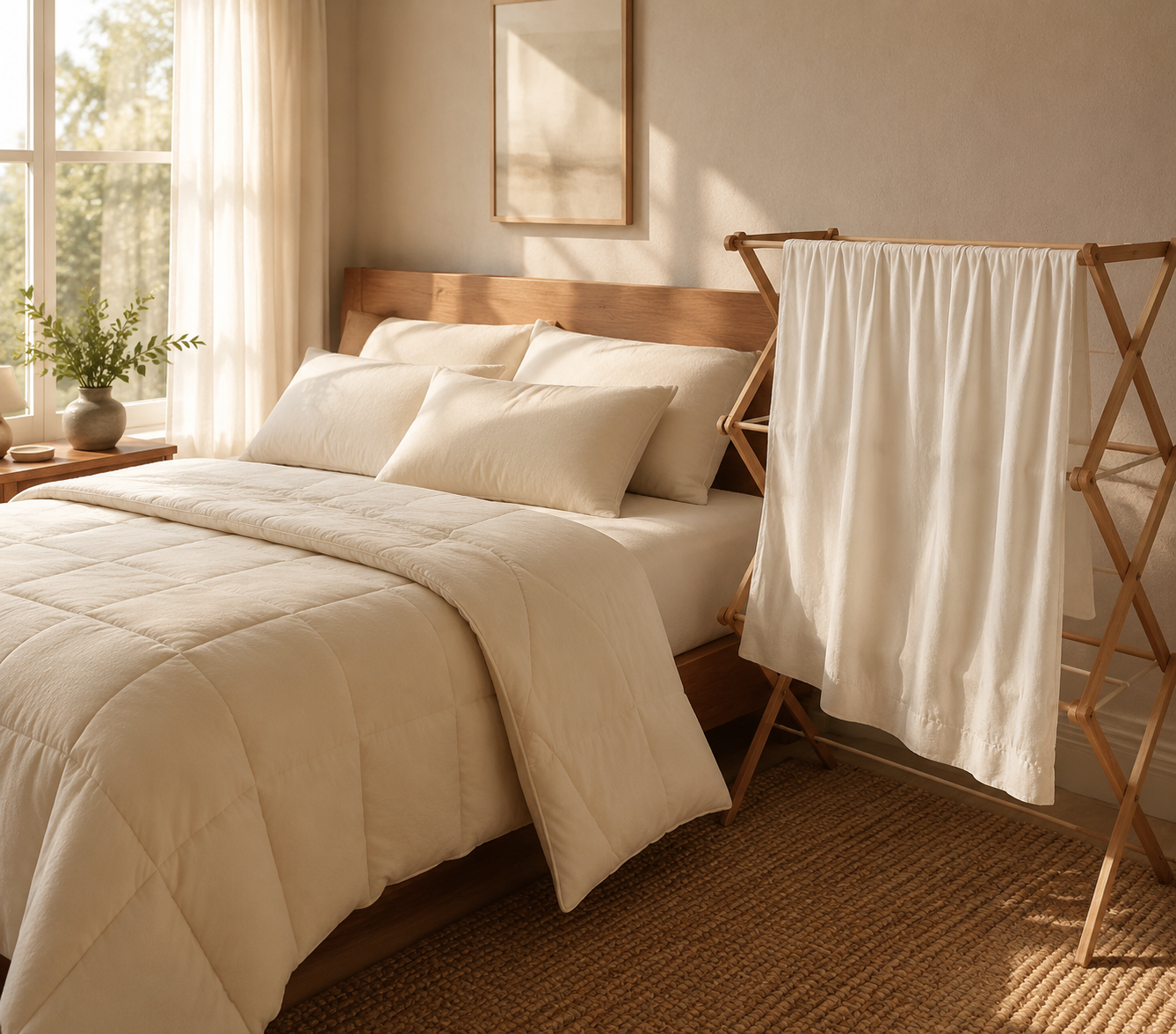
Flat air-drying is slow, but it protects the structure of merino wool bedding better than heat or tumbling. After washing, support the full weight of the damp item, reshape it, and dry it flat over a rack or clean towels with airflow around it. Hanging a saturated wool blanket or comforter from one edge can stretch the fabric or pull fill unevenly.
Avoid direct sunlight while drying. Sun and heat can stress fibers and affect color; more importantly for sleep use, unnecessary heat exposure adds one more chance to change the hand, loft, and moisture behavior of the bedding. Do not use a tumble dryer unless the care label explicitly allows it, and for merino bedding that permission should never be assumed. Woolmark’s blanket-care guidance emphasizes drying flat and avoiding tumble drying unless the care claim permits it.[5]
Plan washing for a day when the item can dry completely before bedtime. Putting even slightly damp wool bedding back on the bed defeats the point of a moisture-managing sleep surface and may leave the room feeling musty.
Sheets, Duvet Covers, Comforters, and Pillows Should Not Share One Schedule
Merino sheets sit closest to skin, sweat, body oils, and skincare products. They need washing more often than a wool-filled duvet protected by a cover. A reasonable merino-sheet interval is every 4 to 6 weeks, rather than the weekly rhythm many people use for cotton sheets, assuming normal use and no illness, heavy sweating, spills, or skin-care residue.[8]
Duvet covers and pillow protectors change the washing burden. If they are doing their job, they absorb most direct contact and can be washed more frequently while the wool fill is left alone. Antipodean Home advises that a duvet cover and pillow protector can dramatically reduce how often the wool fill itself needs washing, with wool duvets or comforters often needing washing only 1 to 2 times per year or less.[8]
| Item | Typical washing judgment |
|---|---|
| Merino sheets | About every 4–6 weeks, sooner after heavy sweating, illness, spills, or noticeable body-oil buildup |
| Duvet cover | Wash more often than the wool fill because it takes the direct skin and oil exposure |
| Wool-filled duvet or comforter | Often 1–2 times per year or less when protected, but follow the manufacturer’s label |
| Merino or wool pillow | About every 3–4 months if washable and protected; clean the protector more often |
Climate and body chemistry matter. Someone sleeping through humid nights, hot flashes, night sweats, or a summer heat wave will load bedding with moisture and salts faster than someone in a cool, dry bedroom. Merino can be part of evidence-based cooling strategies for sleep during a heat advisory, but that does not make the bedding self-cleaning. Air it between uses, wash protective covers on a normal bedding schedule, and wash the wool itself when protection is no longer enough.
Air Out More Often Than You Wash
For wool bedding, airing is not a lazy substitute for washing; it is part of the care strategy. Let the bed breathe before making it tightly. Shake out sheets or covers gently. Give a duvet time outside the cover when humidity or sweat has built up. This supports the same moisture-management system that helps the body shed heat for sleep onset, especially in warm rooms or during nights when you are trying to cool your body without air conditioning.
This is also where allergen expectations need precision. Merino wool bedding has been officially recognized as asthma and allergy friendly by Allergy Standards Limited under ASP: 02-25/101, but that certification does not mean a bed can ignore protectors, ventilation, or routine cleaning.[3] A pillow protector and duvet cover reduce the amount of skin scale, oil, and dust reaching the wool item. They preserve the lower-allergen setup by reducing the need to repeatedly wash the most delicate layer.
When to Override the Routine
Do not force a wool comforter into a home washer because a generic guide says wool can be washed cold. Large wool-filled items become heavy when wet, and crowded drums increase friction. If the label says dry clean only, spot clean only, no spin, no agitation, or professional laundering, follow that instruction. If the item barely has room to move, the machine is too small even if the cycle is technically gentle.
Also override the schedule after illness, spills, visible soiling, persistent odor, or heavy sweat episodes. In those cases, clean the exposed layer first if possible: sheet, pillowcase, protector, or duvet cover. Only wash the wool fill when the soil has reached it or when the manufacturer’s maintenance schedule calls for it.
The usable standard is simple enough to remember but strict enough to protect the bedding’s sleep value: wash less often when covers and protectors are doing their job; wash gently when the wool itself needs cleaning; treat heat, harsh detergent, heavy agitation, high spin, fabric softener, and machine drying as the main threats to the temperature, moisture, breathability, and allergen-related benefits you paid for.
References
- The science of a good night's sleep, Woolmark.
- Wool & Sleep, International Wool Textile Organisation.
- Wool and Dust Mites Allergy Guide, Antipodean Home.
- Does Merino Wool Require Special Care?, Woolroom.
- How to wash and dry wool blankets, Woolmark.
- Washing and caring for merino wool, IVAN vanlife.
- How to Take Care of Wool Filled Bedding, Down Under Bedding.
- How to Wash a Wool Comforter, Antipodean Home.
Comments
Join the discussion with an anonymous comment.