
The 2026 Perseid meteor shower is one of the rare late-night sky events that deserves a real plan, not a vague promise to “stay up.” The peak falls on August 12–13, and the new moon on August 12 leaves the sky at 0% illumination, giving the Perseids the dark backdrop they need.[1] Under good dark-sky conditions, a practical expectation is roughly 50–100 meteors per hour, with the strongest viewing after midnight and especially around 2–4 AM local time.[1][2]
That timing is the whole problem. The best Perseid viewing asks for the part of the night many adults rely on for recovery before work, caregiving, driving, or simply staying emotionally even the next day. The goal is not to pretend the sleep loss does not matter. It is to keep it contained: one planned exception, one recovery day, then back to normal.
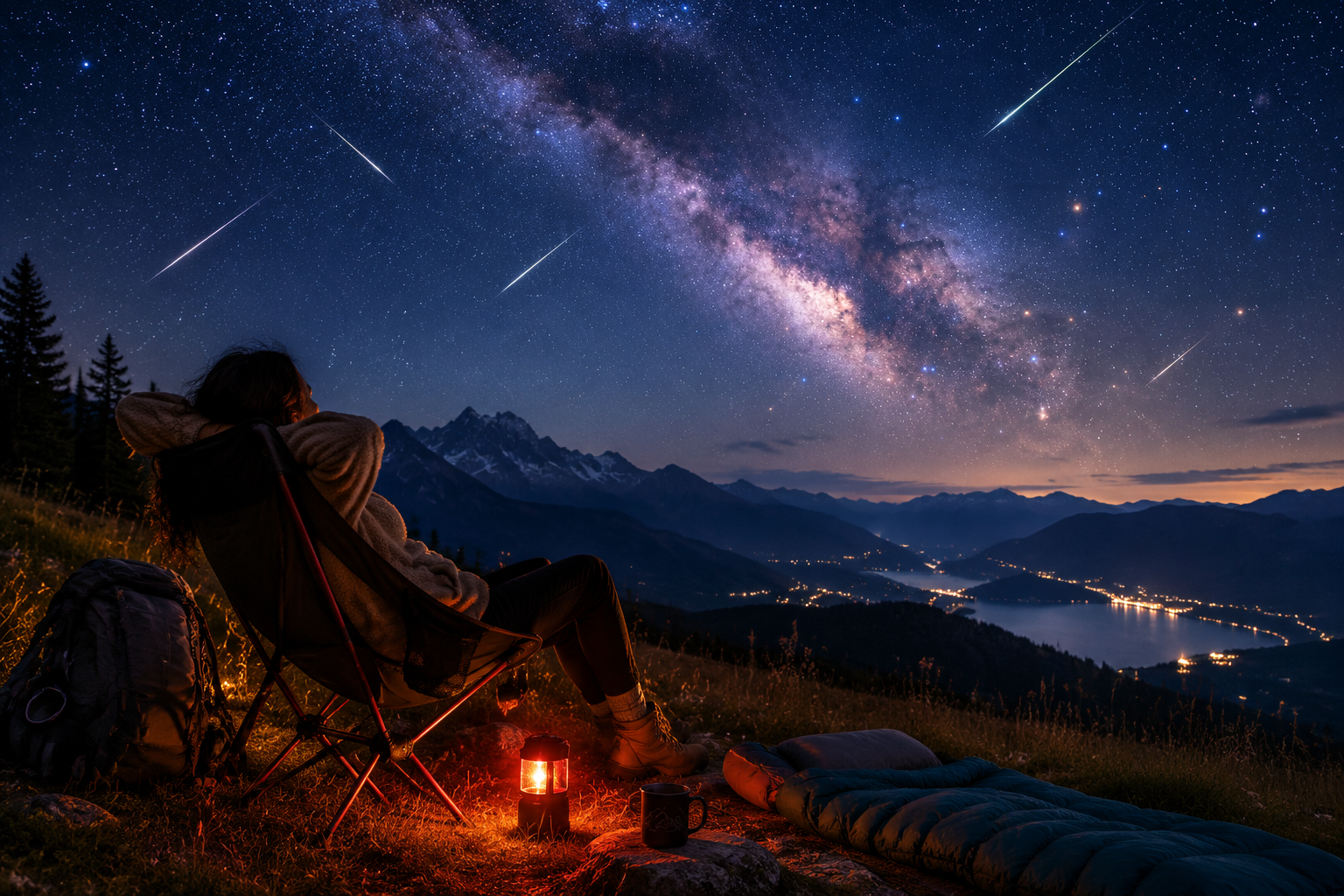
The August 12–13 Sleep Schedule
Use this as the default plan if you are a healthy adult, you can protect the next morning from anything safety-critical, and you are viewing close to home or have a non-drowsy ride arranged. Adjust the clock times slightly for your normal schedule, but keep the sequence intact.
| Time | What to do | Why it matters |
|---|---|---|
| Morning, August 12 | Wake at your normal time. Do not sleep in to “bank” the night. | A normal wake time keeps the day anchored and makes the recovery night easier. |
| Before 3 PM | Take a 20–30 minute nap if you can. | A short nap reduces sleep pressure without making it harder to fall asleep later.[3] |
| After 3 PM | No long naps. Keep caffeine moderate and early enough that it does not drift into the viewing window. | Late sleep and late caffeine are the easiest ways to turn one late night into two. |
| Evening | Pack layers, reclining chair, water, snacks, red light, and any medication you normally need. Decide before leaving who drives home. | The more decisions you make at 1 AM, the more likely you are to make the reckless one. |
| 10:30–11:30 PM | Dim indoor lights. Put your phone in night mode, then mostly away. | The sky itself is not the melatonin problem; bright devices are. |
| Midnight–2 AM, August 13 | Begin viewing from a dark location. Let your eyes adapt. Look broadly, not only at the radiant. | Rates improve after midnight as your location rotates into the meteor stream.[1][2] |
| 2–4 AM | Make this the protected viewing window. | This is the best practical window for the highest visible rates on peak night.[1][2] |
| 4–4:30 AM | Stop while you can still travel safely. Wind down without scrolling. | The last 30 minutes can decide whether recovery starts now or gets postponed. |
| Morning, August 13 | Get morning outdoor light soon after waking. Delay caffeine about 90 minutes if your schedule allows. | Light re-anchors the body clock; delayed caffeine avoids stacking stimulation onto grogginess.[5][6] |
| Before 3 PM, August 13 | Take one optional 20-minute recovery nap if needed. | Keep it short and early so the normal bedtime still works.[3] |
| Night of August 13 | Go to bed at your normal bedtime, not dramatically early. | A stable bedtime helps the disruption end after one night. |
If your sleep timing runs unusually early or late, use the same principles rather than forcing the exact clock. A dedicated chronotype version is a better fit if you already know that 2 AM is either painfully late or barely late for you: Perseid Meteor Shower Best Viewing Time for Your Sleep Type.
Why 2026 Is Worth the Exception
The Perseids are reliable enough to plan around most years, but 2026 removes one of the biggest viewing spoilers: moonlight. A new moon on August 12 means the peak night is not fighting a bright lunar sky.[1] That does not guarantee clear weather, dark surroundings, or your personal stamina. It does mean the calendar is unusually cooperative.
There is some peak-time fine print. Predictions can shift as August approaches, and one published estimate places the peak around 14:53 UTC on August 13, which may favor Europe and Africa for the absolute maximum.[1] For a North American viewer making a real-life sleep decision, the actionable answer does not change much: the pre-dawn hours of August 13 are still the window to protect.
Meteor-rate numbers also need a little honesty. The American Meteor Society lists the Perseids with a zenithal hourly rate of 100, while some guides publish higher theoretical figures under ideal assumptions.[2] A person on a blanket or in a camp chair should not treat any single number as a promise. Under dark, clear skies, 50–100 meteors per hour is a better planning range than a guarantee.
The Viewing-Night Plan, With the Failure Points Removed
Keep the morning ordinary
Start August 12 with your normal wake time. Sleeping in may feel like a clever way to prepare, but it blurs the circadian signal you will need the next night. The body does better when the exception is placed in the middle of an otherwise recognizable routine.
If you already wake sleep-deprived, treat that as information, not a challenge. A meteor shower is not a good reason to add acute sleep loss on top of a week that has already been running on fumes.
Nap early, and stop before it becomes a second sleep
The nap belongs before 3 PM, and it should be short: 20–30 minutes. Sleep Foundation guidance on napping places that range in the useful zone for alertness while limiting grogginess and reducing the chance that the nap interferes with nighttime sleep.[3]
Set an alarm before you lie down. If you know you routinely sleep through short nap alarms, skip the nap rather than taking a 90-minute accidental detour at 4 PM. The purpose is to shave off pressure, not move bedtime into the afternoon.
Prepare like you are protecting a drive home, not staging a photo
Pack before dinner: warm layers, a reclining chair or pad, water, quiet snacks, a red-light flashlight, a power bank you hope not to use, and any normal nighttime medication or medical supplies. If you need to drive, decide the return plan before you leave. A beautiful sky is not a mitigation plan for drowsy driving.
This is also the moment to choose the lower-yield version if the logistics are bad. Watching from a nearby dark-ish yard between midnight and 1:30 AM may show fewer meteors than a remote site at 3 AM, but it may be the right decision if the alternative is a long, sleepy drive home.
Protect darkness from indoor light, not from the sky
A moonless dark-sky field is extremely dim, roughly 0.0001–0.001 lux in one sleep-and-meteor synthesis that cites light-exposure research; that is far below the light levels associated with strong melanopsin activation.[4] The stargazing itself is not the obvious melatonin hazard. The bright phone in your hand is.
That same synthesis contrasts moonless outdoor darkness with indoor device exposure and cites research in which evening screen light delayed melatonin timing by about 90 minutes.[4] Because the source is a commercial mattress retailer, treat it as a synthesis rather than an independent authority; the practical point is still sound and boringly important: use red light, dim the screen if you must check it, and avoid scrolling while you wait for the sky to improve.
- Turn on red-light mode before you leave home, not after your eyes adapt.
- Download maps, weather, and sky information in advance.
- Use audio timers instead of repeatedly checking the time.
- If you take photos, batch the attempts instead of looking at a bright screen every few minutes.
Give midnight to 2 AM a quieter job
Midnight is when the plan becomes real, but it does not need to become intense. Settle in, let your eyes adapt, and look at a wide portion of sky. The Perseids appear to radiate from Perseus, but meteors can streak across large areas of the sky; staring rigidly at one point is less useful than having a broad, dark view.
This early stretch is also when you should notice whether the night is actually working. If clouds close in, the site feels unsafe, or you are already fighting sleep hard, leave before 2 AM. The peak window is valuable, but it is not owed the rest of your judgment.
Treat 2–4 AM as the main event
The 2–4 AM stretch is the reason this schedule exists. Meteor activity improves after midnight and into the pre-dawn hours because your side of Earth is rotating into the debris stream.[1][2] On the 2026 peak night, that timing pairs with new-moon darkness, so this is the window most worth defending from distractions.
Defending it does not mean adding stimulants at 2 AM unless you have already decided that is necessary and safe for your situation. Late caffeine can push the problem into the recovery day. If you use caffeine, keep it earlier and modest; if you need a large dose to stay awake, that may be your body voting against the plan.
Stop before the night becomes careless
A clean stop around 4 AM is not a failure. It is how the plan avoids becoming a slow-motion all-nighter. Pack while you are still coordinated, keep lights dim, and do not use the drive home as the time to catch up on messages.
If you feel drowsy, do not drive. Use the backup ride, nap safely before leaving, or choose a viewing site where staying put is allowed and safe. The practical sleep schedule depends on a non-negotiable safety boundary.
What the Lost Sleep Is Likely to Cost
The main physiological cost of Perseid peak viewing is not mysterious: you are borrowing from late-night sleep. Later sleep cycles contain more REM sleep than the first part of the night; one synthesis describes REM as roughly 50–60% of late-sleep-cycle time compared with about 15–20% in the first cycle.[4] A 2–4 AM viewing window therefore tends to cut into REM-rich territory.
That does not make the night harmless, and it does not make it catastrophic. A single disruption in a healthy adult is different from chronic sleep restriction. The same sleep synthesis, citing sleep-deprivation research and clinical sleep references, describes REM rebound and functional recovery over one to two recovery nights for many healthy adults after a single deprivation event.[4] The narrower, safer conclusion is this: if your sleep is otherwise stable, the plan is usually recoverable; if your sleep is already unstable, the same night can land harder.
For a broader look at the trade-off between the Perseids, sleep loss, mood, and next-day function, use How the Perseid meteor shower affects your sleep and health. This article is narrower: it is about keeping the 2026 peak from spreading into the rest of the week.
Who Should Modify the Plan or Skip the Peak
The full 2–4 AM plan is for most healthy adults, not everyone. The phrase matters. Some people should choose an earlier, lower-yield viewing window, and some should skip the peak night entirely.
- Skip or shorten the plan if you have an early safety-sensitive shift, professional driving, a long solo drive, or caregiving duties that require sharp attention the next morning.
- Be cautious if you are already carrying major sleep debt; the recovery estimate is not meant for someone starting from a deficit.
- Modify the plan if you have chronic insomnia, a circadian rhythm disorder, untreated or poorly controlled sleep apnea, or a history of one late night turning into several.
- Choose a nearby site or earlier window if the only dark-sky option requires a long return trip after 4 AM.
- Do not use alcohol as a sleep aid after viewing; it may make sleep feel easier while worsening sleep quality.
A perfectly respectable alternative is to watch from midnight to 1:30 AM, accept fewer meteors, and keep the next day intact. Another is to use a general protection plan rather than a peak-maximizing schedule: How to Enjoy the Perseid Peak Night and Protect Your Sleep is the better fit if you want the event without building the whole night around the maximum.
The Recovery Day Matters More Than the Perfect Bedtime
August 13 is where many well-intended plans come apart. People survive the viewing window, then sleep until noon, drink caffeine late, nap at 5 PM, and wonder why Thursday night feels strange. Recovery is not punishment. It is timing.
Get light soon after waking
Morning light is the first recovery tool. Sleep Foundation guidance on circadian rhythm emphasizes light-dark timing as a major cue for shifting or stabilizing the body clock, and Oura’s recovery guidance recommends getting sunlight within 30 minutes of waking after a bad night.[5][6] You do not need a heroic sunrise hike. You need outdoor light early enough that your brain receives a clear “day has started” signal.
Avoid the snooze-button spiral if you can. A short extra doze may feel merciful, but repeated alarms make the morning mushy and delay the first strong circadian cue of the day.
Use caffeine as a tool, not a rescue flare
If your schedule allows, wait about 90 minutes after waking before your first caffeine. Oura recommends that delay as part of a bad-sleep recovery routine, and it is best treated as practical guidance from a wearable company rather than a medical rule.[6] The useful idea is to avoid slamming caffeine into the first groggy minutes and then needing more late in the day.
Cut caffeine early enough that it does not steal the recovery night. The exact cutoff varies by person, but the principle is simple: the recovery bedtime is the main event now, not the afternoon productivity fantasy.
Take one recovery nap, or none
If you are dragging, take a 20-minute nap before 3 PM. This is the same nap logic as the viewing day: short enough to reduce sleepiness, early enough to protect the night.[3] Do not turn the recovery nap into a second sleep period unless illness, safety, or an unusual schedule requires it.
If you feel unsafe to drive, work, or care for someone, that is not a nap-optimization problem. It is a stop-and-change-the-plan problem.
Go to bed normally
The most tempting mistake is going to bed dramatically early on August 13. A slightly calmer evening is sensible; collapsing into bed hours early can weaken sleep pressure and create a split night. Keep lights dim in the evening, reduce stimulation, and aim for your ordinary bedtime.
Sleep Foundation notes that a single late night does not permanently shift circadian phase in healthy adults, and normal light-dark cues can help resynchronize timing over the next one to two days.[5] That is the boundary to protect. The meteor shower gets one night; it does not get the whole week.
A Simple Yes-or-No Test for Your 2026 Plan
Say yes to the full Perseid peak plan if you can nap early, view safely, avoid bright screens, protect the 2–4 AM window, keep the next morning free of critical obligations, and return to a normal bedtime on August 13. For that person, the 2026 new-moon peak is a reasonable one-night exception.
Say no, or choose the earlier version, if the plan depends on drowsy driving, major caffeine at 3 AM, an already unstable sleep pattern, or pretending that tomorrow does not count. You can still enjoy the Perseids without chasing the maximum. For a broader non-peak version, use How to watch the Perseid meteor shower without wrecking your sleep.
References
- Everything you need to know: Perseid meteor shower, EarthSky.
- Meteor Shower Calendar, American Meteor Society.
- Napping, Sleep Foundation.
- Best Meteor Shower Sleep, Mattress Miracle.
- Can You Change Your Circadian Rhythm?, Sleep Foundation.
- How to Recover From Bad Sleep, Oura.
Comments
Join the discussion with an anonymous comment.