
To sleep in heat without air conditioning, start with the part of the problem you can still control: your body has to unload heat before sleep can take hold. Sleep onset is tied to a drop in core body temperature of about 1°C, and hot exposure suppresses that decline, fragments sleep, and can reduce slow-wave and REM sleep. In one review, sleep disruption from heat did not simply disappear after five consecutive hot nights, which is worth remembering when the advice is to “get used to it.” [1]
The usual ideal bedroom-temperature ranges are still useful as a reference point, but only briefly. Sources vary: some put the target around the mid-60s Fahrenheit, others closer to the high 60s or low 70s, and the European Insomnia Network identifies sleep disruption as becoming significant above 25°C, or 77°F. [2] If your room is already above that, the useful question is not whether cooler would be better. It is how to help skin, blood vessels, sweat, and timing do more work while the room stays hostile.
For a broader setup guide, sleep environment optimization can help when you can change the room. This article is for the worse night: no AC, no renovation, maybe no safe window to open, and work in the morning.
The Fastest Leverage Is Air Moving Across Bare Skin
A fan cooling the room and a fan cooling your body are not the same intervention. In a hot bedroom, a fan pointed vaguely into the air may only stir warm air. A fan aimed across exposed skin can increase convection and accelerate evaporation from sweat or light surface moisture. That is the practical route: move heat off the skin so the body has a better chance of lowering core temperature.
The European Insomnia Network recommends forced ventilation during heat waves and notes that a fan can use roughly 50 times less electricity than air conditioning. [2] The electricity comparison is not a sleep-effectiveness trial, and it does not mean a fan is safe or sufficient in all heat. It does underline why fans matter for people who cannot run AC: they are cheap enough to aim precisely, run for hours, and combine with skin exposure.
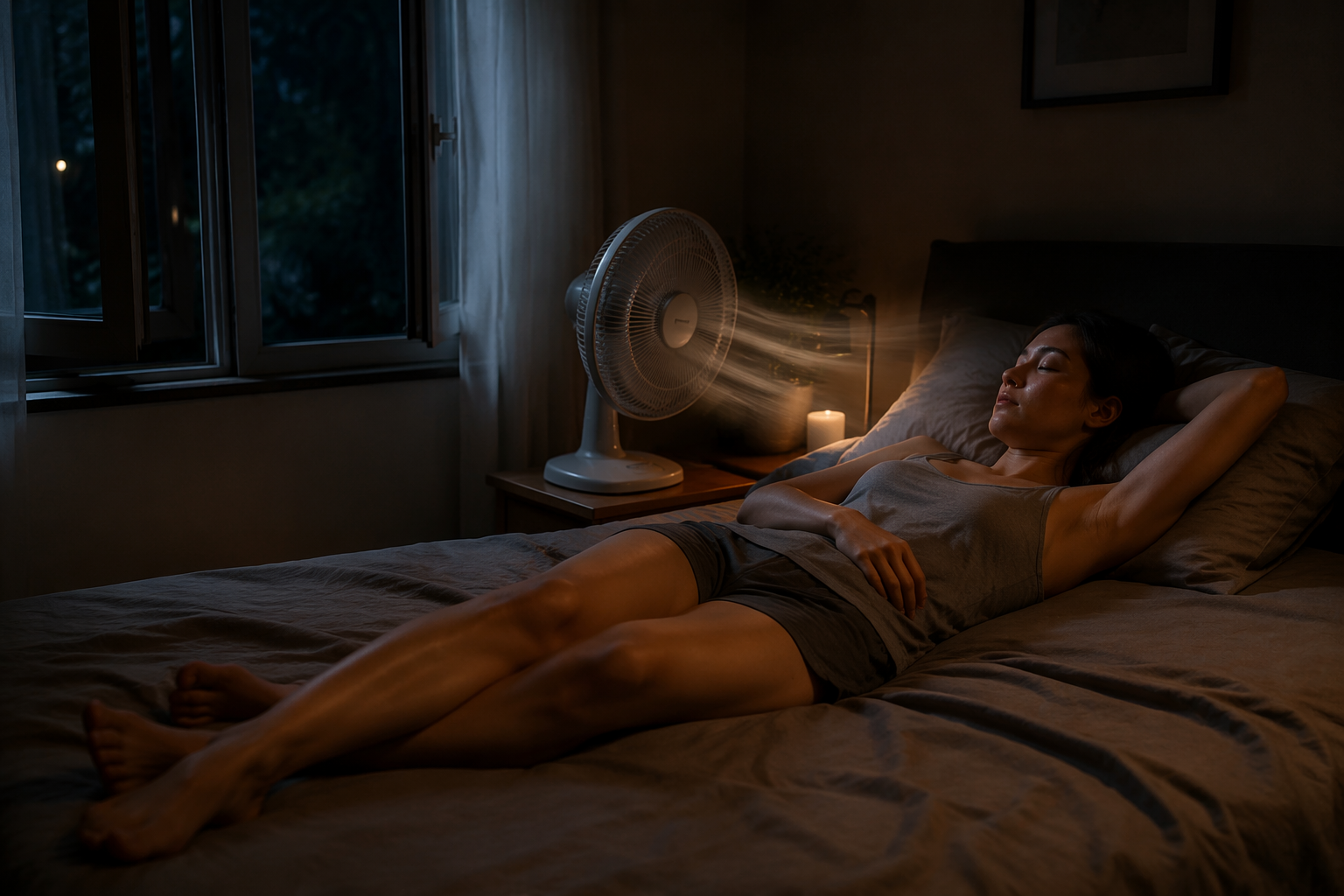
Set the fan so the air crosses the body, not just the bedframe or the ceiling. Bare arms, legs, neck, feet, and upper chest give the moving air more skin to work on. If clothing or bedding traps humid air against the body, evaporation slows. A loose sheet may feel comforting, but if it blocks airflow from reaching damp skin, it can turn the body’s best cooling surface into insulation.
Moisture can help, as long as it is controlled. A lightly damp washcloth on the torso, forearms, shins, or feet gives the fan water to evaporate. Damp sheets and the so-called Egyptian method work from the same principle; one compilation describes continuous evaporative cooling from damp fabric as lasting about 1–2 hours. [3] That is useful for sleep onset, not a guarantee for the entire night.
Humidity is the limiter. Evaporation is less effective when the air is already moisture-heavy, which is why a fan can feel dramatic in dry heat and disappointing in a muggy room. A dehumidifier can make sweat evaporation easier, but it also adds heat while it runs. If you use one, the better move is often to run it earlier, then switch to direct fan cooling at bedtime.
If the room allows it, cross-ventilation can help the fan do more than blow hot air in place. NPR’s reader-sourced heat-hack collection includes practical variations such as wet towels near airflow and two-fan setups for moving air through a room. [4] Treat those as household improvisations, not universal fixes: outdoor air quality, security, noise, and wildfire smoke may make open-window tactics unusable. During smoky heat waves, the closed-window dilemma is real, and summer heat and wildfire smoke require a different safety calculation.
A Fan Setup for Tonight
- Expose skin first: shorts, a loose top, or minimal sleepwear if safe and comfortable.
- Aim the fan across the body, especially arms, legs, feet, neck, and upper chest.
- Add light moisture only where it can evaporate; avoid soaking the bed so heavily that it becomes clammy.
- Keep bedding easy to move off during the first stretch of sleep.
- Stop or change the setup if airflow causes breathing irritation, eye dryness, chills, or unsafe exposure.
The Warm-Shower Paradox
A cold shower feels like the obvious answer to a hot room. It can give immediate relief, and on a miserable night that relief is not meaningless. The problem is what the body may do next. Cold exposure can constrict blood vessels near the skin, reducing heat loss from the body’s surface. The skin feels cooler while core heat has fewer routes out.
A warm shower works in the less intuitive direction. Warm water encourages vasodilation, bringing more blood toward the skin. After the shower, as heat leaves through the skin into the surrounding air, core temperature can drop in a way that better matches the physiology of sleep onset. HealthPartners describes the useful timing window as about 60–90 minutes before bed. [5]
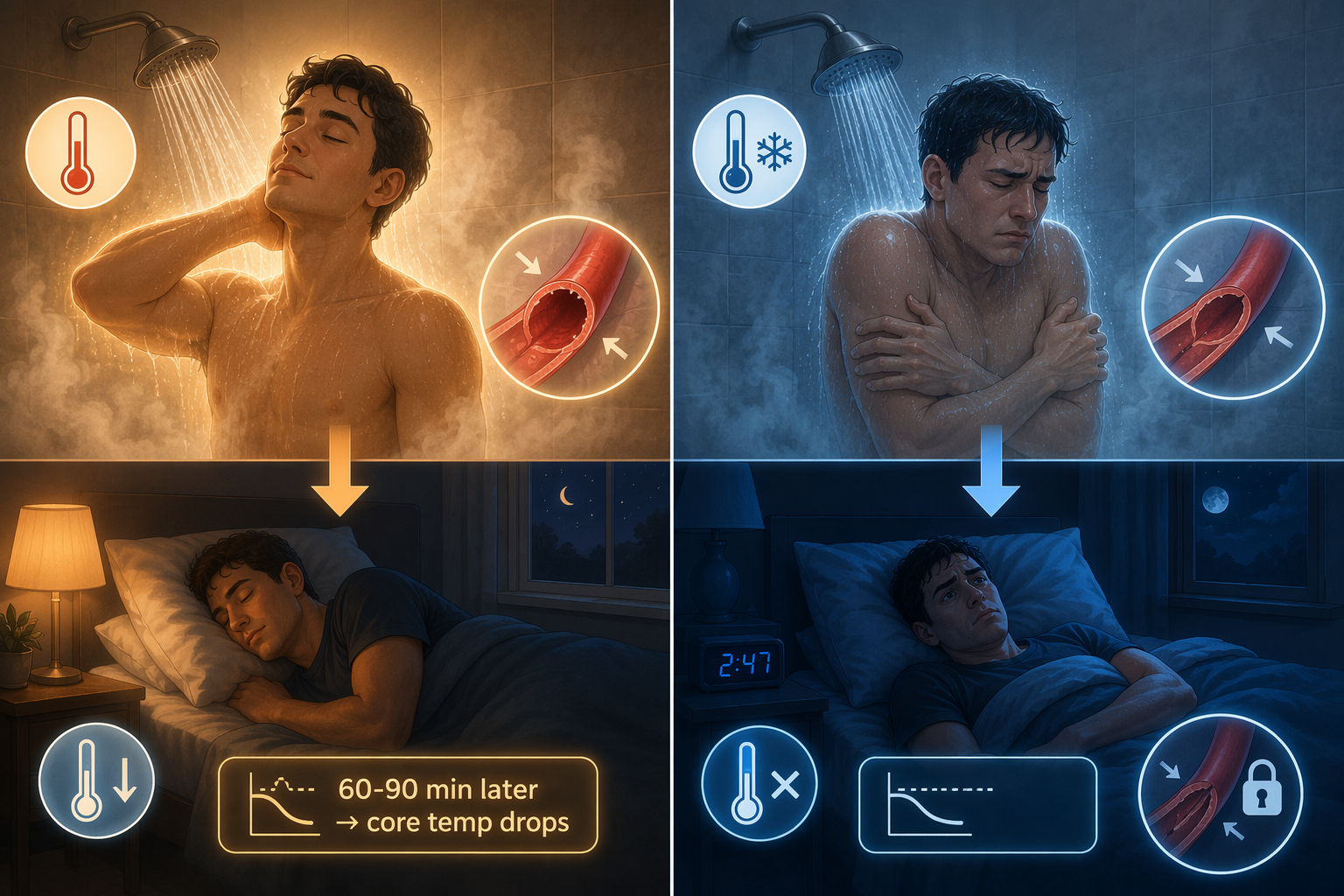
The timing matters because the shower itself is not the sleep cue. The post-shower decline is. Step out, dry off enough that you are not dripping, dress lightly, and let a fan move air across bare or lightly damp skin. In that sequence, the shower opens the heat-loss route and the fan helps carry heat away.
Do not turn this into a punishment ritual. “Warm” does not mean scalding, and people with dizziness, blood-pressure issues, pregnancy-related heat sensitivity, or other medical vulnerabilities may need to avoid hot bathing or use a milder version. Individual comfort varies, too. Some people will still prefer a brief cool rinse for immediate distress. Just separate the pleasant shock of cold water from the sleep-relevant goal of helping core temperature fall.
Pulse Points Are a Small Tool, Not a Magic Map
Pulse-point cooling is useful because certain blood vessels run close to the skin, so cool contact there can affect blood moving through the area. Common targets include the wrists, neck, inner elbows, behind the knees, and tops of the feet. [6] The point is not that these spots have mystical status. They are simply places where cooling the surface has a better chance of meeting circulating blood.
Use a cool damp cloth, wrapped cool pack, or briefly chilled towel. Keep the sensation cool, not painfully cold. If the skin goes numb or the cold feels sharp, back off; intense cold can push the body toward constriction again. This is most helpful when you are already lying down, the fan is running, and your body still feels heat-loaded in the neck, feet, or limbs.
| If you feel heat most in… | Try… | Why it may help |
|---|---|---|
| Face and neck | Cool damp cloth at the sides or back of the neck | Blood vessels are close enough to the surface for cooling to feel fast |
| Hands and forearms | Wrists and inner elbows under moving air | Exposed skin plus airflow improves heat loss |
| Legs and feet | Tops of feet or behind knees with a cool cloth | These areas can cool without covering the torso |
| Whole-body heat after a shower | Fan across bare skin with light residual moisture | Combines vasodilation, evaporation, and convection |
Hydrate Early Enough for Sweat to Work
Sweat only helps if the body has fluid available and the air can evaporate it. One heat-safety compilation notes that even 1–2% dehydration can impair thermoregulation. [3] That does not mean chugging water at midnight is the answer. It may only trade heat wakeups for bathroom wakeups.
Front-load fluids in the evening, then taper closer to bed. If you have been sweating heavily, eating normally usually supplies sodium and other electrolytes for most people; specific electrolyte strategies belong to medical or athletic contexts, not a universal bedtime rule. Alcohol deserves special suspicion on hot nights because it can fragment sleep and interfere with temperature regulation, and the European Insomnia Network also cautions against caffeine close to bedtime during heat waves. [2]
A Prioritized Sequence for a Hot Night Without AC
If you only have enough energy for a simple plan, do the parts that change heat loss most directly.
- Drink earlier in the evening, not all at once right before bed.
- Take a warm shower 60–90 minutes before sleep, then dress lightly.
- Aim a fan across bare skin rather than into the room generally.
- Add light moisture where airflow can evaporate it: a damp cloth, dampened sheet edge, or wet forearms and shins.
- Use cool pulse-point contact if your neck, wrists, feet, or limb creases still feel overheated.
- Keep alcohol and late caffeine out of the experiment so you can tell whether the cooling routine actually helps.
Travelers can use the same order in a bad hotel room: shower first, fan or airflow second, exposed skin third, pulse points last. If the problem is a warm room during a major event or crowded travel period, hotel sleep tactics for hot host cities can fill in the room-specific details without changing the body-cooling logic.
There is a boundary here. These methods can help the body initiate the temperature drop that sleep needs; they do not make dangerous heat safe. If the room stays extremely hot, if humidity prevents evaporation, if smoke or unsafe outdoor air blocks ventilation, or if someone is older, pregnant, medically fragile, taking heat-sensitive medications, or showing signs of heat illness, the right answer may be a safer cooled location rather than a better bedtime routine.
For ordinary awful summer nights, though, the order is clear: do not spend the whole night trying to cool the room by a degree while your skin is covered and dry. Give heat a path out of the body.
References
- Effects of thermal environment on sleep and circadian rhythm, PMC, 2012
- How to deal with sleep problems during heatwaves, Journal of Sleep Research, 2024
- How to Keep Your Bed Cool in Summer, Evapolar
- No AC, no problem. Here are 11 hacks for cooling your body down, NPR
- Can a warm shower or bath help you sleep?, HealthPartners
- Pulse Point Cooling: A Simple Way to Cool Down Fast, Quadra Wellness
Comments
Join the discussion with an anonymous comment.