
The public first noticed the ring before it noticed the nervous system. During Prince Harry and Meghan Markle's 2018 Australia tour, photographs showed Harry wearing a black Oura ring, and interest in the sleep tracker surged; NBC News reported a retailer-cited 900% spike in searches after the images circulated.[1] That number says more about public curiosity than clinical significance, but the fascination was understandable. A discreet ring seemed to promise a hidden readout: sleep, stress, recovery, strain.
The more important question was never only what Harry was wearing. It was what a body like his might be trying to measure. Oura-style rings estimate sleep through signals such as heart rate, heart rate variability, temperature, movement, and sleep-stage algorithms; they do not directly measure brain waves, which are the clinical basis for sleep staging in a lab.[2] A ring can make a restless night visible. It cannot, by itself, explain why the body keeps preparing for danger after the danger has passed.
Harry has not publicly confirmed a formal PTSD or insomnia diagnosis, and it would be careless to assign one from a distance. What he has described, repeatedly, is a recognizable cluster of distress: childhood trauma after his mother's death when he was 12, panic in public-facing duties, agoraphobia, feeling hunted in familiar places, drinking to dull pain, therapy, EMDR, meditation, and structured routines. Those details do not make him a diagnosis. They do make him a useful map of how trauma can live in the body long after the original event.
The Symptoms Harry Described Were Bigger Than Bad Sleep
In accounts from his memoir Spare, Harry described agoraphobia and panic attacks, including episodes linked to public appearances and crowded settings.[3] In an earlier conversation about royal life, he said he experienced severe anxiety and described going into “fight-or-flight mode” before engagements.[4] Those are not small inconveniences around a busy calendar. They are signs of an alarm system activating before the social obligation even begins.
He has also described feeling exposed in London, as if the city itself made him scan for threat.[3] Fox News also reported his 2019 comments that he sometimes felt so overwhelmed by the world's problems that he struggled to get out of bed.[5] Taken together, these details point toward a body that had trouble shifting out of defensive readiness.
Sleep is often where that readiness becomes impossible to ignore. A person may be able to perform through daylight obligations, especially if status, work, or family duty demands it. At night, the nervous system has fewer distractions. The heart rate that will not settle, the light sleep, the early waking, the jolt of dread before a known obligation—all of these can feel like separate problems until the pattern comes into view.
Why Trauma Keeps the Body Awake
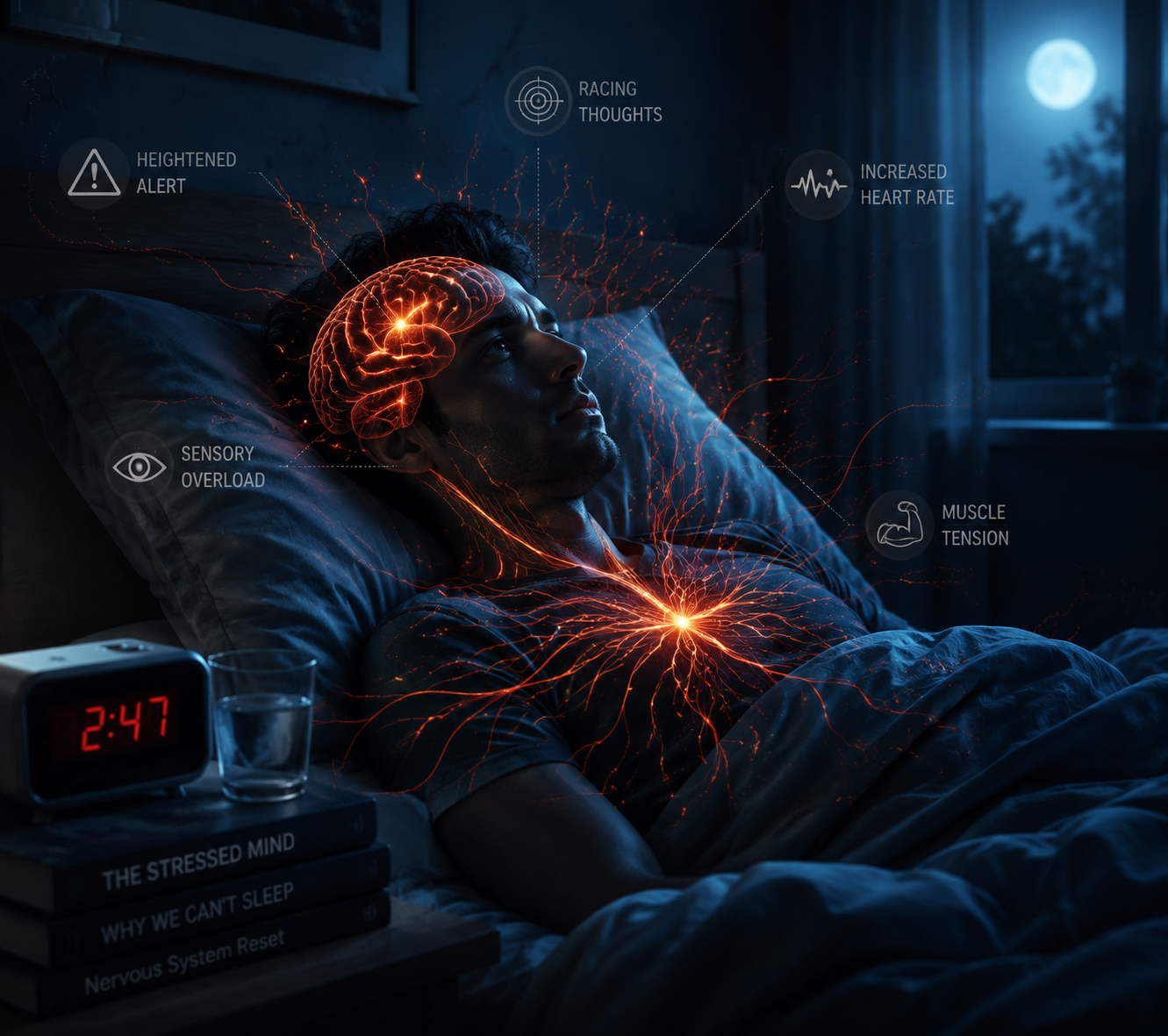
The clinical word that matters here is hyperarousal. In trauma-related sleep disruption, the body does not merely “think too much.” It remains physiologically prepared to respond. The Sleep Foundation describes hyperarousal as a core driver of sleep problems in PTSD, and notes that insomnia affects an estimated 80% to 90% of people with PTSD.[6] That statistic does not apply specifically to Harry. It does show how commonly trauma and sleep disruption travel together in diagnosed PTSD populations.
Hypervigilance is one way this state shows itself. Verywell Mind describes it as a condition of heightened alertness and constant threat-scanning, often associated with PTSD.[7] In ordinary terms, the brain keeps asking: Who is behind me? What will happen when I enter that room? Can I leave if I need to? Is the sound outside harmless, or is it the beginning of something? This scanning may be protective in genuine danger. In a bedroom, it becomes incompatible with deep rest.
Restorative sleep asks the nervous system to surrender some control. Hyperarousal asks it to keep watch. That conflict can affect how easily someone falls asleep, how often they wake, how much time they spend in lighter sleep, and how threatening the next day feels after a poor night. A person can then begin to dread sleep itself—not because sleep is the original enemy, but because the bed has become the place where an overactivated alarm system gets loud.
Childhood trauma can make this pattern especially durable. The Sleep Foundation's trauma-and-sleep review cites research finding that childhood trauma increases adult insomnia risk by approximately 20% per adverse childhood experience, with effects that may persist for up to 50 years.[8] That is the sobering part of Harry's public story. The body may carry early threat into middle adulthood, not as a memory alone, but as a default setting for arousal, vigilance, and sleep.
This is also why anxiety-driven sleep disruption can feel so unfair to people living through it. They may avoid caffeine, buy blackout curtains, put the phone away, and still wake at 3 a.m. with a pounding heart. The missing piece is not always discipline. Sometimes the body is interpreting quiet as vulnerability. The same mechanism appears in other fear-linked sleep patterns, including disaster-related anxiety after storms or earthquakes; the common thread is a nervous system rehearsing threat when it is supposed to be recovering.
For readers trying to place their own symptoms, our guides to hurricane anxiety and sleep disruption and earthquake anxiety follow that same threat-detection pathway in less celebrity-shaped circumstances.
What the Oura Ring Can Show—and What It Cannot Treat
The Oura ring became a useful symbol because it sits exactly at the boundary between observation and treatment. A tracker can show short sleep, a late bedtime, frequent movement, a higher resting heart rate, lower heart rate variability, or an estimated shift in sleep stages. For some people, that information is the first objective-looking evidence that their nights are not as restorative as they hoped.
That visibility can matter. People with trauma-related arousal often minimize their own symptoms, especially if they function well in public. A ring may show that the body is paying a cost: recovery scores fall, sleep looks fragmented, readiness drops after stressful days. The data can help someone notice patterns they might otherwise dismiss.
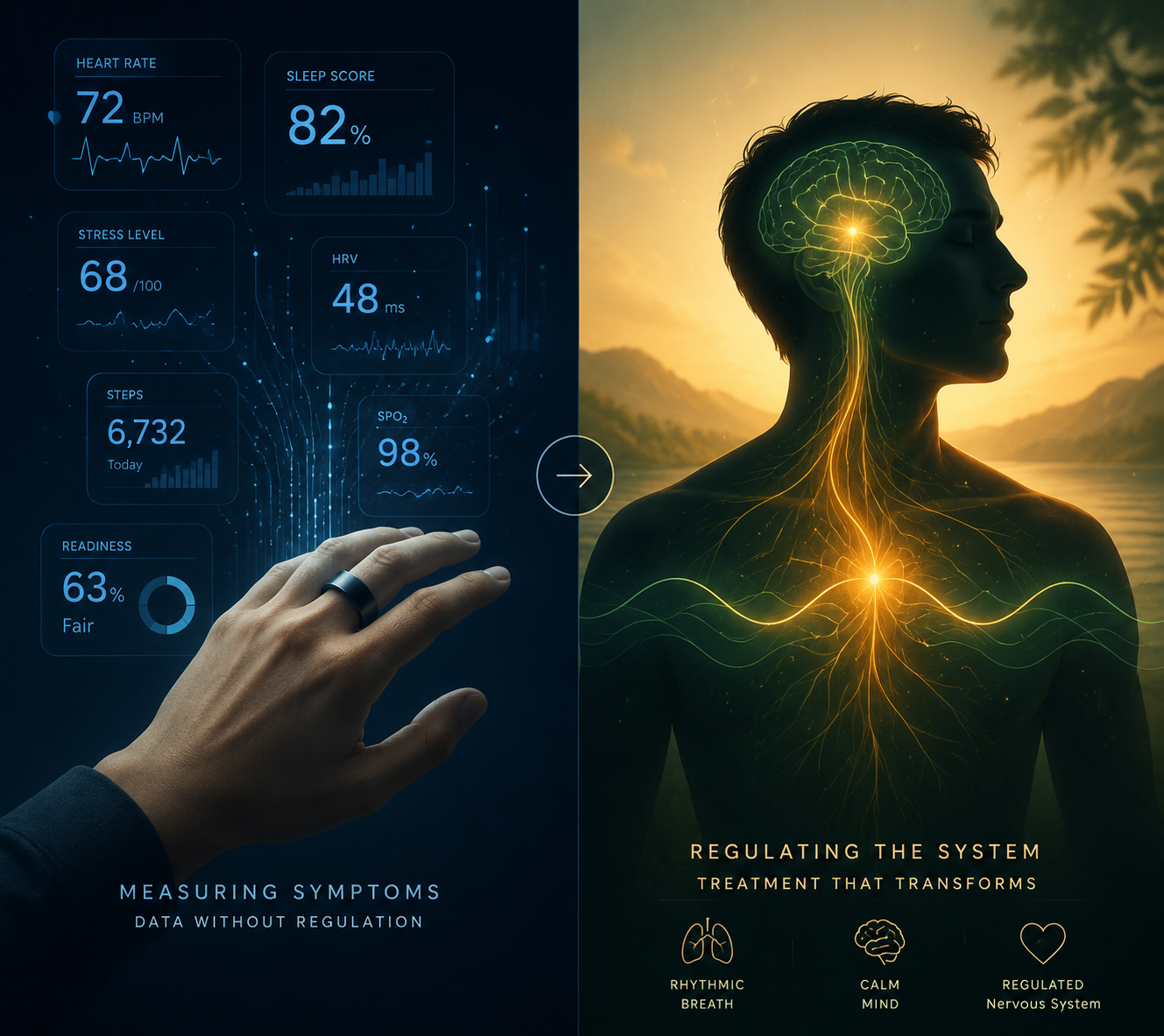
But the same data can also seduce a person into monitoring instead of recovering. Consumer sleep trackers estimate sleep from indirect signals; as Vox noted in its coverage of Harry's ring, devices like Oura infer sleep stages without measuring brain waves.[2] That distinction matters most when distress is psychological and physiological at once. A ring may estimate that REM sleep was low. It cannot tell whether the underlying driver was trauma-related hyperarousal, alcohol, jet lag, pain, medication, schedule disruption, depression, or a sleep disorder that needs clinical evaluation.
For readers comparing devices, the practical question is not whether a ring is useless. It is what job the device is being asked to do. Our Oura Ring accuracy guide looks more closely at the limits of sleep-stage estimates, while our sleep and fitness tracker comparison and sleep monitoring device form-factor guide can help separate comfort, battery life, and data style from medical usefulness.
The hardest part is emotional, not technical. A person in chronic hyperarousal may want a number to deliver certainty: Was last night bad enough to explain today? Am I getting better? Did my nervous system finally cooperate? Metrics can support reflection, but they can also become another form of checking. If the first act of the morning is to look for permission to feel tired, the tracker has moved from tool to judge.
The Recovery Clues Are Less Glamorous Than the Ring
The more instructive part of Harry's public mental-health arc is not the device. It is the treatment and routine that came later. He has publicly discussed EMDR, a trauma therapy that uses bilateral stimulation while a person recalls distressing experiences; The Guardian covered both the method and Harry's endorsement of it in 2021.[9] EMDR is not a sleep gadget. It is a way of helping the brain reprocess traumatic material so the body may stop reacting as if the old threat is still happening.
That distinction is central. If the sleep problem is being driven by threat physiology, the intervention has to reach threat physiology. For some people, that means trauma-focused therapy such as EMDR with a qualified clinician. For others, it may mean therapy for anxiety, panic, grief, substance use, or depression. If insomnia has become persistent, evidence-based insomnia care may also be needed. The point is not to choose between therapy and sleep behavior; it is to stop expecting a sleep score to do the work of nervous-system regulation.
Harry has also spoken about daily meditation and burnout. NBC News reported his comments about needing to meditate every single day, in the context of broader discussion of burnout and mental health.[11] Hola! reported that he described a 30-to-45-minute morning routine involving meditation, exercise, nature exposure, and walking the dog.[10] None of these practices is dramatic enough to satisfy the celebrity-news appetite. That is partly why they are worth taking seriously.
Morning routines matter because they give the nervous system repeated evidence of sequence and safety. Wake, move, breathe, go outside, return to ordinary tasks. The value is not that a walk or meditation session erases trauma. It is that the body practices shifting states: from sleep to waking, from alertness to groundedness, from rumination to contact with the present environment. Over time, those repetitions may matter more than any single impressive night of tracked sleep.
When Tracking Should Give Way to Care
There is a modest, useful place for a sleep tracker in trauma-related sleep disruption. It can show whether bedtime is drifting, whether alcohol-heavy evenings are followed by worse recovery, whether meditation or morning exercise coincides with steadier sleep, or whether travel and public stressors are taking a visible toll. Used this way, the device is a notebook with sensors.
It becomes less useful when the wearer asks it to answer clinical questions it cannot answer. A consumer ring cannot diagnose PTSD, insomnia, panic disorder, sleep apnea, depression, or alcohol-related sleep disruption. It cannot distinguish a body remembering danger from a body reacting to an untreated breathing problem. It cannot provide the experience of safety that trauma has interrupted.
The threshold for getting help is not a perfect sleep graph. It is impairment. If panic, fear of leaving home, nightmares, alcohol use to blunt distress, dread of bedtime, or exhaustion is interfering with work, relationships, parenting, or basic functioning, the next step is clinical care. A primary care clinician, licensed therapist, trauma specialist, or sleep medicine professional can help sort out what the tracker cannot.
Harry's ring made the visible problem easy to photograph. His described history makes the deeper lesson harder and more useful: trauma-related sleep struggles often begin before bedtime. Recovery begins when measurement becomes information, not identity, and when the work turns toward regulation—therapy when appropriate, routine when possible, movement, morning light, meditation, and enough support for the body to relearn that night is not a threat.
References
- Prince Harry's ring sparks interest in new sleep tracker, NBC News
- Prince Harry's Oura ring sleep tracker, explained, Vox
- Prince Harry and Agoraphobia: Royal Talks Mental Health in New Memoir, Healthline
- Prince Harry Opens Up About Panic Attacks and Anxiety During Royal Life, Harper's Bazaar
- Prince Harry admits he's so overwhelmed over world's issues that he struggled to get out of bed: reports, Fox News
- PTSD and Sleep, Sleep Foundation
- Hypervigilance: Symptoms, Causes, and Treatment, Verywell Mind
- Trauma and Sleep, Sleep Foundation
- EMDR: what is the trauma therapy used by Prince Harry?, The Guardian, May 21, 2021
- Prince Harry's morning routine includes meditation, exercise and nature exposure, Hola!
- Prince Harry talks burnout, meditation and trolls attacking him, NBC News
Comments
Join the discussion with an anonymous comment.