
At Balmoral, Queen Elizabeth II’s bedroom routine began with the window. According to former royal butler Paul Burrell, she slept with the windows open every night during her late-summer and early-autumn stays, from August through early October, and did not close them even when the Highland air made the room “very, very cold.” The compensation was not a radiator turned higher or a reluctant crack in the window. It was bedding: sheets, blankets, and eiderdowns piled so heavily that, in Burrell’s phrase, “it was hard to find her.” [1]
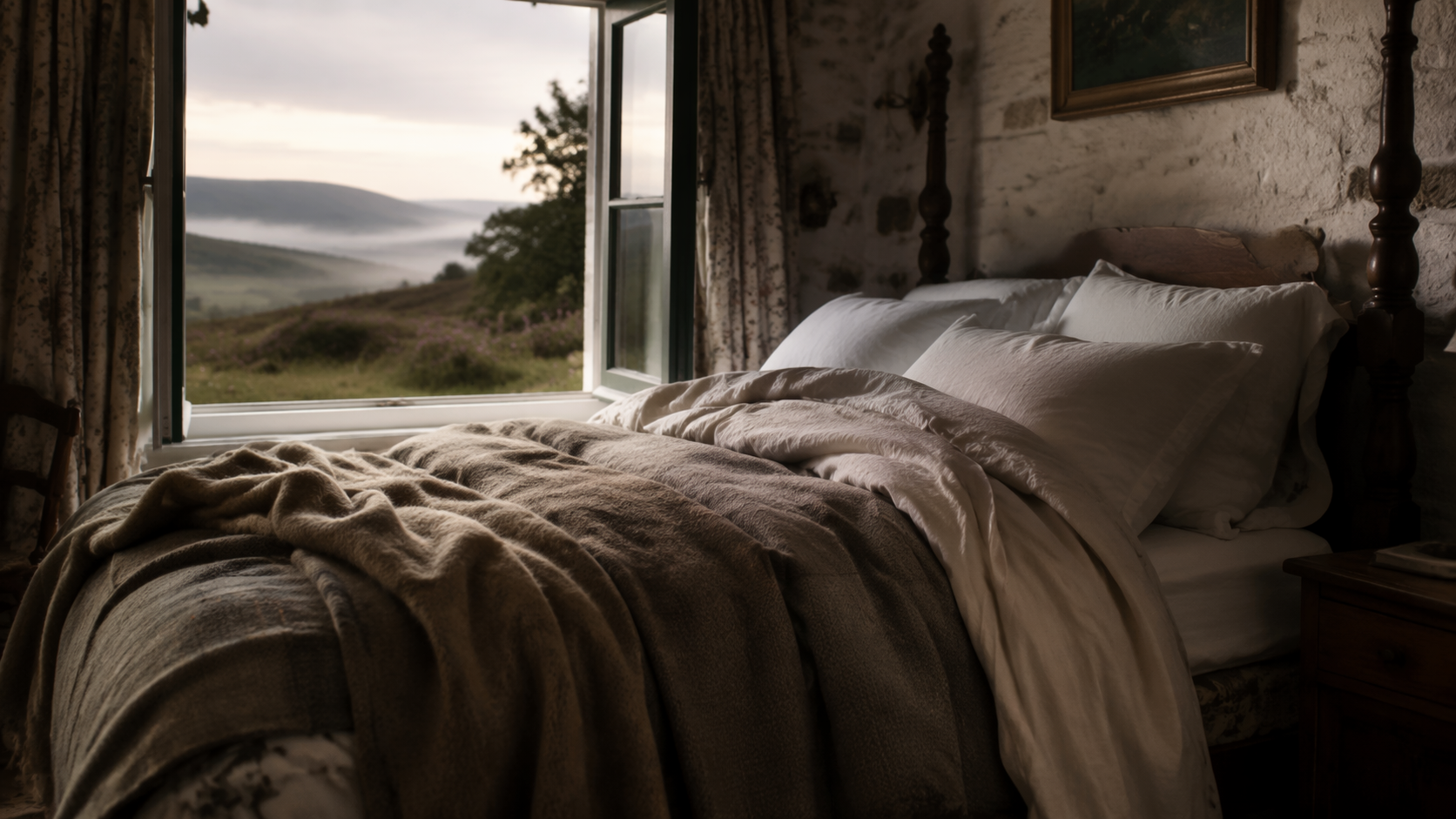
That is the useful detail. The habit sounds eccentric only if the open window is treated as the whole story. In practice, it was a complete sleep environment: cold air in the room, warm insulation around the sleeper, and a household standard firm enough that everyone else had to work around it. The modern version is less royal than practical. Many good sleepers already do some form of it when they lower the thermostat, open a window, or use a lighter summer duvet with a warmer throw nearby.
The guest side of the rule is less cozy. A 1960s-era account of Balmoral describes guest bedrooms on the ground floor without en-suite bathrooms, meaning visitors had to walk through cold corridors when they needed the bathroom at night.[2] That does not prove every later guest experienced the castle in exactly the same way, and the layout may have changed over time. Still, it gives Balmoral’s rules for guest sleep their domestic bite. A sleeping preference at the top of the house is not merely personal when the whole place is being run around it.
The Bedroom Was Cold; The Sleeper Was Not Supposed To Be
The distinction matters because “sleep in a cold room” is often repeated as if discomfort were the treatment. It is not. A cold room can help the body move toward sleep, but a cold sleeper will simply wake, tense, shiver, or add stress to a night that was meant to calm down. The Queen’s Balmoral arrangement solved that mismatch with a blunt household technology: more layers.
Modern sleep guidance commonly places the ideal bedroom temperature around 60–67°F, or 15–19°C.[3] That range is not magic, and it is not equally comfortable for every body, every climate, or every building. It is a population-level sweet spot because sleep is tied to thermoregulation. Before sleep onset, core body temperature drops by roughly 2°F; cooler surroundings can support that natural decline, while overheated rooms can make it harder to settle and stay asleep.[3]
The body is not simply losing heat at random. Circadian timing, melatonin production, skin temperature, and core temperature are linked. A cooler room can make it easier for heat to move away from the body, which is one reason cool bedrooms are associated with faster sleep onset and more slow-wave sleep in sleep-hygiene discussions.[3][4] That does not mean the Queen was deliberately applying a modern thermoregulation model. It means her preference landed on a pattern sleep researchers now recognize.
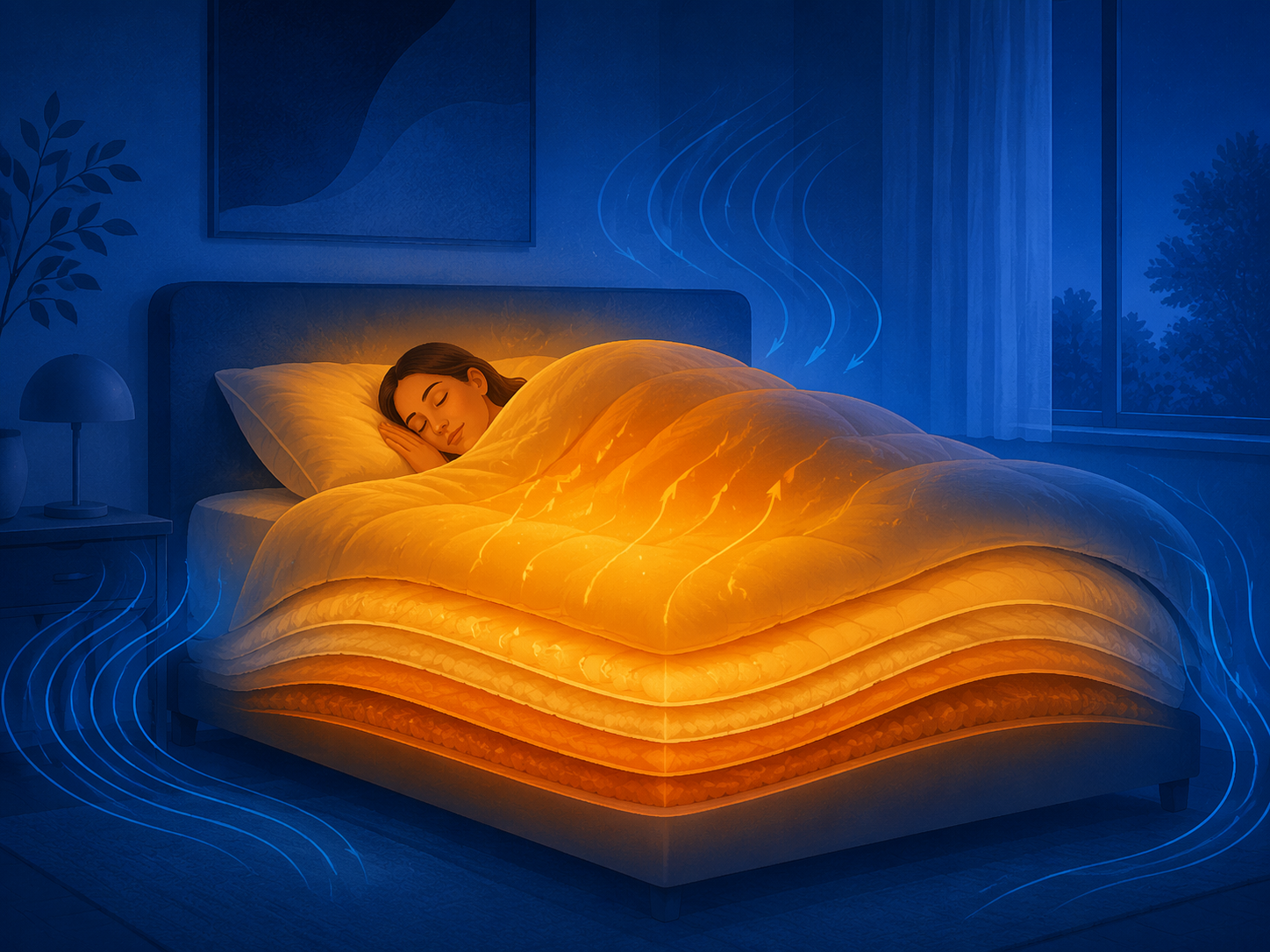
Bedding is the adjustable layer in that system. A room has one temperature; a bed can have several microclimates. A sleeper can add a blanket over the legs, remove a duvet from the torso, choose wool over down, or let one arm out without changing the air in the room. That is the quiet cleverness of the Balmoral setup. It separated ambient temperature from personal warmth.
| Part of the setup | What it changes | Why it matters for sleep |
|---|---|---|
| Open window or cool room | Ambient air temperature | Helps the body shed heat as it prepares for sleep |
| Sheets, blankets, eiderdowns | Personal insulation | Keeps the sleeper comfortable without warming the whole room |
| Ability to add or remove layers | Fine-tuning during the night | Prevents the cool-room advice from becoming cold-body discomfort |
The Open Window Also Changed the Air
Temperature is the obvious part of an open window. Ventilation is the less decorative part. A closed bedroom can accumulate exhaled carbon dioxide overnight, especially in smaller rooms, tightly sealed homes, or spaces shared by more than one sleeper. Opening a window is one simple way to exchange stale indoor air for outdoor air when the outdoor conditions are safe and clean enough.
Fan et al. 2022, published in Building and Environment and summarized by Health.com, found that sleeping with a window open reduced bedroom CO2 concentration and measurably improved sleep quality and next-day cognitive performance.[5] That is not a license to say every open window will improve every night. It does give the Balmoral habit a second plausible sleep-science alignment: the window cooled the room and may also have improved air exchange.
The ventilation point is especially useful because it explains why an open window can feel different from simply setting a thermostat lower. A thermostat changes temperature. A window can change temperature and air composition, though it can also bring in noise, pollen, smoke, humidity, insects, or security worries. The same opening that makes a Highland bedroom feel fresh may be a terrible idea beside a busy road or during a poor-air-quality night.
Why Most People Do Not Just Open the Window
The Balmoral rule had one enormous advantage: context. A royal estate in the Scottish Highlands is not the same sleep environment as a street-facing apartment, a wildfire-prone region, a humid city, or a first-floor bedroom where an open window feels unsafe. That is why the habit should not be turned into a universal prescription.
A 2022 Sleep Foundation survey found that 53.2% of U.S. adults sleep with their windows closed, with security and privacy among the main reasons. The same survey found that people in colder states were more likely to sleep with windows open.[6] That contrast is sensible. Cool outdoor air is appealing only when the outside air, the neighborhood, the building, and the sleeper’s own body make it workable.
This is also where royal-routine storytelling can get too tidy. Reports differ on whether the Queen’s usual bedtime was closer to 11 p.m. or midnight, but that dispute does not change the mechanics of the open-window habit. The stronger boundary is location. The documented account concerns Balmoral from August through early October. It should not be stretched into a claim about every palace, every season, or every bedroom she used.
What a Modern Sleeper Can Borrow
The borrowable part is not “leave the window open no matter what.” It is the arrangement: cool the room, then warm the sleeper. For many people, that can mean lowering the thermostat toward the 60–67°F range, airing out the bedroom before bed, using a fan safely, choosing breathable bedding, or keeping layers available instead of relying on one heavy cover that is either too much or not enough.
- If the bedroom runs warm, start by cooling the air before bedtime rather than waiting until you are already overheated.
- If you wake cold, keep the room cool but add targeted insulation: socks, an extra blanket, or a warmer layer over the lower body.
- If the air feels stale, ventilate when conditions allow, but treat outdoor air quality, noise, and safety as part of the sleep setup.
- If you share a bed, solve for each sleeper separately with layers before changing the whole-room temperature.
There are real limits. People with Raynaud’s, asthma, or COPD may need warmer conditions or more careful control of cold air exposure.[4] Someone sensitive to pollen, smoke, dampness, or nighttime noise may sleep worse with an open window even if the thermometer looks ideal. The guideline is a starting point, not a loyalty test.
The Queen’s Balmoral habit was probably personal preference before it was anything else. Still, it captured a principle that modern sleep advice often states too casually: the room can be cool without making the sleeper cold. Open window, cold Highland air, absurdly deep bedding — odd in its particulars, practical in its structure.
References
- Queen Elizabeth's bizarre bedroom habit that she always insisted upon at Balmoral — Express
- Balmoral guest bedroom account citing Alexandra’s 1960s Prince Philip biography — Scene Therapy
- The Key Role of Temperature in Sleep Quality — Psychology Today
- What Happens to Your Body When You Sleep in a Cold Room Every Night — Verywell Health
- Is It Healthier to Sleep With the Window Open? — Health.com
- Why Don't More of Us Sleep With the Window Open? — Sleep Foundation
Comments
Join the discussion with an anonymous comment.