
If you are trying to figure out how to sleep well traveling Europe on a budget, start before you buy the earplugs. The biggest sleep decision is usually not what goes in your backpack. It is the room you choose, the bed you ask for, and the small signals you catch in reviews before you hand over your card.
Hostel sleep is not random luck. It can still be messy, because shared rooms contain snorers, late arrivals, plastic bags, hallway doors, heat, and other people’s alarms. But a traveler who books for sleep instead of only for price or “vibe” has more control than hostel horror stories suggest.
The useful hierarchy is simple: choose the least disruptive dorm you can afford, then the least disruptive bed in that dorm, then repeat the same short wind-down routine each night. Gear helps at the margins. Booking does the heavier lifting.
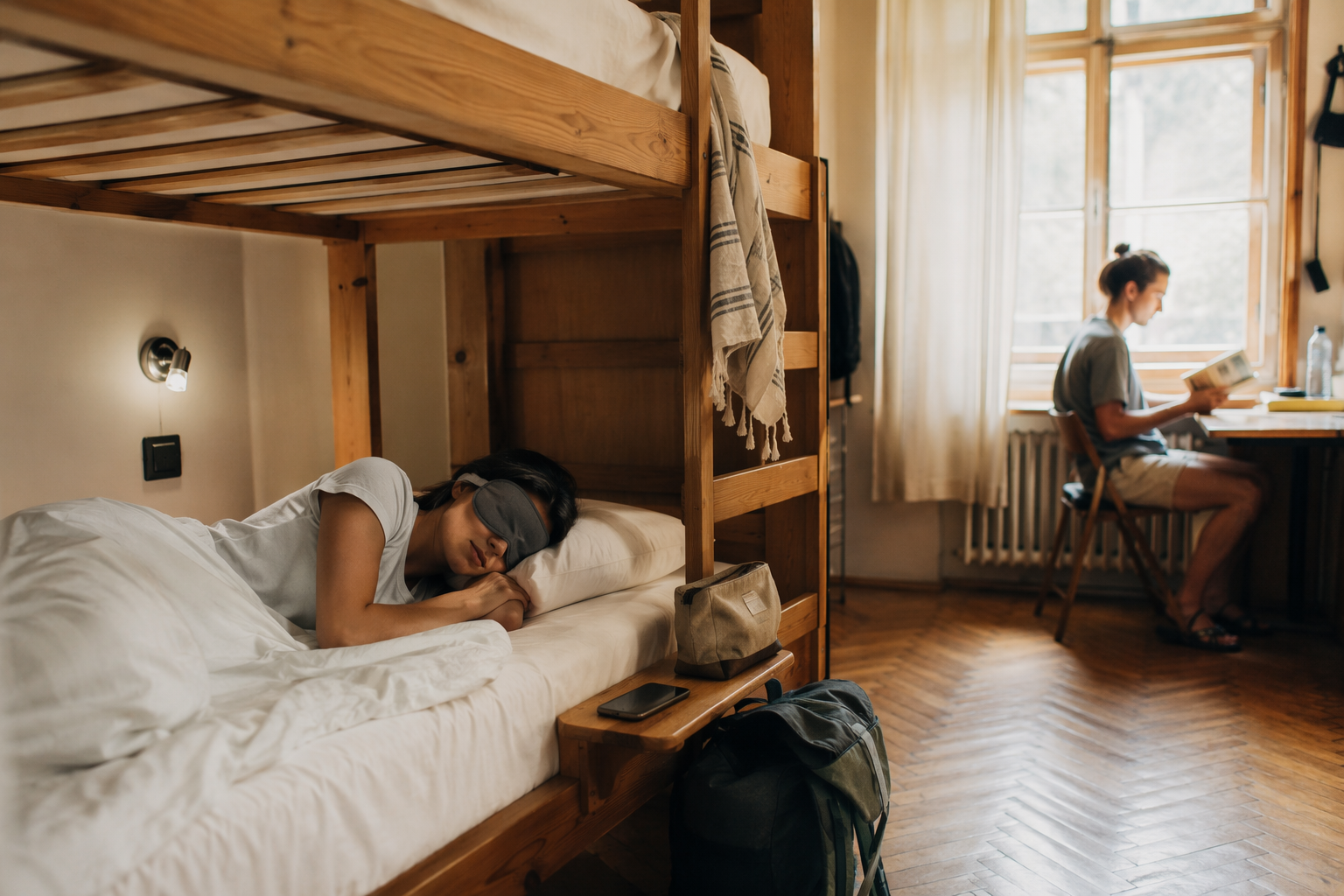
Book the room as if you will actually have to sleep there
Hostel booking pages are very good at showing kitchens, murals, pub crawls, and rooftop views. They are less good at showing whether the dorm door slams every twelve minutes. For a light sleeper, the booking process needs a different filter.
Start with dorm size. A 4–6 bed dorm is usually the best budget compromise: still much cheaper than a private room, but with fewer alarms, fewer bathroom trips, fewer late arrivals, and fewer chances that one restless person wakes the whole room. This is practical travel judgment rather than a sleep-lab finding; hostel-specific tactics such as choosing smaller rooms and managing light and noise appear consistently in hostel sleep guides, but they are not clinical trials.[3][4]
The jump from six people to twelve or sixteen is not just a number on a booking screen. It multiplies the number of schedules in the room. Someone catches an early train. Someone comes back from a bar. Someone packs before sunrise. Someone’s phone buzzes against a metal bunk frame. None of these are dramatic travel disasters; they are just ordinary shared-room arithmetic.
| Booking choice | Sleep consequence | How to read it |
|---|---|---|
| 4–6 bed dorm | Fewer people moving, packing, and setting alarms | Best default for light sleepers on a budget |
| 12–16 bed dorm | More schedules and more chances of noise | Only choose when price matters more than sleep |
| Ensuite bathroom | Convenient, but door, fan, sink, and shower noise may be inside the room | Check reviews before assuming it is quieter |
| Party hostel | Social value, but late-night returns are part of the product | Do not book one and expect library conditions |
| Street-facing dorm | Possible traffic, tram, bar, or pedestrian noise | Search reviews for street-noise language |
The word “ensuite” deserves special suspicion. It sounds like comfort, and sometimes it is. But in a dorm, it can also mean the shower, sink, toilet flush, bathroom fan, and door latch are all inside the room where people are trying to sleep. A hallway bathroom can be annoying too, but at least some of the noise is moved out of the sleeping area.
Location matters in the same practical way. A hostel beside a nightlife strip may be perfect for someone who wants that trip. It is a poor bargain for someone who needs sleep before a museum day, long train transfer, or early flight. Rick Steves’ budget lodging advice treats sleeping cheap as a way to stretch a trip, not as a reason to ignore basic comfort and common sense.[5]
Search reviews for sleep words, not mood words
A hostel can have great “atmosphere” and still be a terrible place to sleep. Review scores blur too many things together: staff friendliness, price, cleanliness, social life, location, breakfast, and whether the reviewer was twenty-two and immune to door noise. Use the search box inside reviews and look for physical details.
- Search for “squeaky beds,” “metal bunks,” “thin mattress,” “springs,” “curtains,” and “locker noise.”
- Search for “street noise,” “bar downstairs,” “tram,” “traffic,” “construction,” and “courtyard.”
- Search for “door slamming,” “bathroom fan,” “ensuite,” “hallway,” and “stairs.”
- Search for “hot,” “stuffy,” “no AC,” “window,” “ventilation,” and “mosquitoes.”
- Search for “party,” “pub crawl,” “quiet hours,” “families,” and “business travelers.”
The useful review is not “amazing vibes, would stay again.” It is the boring one that says the lockers were under the beds and loud at night, or the bunks squeaked when anyone turned over, or the street-facing rooms were noisy until bars closed. Those details tell you what your nervous system will be dealing with at 2 a.m.
Be especially careful with old complaints and one-off disasters. A single review about a snorer does not tell you much; every dorm will eventually have one. Repeated mentions of the same physical problem do. If five people across several months mention slamming doors or loud street noise, treat that as part of the room, not bad luck.
Choose the bed like a person who wakes easily
If the hostel lets you request a bed, ask for a bottom bunk away from the door and bathroom. This is not because bottom bunks are magically quiet. They are just easier to enter without climbing, easier to curtain with a towel if the bed frame allows it, and less likely to make you the person shaking the whole structure at midnight.
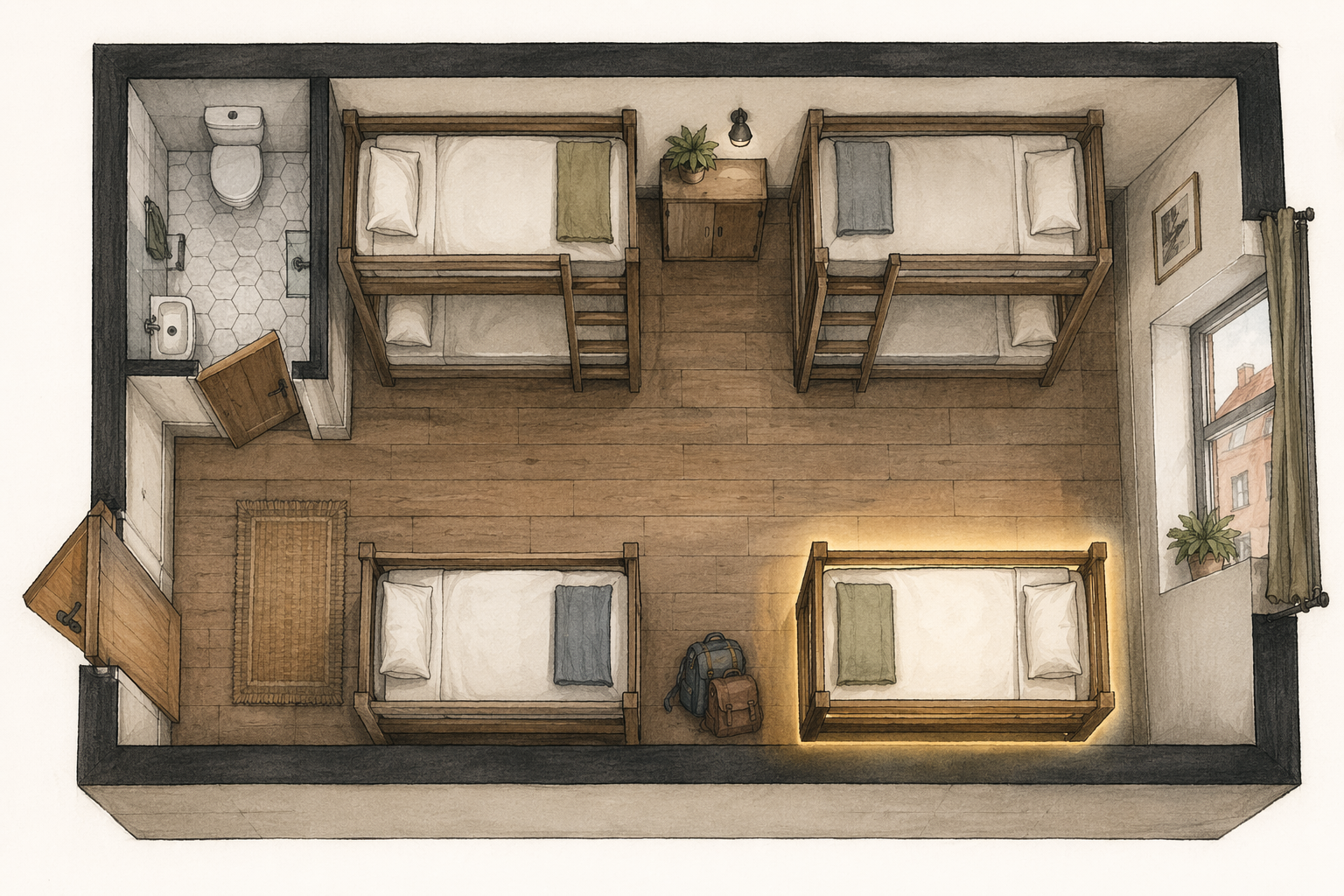
Distance from the door matters because doors collect movement. Distance from the bathroom matters because bathrooms collect light, water, fans, and zippers from people who realize they forgot something. Distance from the main window is more situational: in a hot room, the window can be a blessing; on a noisy street, it can be the whole problem.
When bed assignment happens at check-in, ask plainly: “If possible, could I have a bottom bunk away from the door? I’m a light sleeper.” This is not precious. It is easier for staff to help before everyone has unpacked. If they cannot, you have lost nothing.
The first night is allowed to be weird
Even with a sensible booking, your first hostel night may be lighter, choppier, and more alert than sleep at home. That does not mean you chose wrong or that your trip is about to unravel. Travel itself disrupts sleep, and Sleep Foundation describes the first-night effect as a real pattern in which people often sleep worse in an unfamiliar place.[1]
Clayton Sleep Institute explains the same problem in more clinical terms: unfamiliar sleep environments can keep the brain more vigilant, with one hemisphere staying more alert than it would at home.[2] That is a useful explanation for a very ordinary hostel feeling: you are tired, the room is quiet enough, and somehow you are still listening for every movement.
This matters because many travelers judge the whole trip from night one. They arrive after an overnight flight, lie awake in a new room, hear two roommates come in late, and decide they are “bad at hostels.” Sometimes the room really is bad. Often, the first night is carrying extra load: unfamiliar bed, unfamiliar sounds, unfamiliar people, and a body clock that may not have caught up.
A better standard is to protect the first night and judge the pattern after the second. If night two is still awful because the bed frame shrieks, the room overheats, and the hallway door bangs all night, that is useful information. If night two improves, you have probably moved past the alarm-stage of sleeping somewhere new.
Run a five-minute routine before the room goes dark
The best hostel bedtime routine is not elegant. It is quiet, repeatable, and finished before other people are asleep. The goal is to reduce three things: noise, light, and vigilance. You are not trying to turn a dorm into a bedroom. You are trying to remove enough friction that your body stops scanning the room.
- Pack tomorrow’s first items before bedtime: clothes, toiletries, charger, passport pouch, and anything you would otherwise dig for in the dark.
- Use the bathroom before the room quiets down, especially in an ensuite dorm.
- Set your phone to airplane mode, dim the screen, set one alarm, and place it where it will not vibrate against metal or wood.
- Put in foam earplugs and start low-volume white noise, pink noise, or another steady sound if it helps you ignore irregular dorm noise.
- Put on a sleep mask, or hang a towel or shirt as a partial bunk curtain if the bed frame allows it and airflow is not blocked.
The boring part is the point. If you wait until you are exhausted, you will discover that your earplugs are at the bottom of your bag, your toothbrush is in a locker, your charger is across the room, and your pajamas are inside a packing cube with a zipper that sounds like farm machinery.
Hostel sleep guides often recommend earplugs, masks, white noise, and pre-bed organization because these tactics address the obvious dorm disruptors.[3][4] They should be treated as practical consensus, not as proof that every traveler can overcome every bad room. A phone-based sound app can mask small irregular noises, but it will not fix a bunk that squeaks every time your upstairs neighbor breathes. For a deeper look at steady background sound, see Sleeping with a Fan On: What the Evidence Actually Says About White Noise.
A warm shower can help some travelers shift into sleep mode, especially after a long travel day, but hostel logistics matter. If showering late means turning on a dorm bathroom fan, waking people with a hair dryer, or rummaging through a locker afterward, do it earlier. The sleep benefit disappears quickly if the routine makes you tense or makes everyone else tense. For the physiology behind warm bathing and sleep onset, see A Warm Bath Before Bed Speeds Sleep Onset by 36%.
Be quiet before you need others to be quiet
The most reliable hostel sleep skill is not moral outrage at noisy roommates. It is not becoming one. Pack the plastic bags before midnight. Move tomorrow’s clothes into a soft pouch. Open lockers slowly. Turn off keyboard clicks. If you have a dawn train, set out everything except valuables before you sleep.
This is partly courtesy and partly self-interest. A dorm where several people behave quietly has a different nervous-system feel from a dorm where everyone assumes disturbance is someone else’s problem. You cannot control the whole room, but you can avoid adding one more avoidable sound.
Treat jet lag as a force multiplier
For US travelers flying to Europe, the first hostel night often follows an eastward time-zone jump. That means the room is unfamiliar and your circadian rhythm may also be late. Stanford Lifestyle Medicine notes that light exposure, sleep timing, and meal timing all influence how travelers adjust across time zones.[6] The CDC also advises using light strategically and notes that adjustment can take about one day per time zone crossed.[7]
You do not need to turn this into a full circadian project while standing in a hostel hallway. For the first Europe day, the practical version is: get morning outdoor light after arrival if it is safe and realistic, avoid a long late-afternoon nap, eat on local time, and keep the first night easy. If your route is new or the eastward jump has wrecked you before, use a flight-direction plan such as Choose Your Jet Lag Prevention Tips Based on Flight Direction or How to Prevent Jet Lag on a New Flight Route before departure.
The main mistake is stacking every hard thing onto night one: overnight flight, cheapest mega-dorm, party hostel, top bunk by the door, late caffeine, and an early nonrefundable tour. Any one of those may be manageable. Together, they make a bad night much more likely.
Use gear as support, not rescue
A small sleep kit is worth packing. It should not become the place where you try to solve a booking mistake. Foam earplugs, a comfortable sleep mask, and a phone-based sound app cover most budget-hostel needs without taking much space. Live Work Sleep’s 2026 accessory guide lists typical consumer price ranges of about $5–20 for earplugs, $8–20 for sleep masks, and $15–25 for travel pillows, though prices can shift.[8]
Spend attention before money. Foam earplugs only help if you practice inserting them before the trip. A sleep mask only helps if it does not press on your eyes or slide off. A travel pillow may be useful on trains and flights, but it is not the main tool in a dorm bed with a normal pillow. The most important accessory is the one you will actually use at 1 a.m. without fuss.
White noise from a phone is a good example of a supportive tool. Keep it low enough that it does not leak through the room, and use wired earbuds, sleep-friendly earbuds, or the phone speaker close to your head only if it will not bother others. The purpose is not volume. It is steadiness: a soft consistent sound can make irregular hallway or bunk noise less attention-grabbing.
Be cautious with melatonin
Melatonin belongs in the backup category, not the center of a hostel sleep plan. Availability varies across Europe, with some countries treating it differently than US over-the-counter shoppers may expect. Label accuracy also varies across brands, so it is not a casual candy-like add-on. If you already use it safely, understand your dose, and know how it affects you, discuss travel timing with a clinician before relying on it abroad.
Know when the room is the problem
There is a point where better habits stop being the answer. If the dorm is overheated, airless, facing a loud bar, full of squeaky bunks, or attached to an ensuite bathroom with constant door noise, you are not failing at sleep hygiene. You are sleeping in a bad sleep environment.
Temperature and air quality are easy to underestimate in dorms because noise gets all the attention. A room with many sleepers can feel stuffy by morning, and poor ventilation can make sleep feel lighter even when the room is quiet. If you are comparing hostels in warm months, reviews mentioning AC, fans, windows, and ventilation deserve the same attention as reviews mentioning lockers and beds. For more on why air conditions matter at night, see How air quality silently affects your sleep quality.
If you are already checked in and the room is clearly wrong, ask early and specifically. “Is there a quieter dorm available away from the street?” is more useful than “I can’t sleep.” Staff may be able to move you from a top bunk to a bottom bunk, from a street-facing dorm to a courtyard room, or from a huge dorm to a smaller one if beds are open. MEININGER’s own travel sleep advice acknowledges common disruptions such as unfamiliar surroundings and environmental conditions, which is a reminder that this is not an imaginary problem limited to fussy guests.[9]
If nothing can be changed, lower the stakes for the next day if possible. Move the museum ticket later. Take the slower morning. Do laundry instead of forcing a packed sightseeing schedule. Budget travel often rewards endurance, but sleep debt charges interest.
A realistic hostel sleep plan
The plan does not need to be complicated. Before booking, favor a 4–6 bed dorm, read reviews for sleep-specific physical details, avoid obvious nightlife and street-noise traps, and request a bottom bunk away from the door and bathroom. On arrival, set up your bed before you are tired. Before sleep, do the same five-minute routine and make yourself easy to share a room with.
Then give night one some grace. An unfamiliar room can keep the brain more alert, and an eastward flight can make that first night harder. Night two is often the fairer test. If the second night improves, keep going. If the environment itself is the problem, change rooms or change hostels when you can.
Cheap sleep in Europe will never be perfectly controlled. Someone will snore. Someone will unzip a bag at the wrong hour. A door will slam. A room will be warmer than advertised. But if you book for sleep, protect the first night, and repeat a quiet routine, a rough first night is not proof that you are bad at budget travel. It is just the first night.
References
- Travel & Sleep: Potential Sleep Disruptions & Tips, Sleep Foundation
- Travel Insomnia Explained: Why You Can't Sleep Away From Home, Clayton Sleep Institute
- How to Sleep in a Hostel: 12 Tips, Sleep Advisor
- How to Sleep Better in a Hostel, Generation Nomad
- Daring to Sleep Cheap, Rick Steves
- How to Beat Jet Lag and Get Better Sleep While Traveling, Stanford Lifestyle Medicine
- Jet Lag | Travelers' Health, CDC
- Travel Sleep Accessories 2026: What Actually Works, Live Work Sleep
- Tips to Improve Sleep While Traveling, MEININGER Hotels
Comments
Join the discussion with an anonymous comment.