
At Balmoral, the most useful royal bedroom detail is not the grandeur of the room. It is the open window. Former royal butler Paul Burrell has said that Queen Elizabeth II kept her bedroom windows open there from August through early October, a small domestic rule that sounds, at first, like palace eccentricity: cool Scottish air, white curtains, an old house breathing at night.[1]
As royal bedroom cooling rules for sleep go, this one matters because it touches a real bodily process. Sleep usually arrives more easily when the body is able to shed heat. The core does not simply “turn off” at bedtime; it begins a coordinated temperature drop, with heat moving toward the skin and extremities so it can leave the body. A cooler room can help that process, but the story is not as simple as “cold is good.” The same sleep routine attributed to the Queen also included hot water bottles in winter, separate beds, and a fixed 11 pm to 7:30 am schedule. Taken together, those habits form a surprisingly coherent thermoregulation routine — provided we treat the royal reporting as anecdote, not medical proof.
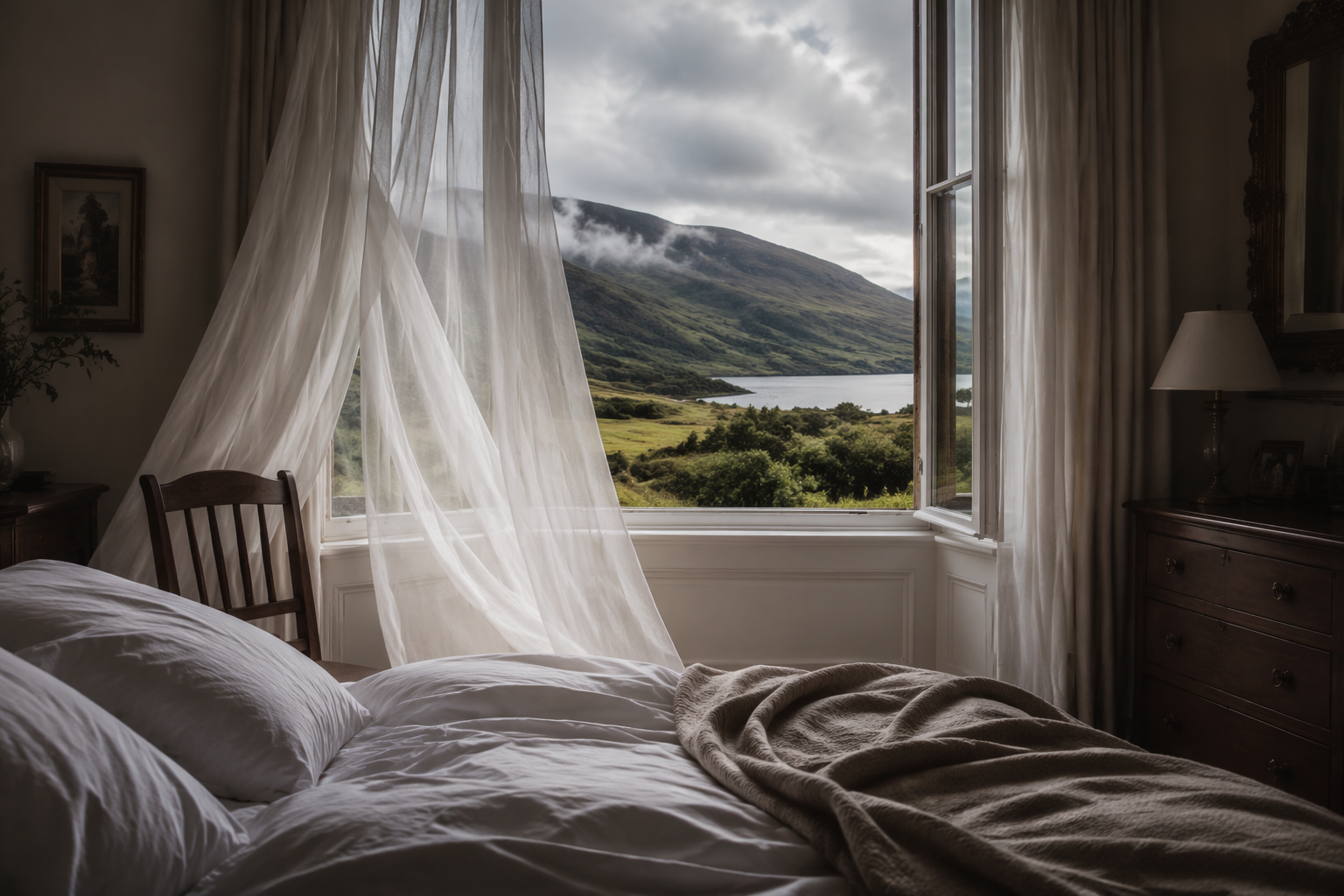
The open window was doing more than making the room feel fresh
An open window changes the sleep environment in two ways. It can lower the room temperature, and it can make the air around the sleeper less stagnant. Neither effect is mystical. Both affect the thin layer of warmth and humidity that builds around a sleeping body, under bedding, and near the face.
The better-supported point is the temperature cue. In a study of three preindustrial societies without modern climate control, sleep onset tended to occur during the period of falling ambient temperature rather than at sunset itself.[2] That distinction is important. Darkness mattered, but the nightly drop in environmental temperature also appeared to help mark the body’s transition toward sleep.
Modern sleep physiology gives that observation a mechanism. Temperature and sleep are regulated together, not as separate systems that happen to meet in the bedroom. Reviews of the field describe sleep architecture, thermoregulation, skin temperature, and core temperature as tightly linked, with the preoptic area of the hypothalamus playing a central role in coordinating sleep and cooling.[3]
So the open Balmoral window is not persuasive because it was royal. It is persuasive because it matches a pattern seen outside palaces: sleep is easier when the surrounding environment allows body heat to move away at the right time.
Why a hot water bottle can belong in a cool-sleep routine
The hot water bottle is the apparent contradiction. If the goal is a cooler sleep environment, why warm the bed before getting in? The answer is that sleep-friendly cooling is not the same as making every part of the body cold. In many cases, gentle warming at the skin helps the body lose heat from the core.
Raymann and colleagues showed this elegantly in a 2008 study published in Brain. Mild cutaneous warming — only 0.4°C within a skin-temperature range of 31°C to 35°C — shortened sleep latency and deepened non-REM sleep.[4] That is a small temperature shift, much closer to the comfort of warm sheets or a warmed foot area than to a dramatic heat treatment.
The mechanism becomes clearer when you follow where the heat goes. Gentle warming of the skin encourages blood vessels near the surface, especially in the hands and feet, to dilate. That movement brings heat from the body’s center toward the periphery, where it can be released. The sleeper may feel warmer at the toes while the core temperature is moving in the direction sleep needs.

A later animal study identified a neural pathway that helps explain why this is not just a comfort effect. Harding and colleagues reported that nitrergic-glutamatergic neurons in the preoptic hypothalamus can initiate non-REM sleep and body cooling in response to gentle skin warming.[5] That is the physiology hiding inside the old-fashioned hot water bottle: the warmth is useful when it helps trigger heat loss, not when it turns the bed into an overheated pocket.
Kräuchi’s work on distal vasodilation supplies another piece. Warm hands and feet predicted shorter sleep onset, suggesting that the body’s ability to move heat outward is a reliable marker of readiness for sleep.[6] A related Lancet study found that people with vasospastic disorders had significantly longer sleep latencies, which supports the same practical point from the opposite direction: if the extremities resist warming and blood flow, sleep onset can become harder.[7]
This is why “keep the bedroom cool” can be incomplete advice. A sleeper with cold feet in a cool room may not be thermoregulating efficiently; they may simply be uncomfortable. Warm socks, a brief warm bath, or a hot water bottle used before sleep can support cooling from the inside out, as long as the bed does not stay oppressively hot through the night.
Separate beds solve a temperature problem before they solve any social one
Lady Pamela Hicks has confirmed that Queen Elizabeth II and Prince Philip slept in separate bedrooms for decades.[8] That detail is often treated as a social or marital curiosity, but for sleep it has a plainer explanation: two bodies create a different microclimate than one.
A shared bed can add body heat, trap warmth under shared covers, and make one person’s movement part of the other person’s night. For some couples, that tradeoff is worth it. For others, especially when one partner runs hot or one needs heavier bedding, the shared sleep surface becomes a small climate dispute that repeats for hours.
The relevant sleep-hygiene lesson is not that separate bedrooms are superior. It is that bedding arrangements are part of thermoregulation. Separate duvets, different blanket weights, or a larger bed can sometimes solve the same problem without separate rooms. What matters is whether each sleeper can maintain a stable enough temperature and avoid repeated awakenings caused by heat, tugged covers, or movement.
The schedule matters because the body has to anticipate the cooling
The Queen’s reported 11 pm to 7:30 am sleep window is less picturesque than the open window, but it may be just as physiologically relevant. A steady schedule gives the circadian system something to predict. The body’s temperature rhythm is not improvised from scratch each night; it is trained by repeated timing, light exposure, activity, meals, and sleep.
Kräuchi and colleagues found that the steepest decline in core body temperature is closely tied to sleep initiation.[9] In practical terms, the body is not only waiting for a cool room. It is preparing a timed shift: blood flow changes, skin warms, the core cools, and sleep pressure meets the circadian signal.
That is where routine becomes more than discipline. If bedtime moves by hours from one night to the next, the cooling signal may not line up with the attempted sleep period. A person can be in a cold bedroom and still feel oddly awake because the internal timing is wrong. Conversely, a familiar bedtime allows the body to start its thermal descent before the lights are out.
Room temperature data should calibrate the habit, not turn it into a commandment
Temperature studies are useful, but they do not turn one bedroom setting into a universal prescription. A 2020 SLEEP abstract reported that, across a bedroom-temperature range of 60°F to 85°F, each 1°F rise correlated with a 0.06% decrease in sleep efficiency.[10] That is a calibration point, not a law of nature that applies identically to every sleeper, every mattress, and every season.
The direction still matters. Excess warmth can erode sleep quality, especially when it prevents heat from leaving the body or causes awakenings under bedding. But the effect of a one-degree change depends on the whole sleep system: pajamas, duvet weight, mattress materials, humidity, a partner’s body heat, age, metabolism, hormonal status, and whether the sleeper tends to wake cold in the early morning.
That is also why the royal pattern is more useful than a single number. Open windows reduce excess environmental heat. Separate bedding or beds reduce shared heat and disturbance. A hot water bottle can warm the periphery so heat leaves the core. A fixed bedtime helps the circadian system know when to begin the shift.
How to translate the royal routine without imitating it
The Queen’s bedroom was not a clinical trial, and secondary royal reporting should not be mistaken for medical evidence. The stronger conclusion is narrower and more useful: the habits attributed to her converge with what sleep thermoregulation research already suggests.
- If you wake hot, reduce trapped heat first: lighter bedding, more air movement, separate covers, or a cooler room.
- If you struggle to fall asleep with cold feet or hands, try gentle peripheral warming before bed rather than raising the whole-room temperature.
- If a bed partner disturbs your temperature or sleep, solve the microclimate problem directly with separate blankets, different bedding weights, or more space.
- If your bedtime varies widely, make timing part of the temperature routine; the body cools into sleep more reliably when the schedule is predictable.
The appealing part of the Balmoral image is not that everyone should sleep like a monarch. It is that an old domestic routine — open air, warm sheets, separate bedding, regular hours — maps neatly onto the body’s nightly work of moving heat outward so sleep can begin and hold.
References
- Paul Burrell’s account of Queen Elizabeth II keeping Balmoral windows open, Woman & Home
- Natural Sleep and Its Seasonal Variations in Three Pre-industrial Societies, Current Biology, 2015
- The Temperature Dependence of Sleep, Frontiers in Neuroscience, 2019
- Skin deep: enhanced sleep depth by cutaneous temperature manipulation, Brain, 2008
- A neuronal hub binding sleep initiation and body cooling in response to a warm external stimulus, Current Biology, 2018
- Warm feet promote the rapid onset of sleep, Nature, 1999
- Cold feet and prolonged sleep-onset latency in vasospastic syndrome, The Lancet, 2001
- Lady Pamela Hicks’ account of Queen Elizabeth II and Prince Philip sleeping separately
- Thermoregulatory changes around sleep onset, 2000
- Bedroom temperature and sleep efficiency abstract, SLEEP, 2020
Comments
Join the discussion with an anonymous comment.