
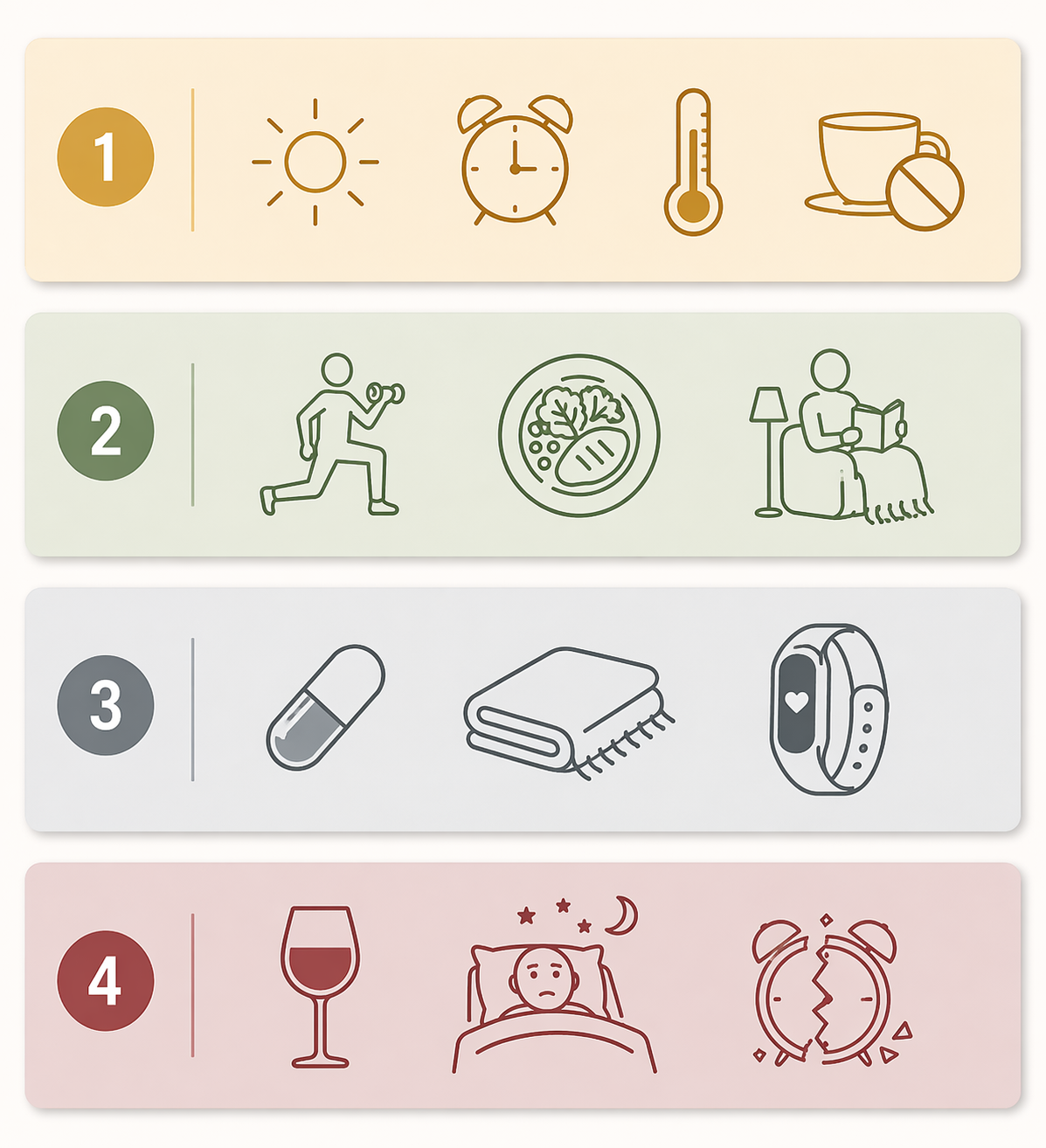
If you search for tips for better sleep, you usually get a pile of advice that treats every suggestion as equally urgent: buy a weighted blanket, stop caffeine, take melatonin, meditate, avoid screens, tape your mouth, wake up earlier, stop worrying. That is not a plan. It is a burden.
The need is real. In 2024, 30.5% of U.S. adults reported sleeping fewer than seven hours in a 24-hour period, and only 54.8% said they woke up well-rested in the past week, according to CDC National Center for Health Statistics data published in 2026.[1] Some readers are dealing with ordinary sleep disruption; others may be dealing with chronic insomnia, which is a different problem. An AASM survey reported that 12% of Americans have been diagnosed with chronic insomnia.[2]
So the useful question is not “Which sleep tip sounds nice?” It is: which changes deserve your first effort, which are reasonable add-ons, and which ones should not be carrying the weight of your sleep plan?
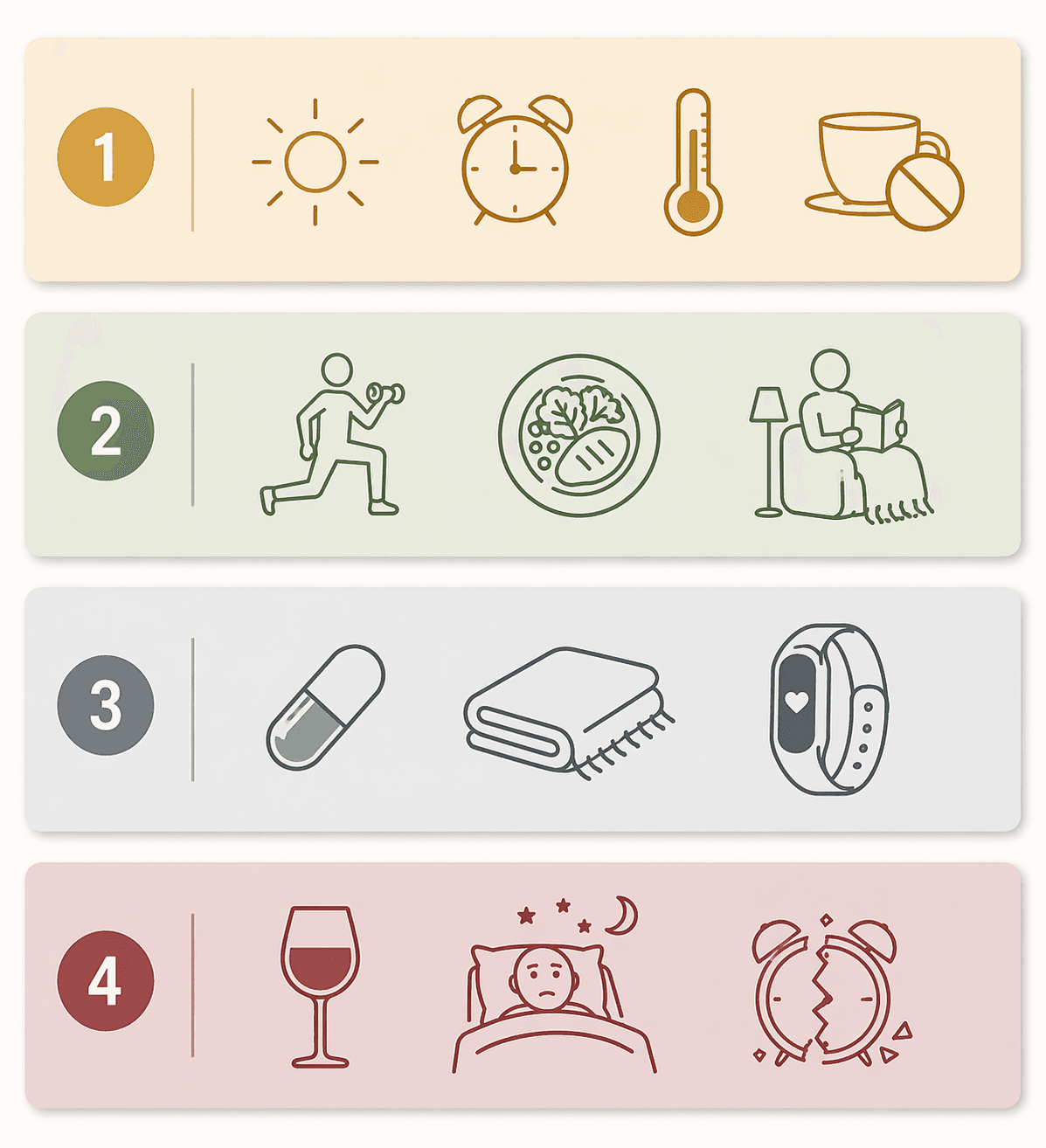
The evidence tiers: what to try first, what to treat carefully
| Tier | Sleep practices | Evidence basis in plain language | Practical judgment |
|---|---|---|---|
| Tier 1 — Strongest starting points | Consistent wake time; morning light; cooler sleep environment; caffeine timing; CBT-I components for chronic insomnia | Supported by sleep physiology, CBT-I principles, trials or reviews, and measurable effects on sleep timing, sleep pressure, temperature regulation, or insomnia behavior patterns.[3][4][5][6][7] | Try these first. They ask for effort, but the effort is proportionate to the evidence. |
| Tier 2 — Useful, conditional | Exercise; avoiding alcohol close to bed; meal timing; evening wind-down routine | Generally plausible and often supported by observational evidence, clinical practice, or some intervention research, but effects depend more on timing, dose, and the person. | Worth using, especially if the pattern fits your problem. Do not let them distract from Tier 1. |
| Tier 3 — Emerging, mixed, or over-promoted | Melatonin; weighted blankets; sleep trackers; mouth taping; magnesium; glycine; valerian | Some may help certain people, but the evidence is smaller, more mixed, or less directly tied to durable sleep improvement. Product quality and measurement accuracy can be real issues.[8] | Use cautiously. Treat these as experiments, not the foundation. |
| Tier 4 — Popular but contradicted | Weekend catch-up as a fix; alcohol as a sleep aid; staying in bed until sleep comes; assuming you can adapt to less sleep | These conflict with circadian stability, sleep architecture, stimulus control, or established sleep-health findings.[9] | Do not rely on these. Some actively train the wrong pattern. |
Tier 1: the sleep tips that deserve first effort
Tier 1 is not glamorous. It is mostly timing, light, temperature, caffeine, and what you do when sleep will not come. That is exactly why these practices are useful: they act on systems that actually regulate sleep instead of asking you to stack five soothing rituals and hope one of them lands.
Keep wake time steady before obsessing over bedtime
A consistent wake time is one of the least exciting sleep recommendations and one of the most important. It gives your body a stable anchor for circadian timing and sleep pressure. Bedtime can vary somewhat because real life varies; wake time is the stronger lever because it starts the next sleep cycle.
This is also where weekend “recovery” becomes tricky. Sleeping far later on Saturday and Sunday may feel like repayment, but it can shift your timing later and make Monday morning feel like a small time-zone change. If your weekdays are chronically short, the better fix is not heroic weekend sleep-ins; it is protecting enough sleep more consistently across the week.
Get morning light, especially if your sleep has drifted late
Morning light is not just a wellness flourish. It is a timing signal. A 2025 study in Brazil found that every additional 30 minutes of morning sun exposure before 10 a.m. was associated with a sleep midpoint 23 minutes earlier.[3] That is a meaningful effect if your main problem is that your nights keep sliding later.
The caveat matters: the study used self-reported sun exposure and was conducted in Brazil, so the size of the effect may not transfer neatly to a U.S. reader in a northern winter, a cloudy climate, or a night-shift schedule. Still, the mechanism is strong enough to make morning outdoor light a sensible early move. If you want the deeper biology, the circadian timing piece is better handled in a dedicated guide to circadian rhythm mechanisms.
Cool the sleep environment enough for your body to shed heat
Temperature advice often gets reduced to a single thermostat number, but the real target is thermoregulation. Your body needs to lose heat as it prepares for sleep. A room that is too warm, bedding that traps heat, or pajamas that make you sweat can interfere with that process.
Sleep Foundation summarizes the commonly recommended bedroom range as about 65–68°F, or 15.6–20°C.[4] A 2024 systematic review in Sleep Medicine Reviews also found that heat exposure degrades sleep across global contexts, which matters as nighttime temperatures rise in many places.[5] There is also a large device-based SLEEP journal dataset often cited in discussions of bedroom temperature, but because only abstract-level information is available for that dataset, it should be treated as supportive rather than definitive.
The practical version is simple: if you wake sweaty, kick off covers, or sleep better in cooler weather, temperature may be a high-yield bottleneck. Adjust the room, bedding, sleepwear, or pre-bed shower timing before buying specialized gadgets.
Move caffeine earlier, but do not pretend one cutoff fits everyone
Caffeine is one of the clearest examples of a sleep tip that needs both evidence and individual adjustment. Johns Hopkins Medicine notes that caffeine consumed six hours before bed reduced total sleep time by about one hour in a 2013 study.[6] That does not mean 2 p.m. is the magic line for every adult. Caffeine half-life varies widely, and some people feel an afternoon coffee long after others would notice nothing.
A reasonable test is to move your last caffeine serving earlier for one to two weeks and watch sleep onset, night waking, and next-day alertness. If you are sensitive, the useful cutoff may be late morning. If you metabolize it quickly, an early afternoon cutoff may be enough. The point is not moral purity; it is removing a stimulant from the hours when your sleep system is trying to build momentum.
If insomnia is chronic, stop treating it like ordinary sleep hygiene
For chronic insomnia, the strongest move is not another supplement or a prettier evening routine. CBT-I components such as stimulus control and sleep restriction are designed to change the learned relationship between bed, wakefulness, effort, and anxiety. Sleep Foundation reports that 10–15% of adults meet criteria for chronic insomnia disorder, and up to two-thirds experience occasional insomnia symptoms.[7]
Stimulus control corrects one of the most understandable but counterproductive instincts: staying in bed trying harder to sleep. If the bed becomes the place where you rehearse frustration for hours, your brain learns that bed equals wakefulness. CBT-I reverses that pattern by restricting wakeful time in bed and rebuilding the bed-sleep association.
That does not mean everyone with a bad week of sleep needs a formal insomnia program. It does mean that if sleeplessness is persistent, impairing, or anxiety-driven, general lifestyle optimization is no substitute for clinical guidance and evidence-based insomnia treatment.
A quick way to choose your first Tier-1 change
| If your main pattern is... | Start with... | Why this is the better first test |
|---|---|---|
| You fall asleep and wake later than you want | Fixed wake time plus morning outdoor light | These target circadian timing rather than adding more bedtime effort. |
| You wake hot, sweaty, or restless | Room, bedding, and clothing temperature changes | Heat can interfere with sleep continuity even when your routine is otherwise reasonable. |
| You fall asleep late after afternoon caffeine | Move caffeine earlier or reduce dose | This tests a stimulant effect before blaming your willpower or bedtime routine. |
| You lie awake in bed for long stretches | CBT-I-style stimulus control and clinical support if chronic | This addresses the bed-wakefulness association instead of reinforcing it. |
| Your routine is chaotic but insomnia is not chronic | Wake time first, then light and caffeine | A stable anchor makes the rest of sleep hygiene easier to interpret. |
For readers building a complete routine, the broader step-by-step material belongs in a separate sleep hygiene fundamentals guide. Here, the ranking matters more than completeness. A smaller number of high-evidence changes is usually easier to judge than six simultaneous experiments.
Tier 2: useful habits that depend on timing and context
Exercise belongs near the top of the moderate tier because it helps many people sleep better and supports overall health. The timing matters. A hard workout close to bedtime can be too activating for some people, while earlier activity may improve sleep quality without interfering with wind-down. If evening is the only time you can exercise and you sleep well afterward, there is no need to invent a problem.
Alcohol avoidance is more urgent than many people realize, but it sits here because the behavior is conditional: the closer to bedtime and the higher the dose, the more likely it is to disrupt sleep. Alcohol can make sleep onset feel easier, then fragment the second half of the night, reduce REM sleep, and worsen snoring or sleep apnea risk.[7]
Meal timing is similar. A heavy meal close to bed can push sleep later or make sleep less comfortable, especially for people prone to reflux or late-night alertness. The evidence does not require a rigid early-dinner rule for everyone. It supports paying attention to whether late meals are part of your pattern.
Wind-down routines are where it is easy to get unfairly dismissive. A quiet transition, lower light, reading, stretching, or a predictable sequence can help some people stop carrying the day directly into bed. The limitation is that a wind-down routine is not the same as a treatment for chronic insomnia, and it cannot reliably overpower late caffeine, unstable wake timing, heat, or alcohol-fragmented sleep.
Tier 3: experiments, not foundations
Tier 3 is not a junk drawer. Some of these practices may be useful for some people. The problem is that they are often marketed or repeated online with more confidence than the evidence supports.
Melatonin is the clearest example. It has a plausible role for circadian timing in specific situations, but many people use it as a general sedative. Product reliability also complicates the “why not just try it?” attitude. A JAMA analysis of melatonin gummy products found that 88% were inaccurately labeled, and actual melatonin content ranged as high as 347% of the labeled amount.[8] That does not make melatonin useless. It does make casual, indefinite self-experimentation less harmless than it sounds.
Weighted blankets have some promising small-study support and may help people who find deep pressure calming. They are reasonable to try if they are comfortable, safe, and not financially burdensome. They should not be treated as equivalent to fixing a drifting wake time or addressing chronic insomnia.
Sleep trackers can be useful for patterns: bed timing, approximate sleep duration, consistency, and trends after a change. They are not clinical-grade diagnostics. If a tracker makes you more anxious or convinces you that one imperfect score has ruined your day, it has stopped being a helpful feedback tool.
Mouth taping has become popular online, especially in wellness and fitness circles, but controlled evidence remains minimal. It is also not a casual experiment for people with nasal obstruction, suspected sleep apnea, breathing concerns, or panic around restricted breathing. Snoring, gasping, and witnessed pauses in breathing deserve medical evaluation, not tape.
Magnesium, glycine, and valerian sit in the same broad category: mixed findings, smaller samples, and lots of confident claims. If supplements are the part you want to examine more closely, use a dedicated home remedies for insomnia evidence guide rather than letting supplement marketing set the hierarchy.
Tier 4: advice that points you in the wrong direction
Weekend catch-up sleep can feel necessary after a short week, and occasional extra rest is not a personal failure. The problem is treating it as a full repair strategy. If it shifts your clock later, Sunday night becomes harder, Monday morning gets rougher, and the cycle repeats.
Alcohol as a sleep aid is contradicted by what it does after sleep begins. It may shorten the time it takes to fall asleep, but it fragments sleep and can worsen breathing-related sleep problems.[7] A faster knockout is not the same thing as better sleep.
Staying in bed until sleep comes is another common mistake. It feels disciplined, but stimulus control says the opposite: long wakeful stretches in bed can teach the brain that bed is a place for effort, monitoring, and frustration. For chronic insomnia, this is exactly the pattern CBT-I tries to unwind.
The idea that people can simply adapt to less sleep also deserves to be retired. A 2019 Sleep Health paper identifying common sleep myths included the belief that adults can do well on five or fewer hours of sleep as one of the myths that conflicts with evidence. The ability to fall asleep “anytime, anywhere” may signal sleep deprivation rather than superior sleep skill.[9]
Use the tiers as a filter, not a personality test
Low-evidence does not always mean useless. A warm ritual, a favorite blanket, or a calming playlist may have a place if it helps you transition and costs little. The problem starts when low-certainty habits crowd out the practices more likely to change sleep timing, sleep pressure, temperature regulation, stimulant exposure, or insomnia conditioning.
Pick one or two Tier-1 changes that match your most likely bottleneck. Keep the test clean enough to judge. If your sleep is late, start with wake time and morning light. If your nights are restless and hot, start with temperature. If you use caffeine late, move it earlier. If you spend long stretches awake in bed, treat that as an insomnia-pattern problem rather than a sign that you need a longer list of bedtime tips.
After that, Tier 2 habits can support the plan, and Tier 3 experiments can stay optional. The order matters because your energy is limited. Sleep advice should respect that.
References
- Sleep Difficulties in Adults: United States, 2024 — CDC National Center for Health Statistics, 2026.
- Survey shows 12% of Americans have been diagnosed with chronic insomnia — American Academy of Sleep Medicine, 2024.
- Association between sunlight exposure and sleep timing: a cross-sectional study among adults in Brazil — BMC Public Health, 2025.
- The Best Temperature for Sleep — Sleep Foundation.
- The impact of heat exposure on sleep: A systematic review — Sleep Medicine Reviews, 2024.
- Seven Ways to Get a Healthier Night's Sleep — Johns Hopkins Medicine.
- Sleep Facts and Statistics — Sleep Foundation.
- Quantity of Melatonin and CBD in Melatonin Gummies Sold in the US — JAMA, 2023.
- Sleep myths: an expert-led study to identify false beliefs about sleep that impinge upon population sleep health practices — Sleep Health, 2019.
Comments
Join the discussion with an anonymous comment.