
Mechanism explainer
Stimulus Control Therapy for Insomnia: The Conditioning Logic Behind Each Rule
A mechanistically grounded guide to stimulus control therapy — the most empirically validated standalone behavioral treatment for chronic insomnia — explaining why each of the five Bootzin rules works, how conditioned arousal develops and is reversed, and how to implement the protocol correctly without the errors that undo it.
What Stimulus Control Therapy Is — and What It Is Not
Stimulus control therapy (SCT) is a behavioral reconditioning protocol. Its purpose is specific: to break the learned association between the bed and wakefulness, and to rebuild the bed as a reliable cue for sleep. It is not a collection of sleep tips, not a relaxation technique, and not a hygiene checklist.
That distinction matters practically. Sleep hygiene — avoiding caffeine late in the day, keeping the bedroom dark and cool, dimming lights before bed — addresses environmental and physiological conditions that support sleep. SCT addresses a different problem: a conditioned psychological response that has made the bed itself a trigger for arousal. The two can coexist in a treatment plan, but they work on different mechanisms and should not be conflated.
SCT was first described by Richard Bootzin in 1972 as a set of behavioral instructions derived from learning theory. The goal was to use conditioning principles — the same mechanisms that explain how Pavlov's dogs learned to salivate at a bell — to reshape what the bedroom means to the nervous system. Decades of subsequent research have confirmed it as one of the most effective standalone interventions for chronic insomnia available.
How Conditioned Arousal Develops: The Mechanism That Maintains Chronic Insomnia
Chronic insomnia rarely begins as a conditioning problem. It usually starts with a period of acute stress, illness, travel disruption, or a significant life event that makes sleep difficult for a few nights. For most people, sleep normalizes when the trigger resolves. For others, something different happens: the difficulty sleeping persists after the original cause has passed.
What sustains it is conditioning. Every night spent lying awake in bed — watching the ceiling, checking the clock, feeling the body tighten with frustration — is a learning trial. The bedroom environment (the mattress, the pillow, the darkness, the particular quality of quiet) becomes paired, again and again, with the physiological state of wakefulness and arousal. Through classical conditioning, these environmental cues begin to reliably elicit that state. The bedroom stops being a neutral space and becomes a trigger.
This is not metaphorical. The conditioned response is measurable: people with chronic insomnia often report feeling more alert when they get into bed than they did minutes earlier on the couch. The bed has become a discriminative stimulus — a signal the nervous system has learned to associate with a particular outcome. In this case, the outcome is wakefulness.
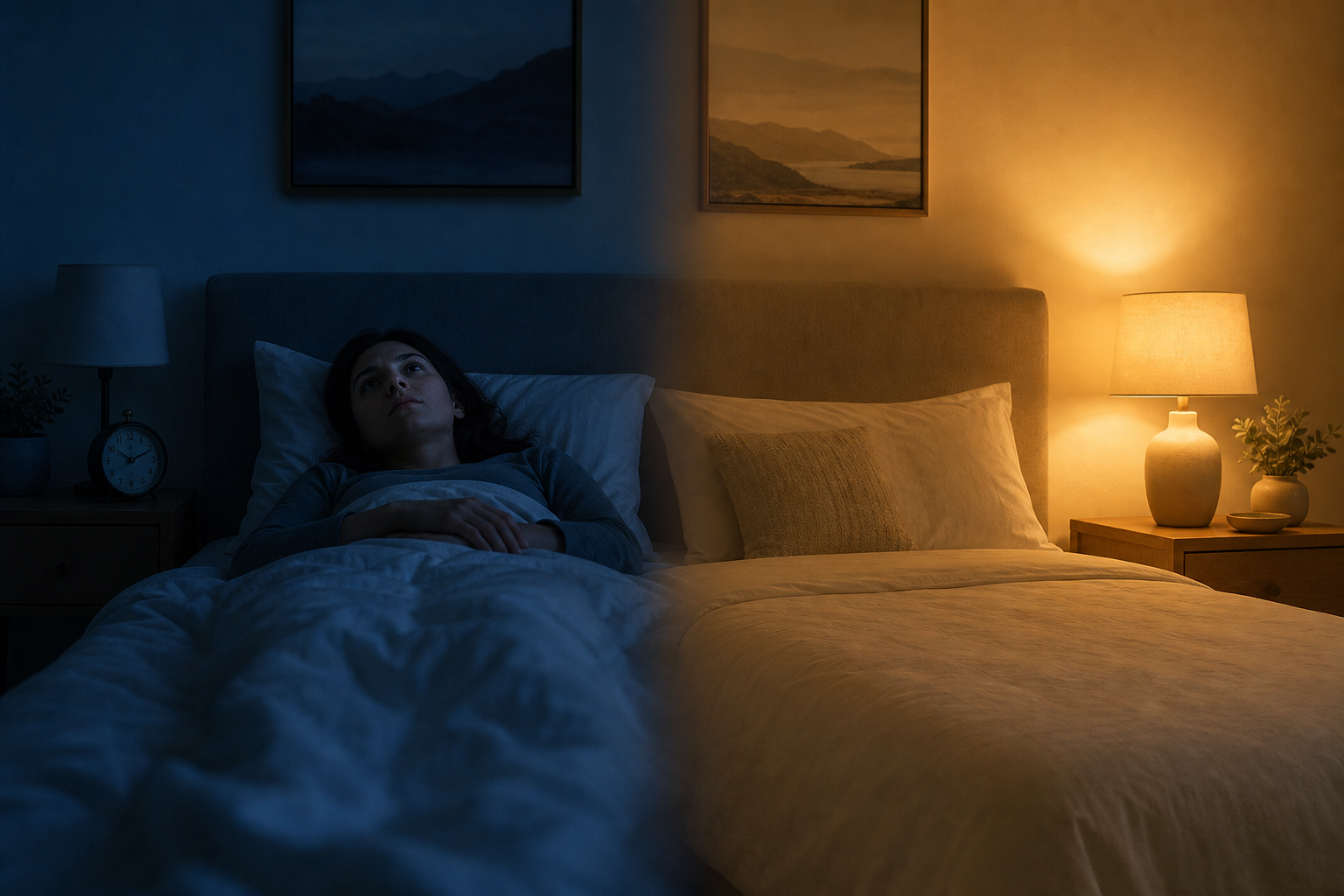
The conditioning loop is self-reinforcing. Lying awake in bed strengthens the bed-wakefulness association. A stronger association means more arousal at bedtime, which means more time spent lying awake, which means more conditioning trials. Without deliberate intervention, the loop tightens over months and years.
There is also an operant dimension. Falling asleep can be understood as a behavior that produces a reinforcing outcome (sleep). When the bedroom environment consistently fails to produce that outcome, the behavior itself is extinguished in that context — the bed stops being a place where sleep happens reliably.
For readers whose insomnia is heavily intertwined with nighttime anxiety and worry, the conditioning loop described here is part of a larger picture. The relationship between sleep anxiety and insomnia — including how hyperarousal perpetuates the association — is covered in detail separately.
The Five Bootzin Rules, Each With Its Conditioning Rationale
The five SCT instructions are not arbitrary lifestyle recommendations. Each one targets a specific conditioning error. Understanding why each rule exists is what makes it possible to follow the rule correctly under pressure — and to resist the modifications that undo the treatment.
Rule 1: Go to bed only when sleepy
"Sleepy" here means physiologically drowsy — eyes heavy, difficulty keeping attention, body pulling toward sleep. It does not mean tired, fatigued, or ready to lie down and rest.
The conditioning error this rule corrects: going to bed at a fixed clock time regardless of sleep readiness. When someone who is not yet sleepy gets into bed, they lie awake. Each such episode is another pairing of the bed with wakefulness. The rule breaks this by ensuring that the bed is encountered primarily in a state of genuine sleep readiness — so the bed-sleep pairing, rather than the bed-wakefulness pairing, is what gets reinforced.
Rule 2: Use the bed only for sleep and sex
Reading in bed, watching television, scrolling a phone, working on a laptop, eating, or even lying awake thinking about the day — all of these activities pair the bed with states of wakefulness and engagement. The more varied the activities associated with the bed, the weaker the bed-sleep association becomes relative to a generalized bed-wakefulness association.
The rule restricts the bed's associative field to a single outcome. The bed becomes a context-specific cue: this place means sleep. That specificity is what gives the cue its power.
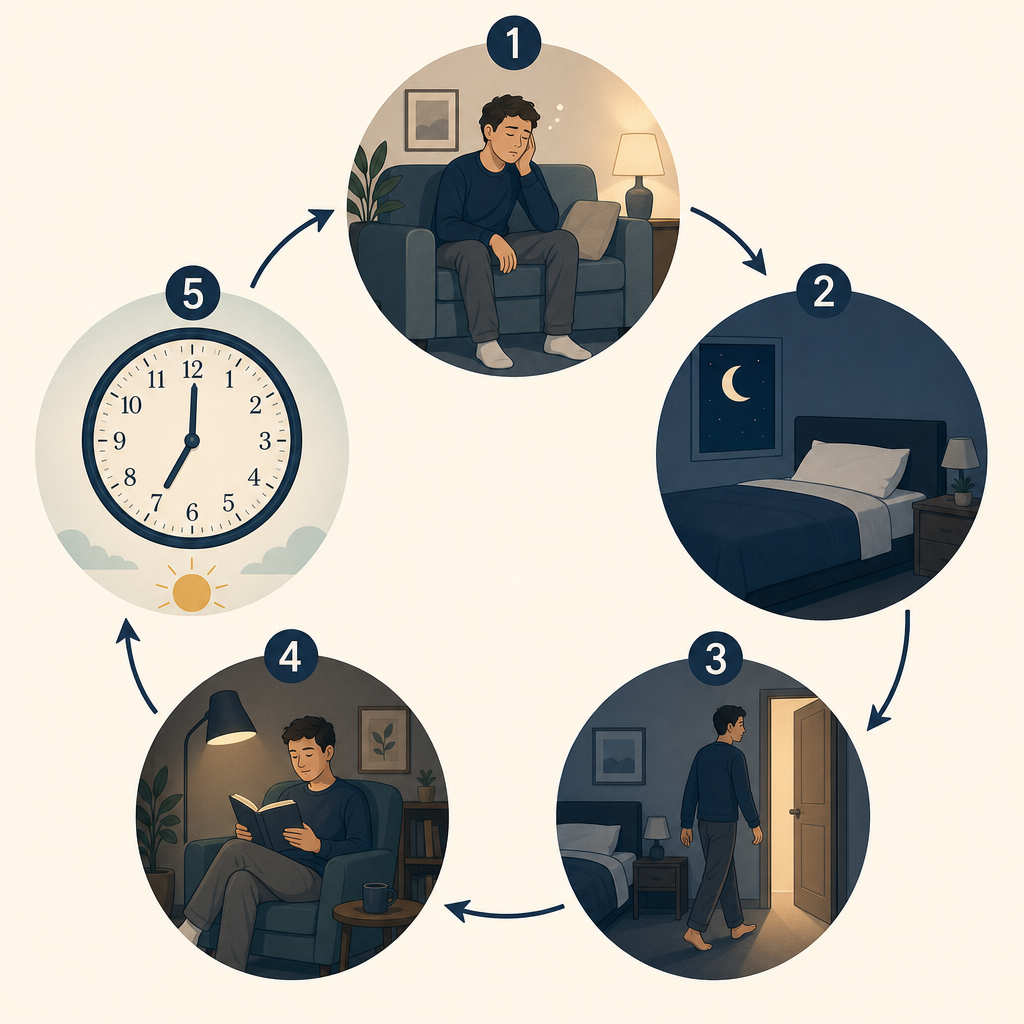
Rule 3: Leave the bed if you are not asleep within approximately 20 minutes
This is the rule most people resist most strongly, and it is the one that does the most direct reconditioning work. When you remain in bed while awake — even if you are lying quietly and trying to sleep — you are running a conditioning trial. The bed is present; wakefulness is present; the association is being reinforced.
Leaving the bed interrupts the trial. It removes the conditioned stimulus (the bed) from the wakefulness state, preventing further pairing. Over repeated nights, the bed stops predicting wakefulness because wakefulness no longer reliably occurs there.
The "20 minutes" threshold is a clinical convention, not a precise biological boundary. Published trials have used thresholds ranging from 10 to 25 minutes. The exact duration matters less than the principle: do not remain in bed while awake for extended periods. If you are not asleep and not drifting toward sleep, get up.
Rule 4: Maintain a fixed wake time every day without exception
A fixed wake time does two things simultaneously. It anchors the circadian rhythm, giving the body a consistent temporal signal that stabilizes the sleep-wake cycle. And it prevents compensatory sleep extension — sleeping in after a bad night — which is one of the most common ways people inadvertently weaken their sleep pressure and make the next night harder.
"Without exception" is not rhetorical emphasis. Sleeping in on weekends, or after a particularly poor night, resets the circadian anchor and rebuilds the pattern of irregular sleep timing that SCT is designed to dismantle. The rule applies on days off, after travel, and after nights when total sleep was minimal.
Rule 5: Avoid daytime napping
Daytime napping reduces the homeostatic sleep drive — the accumulation of sleep pressure that builds throughout the day and makes it easier to fall asleep at night. When that pressure is partially discharged by a nap, the physiological sleepiness that Rule 1 requires (go to bed only when sleepy) is harder to achieve at a normal bedtime.
Napping also introduces a second sleep context — the couch, the recliner, wherever the nap occurs — which can dilute the specificity of the bed-sleep association being built. The goal is for sleep to happen in one place, at one time, with one set of cues.
| Rule | Conditioning error it corrects | What happens if you break it |
|---|---|---|
| Go to bed only when sleepy | Pairing the bed with wakefulness by going to bed too early | Lying awake in bed adds another conditioning trial linking bed with wakefulness |
| Use bed only for sleep and sex | Associating the bed with multiple arousal states (reading, screens, worry) | The bed's cue specificity weakens; it predicts wakefulness as reliably as sleep |
| Leave the bed if not asleep in ~20 min | Staying in bed while awake reinforces the bed-wakefulness pairing | Every minute of wakefulness in bed strengthens the conditioned arousal response |
| Fixed wake time every day | Irregular wake times destabilize circadian rhythm and allow compensatory sleep extension | Sleep pressure is reduced; circadian anchor drifts; next-night sleep becomes harder |
| No daytime napping | Napping discharges sleep pressure needed for nighttime sleepiness | Homeostatic drive at bedtime is insufficient; Rule 1 sleepiness is harder to reach |
What to Do When You Leave the Bed: The Most Mishandled Rule
Most people who attempt SCT on their own understand that they are supposed to get out of bed when they cannot sleep. Far fewer understand that what they do during that time is not neutral.
The out-of-bed period has one purpose: to allow sleepiness to rebuild. Every choice made during that period either supports that goal or works against it. High-stimulation activities — checking the phone, watching television, doing anything cognitively demanding or emotionally activating — raise arousal. An elevated arousal state delays the return of sleepiness, which means a longer time before you can return to bed, which means more time awake overall.
The practical standard for out-of-bed activity is: low stimulation, dim light, no screens, no clock-watching. Sitting in a chair in another room, reading something undemanding in warm low light, or listening to quiet audio are appropriate. The goal is a state of calm wakefulness — not sleep-onset, but not engagement either.
- Stay in a room other than the bedroom if possible — maintaining the bedroom's associative boundary.
- Keep lighting dim and warm — bright or blue-spectrum light suppresses melatonin and signals wakefulness to the circadian system.
- Avoid screens entirely — the combination of light exposure and cognitive engagement is doubly counterproductive.
- Do not watch the clock — clock-watching during out-of-bed time increases performance anxiety and activates the same hyperarousal loop the protocol is trying to dismantle.
- Return to bed only when genuinely sleepy — the same physiological drowsiness criterion as Rule 1, not simply when a certain amount of time has passed.
Week-by-Week Implementation: Why Week One Often Feels Worse
The most important thing to understand about SCT implementation is that early worsening is expected and mechanistically explicable. It is not a sign that the protocol is failing.
In the first week, the conditioned association between bed and sleep is being actively dismantled. The nervous system is losing a prediction it has relied on — even if that prediction was for wakefulness, the loss of any reliable pattern creates transient disruption. Sleep onset latency may increase. Nights may feel harder than before starting the protocol. This is the expected early-phase response.
| Week | What typically happens | What it means |
|---|---|---|
| Week 1 | Sleep onset latency may increase; more time out of bed; heightened frustration | The conditioned bed-wakefulness association is being disrupted — expected, not failure |
| Week 2 | Sleep onset latency begins to stabilize; some nights noticeably easier | New bed-sleep associations are beginning to form; the protocol is working |
| Weeks 3–4 | Consistent improvement in time to fall asleep; waking less frequently | Reconditioning is consolidating; bed is becoming a reliable sleep cue |
| Beyond week 4 | Continued gradual improvement; occasional setbacks are normal and do not reset progress | Maintain all five rules; a single bad night does not undo the conditioning built |
Adherence is the primary variable that determines outcomes. Research estimates adherence to SCT at 40–85% across studies, with the two main barriers being difficulty believing the instructions will actually work and discomfort with the behavioral demands — particularly the rule requiring getting out of bed.
Common Implementation Errors and How Each One Undoes the Treatment
SCT fails most often not because the protocol is wrong but because it is modified in ways that feel reasonable in the moment and are conditioning disasters in practice. Each of the following errors has a specific mechanism by which it rebuilds the association SCT is trying to dismantle.
- Going to bed before genuinely sleepy. This is the most common error. "I'm tired, I should try" is not the same as physiological sleepiness. Every attempt to fall asleep while not yet sleepy that results in lying awake is a conditioning trial reinforcing the bed-wakefulness link.
- Using the bedroom for non-sleep activities. Reading in bed to "wind down," watching one episode on a laptop, keeping a phone on the nightstand and checking it during the night — each of these weakens the bed's associative specificity. The bed stops being a sleep-only context.
- Returning to bed too quickly after getting up. Getting up, spending five minutes in another room, and returning to bed while still alert is functionally equivalent to not getting up at all. The out-of-bed period must last until genuine sleepiness returns, regardless of how long that takes.
- Abandoning the protocol after a bad night. A single poor night during SCT implementation is not evidence that the protocol has failed. Abandoning the rules after a difficult night — sleeping in, napping, going to bed early the next night — reintroduces the patterns the protocol is correcting and resets the conditioning progress made.
- Sleeping in on weekends or after poor nights. This directly violates Rule 4 and disrupts the circadian anchor. It also reduces sleep pressure for the following night, making it harder to feel genuinely sleepy at the target bedtime.
How SCT Relates to Sleep Restriction Therapy: A Brief Orientation
SCT and sleep restriction therapy (SRT) are often delivered together within full CBT-I, but they work on different mechanisms. SCT targets conditioned arousal — the learned association between bed and wakefulness. SRT targets homeostatic sleep drive — it consolidates sleep by temporarily limiting time in bed, building the pressure that makes sleep onset faster and sleep more continuous. The two approaches are complementary: SCT clears the conditioned obstacle; SRT builds the physiological momentum. Either can be used as a standalone intervention, and SCT has the stronger standalone evidence base for sleep onset latency specifically. For readers working through sleep restriction questions specifically, the sleep restriction therapy troubleshooting guide addresses common stalls and implementation problems in that protocol.
The Evidence Base: What the Research Actually Shows
The American Academy of Sleep Medicine (AASM) designates stimulus control therapy as a Standard treatment for chronic insomnia disorder in adults — its highest evidence grade — and includes a conditional recommendation for its use as a single-component intervention, separate from the full CBT-I protocol. The AASM also notes explicitly that sleep hygiene recommendations do not constitute an effective standalone therapy, directly contrasting SCT's evidence status with sleep hygiene's lack of monotherapy support.
The quantitative evidence for SCT's specific effects became substantially clearer with the publication of the first comprehensive standalone systematic review and meta-analysis of SCT by Jansson-Fröjmark and colleagues in 2023 (Journal of Sleep Research, doi:10.1111/jsr.14002). Against passive comparators, SCT produced large effect sizes on sleep onset latency (Hedge's g = 0.85–0.87). The effect on total sleep time was smaller and non-significant (g = 0.38). This distinction is important: SCT's primary strength is on how quickly people fall asleep, not on how many total hours they sleep.
A 2024 network meta-analysis by Verreault and colleagues (Journal of Sleep Research, doi:10.1111/jsr.14008) confirmed these findings across 23 randomized studies. SCT significantly reduced sleep onset latency versus waitlist (mean difference of approximately 18 minutes), versus placebo (approximately 26 minutes), and versus no treatment (approximately 62 minutes). SCT also outperformed sleep restriction therapy on total sleep time in this analysis.
| Outcome measure | SCT effect vs. passive comparators | Interpretation |
|---|---|---|
| Sleep onset latency (SOL) | Large effect (Hedge's g = 0.85–0.87) | SCT's primary and most consistent benefit |
| Wake after sleep onset (WASO) | Significant reduction confirmed in 2024 NMA | Meaningful improvement in sleep continuity |
| Total sleep time (TST) | Small, non-significant (g = 0.38) | SCT does not reliably increase total sleep duration substantially |
When Stimulus Control Alone Is Not Enough
SCT as a standalone intervention addresses conditioned arousal effectively. It does not directly address dysfunctional beliefs about sleep ("I must get eight hours or I cannot function"), catastrophic thinking about poor sleep nights, or the sleep fragmentation that benefits most from sleep restriction's consolidation effect. When these factors are prominent, the full CBT-I protocol — which integrates SCT with cognitive restructuring, sleep restriction, and relaxation components — is the appropriate next step.
SCT also has limits when sleep fragmentation (frequent middle-of-the-night waking, rather than difficulty falling asleep initially) is the primary complaint. The evidence for SCT is strongest on sleep onset latency. For readers whose main problem is fragmented sleep rather than prolonged sleep onset, the complete multicomponent approach is likely more effective.
Supports these guides
Spot an error or have clinical feedback?
Because this article covers clinical, medication, or safety information, we use a moderated correction channel instead of open public comments. Let us know if something about “Stimulus Control Therapy for Insomnia: The Conditioning Logic Behind Each Rule” needs a closer look.
Send feedback on this article