
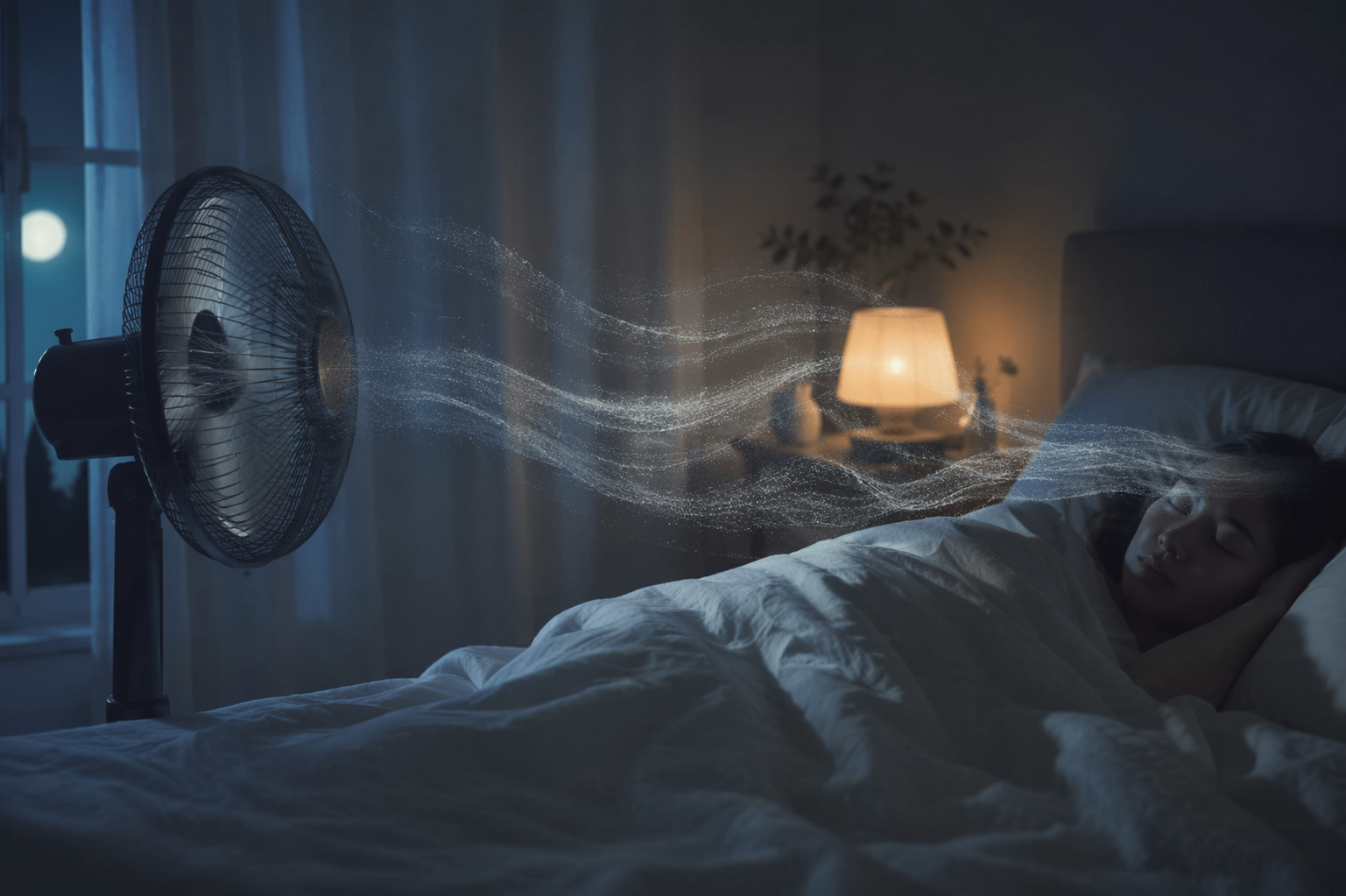
Why you wake up dry, stuffed up, or stiff
If sleeping with a fan on leaves you waking up with a dry nose, gritty eyes, or a throat that feels scraped out, the fan is usually not doing one dramatic thing. It is changing the room’s air movement enough to speed up moisture loss, shift how mucus behaves, and move around whatever is already floating in the bedroom. The nose is built to warm, humidify, and filter air; steady airflow can outrun that overnight balance, especially in a dry room. A bedroom kept closer to 50–60% relative humidity will usually feel different from one in a much drier range. [1]
That is why the morning-after question is more useful than the blanket one. A fan can be harmless in one room and irritating in another because the body does not experience moving air as a single sensation. It experiences drying at the nose, eyes, and mouth, then tries to compensate for it while you are asleep. In a humid room that compensation may be modest. In an arid room, the same fan can become the difference between waking refreshed and waking parched. [1]
The first mechanism: evaporation outruns replenishment
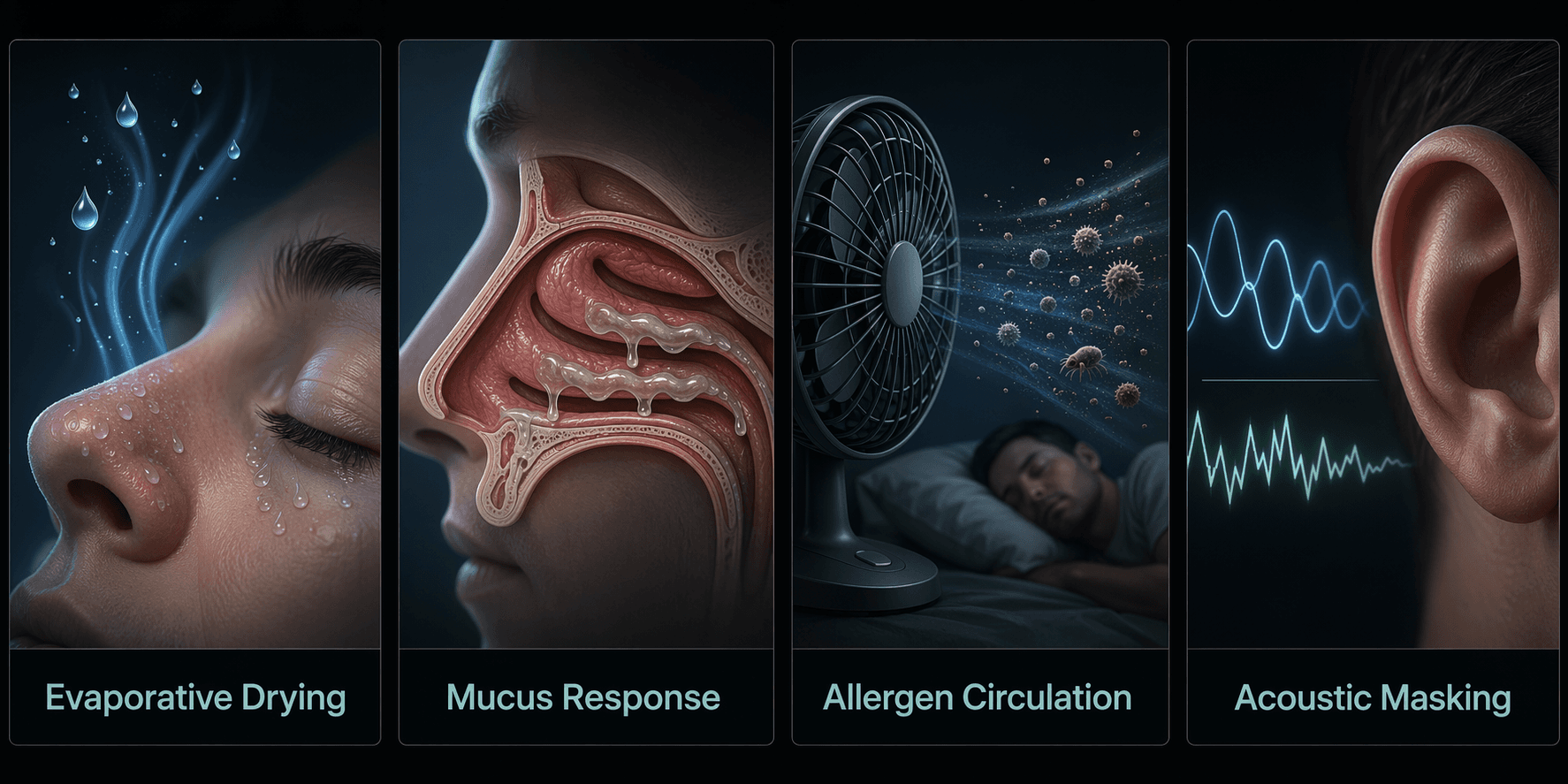
The clearest physiologic effect is simple evaporation. Air moving across the face and upper airway pulls moisture from the tear film, the lining of the nose, and the mouth more quickly than still air does. Overnight, those surfaces normally rehydrate between breaths and across cycles of nasal mucus production. Fan airflow makes that replenishment harder to keep up with, so the tissue feels dry before it feels injured. [1]
That dryness is not just a comfort issue. The nose depends on a thin, moist lining to condition inhaled air. When the surface gets stripped down, the lining becomes more reactive, which is why some people interpret drying as congestion rather than as simple dehydration. The target is not to eliminate airflow entirely; it is to keep the room from becoming so dry that the nose spends the whole night catching up. [1]
Why dryness can feel like congestion
This is the part that makes fan complaints sound contradictory. People expect dryness to feel open, but irritated nasal passages can respond by thickening mucus and slowing clearance. Instead of a clean, empty airway, the result is often a stuffy one. The air may be moving well; the mucus is the part that changes. In allergy-prone noses, the mucociliary system that normally moves debris out of the airway can already be less efficient, so the same drying effect can feel more dramatic. [1]
That is the mechanism behind the common "fan congestion" story: the fan does not necessarily create a blocked nose from scratch, but it can push a sensitive nose into a cycle of drying, irritation, and compensatory mucus production. The body reads the irritation as a reason to make the lining wetter or thicker, and that new mucus can feel like pressure, congestion, or postnasal drip by morning. [1]
When the fan is really stirring up allergens
Moving air also changes what stays suspended in the room. A fan does not manufacture dust, pollen, or pet dander, but it can recirculate what has settled on the blades or on nearby surfaces. If the blades are dirty, they become part of the problem. For someone with allergic rhinitis or a dust-sensitive airway, that extra circulation can add irritation on top of the drying effect. [2][3]
This is where the question stops being abstract. A clean fan in a clean, humid room may be nearly invisible to the body. A dusty fan in a dry room can become a small but persistent irritant source all night long. The difference is not philosophical; it is mechanical.
Noise helps until it doesn’t
The sleep-aid argument for fans is real, but it is narrower than it sounds. Fan sound can mask sudden external noises, which may make it easier to drift off or stay asleep in a noisy environment. The problem is volume. Sleep Foundation notes that sounds above about 48 dB can begin to disrupt sleep, and Harvard Health cautions that white noise may interfere with REM and deep sleep if it is too loud. [4][5]
So the fan can play two roles at once: it can smooth out unpredictable noise from outside the room, and it can also become its own arousal source if the motor hum, oscillation, or blade noise is loud enough. The useful question is not whether white noise is always good or bad. It is whether the specific fan in the specific room is quiet enough to stay in the background.
The stiff-neck complaint is plausible, but not proven
The neck-stiffness story deserves more caution than the congestion story. There is no controlled evidence showing that fan airflow directly causes muscle tension overnight. What is plausible is that a person who feels chilled, irritated, or too directly blown on may tense the neck, change sleep position, or wake repeatedly and settle back into a strained posture. That makes stiffness a reasonable symptom to pay attention to, but not proof that the fan itself injured the muscle.
If the stiffness shows up mainly when the fan is aimed at the face or neck, the setup is the more likely suspect than the appliance as such. If it happens regardless of airflow direction, the pillow, mattress, and sleep posture probably deserve a look first.
What the evidence actually supports
For healthy adults, sleeping with a fan on is generally safe. The honest verdict is conditional, not universal: the net effect depends on airway sensitivity, room humidity, fan placement, and volume. People with dry eyes, allergic rhinitis, or a nose that already runs dry are more likely to notice the downsides. People in hotter, more humid rooms are more likely to tolerate the airflow well. The fan is not the story by itself; the room and the body are.
References
- Sleeping With the Fan On Every Night: An ENT Surgeon’s Honest Verdict — The ENT Doctor
- Is Sleeping with a Fan On Bad for You? — Sleep Foundation
- Can Sleeping With a Fan Trigger Allergies? — Palmetto ENT & Allergy
- Can White Noise Really Help You Sleep Better? — Harvard Health
Comments
Join the discussion with an anonymous comment.