
What Is the Circadian Rhythm and Why It Matters
Every cell in your body operates on a roughly 24-hour cycle. This internal timing system — the circadian rhythm — is orchestrated by a cluster of roughly 20,000 neurons in the brain's hypothalamus called the suprachiasmatic nucleus (SCN). The SCN acts as a master clock, synchronizing peripheral clocks in your liver, muscles, and other tissues to the external day-night cycle.
Two primary physiological signals mark the circadian rhythm's influence on sleep. The first is melatonin timing: under normal conditions, the SCN signals the pineal gland to begin melatonin release roughly two hours before your habitual bedtime, creating a biochemical "permission" for sleep onset. The second is core body temperature: your internal temperature typically hovers around 98.6°F during the day but drops by approximately 2°F during the night, reaching its nadir in the early morning hours. This temperature decline is not a passive consequence of sleep — it is an active circadian process that facilitates sleep initiation and maintenance.
When these rhythms are aligned with the environment, falling asleep and waking up feel natural. When they are misaligned — as happens with jet lag, shift work, or chronic late-night screen use — the SCN and peripheral clocks fall out of sync, and sleep becomes a struggle. For a deeper look at the two-system model that governs sleep timing and pressure, see our mechanistic guide to the two-system sleep problem.
How Modern Life Misaligns Your Internal Clock
The human circadian system evolved under a simple light-dark cycle: bright days and dark nights. Modern life has replaced that cycle with a far more complex signal environment. The consequences are measurable and widespread.
According to CDC data from the Behavioral Risk Factor Surveillance System (2013–2022), the percentage of adults not getting enough sleep (less than 7 hours) ranged from 30% in Vermont to 46% in Hawaii in 2022. Nationally, insufficient sleep was highest among men (37%), adults aged 45–64 (39%), and Native Hawaiian or Pacific Islander adults (49%). These figures represent a population-level circadian disruption problem, not just a collection of individual bad habits.
Three specific features of modern life drive this misalignment:
- Evening light exposure: The foundational chronobiology study by Gooley et al. (2011, Journal of Clinical Endocrinology and Metabolism) demonstrated that exposure to ordinary room light before bedtime suppresses melatonin onset and shortens melatonin duration in humans. This means that simply having the lights on in your living room after dark can blunt the primary biochemical signal that tells your body it is time to sleep.
- Irregular schedules: The NHLBI recommends limiting the difference between weekday and weekend sleep schedules to no more than about one hour. When people shift their sleep timing by two or three hours on weekends — so-called "social jet lag" — they effectively give themselves a mild version of jet lag twice per week, forcing the SCN to constantly re-entrain.
- Shift work and round-the-clock demands: An estimated 15–20% of the workforce in industrialized countries is engaged in shift work. These schedules force activity and eating during the biological night, when the SCN is signaling for sleep and peripheral clocks in the liver and pancreas are primed for fasting, not digestion.
The consequences extend beyond poor sleep. As reviewed by Vetter (2020, Nature Reviews Endocrinology), chronic circadian disruption is linked to metabolic disorders, cardiovascular disease, and mood dysregulation. This is not merely about feeling tired — it is about the fundamental biology of how the body regulates energy, inflammation, and cognition.
Core Circadian Habits: The Primary Levers
Not all sleep habits are equally important. The evidence-based sleep improvement hierarchy places circadian alignment habits — particularly wake-time consistency and morning light exposure — at the top because they directly entrain the master clock. These are the primary levers. Everything else (bedtime routines, supplement timing, mattress choice) is secondary and works best when the circadian foundation is solid.
Morning Light Anchoring
Light is the most powerful Zeitgeber (time-giver) for the SCN. Morning light exposure in the first 30–60 minutes after waking — ideally from natural sunlight, not a phone screen — signals the SCN to stop melatonin production and advance the circadian phase. The NHLBI explicitly recommends spending time outside every day when possible. Even 15–20 minutes of outdoor morning light on a clear day delivers roughly 10,000 lux, compared to the 50–500 lux of typical indoor lighting.
Consistent Wake Time
A fixed wake time is the single most effective behavioral anchor for circadian alignment. The SCN uses wake time as a reference point to predict when melatonin should begin rising the following evening. When wake time varies by more than an hour, the SCN cannot establish a stable prediction, and the entire sleep-wake cycle drifts. The CDC and NHLBI both recommend going to bed and getting up at the same time every day, including weekends.
Evening Light Management
If morning light is the accelerator for the circadian clock, evening light is the brake — and modern homes apply that brake too late. The CDC recommends turning off electronic devices at least 30 minutes before bed. The NHLBI advises avoiding bright artificial light in the hour before bed. Given the Gooley et al. finding that even room-level light suppresses melatonin, the practical takeaway is to dim overhead lights and switch to low, warm, indirect lighting in the two hours before bedtime.
Meal Timing, Exercise Timing, and Body Temperature Rhythms
Light is the dominant circadian signal, but it is not the only one. Meal timing and exercise timing function as secondary Zeitgebers, particularly for peripheral clocks in the liver, pancreas, and skeletal muscle. When these secondary signals conflict with the SCN's light-driven schedule — for example, eating a large meal at midnight — peripheral clocks shift to a different time zone than the master clock, creating internal desynchrony.
| Circadian Signal | Primary Effect | Practical Recommendation |
|---|---|---|
| Morning light | Advances SCN phase; suppresses melatonin | 15–30 min outdoor light within 60 min of waking |
| Consistent wake time | Stabilizes SCN prediction of melatonin onset | Wake within same 30-min window, 7 days/week |
| Meal timing | Entrains liver and pancreatic clocks | Eat largest meals earlier in the day; avoid food 2–3 hours before bed |
| Exercise timing | Raises core body temperature; can phase-shift the clock | Morning or early afternoon exercise supports phase advance; late-evening vigorous exercise may delay sleep onset |
| Evening temperature drop | Facilitates sleep initiation and maintenance | Keep bedroom ~65°F; a warm bath 60–90 min before bed aids the natural cooling process |
The Global Wellness Institute's 2026 trends report identifies "Living (and Sleeping) by the Clock" as a key consumer trend, noting that circadian health is "entering mainstream lifestyle practice" and that "the timing of meals and exercise is also increasingly recognised as influencing the internal clock." Sunrise alarm clocks, morning light therapy panels, and meal timing apps are entering the consumer market as tools for circadian alignment.
Body temperature plays a particularly underappreciated role. The Sleep Foundation reports that the best room temperature for sleep is approximately 65°F. Core body temperature fluctuates by about 2°F throughout the night, and a cooler bedroom environment supports this natural decline. A warm bath or shower 60–90 minutes before bed paradoxically helps: it raises core temperature slightly, triggering a compensatory cooling response that accelerates the circadian temperature drop.
The Science of Blue Light and Melatonin Suppression
The Gooley et al. (2011) study is worth examining more closely because it reveals a mechanism that most sleep hygiene advice oversimplifies. The researchers found that exposure to ordinary room light (approximately 200 lux) before bedtime suppressed melatonin by about 85% compared to dim light conditions. Even more striking, light exposure during the melatonin window shortened the duration of the melatonin signal, meaning that the body's biochemical night was compressed from both ends.
The practical implication is that evening light management is not just about avoiding screens — it is about reducing overall light exposure in the hours before bed. The Sleep Foundation notes that watching TV is the top bedtime ritual among US adults, with 53% reporting they do it before bed, and 50% of those who watch TV before bed get less than seven hours of sleep. This is not because television is inherently sleep-disruptive — it is because the light from the screen, combined with the ambient room light needed to watch comfortably, collectively suppresses the melatonin signal that should be rising in the evening.
A Day-Timed Implementation Plan: From Morning to Bedtime
The following plan integrates all the circadian habits discussed above into a single day-timed framework. The goal is not to follow every suggestion rigidly — it is to understand the circadian logic behind each time block so you can adapt the principles to your own schedule and chronotype.
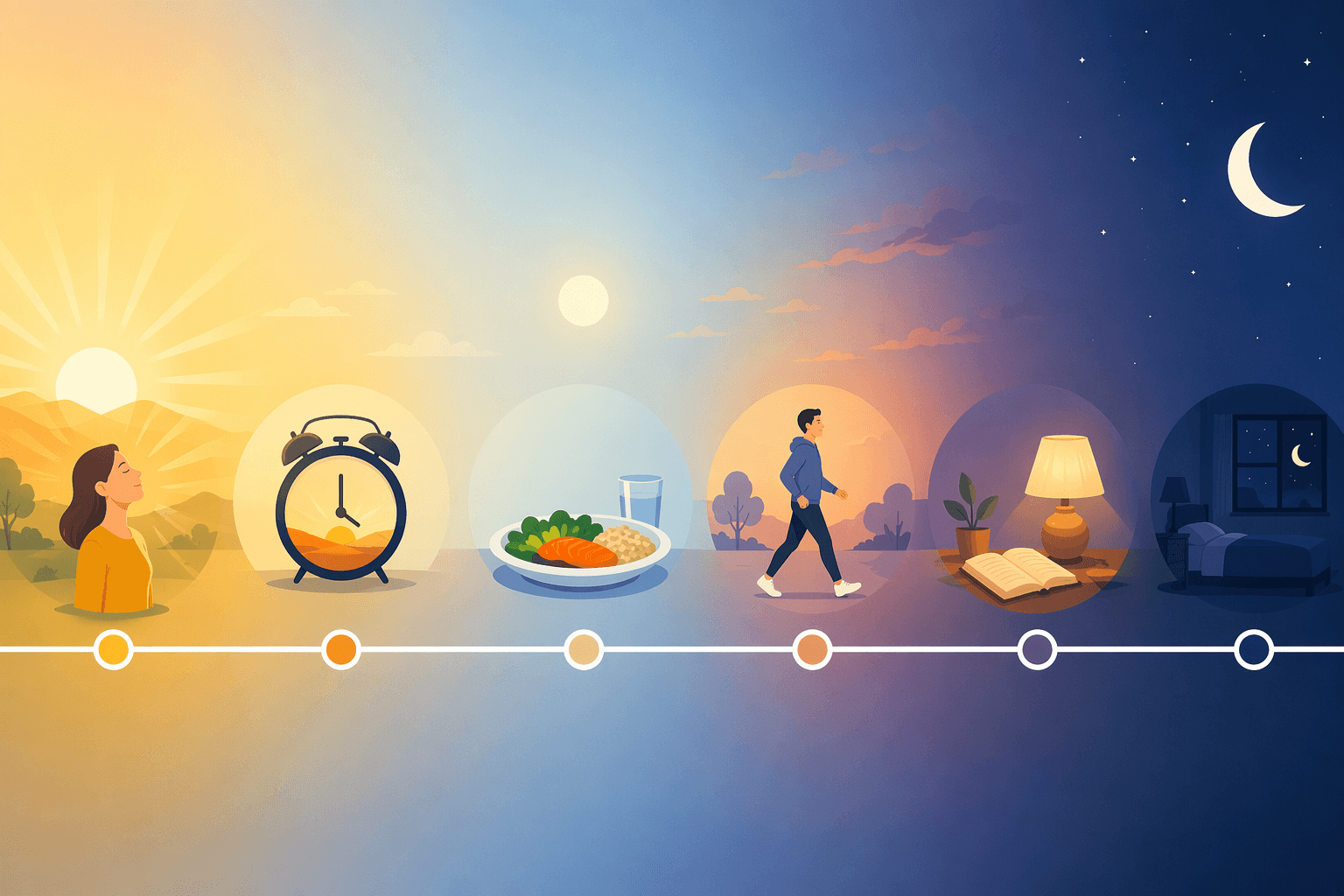
| Time Block | Circadian Goal | Key Actions |
|---|---|---|
| Wake time (same time daily) | Anchor the SCN's reference point | Wake within same 30-min window; no snooze button |
| First 60 minutes after waking | Signal the SCN that day has begun | Go outside for 15–30 min of natural light; avoid phone screens for first 15 min |
| Mid-morning to early afternoon | Align meal timing with peripheral clocks | Eat your largest meal earlier in the day; avoid caffeine after 2 PM |
| Afternoon (before 4 PM) | Use exercise to reinforce circadian phase | Moderate aerobic exercise or strength training; avoid vigorous exercise within 3 hours of bed |
| 2–3 hours before bed | Begin the wind-down and light reduction | Dim overhead lights; switch to warm, low-level lighting; stop eating; avoid intense mental work |
| 60–90 minutes before bed | Facilitate the core temperature drop | Take a warm bath or shower; the subsequent cooling promotes sleep onset |
| 30 minutes before bed | Eliminate sleep-disrupting light | Turn off all screens; read a physical book under warm light; prepare the bedroom to ~65°F |
| Bedtime | Allow the circadian and homeostatic systems to align | Lights out; bedroom should be dark, quiet, and cool |
Putting It All Together: Why Circadian Hygiene Sticks
The shift from a checklist of sleep tips to a mechanistic framework — from "sleep hygiene" to "circadian hygiene" — is not semantic. It changes how you think about each habit. When you understand that morning light is not a vague recommendation but a direct signal to the SCN to stop melatonin production and advance the circadian phase, adherence becomes a matter of biological logic rather than willpower.
A 2026 randomized controlled trial by Pfeiffer et al., published in Frontiers in Sleep, provides supporting evidence for this approach. The study (N=119, mean age 66.5 years, 64.7% female) found that a single 8-minute video-based sleep hygiene education session significantly improved subjective sleep quality (PSQI scores: video-only group from 6.82 to 5.82, p=0.048; video-plus-text group from 7.63 to 6.51, p=0.017), daytime sleepiness (ESS: video-only 6.97 to 5.36, p=0.004; video-plus-text 6.98 to 5.27, p<0.001), and sleep hygiene behaviors (SHI: video-only 11.38 to 8.97, p=0.013; video-plus-text 12.44 to 10.46, p=0.022). Notably, the study found no significant changes in objective sleep parameters measured by Fitbit, suggesting that subjective improvements in sleep quality and daytime functioning may precede measurable changes in sleep architecture.
Circadian hygiene sticks because it answers the question "why" before asking "what." A checklist tells you to dim the lights at night. Circadian hygiene explains that room light suppresses melatonin by roughly 85%, and that the timing of that suppression determines whether you fall asleep at 10 PM or 1 AM. That understanding transforms a chore into a choice — and choices grounded in mechanism are far more durable than habits grounded in vague advice.
Comments
Join the discussion with an anonymous comment.