
You leave the hospital expecting your bedroom to do what the hospital could not: let you sleep. The monitors are gone. No one is checking your blood pressure at 3 a.m. The hallway light is not spilling under the door. Yet your sleep still comes in pieces, and the morning feels less like recovery than proof that something is still wrong.
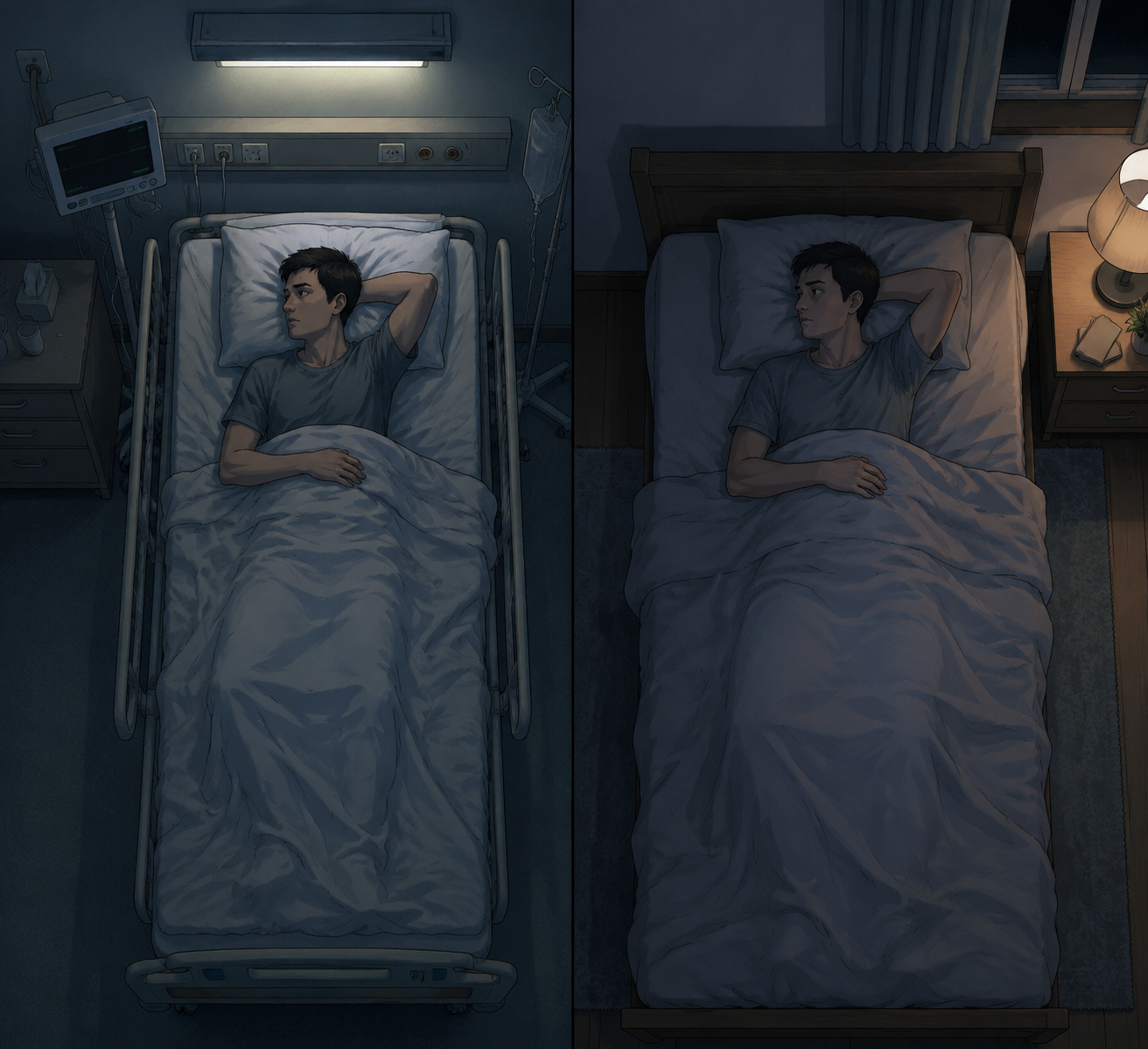
That mismatch is common enough to have been measured. In one actigraphy study of 54 general medicine patients, average sleep time stayed close to 320 minutes, or about 5.3 hours, and sleep efficiency stayed around 74% after discharge; the researchers did not find a meaningful post-discharge improvement in sleep compared with the hospital period.[1] Home changed the setting. It did not automatically reset the body.
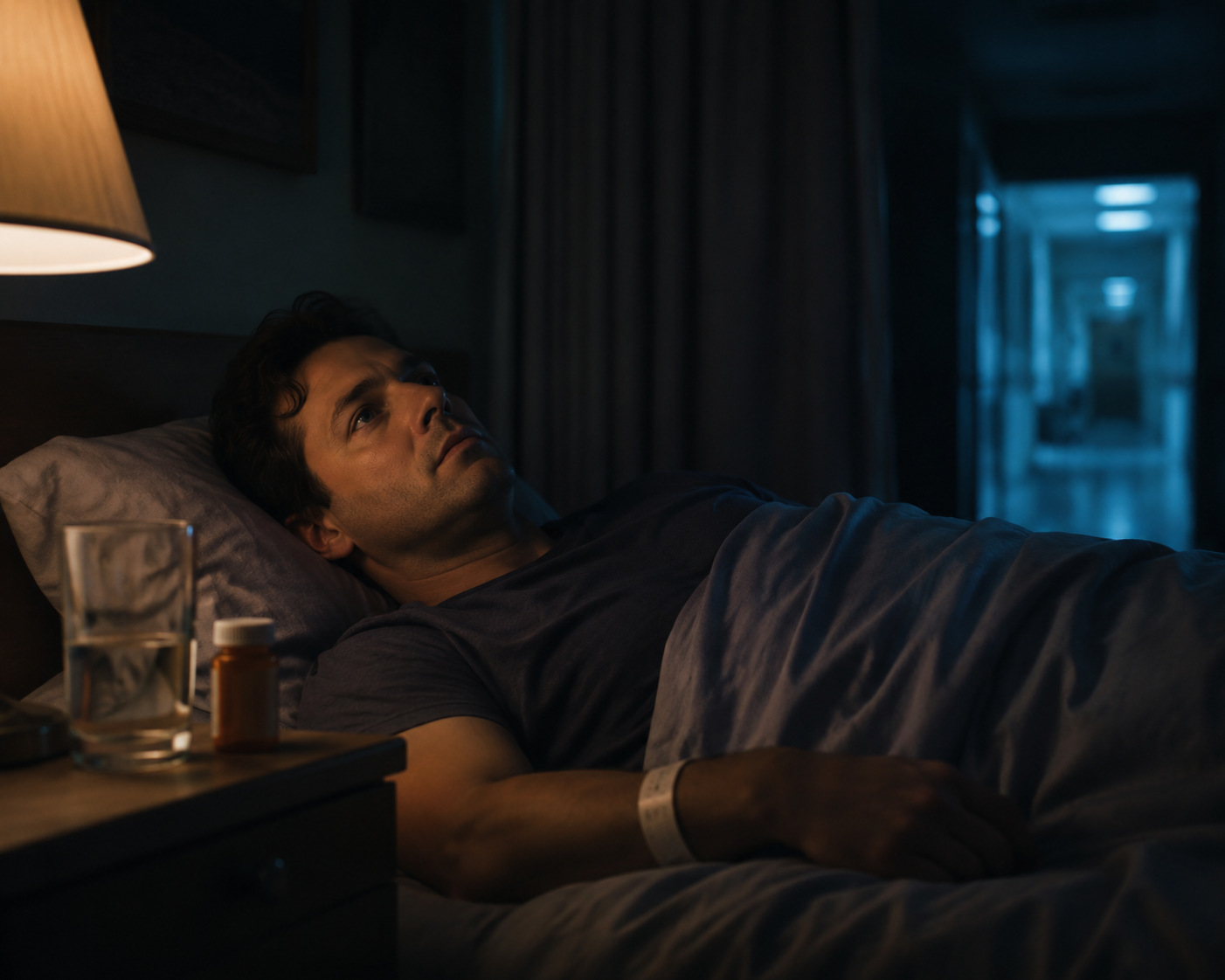
That finding matters because sleep disruption after a medical emergency often gets treated as a separate problem once the immediate danger has passed. The chart says stable. The discharge packet says rest. But the body may still be running the emergency in quieter ways: lighter sleep, more awakenings, earlier mornings, anxious scanning, pain, medication changes, and daytime fatigue that makes nights even more uneven.
Discharge Is Not the Same as Recovery
The cleanest way to understand this is post-hospital syndrome, a framework described by Harlan Krumholz in 2013. The point was not that patients remain sick with the same condition that brought them in. It was that hospitalization itself can leave people in a temporary state of generalized vulnerability, with increased risk for a range of problems after discharge, including problems unrelated to the original admission.[2]
Krumholz described this vulnerable period as lasting up to about 7 weeks after discharge.[2] That does not mean everyone will sleep badly for 7 weeks, or that a brief emergency department visit has the same aftereffects as a long ICU stay. It means the first weeks home deserve more respect than they often get. Your nervous system, sleep drive, pain signals, medication schedule, appetite, movement, and sense of safety may all be trying to renegotiate ordinary life at once.
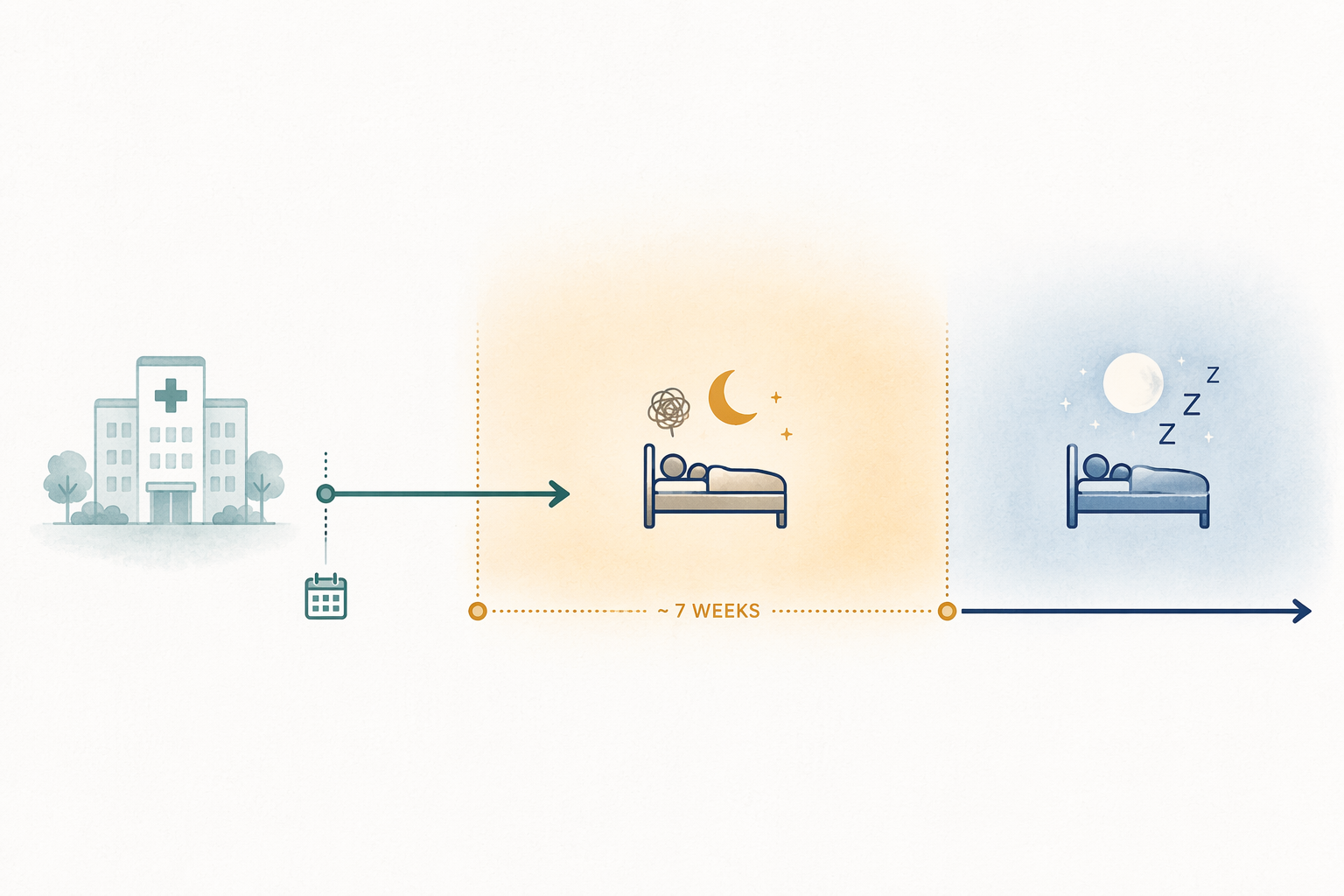
Sleep sits near the center of that vulnerability loop. Poor sleep can reduce pain tolerance, drain attention, make medication routines harder to follow, and lower the energy needed for walking, eating well, and attending follow-up appointments. None of this turns a bad night into a medical crisis by itself. It does mean that waiting passively for sleep to “go back to normal” can be a weak recovery plan.
Why Sleep Does Not Reset When You Get Home
Hospital sleep is usually disrupted for obvious reasons: noise, vital-sign checks, unfamiliar beds, light, pain, worry, procedures, roommates, and alarms. If you are still in the hospital or preparing for another admission, a separate guide to sleeping during hospital recovery is the more useful place to focus on bedside tactics. After discharge, the problem changes. The interruptions may be gone, but the physiology they helped create can remain.
One reason is hyperarousal. A medical emergency is not just an event you remember; it is an event your body may keep monitoring for. Even when you are safe in bed, your brain may treat normal sensations as data to inspect: a faster heartbeat, a twinge near an incision, mild breathlessness, a medication side effect, a noise from another room. This is also why sleep problems after medical events can resemble sleep problems after other frightening events, including car accidents or natural disasters, where the threat has passed but the body has not fully stood down.
A second reason is timing. Hospital days often flatten the cues that help the circadian system know what time it is. You may have slept at odd hours, missed morning light, eaten at unusual times, stayed mostly in bed, or had nighttime care that blurred the line between day and night. At home, sleeping late, napping hard, or spending long recovery days in bed can feel like the kindest thing to do. For some people, it also keeps the clock confused.
A third reason is that recovery creates its own sleep disruptors. Pain may peak when you finally lie still. Steroids, decongestants, some antidepressants, stimulants, or medication timing changes can affect sleep. Diuretics can increase nighttime bathroom trips. New equipment, wound care, breathing treatments, blood sugar checks, or caregiver visits can turn the bedroom into a quieter extension of the hospital.
Then comes the daytime trap. You sleep badly, so you move less. Because you move less, you build less sleep pressure. Because you are exhausted, you nap late or doze in the evening. Because you doze, bedtime produces less sleep. The next morning, the bed feels like the only safe place to recover, so the cycle repeats.
What the Evidence Can and Cannot Say
The Kessler actigraphy study is useful because it followed sleep across the hospital-to-home boundary, rather than assuming home sleep from a questionnaire. Its limitation is also important: the sample was small, with 54 patients, and came from one urban center with predominantly older African American patients.[1] It should not be stretched into a universal prediction for every discharged adult.
Still, the direction is hard to ignore. A home bedroom can remove hospital interruptions while leaving the patient with the same depleted sleep system. The practical conclusion is narrower and stronger than a dramatic claim: if your sleep is still fragmented after discharge, that is not surprising, and it is worth addressing directly.
The ICU literature widens the lens but needs careful handling. A systematic review of 22 studies found that sleep disturbance among ICU survivors was reported in about 50% to 66.7% of patients at 1 month and 10% to 61% beyond 6 months.[3] Those figures should not be casually applied to someone who had a short general-ward stay or a brief emergency visit. Critical illness survivors often face heavier sedation exposure, delirium risk, ventilation, muscle loss, and psychological stress. But the ICU data validate a basic point: for many patients, sleep disruption can persist well after the medical team has declared the acute phase over.
The First Week Home: Protect the Clock Before You Perfect Sleep
The first target is not a perfect 8-hour night. It is a clearer day-night signal. That sounds modest because it is. After a medical emergency, the body often needs consistency before it can deliver depth.
| Recovery lever | What to do | Why it matters |
|---|---|---|
| Wake time | Choose a realistic wake time and keep it within a narrow range, even after a bad night. | A stable morning gives the circadian system an anchor. |
| Light | Get morning light as early as your condition safely allows, even from a chair near a bright window. | Light helps separate daytime alertness from nighttime sleep. |
| Bed use | Use the bed mainly for sleep and necessary medical rest, not all-day recovery if a chair or couch is safe. | The brain relearns that bed means sleep, not monitoring and waiting. |
| Naps | Keep naps earlier and limited enough that they do not replace the next night’s sleep. | Naps can help recovery, but late or long naps can weaken sleep pressure. |
| Medication timing | Review sleep-disrupting timing questions with your discharge team, pharmacist, or clinician. | Some nighttime awakenings are driven by dosing schedules that may be adjustable. |
This is where “sleep hygiene” has to be more than dim lights and good intentions. If you are recovering from pneumonia, surgery, sepsis, a cardiac event, a serious allergic reaction, or another emergency, your plan has to respect medical limits. Morning light may mean opening curtains from bed. Movement may mean a clinician-approved walk to the kitchen, not a fitness routine. Reducing time in bed may mean shifting some awake recovery time to a recliner with supplies nearby.
Keep the Wake Time Boring
A consistent wake time is often more useful than an ambitious bedtime. Bedtime depends on whether sleep pressure has built. Wake time sets tomorrow’s clock. If you had a terrible night, sleeping several hours later may feel like compensation, but it can push the next night later and keep the recovery rhythm unstable.
Choose a wake time you can actually keep while healing. If you need morning medications, wound care, glucose checks, breathing treatments, or caregiver help, build the wake time around those realities. A recovery schedule that ignores the discharge plan will not survive contact with the first morning.
Use Light and Movement as Medical-Recovery Tools
Morning light is not decorative. It is one of the strongest cues your brain uses to set the sleep-wake rhythm. If going outside is safe, a short morning exposure helps. If not, sit near a bright window. If even that is too much, open curtains and keep the room clearly daytime during daytime.
Movement works in the same practical way. Follow your discharge instructions and activity restrictions, but do not let “rest” quietly become immobilization unless your clinician has prescribed it. Gentle, approved daytime activity helps rebuild sleep pressure and reduces the long, half-awake daytime drifting that steals from the night.
Put a Boundary Around the Recovery Bed
After discharge, the bed can become command central: pill bottles, water, discharge papers, pulse oximeter, phone, snacks, heating pad, laptop, fear. Some of that is unavoidable. But if every hour of the day happens in bed, the brain gets no clear message that nighttime bed is different.
Set up a second recovery spot if you can do it safely: a recliner, couch, or chair with water, medications as directed, a blanket, and a place for your phone. Use that spot for awake resting, calls, paperwork, and quiet daytime recovery. Keep the bed as close to sleep-specific as your condition allows.
Treat Night Waking as a Signal, Not a Failure
Waking at night after a medical emergency does not mean you have lost the night. It means you need a repeatable response that does not train your brain to fear the bedroom. Keep lights low. Avoid checking the time repeatedly. If you are awake long enough to become frustrated and it is safe to get up, move to a quiet, dim spot until sleepiness returns. If getting up is unsafe, shift to a low-stimulation routine in bed: relaxed breathing, a familiar audio track, or a body scan that does not require effort.
The goal is not to force sleep. Forced sleep usually becomes more monitoring. The goal is to stop turning wakefulness into an alarm event.
When Anxiety Is Driving the Wake-Ups
Medical emergencies can leave behind a kind of nighttime vigilance that looks very much like trauma-related insomnia. You may be listening for symptoms, replaying the ambulance ride, remembering the emergency room, or checking whether your body feels “normal” yet. That kind of scanning makes sense after danger. It also keeps sleep shallow.
If the emergency itself felt frightening, the overlap with trauma sleep patterns is worth taking seriously. Resources on why people cannot sleep after a car accident or how car accident stress causes insomnia can be useful because the mechanism is similar: the body keeps checking for threat after the event has ended.
This is also where cognitive behavioral therapy for insomnia, or CBT-I, deserves attention. A meta-analysis found CBT-I effective for insomnia comorbid with psychiatric and medical conditions, including large effects in PTSD populations.[4] That does not mean every recently discharged patient needs formal CBT-I. It means persistent insomnia after illness is not just a willpower problem, and behavioral treatment can work even when sleep trouble is tangled with medical or stress-related conditions.
A Realistic Post-Discharge Sleep Plan
For the first few nights, track patterns lightly. Write down bedtime, approximate sleep time, wake time, naps, pain spikes, nighttime medications, bathroom trips, and any symptoms that frightened you. Do not turn the log into a courtroom. Use it to see what is actually interrupting sleep.
- Tonight: set up the bedroom so medical necessities are reachable, remove nonessential clutter from the bed, choose a low-light response for awakenings, and decide tomorrow’s wake time.
- This week: get morning light daily, follow safe daytime activity instructions, keep naps early, and move awake recovery time out of bed when possible.
- Before follow-up: bring your sleep log, ask whether medication timing may be contributing, and report pain, breathing, urinary, mood, or anxiety symptoms that are repeatedly waking you.
- If insomnia persists: ask about CBT-I, behavioral sleep medicine, or a clinician-guided plan rather than adding over-the-counter sleep aids without review.
This plan is deliberately ordinary because recovery is already complicated. It does not ask you to buy a device, chase perfect sleep scores, or solve every symptom at once. It asks you to stop giving the sleep system mixed signals while your body is already under strain.
When to Escalate Instead of Troubleshoot
Some sleep disruption belongs in the normal recovery range. Some does not. Contact your clinician promptly if sleep is being interrupted by worsening shortness of breath, chest pain, fainting, confusion, fever, uncontrolled pain, repeated vomiting, severe medication side effects, new neurological symptoms, or any symptom your discharge paperwork listed as urgent.
Also escalate if you are barely sleeping for several nights in a row, feel unsafe because of exhaustion, have panic that is escalating at night, or notice depression, hopelessness, or traumatic memories becoming harder to manage. The question is not whether sleep trouble is “serious enough” to mention. After a medical emergency, sleep is part of the recovery data.
Condition-specific recoveries can also have their own sleep problems. A person recovering from a transplant, for example, may face medication effects, immune concerns, breathing changes, and prolonged monitoring needs that make the general post-discharge plan only a starting point. A discussion of why sleep quality stays poor after lung transplant shows how much the details can matter after a major medical event.
What This Means for Recovery
Sleep that stays broken after discharge is not proof that recovery has failed. The body can remain in a post-hospital vulnerability window even after the acute emergency is over, and measured sleep may not rebound simply because the patient is back home.
But it is also not something to simply wait out while every night teaches the same pattern. A stable wake time, morning light, safe daytime movement, protected bed cues, careful medication review, and timely clinical follow-up give sleep a path back. In the weeks after a medical emergency, that is not cosmetic self-care. It is part of reducing vulnerability while the rest of the body catches up.
References
- Sleep and delirium in older hospitalized patients: a prospective cohort study. Sleep, 2019. https://pmc.ncbi.nlm.nih.gov/articles/PMC6802567/
- Post-Hospital Syndrome — An Acquired, Transient Condition of Generalized Risk. New England Journal of Medicine, 2013. https://pmc.ncbi.nlm.nih.gov/articles/PMC3688067/
- Sleep Quality after Critical Illness: A Systematic Review. Annals of the American Thoracic Society, 2017. https://pmc.ncbi.nlm.nih.gov/articles/PMC5711402/
- Cognitive Behavioral Therapy for Insomnia Comorbid With Psychiatric and Medical Conditions: A Meta-analysis. JAMA Internal Medicine, 2015. https://jamanetwork.com/journals/jamainternalmedicine/fullarticle/2301051
Comments
Join the discussion with an anonymous comment.