
The 2026 World Cup final is the easy part of your sleep schedule. It kicks off on Sunday, July 19, 2026, at 3pm ET, which puts it at 2pm CT, 1pm MT, and noon PT for most US viewers.[1] That is unusually kind for a global sports final: no midnight alarm, no pre-work grogginess, no bargaining with Monday morning.
The harder sleep problem arrives earlier. The group stage includes eight matches expected to kick off at 8pm ET, and that single time slot behaves very differently depending on where you live in the US.[2] On the East Coast, it can quietly become a midnight bedtime. On the West Coast, it is a late-afternoon match you can watch before dinner.
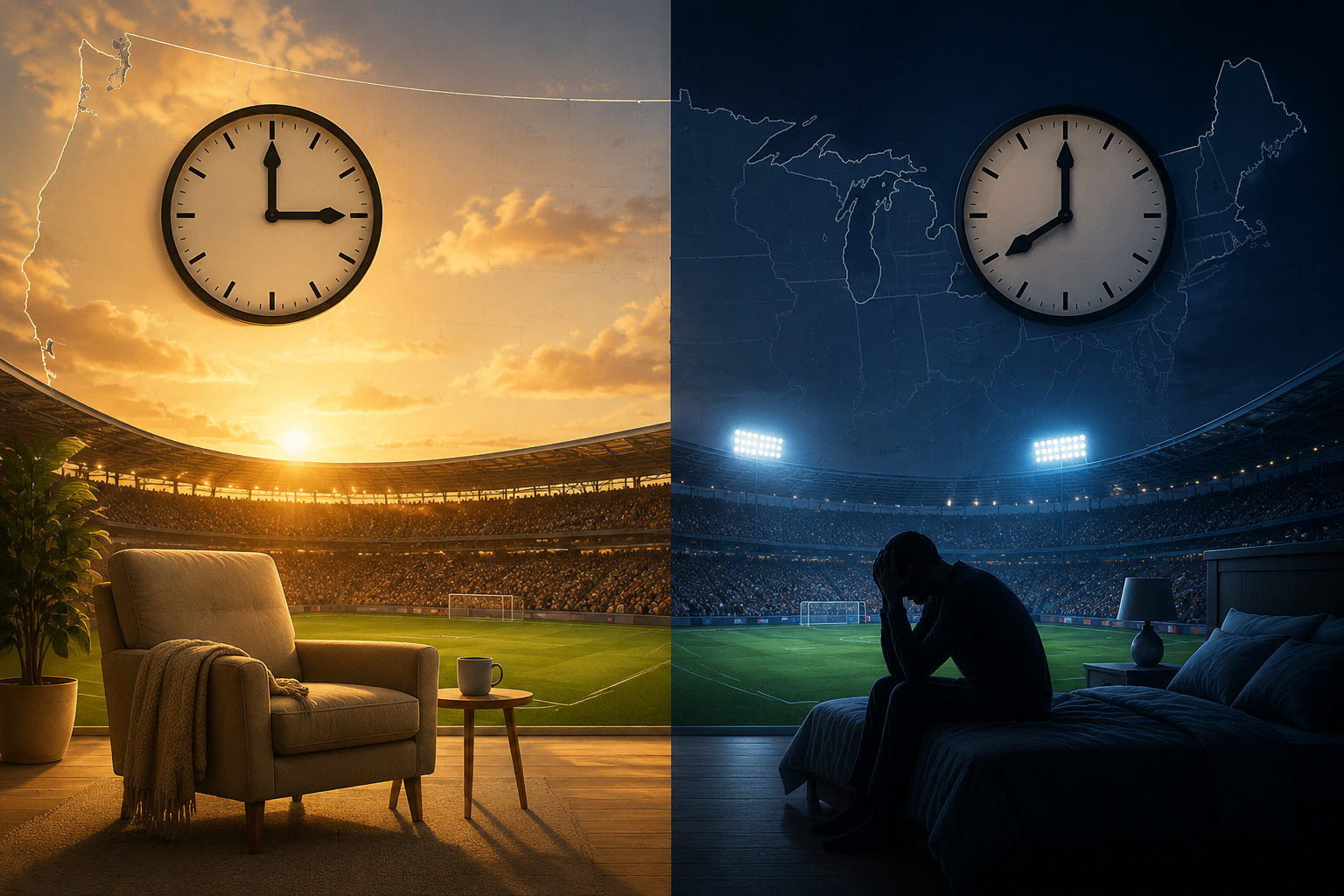
World Cup Final Time By US Time Zone
| Time zone | 2026 World Cup final kickoff | Sleep impact |
|---|---|---|
| Eastern | 3pm ET | Sleep-friendly unless the celebration runs late |
| Central | 2pm CT | Sleep-friendly |
| Mountain | 1pm MT | Sleep-friendly |
| Pacific | Noon PT | Sleep-friendly |
For once, the marquee event is not the trap. Even if the final runs long, the match starts early enough that most US viewers can finish the broadcast, eat, move around, and still keep a normal bedtime. If you are searching for “world cup final time and sleep schedule,” the direct answer is reassuring: the final itself should not require a special sleep plan.
That does not mean the tournament is sleep-neutral. It means the dangerous nights are hiding in the middle of the calendar, where an 8pm ET kickoff looks reasonable until you count the whole evening.
The 8pm ET Group-Stage Slot Is The One To Circle
A soccer match is listed as 90 minutes, but that is not the same thing as a 90-minute sleep disruption. There is halftime. There is stoppage time. There is the post-match segment you did not plan to watch. There is the phone check afterward, which somehow becomes highlights, group chats, standings, and one more replay.
For an 8pm ET group-stage kickoff, a standard viewing window can run to about 10:15pm before any serious wind-down begins.[2] If the match is emotionally loaded, the practical bedtime consequence can stretch much later, especially for viewers who need 20 to 30 minutes to come down from the noise and tension rather than trying to fall asleep at the whistle.
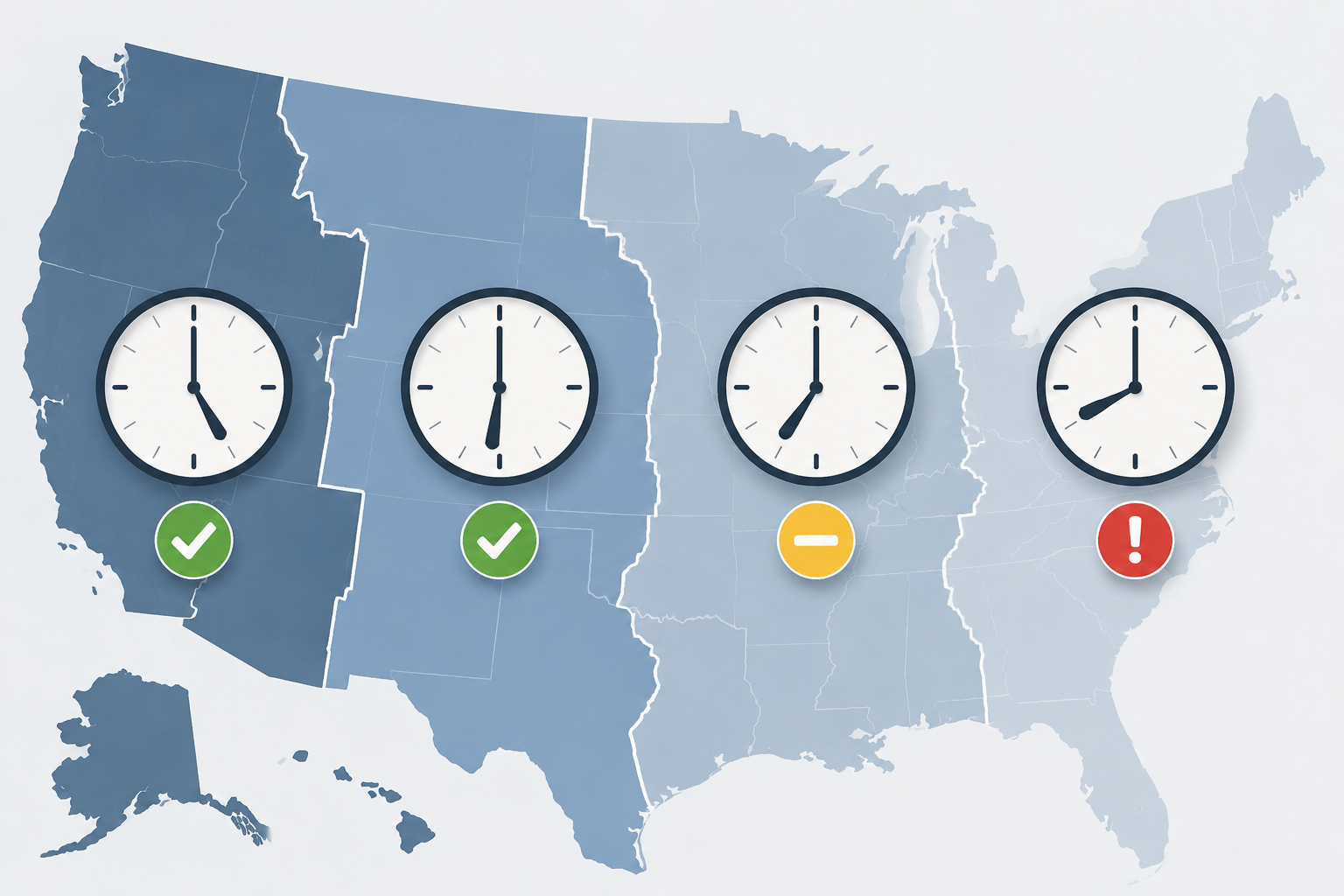
| If kickoff is 8pm ET | Local start time | Likely sleep issue |
|---|---|---|
| Eastern | 8pm | Highest risk: match ends close to normal bedtime, then arousal and scrolling push sleep later |
| Central | 7pm | Moderate risk: manageable for many, but still late for early risers or parents |
| Mountain | 6pm | Lower risk: usually an evening activity rather than a bedtime conflict |
| Pacific | 5pm | Lowest risk: sleep disruption is more likely to come from work, commute, or dinner logistics than bedtime |
This is why generic World Cup sleep advice misses the point. A London viewer facing a 2am kickoff needs a different plan from a New Yorker watching at 8pm, and both need a different plan from someone in Los Angeles starting at 5pm. The physiology is the same; the calendar pressure is not.
How To Plan Around 8pm ET Matches
BBC News published sleep strategies from Prof. Russell Foster of Oxford and Dr. Victoria Revell of Surrey for late-night match viewing: “The Sandwich,” “The Squeeze,” and “The Shift.”[3] Those ideas are useful, but they were framed for UK-style overnight kickoffs. For US viewers, the question is not usually whether to wake at 2am. It is whether to protect enough sleep opportunity after a match that ends just late enough to cause damage.
Eastern Time: Treat 8pm As A Real Sleep Decision
East Coast viewers should not treat an 8pm kickoff as harmless by default. If your normal bedtime is around 10:30pm, the match already sits on top of it. If you need to be alert for a commute, a school drop-off, clinical work, machinery, or an early meeting, the planning decision should happen before kickoff, not at 10:40pm with the remote still in your hand.
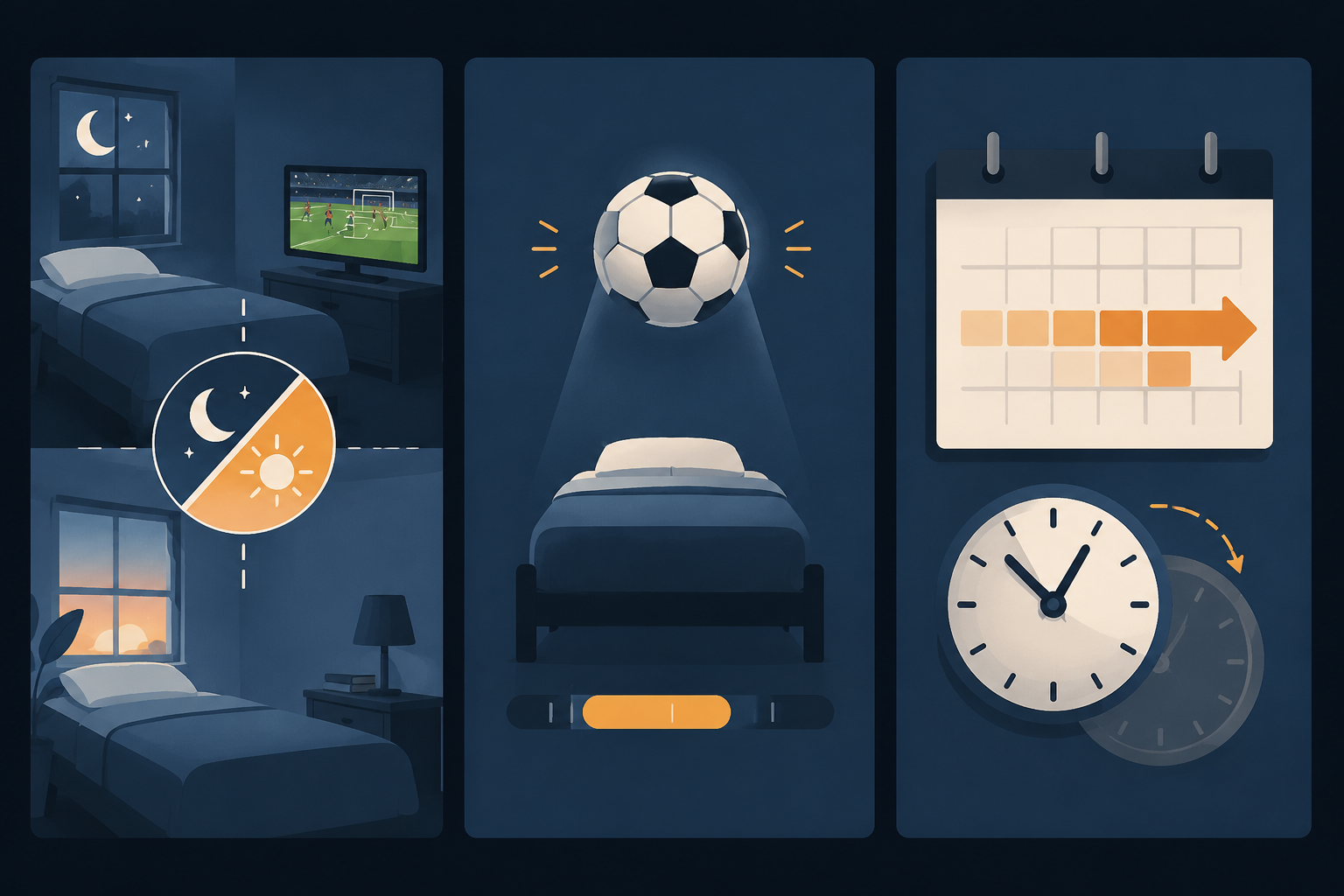
The adapted “Sandwich” approach works best when the match matters enough to justify a split night. Sleep earlier in the evening if you can, wake for the match, then return to bed after a short decompression period. This is awkward for an 8pm start because many adults are not naturally sleepy at 6pm, but it can work for people who are already sleep-restricted or who can manage a short early-evening nap.
The adapted “Squeeze” is more realistic for many East Coast fans: accept a shorter night, remove everything that makes it worse, and protect the next morning. That means no caffeine during the second half, no post-match alcohol as a “wind-down,” no extra highlights in bed, and no pretending a midnight sleep onset is the same as a 10:45pm one.
The adapted “Shift” is worth using only for clusters of matches you genuinely care about. If you know two or three important 8pm ET games are coming in the same week, moving bedtime and wake time slightly later in advance may reduce the shock. It is less useful if your job, kids, pets, or commute fixes your wake time no matter what the tournament does.
Central Time: Usually Manageable, Not Automatic
At 7pm CT, the same match is less threatening. Many viewers can watch the full game and still keep something close to a normal bedtime. The risk concentrates among early risers: the 5am gym person, the parent with a child who wakes before sunrise, the worker who has to drive before coffee has done anything useful.
For Central time, the practical move is usually compression rather than split sleep. Decide before kickoff whether you are watching the full broadcast or only the match. If the answer is “full broadcast,” build in a defined end point afterward. If the answer is “match only,” leave the room when it ends.
Mountain And Pacific Time: The Sleep Problem Mostly Moves Elsewhere
At 6pm MT and 5pm PT, an 8pm ET kickoff is not primarily a bedtime problem. It may collide with work, commuting, dinner, childcare, or evening obligations, but it gives the body much more runway before sleep. Viewers in these time zones usually do not need a special sleep strategy for that slot unless the match triggers a long night of drinking, scrolling, or follow-up coverage.
That difference matters. A single national tip sheet that tells every American to nap, shift, or sacrifice sleep will over-treat half the country and under-prepare the East Coast.
The Wind-Down Is Not Decorative
The most common failed plan is also the most understandable one: “I’ll go straight to bed after the final whistle.” That assumes the body behaves like a TV. It does not shut off just because the broadcast does.
Sleep physiologist Stephanie Romiszewski, quoted in British GQ, warned that trying to force sleep immediately after a high-arousal match can backfire because adrenaline keeps the sympathetic nervous system activated.[4] A 20- to 30-minute low-light, no-screen wind-down is not precious sleep-influencer theater. It is the bridge between a match state and a sleep state.
For an East Coast 8pm match, that means the night might look more like this: kickoff at 8pm, match window to around 10:15pm, decompression until roughly 10:45pm, then bed. If you add highlights, group chats, a drink, and another screen, you have changed the schedule. The match did not single-handedly keep you up until midnight; the after-match did.
- Dim the room as soon as the match ends.
- Keep the phone out of bed, especially if your group chat is still arguing about stoppage time.
- Use quiet, low-effort activity for 20 to 30 minutes: shower, stretch, breathing, or reading something non-sports.
- Do not make the wind-down a second broadcast window.
If you want a deeper routine for that last part of the night, start with sleep hygiene fundamentals and an evidence-based bedtime routine. The point during the World Cup is not to perform perfect sleep hygiene. It is to avoid turning one match into two lost hours.
Which Matches Deserve A Sleep Plan?
Not every match deserves the same sacrifice. Tournament planners know this; tired fans pretend not to. The better question is not “How do I watch everything?” It is “Which nights are worth protecting before they start?”
| Match situation | Best sleep decision |
|---|---|
| Final at 3pm ET | Watch normally; no special sleep plan needed for most US viewers |
| 8pm ET match involving your team or a must-see group | Plan decompression and, for East Coast viewers, consider split or compressed sleep |
| 8pm ET neutral match on a work night | Watch selectively or set a hard end point |
| 7pm CT equivalent with an early wake time | Compress the evening: match only, short wind-down, bed |
| 6pm MT or 5pm PT equivalent | Manage dinner, work, and screens; sleep planning is usually secondary |
The workday overlap is real, too. FinanceBuzz reported that 1 in 4 Americans planned to watch World Cup matches while on the clock, based on a March 2026 survey of 1,000 US adults.[5] That poll does not prove medical sleep harm, and it should not be stretched into a national health claim. It does show why US-specific planning matters: people are not watching the tournament in a vacuum. They are watching around jobs, meetings, school runs, and the next morning’s commute.
If you stack several late nights anyway, the recovery question becomes separate from the viewing plan. For that, read sleep debt and recovery science or how many nights it takes to recover sleep debt. Recovery is not a permission slip to ignore the schedule; it is what you manage after you have already spent the sleep.
A Time-Zone-Aware World Cup Sleep Schedule
For the final, relax. A 3pm ET Sunday kickoff is friendly across the continental US, and most viewers can enjoy it without building a sleep strategy around it.[1]
For the group stage, circle the 8pm ET matches first. If you are on Eastern time, treat them as bedtime events, not just sports events. If you are on Central time, check your wake-up obligation before assuming you are fine. If you are in Mountain or Pacific time, the same match is usually much easier on sleep, though the usual traps—alcohol, scrolling, post-match arguments, and “just one more highlight”—can still create a late night.
That is the useful distinction: the 2026 World Cup final is sleep-friendly; the group stage is schedule-sensitive. The same kickoff time creates four different nights across the US.
References
- 2026 FIFA World Cup final, Wikipedia.
- 2026 FIFA World Cup time zones, CBS Sports.
- Staying up for the match? How to handle a 2am kick-off, BBC News.
- 4 sleep strategies to keep you awake during late-night World Cup matches, British GQ.
- World Cup Data: 1 in 4 Americans Plan to Watch While On The Clock, FinanceBuzz, March 2026.
Comments
Join the discussion with an anonymous comment.