
The first tee at 7:10 AM can make a competent golfer feel briefly borrowed from somebody else. You got there on time. You found a few half-swings beside the cart path, rolled three putts across a wet practice green, maybe even hit a small bucket under the lights. Then the opening drive feels wooden, the hips arrive late, the hands save too much, and the first wedge of the day lands with all the touch of a shovel.
That does not mean early morning golf tee times are foolish. They are often the only civilized choice: less heat, less wind, faster pace, a chance to be home before lunch, or simply the only slot left on a packed public tee sheet. But before 9 AM, and especially around the 6:30 to 7:30 AM band many golfers chase, the body may still be exiting a biological sleep window. Golf asks for sequencing, balance, judgment, and soft hands at exactly the moment the circadian system has not fully handed the keys over.

The Body May Be Awake Before It Is Ready to Play Golf
A lot of bad early golf gets blamed on the wrong thing. The standard explanation is too casual: loosen up more, drink coffee sooner, hit another sleeve of range balls. Those may help at the margin, but they do not erase the larger timing problem. Harvard sleep researcher Dr. Charles Czeisler is quoted in GolfNow calling 6:30 AM “the worst possible time to play golf,” with coordination, flexibility, judgment, and short-term memory all degraded at that hour; the same piece reports that melatonin secretion continues until roughly 7:30 AM.[1]
That quote is expert commentary reported in a golf publication, not a controlled trial proving every golfer loses a specific number of strokes at 6:30. Still, it lands because it matches the shape of the experience. At that hour, many players are not merely stiff. They are slightly delayed. The body is upright, dressed, and standing over a ball, while the systems that help time a sequence and regulate attention are still coming online.
The Poughkeepsie Journal, also discussing Czeisler’s view on early tee times, makes the same practical point: melatonin has not necessarily cleared when golfers are starting at dawn, and the body’s internal clock is still working against peak performance.[2] That matters more in golf than non-golfers assume. This is not a sport where you can simply run harder until the body agrees. A half-degree open face, a late weight shift, or one impatient read on a damp green is enough to turn an ordinary start into a recovery project.
Why the First Few Holes Feel So Wooden
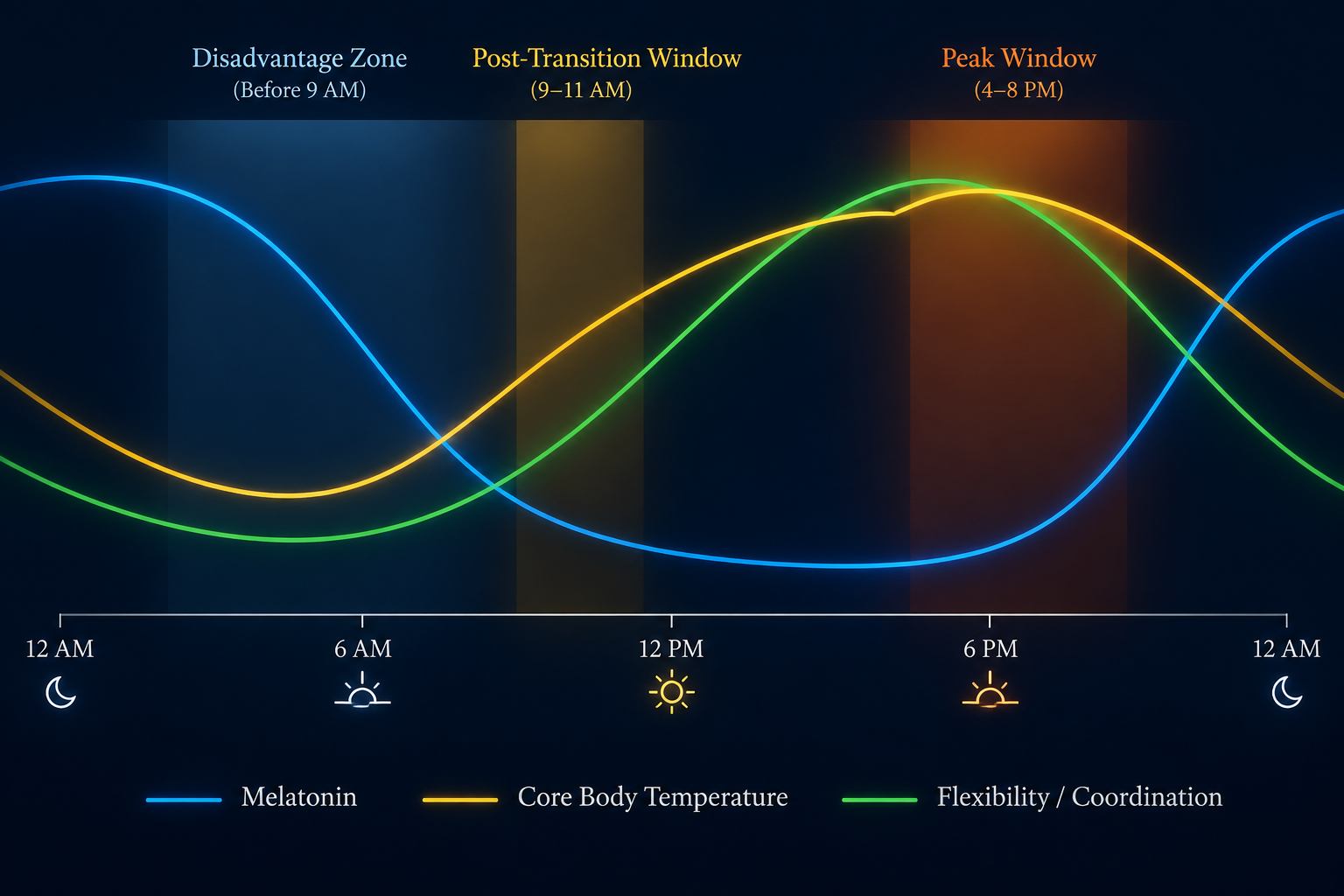
Melatonin is only one part of the problem. Early morning also sits near the daily low point for core body temperature. Lower body temperature is not the same thing as being cold from the weather; it is part of the body’s internal rhythm. When that rhythm is still near its low point, movement feels less elastic, and golf is full of movements that punish small losses in elasticity.
GolfNow attributes to circadian-rhythm researcher Michael Smolensky, via Wall Street Journal reporting, the estimate that muscle and joint flexibility can be up to 20% lower in the early morning than in the evening.[1] That figure should not be treated as a personal diagnostic measurement. Your hips are not guaranteed to be exactly 20% less flexible on the first tee. But as a cited estimate, it is a useful warning against the golfer’s favorite lie: that a stiff opening swing is just lack of discipline.
A golf swing depends on ordered mobility. The trail hip has to turn without the upper body snatching the club inside. The lead side has to accept weight without the hands throwing the clubhead early. The thoracic spine has to rotate enough that the arms do not invent their own route. If the body’s morning state reduces available motion, the swing does not simply become shorter. It often becomes compensatory.
That is why the first three holes can look so strange on the scorecard. A player who normally fades the ball blocks one right because the turn never finishes. A careful putter leaves the first long putt six feet short because the hands are still calibrating speed. A mid-iron starts on line but leaks because balance is just a fraction off. None of those errors needs a dramatic explanation. Circadian timing gives the ordinary explanation enough structure to be taken seriously.
The Short Game Is Not Exempt
Golfers tend to think of stiffness as a full-swing problem, but the early-morning cost may be even more irritating around the green. Chipping and putting ask for fine motor control, touch, visual judgment, and emotional pacing. If short-term memory and judgment are dulled at the same time flexibility and coordination are lagging, the golfer is not just making a physical swing from a worse platform; he is also choosing targets, speeds, and clubs with less sharpness than he will have later in the day.[1]
That shows up after the bad shot, too. Early in the morning, one poor swing can provoke oddly poor course management: forcing a recovery through trees, taking dead aim at a tucked pin, or rushing the next putt before the round has emotionally begun. The usual story calls that temperament. Sometimes it is. But impaired judgment is also part of the performance picture Czeisler’s comments highlight, and golf gives judgment no place to hide.[1]
The Second Cost: Early Tee Times Often Cut the Night Short
The circadian problem is present even if the golfer slept well. But early tee times also create a simpler problem: they pull the wake-up time earlier than the body or the household schedule can comfortably support. A 7:00 AM tee time is not a 7:00 AM obligation. It is a 5-something alarm, a rushed breakfast, a dark drive, shoes changed in the lot, and a warm-up squeezed between starter calls.
The best adjacent evidence here comes from athletes rather than golfers. In a 2022 study of collegiate athletes, Merfeld and colleagues found that athletes averaged 5 hours 58 minutes of sleep on nights before early morning training sessions before 7 AM, compared with 8 hours 09 minutes on non-training nights; the reported effect size was 2.80.[3] The study did not measure golf scores, putting, or driving accuracy, so it should not be stretched into direct golf-performance proof. It does show how early sport schedules can sharply reduce total sleep time.
That matters for the golfer who is trying to make a swing change. The American Association of Sleep Technologists notes that sleep supports muscle memory consolidation, including the brain’s storage of newly learned movement patterns.[4] If a lesson on Thursday introduced a new takeaway or a calmer transition, the final hours of sleep before Saturday’s round are not dead time. They are part of the learning process.
This is where early golf can quietly sabotage practice. The golfer pays for instruction, rehearses the move after work, books the first available weekend slot, then lops off sleep to make it. When the new motion disappears by the fourth swing of the day, the problem may not be that the lesson failed. The body may be trying to perform a fragile motor pattern before it has fully recovered and consolidated it.
For readers who train hard outside golf, the same principle overlaps with broader recovery planning. Early sessions can work, but they need to be treated as a scheduling stressor, not a badge of virtue; that is the same tradeoff discussed in guidance on sleep and recovery when training twice a day, and it is one reason poor sleep is tied to broader concerns around sports injury risk and athletic recovery.
The Tee-Time Windows That Make Physiological Sense
The useful question is not whether dawn golf should be banned from the calendar. It is whether golfers should treat all tee times as performance-neutral. They should not. The body’s daily rhythm creates different playing conditions before the weather, the pin sheet, or the pace of play even enter the picture.
| Tee-time window | What the body is likely dealing with | Best use |
|---|---|---|
| Before 9 AM | Melatonin may still be clearing, core body temperature is low, flexibility and coordination are not at daily best | Useful when life, heat, pace, or course access matter more than peak performance |
| 9-11 AM | Post-transition window after the harshest early circadian disadvantage | A practical compromise for golfers who want morning golf without the deepest sleep-mode penalty |
| 4-8 PM | Reported peak window for strength, flexibility, and mental capacity | Best physiological fit when score, touch, and swing work matter most |
GolfNow’s summary places athletes’ strength, flexibility, and mental capacity at their peak between 5 PM and 8 PM.[1] Golf is not a bench press contest, but this is precisely why the point matters. Late afternoon gives the golfer more of the qualities the sport actually spends: coordination, mobility, balance, and the mental bandwidth to adjust after imperfect contact.
The 9-11 AM window is less glamorous but more useful for ordinary players. It gets the round past the most obvious circadian transition without demanding that everyone become a twilight golfer. For many public-course players, that window is also still early enough to preserve the day. If a golfer has been judging his game mainly from 6:50 AM starts, moving even a couple of hours later is a cleaner experiment than buying another training aid.
Late afternoon has its own problems: work, family dinner, league congestion, summer storms, and slower greens that have been walked on all day. No timing window solves the rest of life. But when the question is physiology rather than convenience, the case for 4-8 PM is strong enough that golfers should stop treating the dawn slot as the disciplined default.[1]
Exercise timing also cuts both ways for sleep. A later round may align better with performance, while the total pattern of exercise, light exposure, and evening wind-down still affects sleep timing; the broader relationship between activity and the body clock is discussed in the four biological pathways that link exercise to better sleep and in guidance on exercise routines for better sleep.
What to Do If the Only Tee Time Is Early
Some golfers cannot choose 9:40 AM or 5:10 PM. The course fills, the kids have a game, the afternoon heat is brutal, or work starts at noon. In that case, the goal is not to pretend biology has disappeared. It is to play the early round with the right expectations and remove avoidable damage.
- Protect the night before. The early alarm is already a sleep challenge; do not add a late bedtime and expect touch to survive.
- Lengthen the first warm-up, not just the range session. Walking, gradual rotation, and putting speed calibration matter more than proving you can hit driver cold.
- Make conservative decisions for the first few holes. If judgment is not yet sharp, avoid hero recoveries and low-percentage pins.
- Delay swing-change evaluation. A new move that looks unreliable at 7 AM may deserve another test in a later biological window.
- Compare your own patterns. Track whether the same misses, three-putts, or poor decisions cluster in pre-9 AM rounds.
That last point is the one golfers are most likely to trust because it uses their own scorecards. If early rounds regularly begin with doubles and settle down by the fifth hole, the explanation may not be mystical. If late-afternoon range sessions keep producing a smoother motion than early Saturday tee times, the range may not be lying. It may simply be catching you when your body is more ready to perform.
Caffeine can help alertness, and a better warm-up can help movement, but neither turns 6:30 AM into 5:30 PM. The mistake is not playing early. The mistake is using early performance as a complete measure of ability, practice quality, or equipment fit.
When the Score Matters, Move the Experiment Later
If the round is social, the early slot may still be perfect. A fast front nine in cool air with friends can be worth a few loose swings. Golf does not have to be optimized every time it is played.
But if the score matters, if a tournament starts at dawn, if a swing change keeps disappearing, or if the same golfer looks competent at 4 PM and confused at 7 AM, tee time belongs in the performance conversation. Early morning golf tee times before 9 AM are not morally bad, and they are often practical. They are just not neutral.
The first experiment is not always a stiffer shaft, a new putter, or a more aggressive warm-up. When possible, move the round into the 9-11 AM transition window, or test the same swing in the 4-8 PM peak window. Take the early slot when life requires it, but do not confuse convenience with optimal physiology.
References
- Timing is Everything — GolfNow Blog
- Early tee times not conducive to great golf play — Poughkeepsie Journal, June 26, 2014
- The Impact of Early Morning Training Sessions on Total Sleep Time in Collegiate Athletes — Int J Exerc Sci, 2022
- Sleep and Golf: How Sleeping Well Improves Your Performance to a Tee — American Association of Sleep Technologists
Comments
Join the discussion with an anonymous comment.