
Yes, Zelda: Ocarina of Time can affect your sleep, but not in one simple direction. A late-night run through a dungeon, a boss attempt, or a puzzle you have not solved in years is more likely to keep the mind switched on. Letting the soundtrack play, or wandering through a familiar low-stakes area without chasing the next objective, may work more like a wind-down cue. The difference is not whether the cartridge, ROM, remake, playlist, or jazz arrangement is “good” or “bad” for sleep. It is whether the session asks your brain to react, decide, remember, and finish something.
That distinction fits the best available adult gaming-and-sleep evidence. A 2024 systematic review found that non-arousing, cognitively undemanding games may improve sleep quality, while arousing games can increase sleep onset latency—the time it takes to fall asleep after trying to sleep.[1] Ocarina of Time contains both versions in the same world. Hyrule Field at a familiar hour and the opening notes of “Kokiri Forest” do not ask the same thing of you as Water Temple routing, enemy timing, or checking one more room before saving.
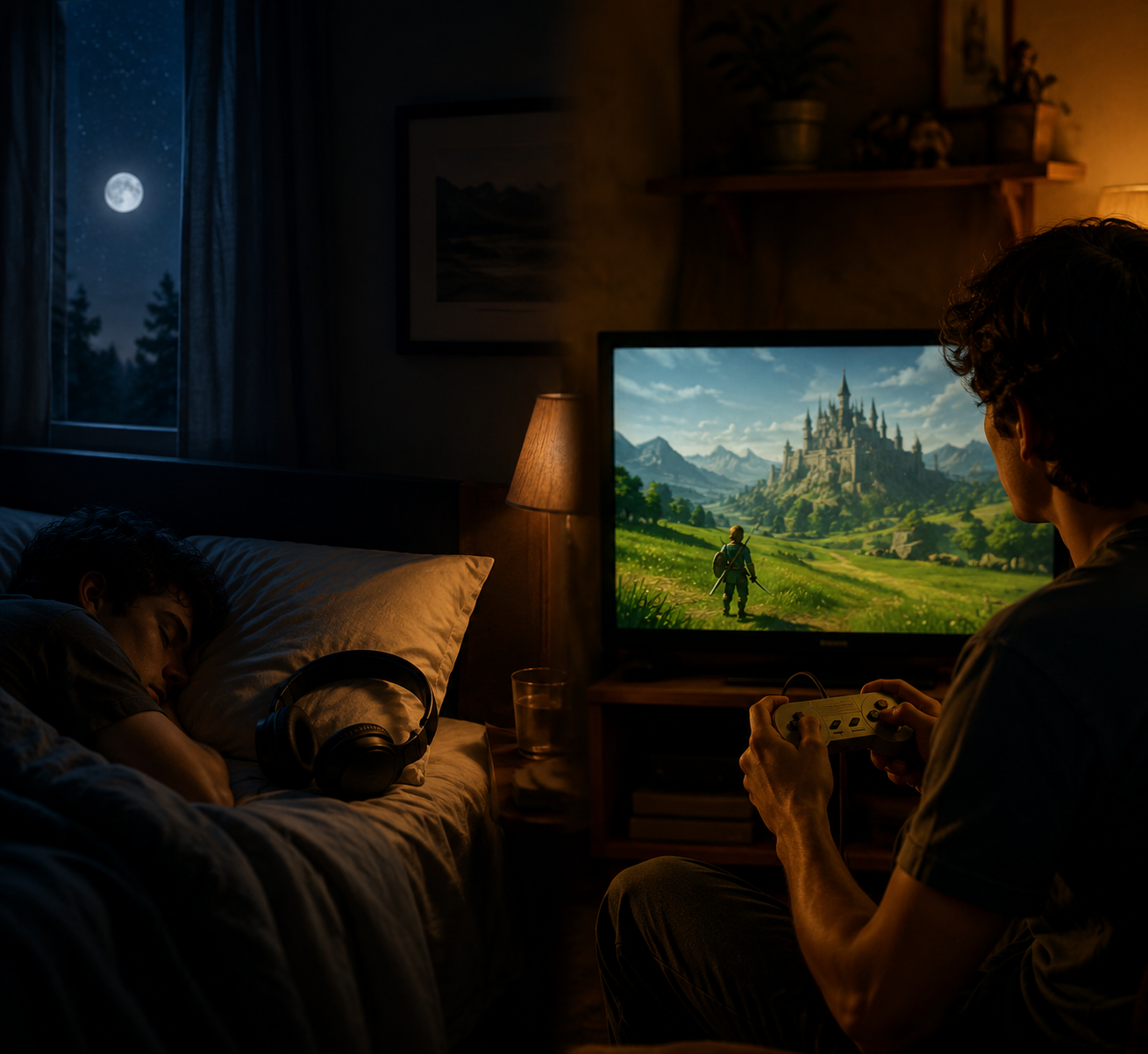
The Same Game Can Put You in Two Different States
Ocarina of Time is easy to misread as one sleep input because it is emotionally coherent. It has the same save file, the same musical language, the same childhood imprint. But from a sleep point of view, “playing Zelda before bed” can mean several different things.
| Before-bed Zelda mode | What your brain is doing | Likely sleep effect |
|---|---|---|
| Listening to the soundtrack with the screen off | Recognizing familiar, predictable music; little decision-making | More likely to support wind-down |
| Slow overworld wandering with no objective | Light navigation inside a known space; low consequence | May be calming if you stop deliberately |
| Dungeon navigation or puzzle-solving | Holding routes, keys, enemies, and unfinished objectives in mind | More likely to delay sleep onset |
| Combat, boss attempts, or challenge runs | Fast reaction, performance pressure, frustration, retry loops | More likely to be stimulating |
| “Just one more thing” completion play | Goal pursuit and mental unfinishedness | Risk rises as the session stretches |
The important part is not the label on the game. It is the state you carry into bed afterward. A familiar melody can let the day loosen its grip. A half-finished dungeon can follow you under the blanket.
Why Active Play Can Keep Sleep Out of Reach
Sleep onset is not just about whether your eyes saw a screen. It is also about whether your mind is still solving. Ocarina of Time can be gentle in texture and still demanding in structure. A dungeon asks you to maintain a map, remember locked doors, interpret visual clues, time jumps or attacks, and hold a chain of intentions: get the key, return to the room, try the switch, check the chest, maybe save after the next small success.
That last piece matters. Many people do not stop a game at the calmest point. They stop because the clock wins. If the session ends with an unsolved puzzle, an incomplete objective, or a loss you want to correct, the body may be lying down while the mind is still in the room with the locked door.
Dose matters too. In a 2013 study of prolonged violent video gaming before bed, 150 minutes of play reduced total sleep time by 27 minutes and sleep efficiency by 7%, bringing sleep efficiency below the 85% clinical cut-off used in that study.[2] That was not Ocarina of Time, and it involved a different game type and population, so it should not be treated as a direct Zelda finding. It does, however, make a useful warning concrete: a long, intense session close to bedtime can cut into sleep even if the player intended it as relaxation.
Shorter stimulating sessions can matter as well. Weaver and colleagues reported that 50 minutes of stimulating gameplay added a median of 7.5 minutes to sleep onset latency.[3] That is not a catastrophic number for every sleeper, but it is large enough to notice if you already struggle to fall asleep, need a strict wake time, or stack the session on top of stress, caffeine, or an irregular schedule.
Why the Soundtrack Feels Different
The soundtrack sits in another category because it removes most of the demands that make active play stimulating. You are no longer managing inventory, scanning for threats, watching for cues, or deciding where to go. You are receiving something known. For someone who grew up with the game, “Zelda’s Lullaby,” “Temple of Time,” or the forest themes can be less like entertainment and more like a body memory: the room gets quieter because the music has taught it how.
General music-and-sleep research supports the plausibility of that effect, especially when music is familiar, predictable, and slow enough to encourage relaxation. Reviews of music interventions have reported sleep benefits, though the strength and consistency of the evidence vary by study design and population.[4] That is a reason to take the soundtrack seriously as a sleep-adjacent tool, not a reason to claim that Ocarina of Time music has been clinically proven to treat insomnia.
The culture around the music has moved in that direction on its own. In May 2026, Scarlet Moon released Prescription for Sleep: Ocarina of Time, an 11-track jazz album by GENTLE LOVE that includes pieces such as “Zelda’s Lullaby” and “Temple of Time” and is marketed for chilling, relaxing, sleeping, or studying.[5] The album is useful evidence of demand and interpretation: adults are not only replaying the game; they are separating its musical comfort from its interactive demands.
Still, an album title is not a clinical outcome. A sleep-branded arrangement can be beautiful, well suited to a nighttime room, and commercially honest about how listeners use it, while still not proving that it shortens sleep onset for a given person. The useful question is simpler: when you listen, do you stop tracking tasks and start letting the day end?
This Is Not Just a Blue-Light Story
Blue light may still matter for some people, especially with bright screens close to the face and sensitive circadian timing. But it is too blunt to explain why one person can drift off after a soundtrack playlist while another lies awake after solving dungeon routes on the same display. The more precise issue is cognitive engagement: how much the content asks from you right before you try to sleep.
BBC Future reported in April 2026 on the debate around screens and sleep, including Stanford researcher Jamie Zeitzer’s argument that brightness is not the main culprit in many cases and that engagement with content is what keeps people awake.[6] That view should not be treated as the final word on every sleeper or every device. It does, however, fit the lived difference between watching a familiar title screen loop and pushing through a dungeon because you almost have it.
Adults Already Use Games This Way
If you have used Ocarina of Time as a sleep aid, you are not doing something rare or unserious. In a 2015 adult study with 844 participants, 10.3% reported using video games as a sleep aid.[7] The same study also linked poorer sleep quality with higher video gaming volume, which is the tension many bedtime players recognize: games can feel soothing in the moment and still become costly when the session grows.
Other research also points toward variability rather than a single universal effect. Miskoff and colleagues concluded that video games before bedtime can affect sleep, with effects varying by game type and player demographics.[8] That matters for Ocarina of Time because a retro action-adventure does not map neatly onto studies built around modern shooters, horror games, or competitive online play. The best available answer has to be conditional.
How to Tell Which Effect You Are Getting
The cleanest test is not whether Zelda feels calming while you are playing. Many stimulating things feel good in the moment. Track what happens after you stop.
- Watch sleep onset: if you regularly take longer to fall asleep after active play than after music-only nights, treat that mode as stimulation.
- Separate session types: do not compare “Zelda before bed” as one category; compare soundtrack, wandering, dungeon play, combat, and completion runs.
- Notice the stop point: ending after a save in a safe area is different from quitting with a puzzle unresolved or a boss half-learned.
- Check the next morning: if you fell asleep eventually but wake unrested, the session may still be too long, too late, or too engaging.
- Change one variable at a time: try the same bedtime with music only, then with low-stakes wandering, then with no Zelda, rather than changing your whole routine at once.
A practical pattern usually emerges within a couple of weeks. Some players will find that the soundtrack is reliably safe, while any controller-in-hand session creates momentum. Others can wander a familiar field for 15 or 20 minutes and stop easily, but cannot enter a dungeon without losing the night. The boundary is personal, but it should be based on sleep behavior, not nostalgia alone.
A Bedtime Version of Ocarina of Time
If you want to keep the game in your nighttime routine, make the sleep version narrower than the full game. Use music, familiar areas, and deliberate stopping points. Avoid new dungeons, boss attempts, trading-sequence errands, heart-piece hunting, or anything that makes you say, “I just need to check one more place.” That phrase is often the sound of bedtime turning into a task list.
Give the session a buffer. Save, turn the screen off, and leave a few quiet minutes between the game and the attempt to sleep. The buffer does not have to be ceremonial. It only has to let your attention stop behaving like it is still holding a controller.
The useful rule is this: treat active Ocarina of Time play as stimulation unless your own sleep data says otherwise. Treat soundtrack listening, or truly low-stakes wandering, as a possible wind-down tool rather than a guaranteed one. The game is not automatically good or bad for sleep. The version of it you bring to bed is what matters.
References
- Video gaming and sleep in adults: A systematic review — ScienceDirect, 2024, link
- The impact of prolonged violent video-gaming on adolescent sleep — PubMed, 2013, link
- Effect of Presleep Video-Game Playing on Adolescent Sleep — American Academy of Sleep Medicine, 2010, link
- Music and sleep: A systematic review — PMC, 2018, link
- Zelda: Ocarina Of Time gets official lullaby jazz album — NME, May 2026, link
- The surprising truth about screens and sleep — BBC Future, April 2026, link
- Sleep quality is negatively related to video gaming volume in adults — PubMed, 2015, link
- The effects of video gaming on sleep patterns and sleep quality — PMC, 2019, link
Comments
Join the discussion with an anonymous comment.