
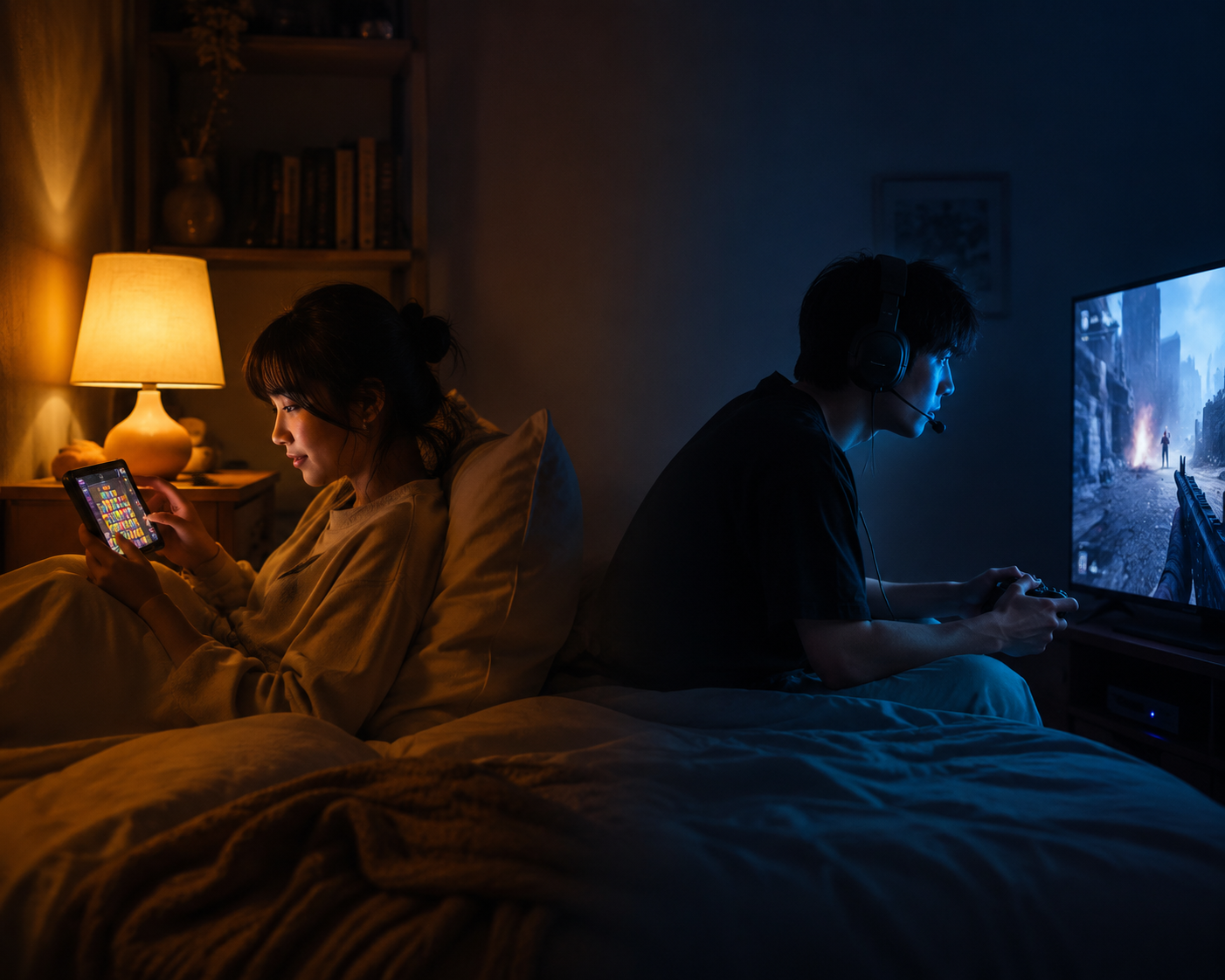
No, you do not automatically have to stop gaming at night to protect your sleep. The better question is what you are playing, how long the session runs, and how close it ends to lights-out. A quiet word game for 30 minutes is not the same sleep exposure as a ranked shooter that stretches past midnight, even though both involve a screen.
When people ask whether video games before bed hurt sleep quality, they are usually asking one question that covers several different situations: low-arousal moderate play, high-arousal play near bedtime, and prolonged sessions that simply push sleep later. Those distinctions matter more than a blanket rule about screens.
The sleep risk depends on genre and dosage
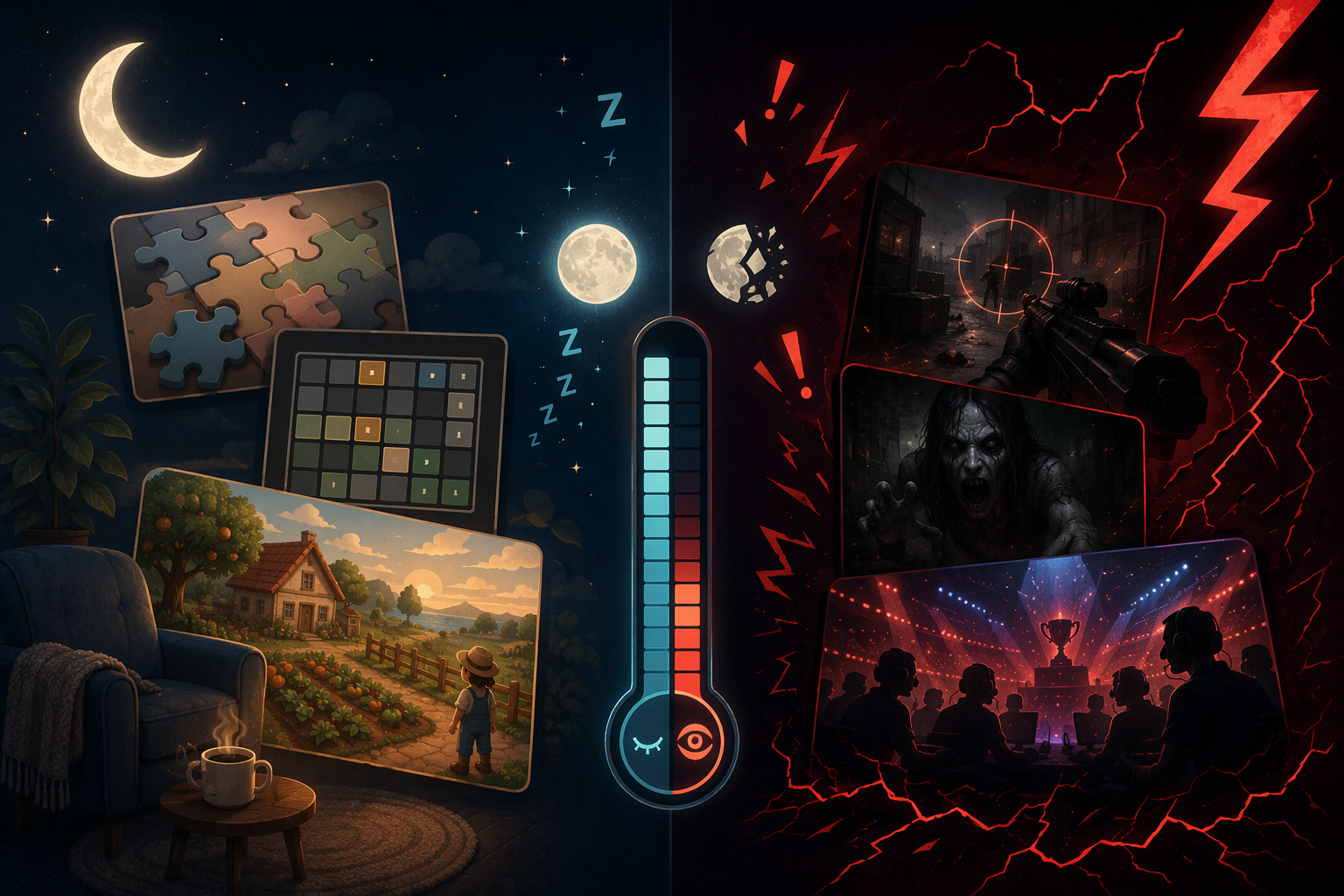
A 2024 systematic review in Sleep Medicine, reported in secondary coverage, found that playing up to about 7 hours of video games per week did not appear to negatively affect adult sleep; the same review also reported a split by game type, with non-arousing, cognitively stimulating games such as word games showing neutral or possibly beneficial sleep associations, while high-arousal genres were more consistently linked with longer sleep latency and reduced REM sleep [1].
That 7-hour figure is useful as a moderation marker, not a clinical cutoff. It comes from one review, and the underlying paper was available only through secondary reporting. Still, it gives adult gamers a more practical starting point than “never play at night.” A few moderate sessions in a week belong in a different risk category than long nightly play that regularly replaces sleep.
The clearest adult-specific boundary comes from Exelmans and Van den Bulck, who found that video gaming for more than 60 minutes per day was associated with greater fatigue, more insomnia symptoms, and later bedtimes in adults [2]. That does not prove every 61-minute session harms sleep, but it does make the hour mark a sensible place to stop pretending duration is irrelevant.
| Before-bed gaming pattern | Sleep-risk level | Why it matters |
|---|---|---|
| Low-arousal game, moderate session, stopped before bed | Lower | Less emotional activation and less chance that play displaces sleep |
| High-arousal game close to lights-out | Higher | More cognitive and emotional activation when the brain should be downshifting |
| Any game that runs past the planned bedtime | Higher | Sleep is lost even if the game itself is not especially stimulating |
| Sessions over about 60 minutes near bedtime | Higher | Adult data link this level of daily gaming with later bedtimes and worse sleep symptoms |
Why a cozy game is not the same as a ranked match
Low-arousal games give the brain tasks without necessarily adding urgency. A puzzle, word game, cozy simulation, or slow single-player routine may hold attention, but it usually does not demand rapid threat detection, social vigilance, voice chat, punishment for leaving, or the adrenaline spike of “one more round.” If the session stays moderate, that kind of play can fit into a wind-down routine for some adults.
High-arousal games load the evening differently. Shooters, horror titles, fast competitive multiplayer, and high-stakes ranked modes ask for reaction speed, emotional control, monitoring opponents, and recovering from wins or losses. Even when the player says it feels relaxing, the body may be doing something closer to performance than rest.
The 2025 Call of Duty experiment is the useful complication. In a small study of 18 non-gamers, playing Call of Duty for 1 hour, with the session ending 30 minutes before bed, did not impair objective sleep quality and reduced stress levels [3]. That result argues against panic about a single intense game session under controlled limits. It does not support unlimited late-night competitive play, and it may not generalize well to regular gamers who are more emotionally invested in performance, ranking, progression, or social obligations.
The biggest problem is often the bedtime that disappears
The most convincing household problem is not always blue light or even stimulation. It is the missing hour. In a 2016 American Academy of Sleep Medicine survey report, gamers delayed bedtime by an average of 101 minutes on 36% of gaming nights, and 67% said gaming caused them to miss sleep [4].
That is the point where evening leisure turns into bedtime displacement. The game may still feel enjoyable, and the player may still describe it as stress relief, but the cost has moved to the next morning: a shorter night, a harder wake-up, a partner handling more of the early routine, or a workday started on sleep debt.
This is also why “I sleep fine after gaming” needs a little audit. If sleep quality feels fine only on the nights when play ends on time, the game is not the problem in every form. If bedtime keeps sliding, the stopping point is the problem.
What the stronger experimental evidence shows
Experimental evidence is thinner than most advice columns imply, and much of it comes from adolescents rather than adults. One often-cited study compared 150 minutes versus 50 minutes of violent gaming in adolescents and found that the prolonged session reduced total sleep time by 27 minutes and lowered sleep efficiency by 7% [5].
The age caveat matters. A teenager’s sleep timing, school schedule, and developmental sleep needs do not map perfectly onto an adult gamer’s life. But the experiment still strengthens the basic dosage point: longer, more arousing play before bed can reduce sleep, not just correlate with people reporting worse nights.
For adults, the current evidence is more mixed and often relies on self-reported sleep. Cross-sectional studies can show that heavier gaming and poor sleep travel together, but they cannot always prove which direction the arrow runs. Some people may sleep badly because they game late; others may game late because they already cannot sleep.
The three mechanisms that actually matter
Evening gaming can disturb sleep through three main pathways: cognitive and emotional arousal, blue-light-related melatonin suppression, and time displacement [6]. The mistake is treating those mechanisms as if every game triggers them equally.
Arousal
Arousal is the reason genre matters. A horror sequence, a close ranked match, or a competitive loss can keep the brain rehearsing what just happened. The session may end, but the argument with a teammate, the missed shot, or the next strategy can continue in bed.
Light
Blue light still counts, especially with bright displays close to the face. But it is only one part of the picture. Lowering brightness, using warmer display settings, or playing farther from the screen may reduce one input while leaving the emotional and timing problems untouched. A calmer screen setting does not turn a midnight ranked grind into a wind-down routine.
Displacement
Displacement is the simplest and most underrated mechanism: the game occupies time that would otherwise be sleep. This is where gaming overlaps with other forms of instant reward. If the hard part is stopping when the next match, puzzle, quest, or reward is already available, the same pattern discussed in How Instant Gratification Affects Your Sleep Quality may be doing more damage than the screen itself.
For a deeper look at these mechanisms in screen use generally, the related guide on how screen time disrupts children’s sleep through three mechanisms covers the same basic pathways, though the practical boundaries for adults need to account for adult schedules and autonomy.
A practical boundary that lets gaming stay in the evening
A workable sleep boundary should be specific enough to use tonight. “No screens” is simple, but it is also blunt. A better rule is to separate game type, session length, and shutdown buffer.
- Keep low-arousal games as the default near bedtime: puzzle, word, cozy simulation, slow single-player, or familiar low-stakes play.
- Treat high-arousal games as earlier-evening activities: shooters, horror, ranked competitive modes, high-pressure raids, or anything that leaves you replaying decisions in bed.
- Use 60 minutes as the yellow-light threshold. Once a before-bed session passes an hour, the evidence for later bedtimes and worse sleep symptoms becomes harder to ignore.
- Stop with a buffer, not at lights-out. The 2025 Call of Duty study used a 30-minute gap before bed, which is a reasonable minimum for a controlled session rather than a license to play until the pillow.
- Count the weekly pattern. About 7 hours per week may be a useful moderation marker, but repeated short sleep nights matter more than hitting a neat number.
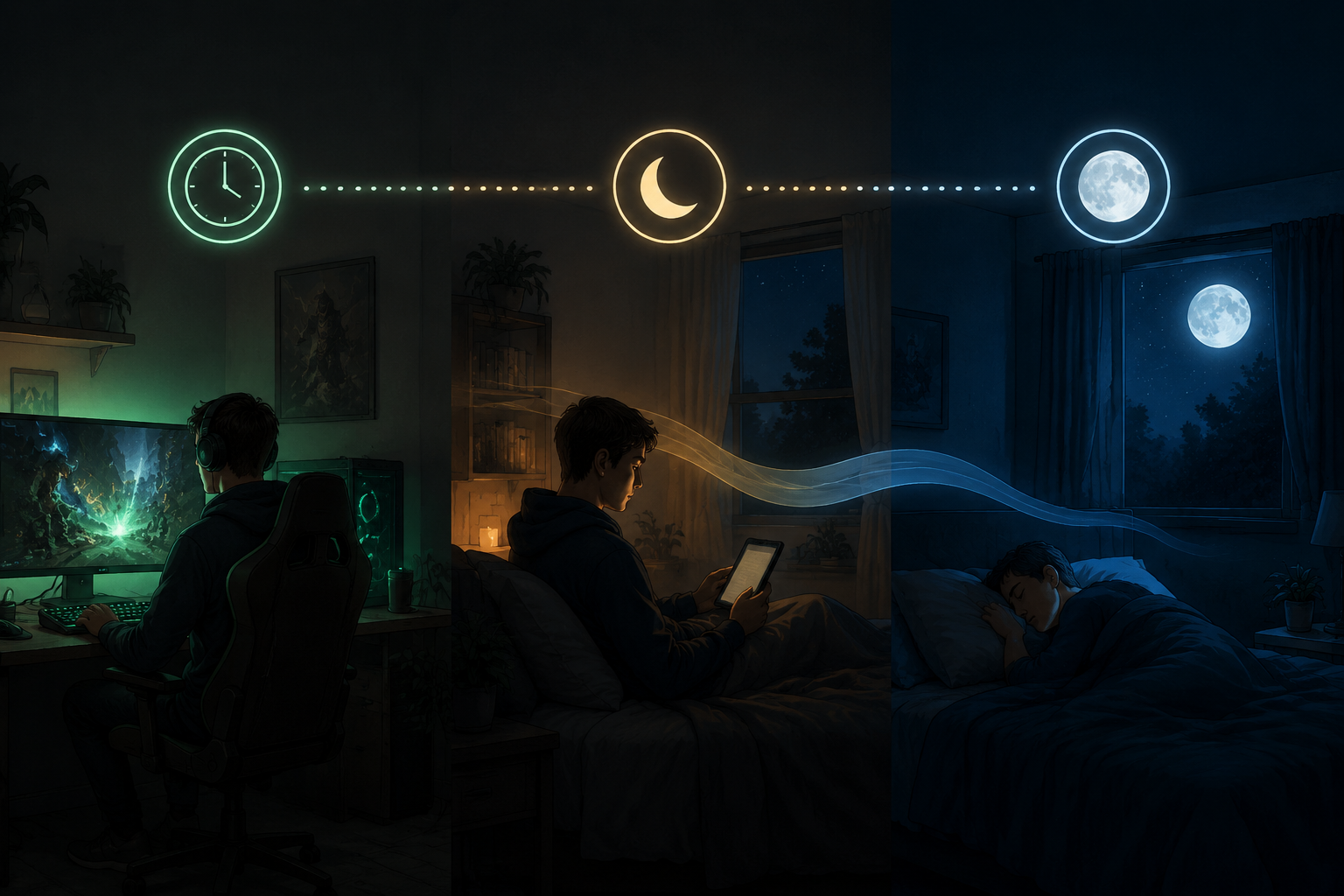
The buffer does not need to be elaborate. Save, log off, dim the room, do the boring hygiene steps, and give your attention something less interactive. If you need a non-gaming wind-down option, Evidence-Rated Home Remedies for Sleeplessness is a better place to look than adding one more in-game task and hoping tiredness catches up.
When the answer should be stricter
Some nights can tolerate flexibility. A weekend co-op session that runs late once in a while is not the same as a nightly pattern that cuts sleep short. The stricter boundary is warranted when gaming repeatedly delays bedtime, makes mornings worse, causes conflict at home, or becomes the only reliable way to avoid going to bed.
It is also worth separating a gaming habit from a broader sleep problem. If you stop late-night gaming for a couple of weeks and still cannot fall asleep, stay asleep, or function during the day, the issue may have moved beyond game timing. The Sleeping Problem at Night vs. Insomnia: A Triage Framework can help sort occasional sleep disruption from a pattern that deserves more attention.
The practical answer is narrow but useful: many adults can keep gaming in the evening if the game is low-arousal, the session stays moderate, and play ends before the sleep routine begins. The risk rises when the game is emotionally activating, competitive, prolonged, or allowed to decide bedtime for you.
References
- The impact of videogaming on sleep: A systematic review. Sleep Medicine, 2024.
- Sleep quality is negatively related to video gaming volume in adults. Journal of Sleep Research, 2015.
- Evening videogaming and sleep quality: an experimental study. Sleep Medicine, 2025.
- Video game playing negatively influences adequate sleep and bedtimes. American Academy of Sleep Medicine, 2016.
- The impact of prolonged violent video-gaming on adolescent sleep: an experimental study. Journal of Sleep Research, 2013.
- Exposure to video games: effects on sleep and on post-sleep cognitive abilities. A systematic review of experimental evidences. Peracchia and Curcio, 2018.
Comments
Join the discussion with an anonymous comment.