
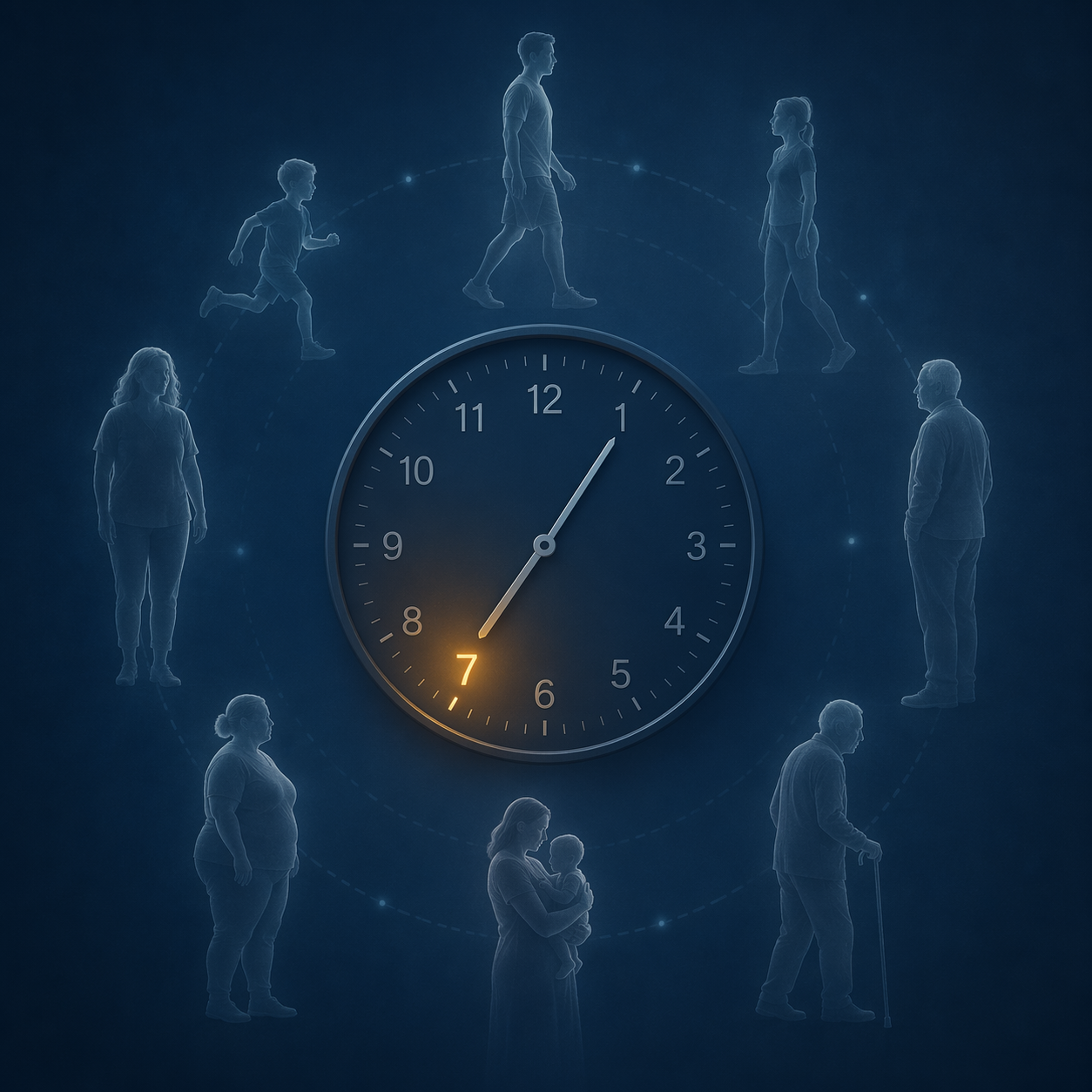
The official recommended sleep for adults is 7 or more hours per night on a regular basis to promote optimal health. That wording came from a deliberate evidence review, not from habit or a catchy wellness rule: a 15-member joint panel from the AASM and SRS spent 12 months using the modified RAND Appropriateness Method and reviewed 5,314 studies across nine health categories before settling on the recommendation [1].
That process matters because it makes the number more trustworthy, but not more absolute. The panel was not uncovering a biological constant; it was turning a large, uneven literature into a usable population benchmark, and the result is a consensus judgment rather than a lab finding or a universal law [1].
Why there is no upper limit
The most misunderstood part of the guideline is what it does not say. The panel declined to set an upper limit because long sleep is often entangled with chronic illness, medication effects, depression, and other confounders that make it hard to know whether sleep duration is the cause of a risk signal or just a marker of poor health [1].
That is a narrower conclusion than popular articles usually suggest. It does not prove that every hour above a threshold is harmless, and it does not prove that long sleep is independently dangerous for everyone. It says the evidence was too confounded to justify a universal ceiling, even though observational studies sometimes show worse outcomes at 9 or more hours [1].
Age bands are close, but not identical
The adult ranges most people hear are close enough to sound identical, but they are not. CDC guidance lists 7 or more hours for ages 18–60, 7–9 hours for ages 61–64, and 7–8 hours for ages 65+ [2]. The National Sleep Foundation uses 7–9 hours for adults 18–64 and 7–8 hours for 65+ [3].
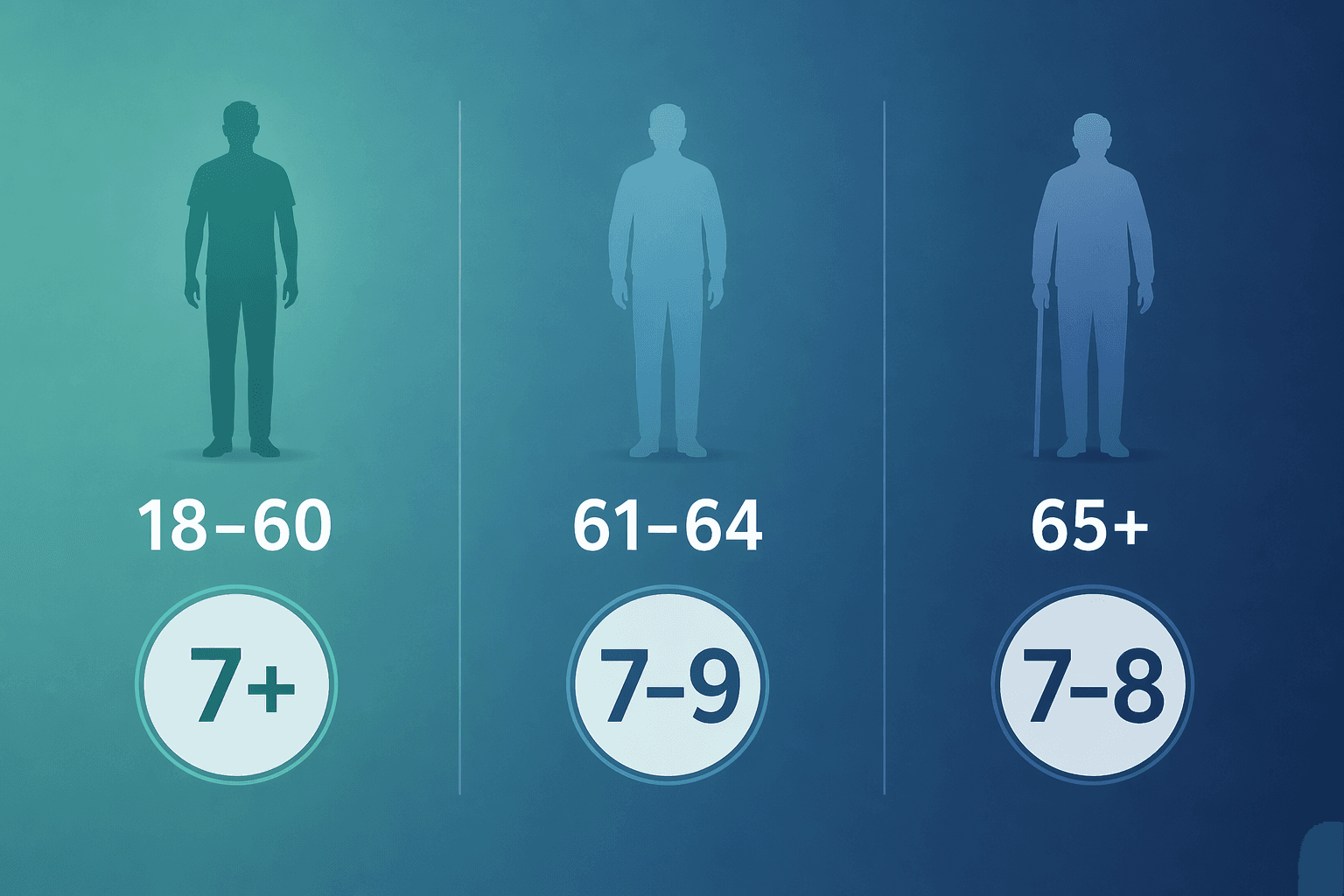
The small split at 61–64 is worth noticing because it shows how the same evidence gets translated into public guidance. It is not a sign that the science suddenly became unstable; it is a sign that recommendations are practical boundaries built from imperfect evidence, not perfect biological cutoffs [2][3].
When less sleep is a real exception
There are rare genetic variants, including DEC2 and ADRB1, that allow a small minority of people to sleep naturally for less time without obvious health consequences. AASM Sleep Education describes natural short sleepers as fewer than 1% of the population, which makes them a real exception but not a useful self-exemption for most adults [4].
Older adults need a careful reading too. The need for 7–8 hours does not disappear after 65, but the ability to get it often changes because circadian phase advances, slow-wave sleep declines, and nighttime awakenings become more common [5].
That means a shorter or more fragmented night in later life is not automatically a sign that sleep needs have dropped. It may simply reflect the way aging changes sleep architecture and timing, which is different from saying older adults no longer need the same amount of sleep [5].
What the guideline can tell you
The seven-hour recommendation is best read as a population-level floor, not a personal diagnosis and not a pass-fail test. It is useful because it gives adults a defensible benchmark, but it still has to be interpreted alongside age, health status, medications, genetics, and daytime function. The more precise question is not whether the number sounds strict enough; it is whether the benchmark fits your actual context, or whether you are treating a public-health guideline as if it were a verdict about your own sleep.
References
- Recommended Amount of Sleep for a Healthy Adult: A Joint Consensus Statement of the American Academy of Sleep Medicine and Sleep Research Society. American Academy of Sleep Medicine / Sleep Research Society, 2015. PMC
- How Much Sleep Do I Need? Centers for Disease Control and Prevention. CDC
- How Many Hours of Sleep Do You Really Need? National Sleep Foundation. National Sleep Foundation
- Short Sleepers and Long Sleepers. AASM Sleep Education. Sleep Education
- Sleep and Older Adults. National Institute on Aging. NIA
Comments
Join the discussion with an anonymous comment.