
Mechanism explainer
How AHRQ Cuts Freeze Sleep Apnea Screening Guidelines
The Trump administration's dismantling of AHRQ has frozen the U.S. Preventive Services Task Force since March 2025, preventing any update to the sleep apnea screening recommendation. This explainer covers why funding was cut, how it blocks new evidence from being incorporated into formal guidelines, and what that means for patients who depend on those recommendations for insurer coverage.
The most consequential sleep apnea document in the United States is not a glossy device clearance, a new cardiology paper, or a payer bulletin. It is a 2022 U.S. Preventive Services Task Force recommendation that gives screening for obstructive sleep apnea in asymptomatic adults an “I” grade: insufficient evidence. That grade does not say sleep apnea is harmless. It does not say screening is useless. It says the Task Force did not find enough evidence to recommend for or against routine screening in that population.
In ordinary times, an “I” grade is supposed to be revisitable. New studies accumulate. Detection tools change. Clinicians report what they are seeing in patients who do not fit the older stereotype of a sleepy middle-aged man with a large neck. Evidence reviewers sort the signal from the noise, and the Task Force decides whether the recommendation should move.
That is the part now stuck. The Trump administration’s cuts to the Agency for Healthcare Research and Quality, or AHRQ, have left the USPSTF unable to function normally. The Task Force has not met since March 2025, only 6 of its 16 members remain, and a tentatively scheduled August 2026 meeting would be its first in 17 months if it happens as planned.[1]
For sleep apnea patients, the question is not only why the Trump administration cut AHRQ funding. It is what happens when the agency that supports the preventive-care recommendation process is disabled while the sleep apnea grade remains formally unresolved.
Why AHRQ Was Targeted
The administration’s stated case is that AHRQ is duplicative. In that view, the federal government already funds biomedical research through the National Institutes of Health and patient-centered outcomes work through the Patient-Centered Outcomes Research Institute, so a separate health quality and evidence agency can be reduced or folded into other capacity. Supporters of the cuts have also suggested that newer tools, including AI-assisted evidence review, could replace some of the work now performed through AHRQ-supported processes.[1]
That argument deserves to be stated plainly because federal agencies do overlap at the edges. NIH funds major medical research. PCORI supports comparative effectiveness and patient-centered outcomes research. But the job at issue here is narrower and more operational: turning a body of evidence into preventive-service recommendations that clinicians, health systems, and insurers can use.
AHRQ is not merely a grant dispenser sitting beside NIH. It convenes the USPSTF, contracts Evidence-based Practice Centers to perform systematic reviews, and disseminates the Task Force’s recommendations. When that machinery stops, the problem is not abstract “less research.” The problem is that evidence cannot move through the formal channel that determines whether a preventive service receives a grade.
The Coverage Chain Breaks Before the Patient Ever Sees It
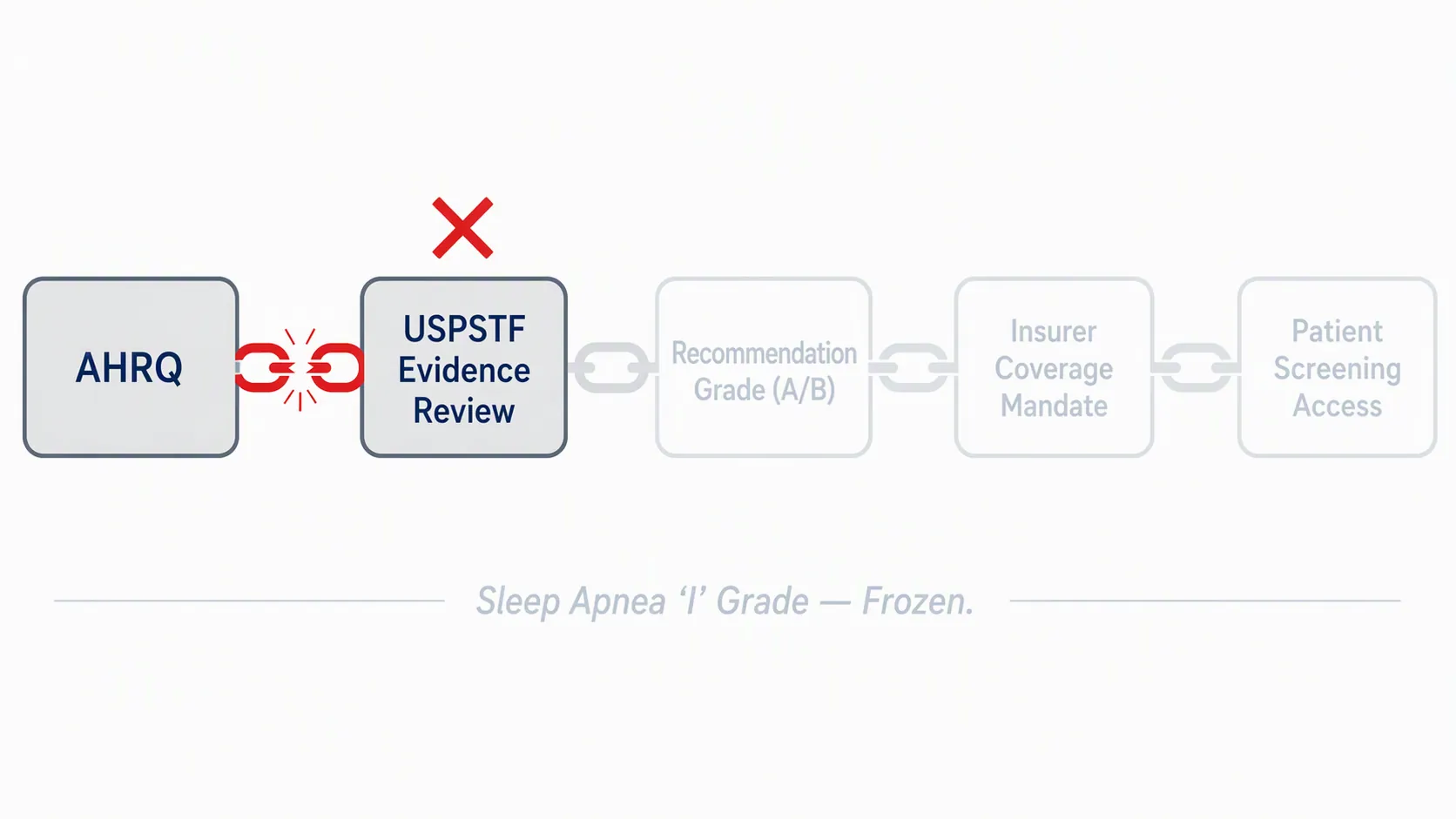
Sleep apnea screening access depends on a chain that is easy to miss until a claim is denied.
- AHRQ supports the USPSTF process and commissions evidence reviews.
- Evidence reviewers evaluate whether newer studies are strong enough to change a recommendation.
- The USPSTF assigns or updates a recommendation grade.
- Under the Affordable Care Act’s preventive-services coverage rules, A and B grades require most private insurers to cover those preventive services without cost-sharing.
- Patients either encounter a covered preventive service or a test that may require symptoms, prior authorization, deductibles, or denial appeals.
That fourth link is why the sleep apnea “I” grade matters so much. An A or B grade can become a no-cost preventive coverage requirement. An “I” grade does not. Avalere warned that disruptions to AHRQ and the USPSTF could affect access because USPSTF recommendations are tied directly to ACA preventive coverage obligations.[2]
The current sleep apnea grade was not caused by the 2025 and 2026 cuts. It was already there. The more precise problem is that the cuts make it much harder to revisit that grade as new evidence arrives. A clinician can know that a patient’s risk is real; a patient can know that waking unrefreshed, snoring, morning headaches, resistant hypertension, or bed-partner reports deserve attention; but the preventive-care coverage framework still sees an unresolved evidence category.
This is not just an inconvenience for people who like tidy guidelines. It changes the conversation in the exam room. A clinician trying to justify sleep testing for someone who does not present as the textbook case may have to lean on symptoms, comorbidities, or specialty criteria rather than a national preventive screening recommendation. The patient then waits while an insurer decides whether the test is diagnostic enough, necessary enough, or documented enough.
What Goes Unreviewed When the Task Force Cannot Meet
The frozen sleep apnea grade should not be confused with a settled scientific verdict. It is a procedural condition. Since the 2022 recommendation, research and clinical practice have continued to move in several directions that matter for screening: portable monitoring, cardiovascular outcomes, and risk in populations that have historically been underrecognized.
Portable monitoring is the most visible example for patients. Home sleep apnea tests, wearable alerts, and device-based signals are not all equivalent, and none should be treated as a universal substitute for clinical evaluation. But they are changing how people first encounter the possibility of sleep apnea. Restful Ground has covered how the consumer-device landscape is still narrow in Only Two Smartwatches Have FDA-Cleared Sleep Apnea Notifications. That kind of evidence does not automatically produce a screening recommendation; it has to be reviewed for accuracy, outcomes, harms, and applicability.
Cardiovascular evidence is another area where the distinction matters. Sleep apnea is entangled with hypertension, arrhythmia, stroke risk, and vascular disease, but a screening recommendation asks a specific question: does screening people without recognized symptoms improve health outcomes enough to justify recommending it broadly? A paper showing association, a trial showing benefit in a treated group, and a preventive-screening recommendation are related, but they are not the same thing. That is exactly why an evidence review exists.
The patient groups most likely to be missed are often the ones harmed by that delay. A perimenopausal woman whose nighttime panic is treated as anxiety may not get asked about snoring or witnessed apneas. Restful Ground discusses that overlap in Why You Wake Up Panicking During Perimenopause. A pregnant person may be reassured that snoring is temporary. An older adult’s fatigue may be filed under age. An adult with ADHD may have fragmented sleep interpreted mainly as behavior or schedule.
Those are not arguments for pretending the evidence review is already complete. They are reasons the review needs to be able to happen. If newer data on portable testing, cardiovascular outcomes, pregnancy, menopause, aging, or neurobehavioral symptoms are strong, the USPSTF process is supposed to show that. If the data remain insufficient, the process is supposed to say that too, with enough clarity that researchers know what is missing.
The AHRQ Cuts Are Not a Normal Slowdown
AHRQ’s condition in mid-2026 is not a routine budget squeeze. HHS confirmed that AHRQ staffing fell from about 300 employees to 74, a reduction of roughly 75%.[1] KFF Health News reported that no new grants had been issued in more than a year and that Congress appropriated $345 million for AHRQ in FY2026, yet less than $15 million had gone to grants by late July 2026.[1]
STAT reported that federal health quality research grants worth $109 million ended early, with researchers losing support for work that had already been awarded.[3] Science likewise described the administration ending dozens of grants studying patient care.[4] The exact funding totals may continue to shift as grantees report notices, courts respond, and Congress acts. The direction, however, is already visible: the agency that supplies the evidence-review backbone for preventive guidance has been hollowed out.
In April 2025, 45 former USPSTF chairs, members, and scientific directors warned that the cuts threatened the Task Force’s independence and capacity.[2] The force of that letter is not nostalgia for a committee. It is the recognition that independence without staff support is ceremonial. A Task Force that cannot meet, cannot maintain membership, and cannot commission reviews cannot update recommendations in the way clinicians and payers rely on.
The Sleep Apnea Consequence Is Specific
For a sleep specialist, the practical consequence begins before treatment. It begins at the moment of deciding who gets tested. Patients with loud snoring, witnessed breathing pauses, excessive sleepiness, resistant hypertension, or high-risk anatomy may still qualify for diagnostic evaluation through other clinical pathways. But the “I” grade leaves routine preventive screening without the ACA coverage force attached to A and B recommendations.
That gap is felt most sharply by people whose risk is plausible but whose documentation is messy. A perimenopausal patient may describe panic awakenings and insomnia more readily than snoring. A pregnant patient may not know whether snoring has become clinically meaningful. An older adult may report fatigue rather than sleepiness. An ADHD adult may focus on attention and restlessness rather than breathing. These presentations can be clinically familiar and still be administratively fragile.
When the formal screening recommendation is unresolved, clinicians are left to build the case one chart note at a time. They document symptoms, comorbidities, oxygen concerns, pregnancy status, medication changes, bed-partner observations, or occupational risk. Sometimes that is enough. Sometimes the patient is told to wait, pay, appeal, or return when symptoms are worse.
The vacuum also changes patient behavior. Some people turn to wearables. Some try lifestyle changes without testing. Some search for mouth taping or other risky shortcuts; Restful Ground’s Mouth Taping Is Unsafe for Sleep Apnea addresses that problem because the absence of clear access does not make breathing problems disappear. It only pushes people toward whatever answer is easiest to reach.
Other Preventive Work Is Caught in the Same Machinery
Sleep apnea is not the only stalled topic. Reporting on the AHRQ disruption has also pointed to delayed or paused recommendations involving obesity-management drugs such as semaglutide and tirzepatide, vision screening, tobacco cessation, and other preventive-care questions.[1] These examples matter because they show the scale of the interruption, not because every topic has the same evidentiary posture.
AHRQ’s work has also extended beyond USPSTF recommendations. AHRQ-funded hospital infection-prevention programs were estimated to have saved 20,500 lives and $7.7 billion from 2014 to 2017, according to AHRQ’s own analysis cited by KFF Health News.[1] That figure does not prove what a sleep apnea screening update would conclude. It does show why dismissing the agency as duplicative misses the practical nature of its work.
What the August 2026 Meeting Can and Cannot Fix
The tentative August 2026 USPSTF meeting is an important checkpoint, not a cure by itself. A meeting can restart visible activity. It cannot instantly replace lost staff, restore dismissed expertise, refill all member seats, or complete the evidence reviews that would be needed to revisit a topic like sleep apnea screening.
The better question is whether the Task Force regains the capacity to do its actual job. That means enough members to deliberate, enough AHRQ staff support to manage the process, enough contracting capacity to commission systematic reviews, and enough independence that recommendations are trusted by clinicians and payers.
If those pieces return, the sleep apnea “I” grade could be revisited through the ordinary evidence pathway. The result might be an updated “I” grade, a narrower recommendation for specific high-risk groups, or a stronger grade if the evidence supports it. That answer should come from a functioning review process rather than from institutional paralysis.
Where Patients and Clinicians Are Left Now
As of July 30, 2026, sleep apnea screening remains trapped in an “insufficient evidence” preventive category while the federal machinery built to reassess that category is damaged. That does not mean every insurer will deny testing. It does not mean patients should ignore symptoms. It does mean there is no current USPSTF A or B recommendation forcing no-cost preventive screening coverage for asymptomatic adults under the ACA framework.
For now, the clinical path is still individualized evaluation: document symptoms carefully, name the comorbidities that raise concern, and avoid treating consumer alerts or internet fixes as substitutes for medical assessment. For policy, the unresolved sentence is simpler. Unless the USPSTF regains enough staff support, membership, meetings, and evidence-review capacity, the sleep apnea “I” grade may say as much about broken guideline machinery as it does about the state of emerging sleep apnea research.
References
- Trump Has Quietly Throttled an Agency Devoted to the Safety of American Healthcare — KFF Health News
- President Trump's Proposed AHRQ Cuts Would Impact Preventive Care Access — Avalere Health
- Federal health quality research grants worth $109 million ended early — STAT, July 22, 2026
- Trump administration ends dozens of grants for studying patient care — Science
Supports these guides
Spot an error or have clinical feedback?
Because this article covers clinical, medication, or safety information, we use a moderated correction channel instead of open public comments. Let us know if something about “How AHRQ Cuts Freeze Sleep Apnea Screening Guidelines” needs a closer look.
Send feedback on this article