
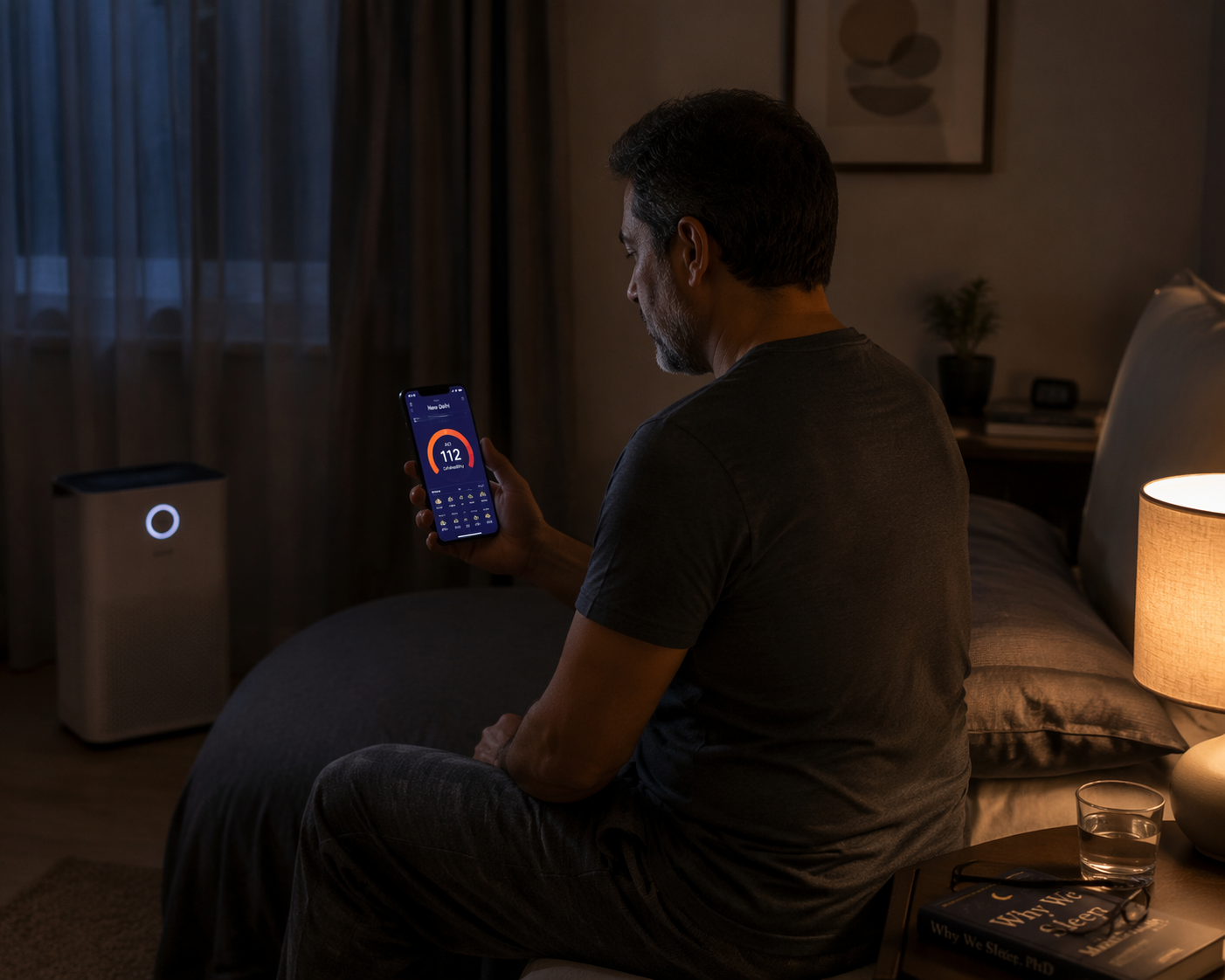
If you already check the weather before deciding whether to carry an umbrella, add one more evening glance: tonight’s AQI. Not tomorrow’s regional air-quality headline, not a vague warning about pollution in general. The useful question is narrower: should your bedroom get outside air tonight, filtered air, or as little outside air as possible?
That small decision matters because sleep happens during a long, mostly unattended exposure window. You may be inside, with the door closed and the lights off, but the bedroom is still connected to the street, the hallway, the HVAC system, the neighbor’s smoke, the kitchen, and whatever the evening air is carrying. For particles such as PM2.5, the timing is especially awkward: one review of air pollution and sleep describes fine-particle concentrations peaking between about 9 PM and 11 PM, close to the hour many people are sealing themselves into bed for the night.[1]
The Three-Band Evening AQI Decision
Use the AQI forecast the way you use temperature: not as a moral verdict on the day, but as a condition that changes the room setup. The basic rule is simple enough to repeat without turning bedtime into a monitoring project.
| Evening AQI band | Bedroom action | Why this action fits |
|---|---|---|
| Good, 0-50 | Ventilate freely before sleep, and keep the window open if noise, temperature, and safety allow. | Outdoor particle levels are low enough that fresh air can help dilute indoor CO2 and odors without adding much PM2.5 burden. |
| Moderate, 51-100 | Ventilate earlier in the evening, then close the bedroom before sleep. | You still get an air exchange, but you avoid leaving the room open during the later bedtime window when particles may rise. |
| Unhealthy for Sensitive Groups or worse, 101+ | Close windows and doors, reduce leakage where practical, and run a correctly sized HEPA purifier. | On these nights, lowering incoming PM2.5 usually takes priority over open-window ventilation. |
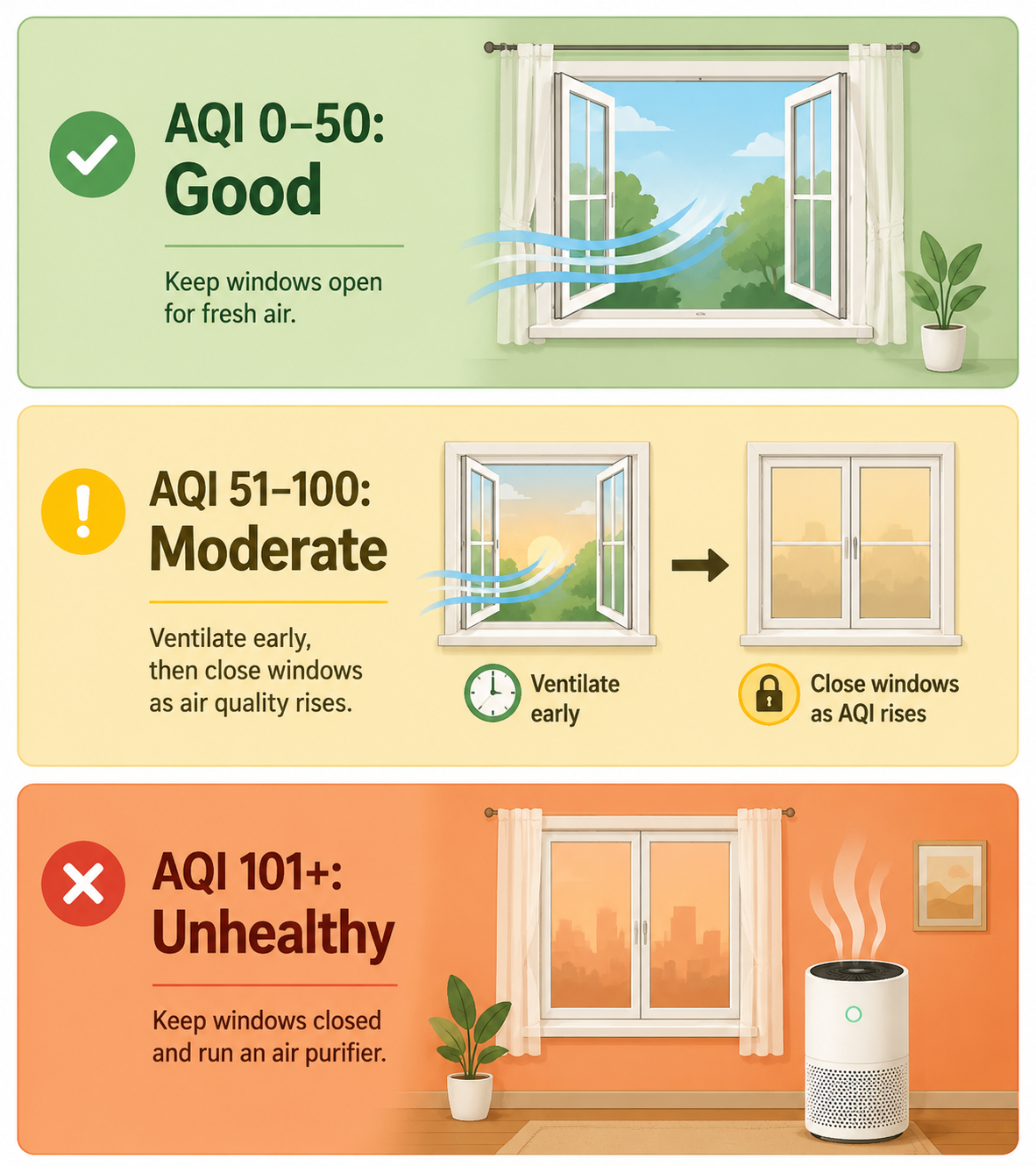
The middle band is the one people tend to mishandle. Moderate AQI is not a command to panic or to live in a sealed box. It is a timing cue. If dinner is at 6:30 and bedtime is 10:30, open the bedroom earlier, use a fan if it helps move air, then close the window before the room becomes your overnight exposure chamber.
On orange or red nights, the order changes. Close first, filter second, and avoid creating new indoor particle sources. That means no incense, no indoor smoking, no late-night frying, and no scented combustion masquerading as relaxation. A purifier cannot make a room clean if the room keeps producing particles.
Why Bedtime AQI Belongs In A Sleep Routine
Most sleep advice still treats the bedroom as if its main variables are light, noise, temperature, caffeine, and screens. Those matter. But air is not a background detail, particularly in dense urban neighborhoods where evening traffic, weather inversions, wildfire smoke, or regional haze can change what comes through a cracked window.
The sleep evidence is suggestive rather than clinically tidy. In the MESA Air and Sleep analysis, higher PM2.5 exposure was associated with about 50% higher odds of low sleep efficiency, and higher NO2 exposure was associated with about 60% higher odds of low sleep efficiency.[3] Low sleep efficiency means a person spends a smaller share of time in bed actually asleep. That is not the same as saying PM2.5 caused one individual’s poor sleep on Tuesday, but it is enough to make evening particle exposure a reasonable sleep-environment variable.
The age caveat is important. A 2025 Guardian report on Johns Hopkins-led research described a finding that cutting PM2.5 exposure in half could reduce the likelihood of poor sleep by roughly 10% among adults over 45.[4] That does not prove the same effect size for a healthy 25-year-old, a child, or someone with untreated sleep apnea. It does explain why an adult who is doing the usual sleep-hygiene work and still waking unrefreshed should not ignore the air-quality line in the weather app.
The Hard Part: Particles Outside, CO2 Inside
Closing a bedroom on a bad-air night is often the right move for PM2.5. It can also create a different problem: stale air. Two adults sleeping in a small room with the door and windows closed can drive carbon dioxide upward over the night, especially in newer apartments with tight envelopes or older bedrooms with poor air movement.
One DTU study of bedroom air quality and sleep found that closing windows could push CO2 above 2,000 ppm, while a 10-minute window opening before bed reduced CO2 from about 2,395 ppm to about 835 ppm.[5] The study was small and specific, so those numbers should not be treated as universal thresholds for every bedroom. They do show the tradeoff clearly: a sealed room may protect against particles while quietly worsening ventilation.
That is why the AQI decision works best when paired with a basic CO2 sense check. On a green night, open the window and let the room breathe. On a yellow night, ventilate earlier instead of waiting until your head is on the pillow. On an orange or red night, seal and purify, but consider opening the bedroom door to a cleaner interior hallway, using mechanical ventilation if it is filtered, or doing a short pre-bed air exchange if outdoor readings briefly improve.
A CO2 monitor is not necessary for everyone. It becomes useful when the same pattern repeats: you sleep with windows closed because of smoke, traffic, pollen, noise, or safety, and you wake heavy-headed despite a reasonable bedtime. The monitor does not diagnose sleep quality. It tells you whether your sealed-room strategy is asking stale air to do clean-air work.
How To Check The Right Air-Quality Number
Start with AirNow.gov or the AQI line in a reliable weather app. For most people, that is enough to choose among the three evening actions. The number to look for is the evening or overnight AQI for your area, not only the daytime high. If the app gives hourly forecasts, check the hours closest to your actual sleep window.
Forecast AQI and real-time AQI are not the same thing. A forecast is the planning tool: it tells you whether tonight is likely to be a window-open night or a purifier night. A real-time local reading tells you what is happening now, which matters during wildfire smoke, localized traffic congestion, industrial events, or fast-changing wind. Community sensor maps such as PurpleAir can add neighborhood-level detail, but low-cost outdoor sensors can vary by placement, calibration, humidity, and maintenance. Treat a cluster of nearby sensors as more informative than one dramatic dot.
Indoor PM2.5 monitors are most helpful when your home has a specific question: does outdoor smoke leak into this bedroom, does the purifier keep up, or does cooking residue reach the sleeping area? Without that question, a monitor can become another glowing object demanding attention at 11 PM. With the question, it can settle an argument you should not have to re-litigate every night.
A Practical Evening Check
- Two to three hours before bed, check the evening AQI forecast for your location.
- If the AQI is green, ventilate the bedroom normally, unless noise, temperature, pollen, or safety argues otherwise.
- If the AQI is yellow, open earlier, then close windows before sleep.
- If the AQI is orange or worse, close the room and run filtration before and during the first part of sleep.
- If the room feels stale or a CO2 monitor repeatedly reads high, solve ventilation as well as filtration.
What A Purifier Can And Cannot Promise
A HEPA purifier is the most straightforward tool for orange and red nights, but only if it matches the room. The relevant number is CADR, or clean air delivery rate. A purifier that is adequate for a small closed bedroom may be underpowered in a large primary suite with a leaky window, an open door, and a hallway feeding it smoky air.
Be wary of purifier claims that sound like a laboratory result pasted onto an apartment. Real-world particle reduction depends on room volume, airflow, filter condition, fan speed, leakage, furniture placement, and whether new particles are being generated indoors. The useful household goal is not a perfect number. It is a repeatable reduction in bedroom PM2.5 during the hours when you are breathing the same air for the longest uninterrupted stretch.
Placement is mundane but consequential. Put the purifier in the bedroom, not across the apartment. Keep the intake and outlet unobstructed. Run it before bedtime so the room is already being cleaned when you lie down. Use a sleep-tolerable fan speed; a silent purifier on its lowest setting may be emotionally satisfying and physically underwhelming.
When The Evidence Should Make You Care, Not Panic
The broader literature does not reduce sleep and pollution to a single clean causal line. A systematic review of air pollution exposure and sleep health found evidence linking pollution with adverse sleep outcomes across the life course, while also noting that causal models remain inconclusive.[6] That is the right level of certainty for this habit. Checking AQI before bed is not a medical treatment. It is environmental sleep hygiene.
That distinction matters for people with persistent insomnia. If you regularly cannot fall asleep, wake for long stretches, or dread the bed itself, the strongest behavioral treatment remains cognitive behavioral therapy for insomnia, not a better air-quality app. But if your sleep is decent in structure and still oddly unrefreshing, especially during smoky weeks or high-pollution evenings, bedroom air deserves a place beside light, noise, temperature, and caffeine.
The habit should stay small: check tonight’s AQI, choose the matching room setup, and notice patterns over time. Green means let the room breathe. Yellow means breathe earlier, then close. Orange or worse means seal what you can and filter what remains. That is enough of a rule to be useful, and not so much of a rule that it pretends one number can explain the whole night.
References
- The Effect of Air Pollution and Climate Change on Sleep
- AirNow.gov, EPA, https://www.airnow.gov/
- The association of ambient air pollution with sleep apnea: the multi-ethnic study of atherosclerosis (MESA), 2019
- Air pollution can affect how well we sleep, scientists discover, The Guardian, Sep 2025
- The effects of bedroom air quality on sleep and next-day performance, 2016
- Air pollution exposure and adverse sleep health across the life course: A systematic review, 2020
Comments
Join the discussion with an anonymous comment.