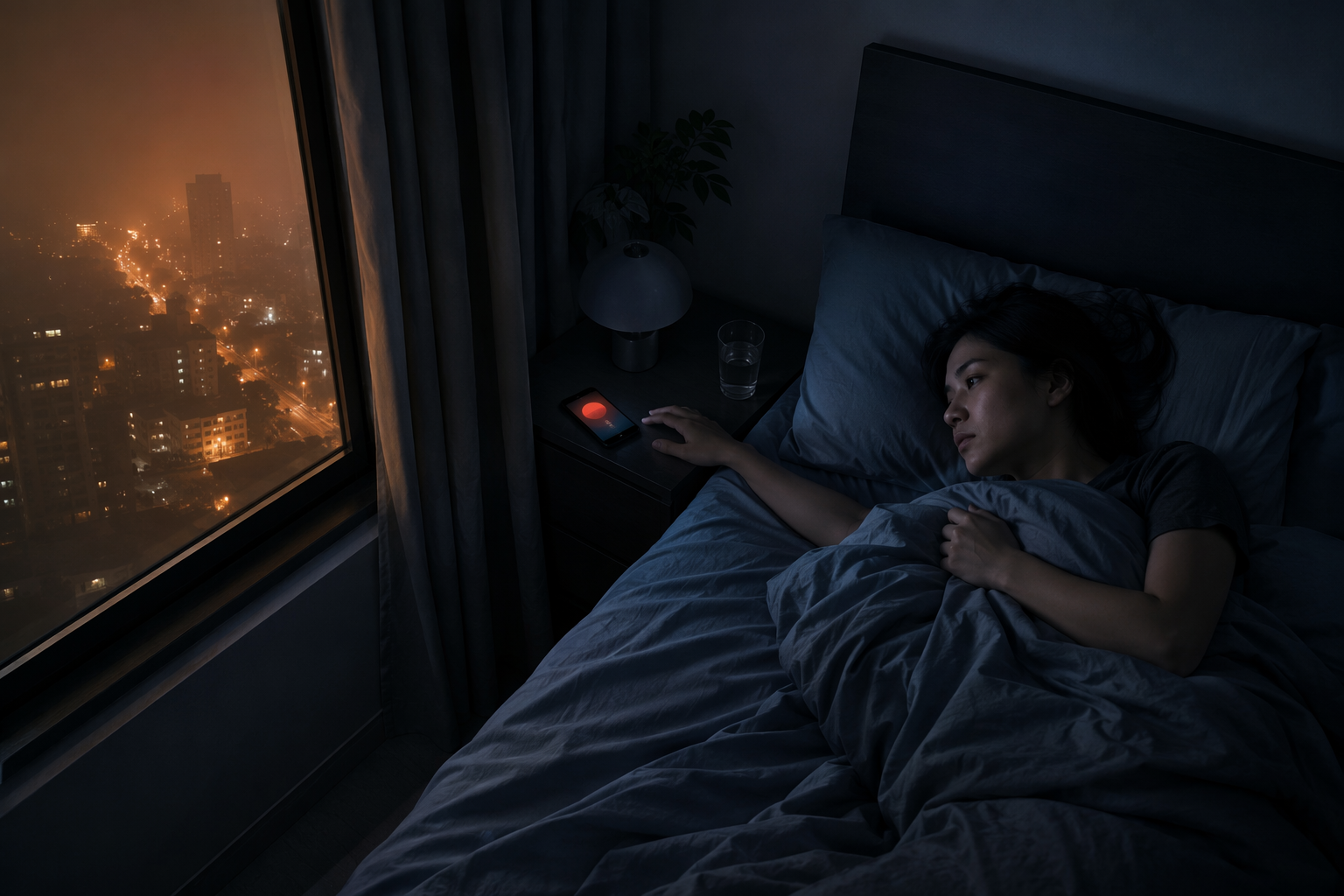
The air quality alert usually arrives before the bad night does. A phone lights up, the weather app turns orange or red, and the advice sounds simple enough: close the windows, limit outdoor activity, wait it out. Then bedtime comes with a scratchy throat, a faint headache, more snoring than usual, or a run of shallow wake-ups that feels too specific to blame on “just stress.”
That suspicion is reasonable. An air quality alert is not the mechanism itself; it is a warning that pollutant levels have crossed a threshold where the body may start paying for the exposure. For sleep, the pollutants that matter most often include fine particulate matter, or PM2.5; nitrogen dioxide, or NO2; and ozone, or O3. They do not disturb sleep in one single way. They can irritate the airway, alter breathing during sleep, plausibly affect brain regions involved in sleep regulation, and make the alert night feel threatening enough to keep the nervous system on watch.
The broad population signal is not subtle. In a 2019 study of 19 Chinese cities, Heyes and Zhu used social media posts as a proxy for sleeplessness and found an 11.6% increase in sleeplessness for each one-standard-deviation increase in the Air Quality Index.[1] That is a clever design, not a clinical insomnia diagnosis. A person posting online at night is not the same as a lab-confirmed sleep disorder. Still, the finding matters because it catches something people often report privately: worse air days and worse sleep nights seem to move together.
A later metastudy reported in 2025 pulled the lens back further, covering 25 studies, about 1.2 million people, and six countries. Its estimate was practical rather than dramatic: cutting PM2.5 exposure by half could reduce the likelihood of poor sleep by about one in ten.[2] Geography, monitoring methods, and sleep measures vary across studies, so that estimate should not be treated as a personal forecast for one bedroom in one U.S. city. It does, however, make it hard to dismiss air pollution as an incidental backdrop to sleep.
The First Pathway Is the Airway
The most immediate route from an air quality alert to a bad night is not mysterious. Polluted air touches the nose, throat, and lungs before it touches any sleep chart. PM2.5 can reach deep into the respiratory tract. NO2 and ozone can irritate inflamed tissue. On a poor air night, the airway may become more reactive, mucus may increase, nasal breathing may get harder, and a person who already snores may have less room for error.
That matters because sleep is unusually vulnerable to small changes in breathing. A mildly irritated upper airway can mean more mouth breathing, louder snoring, or more arousals. For someone with known or suspected obstructive sleep apnea, the same irritation may worsen an already unstable pattern: the airway narrows, breathing becomes more effortful, oxygen dips or sleep fragments, and the sleeper may not fully remember waking.
A nationwide smart-device study made this connection visible during actual sleep time. Zhang and colleagues analyzed 51,842 participants and 6.2 million person-days of data, then linked short-term pollution exposure to sleep apnea severity. Each interquartile-range increase in PM2.5 or NO2 during sleep time was associated with a 0.05 to 0.17 events-per-hour increase in the apnea-hypopnea index, and a 1.14% to 4.31% increase in the risk of obstructive sleep apnea exacerbation. The effects persisted for two days.[3]
Those numbers may look small at the individual event-per-hour level, especially beside the much larger AHI values used to classify sleep apnea severity. But they are measured across a very large dataset, during the hours when people were actually trying to sleep, and they point in the direction patients often describe: the bad air night is followed by worse breathing, not merely worse mood.
The respiratory pathway also explains why some people notice sleep problems during air quality alerts more sharply than others. A healthy adult with no snoring may feel throat irritation and wake more often. A person with asthma, chronic rhinitis, allergies, or sleep apnea may have less reserve. The same outdoor alert can become a different bedroom problem depending on how inflamed the airway was before the alert arrived.
PM2.5 May Also Reach Sleep-Relevant Brain Pathways
The airway explanation is important, but it is incomplete. Dirty air does not have to cause obvious coughing or congestion to matter for sleep. PM2.5 is small enough to raise a different question: what happens when inhaled particles interact with the nervous system more directly?
A systematic review on air pollution and sleep health describes evidence that PM2.5 can move from the nasal epithelium toward the brain through the olfactory nerve, with neuroinflammatory effects reported in regions including the frontal cortex, cerebellum, and hypothalamus.[4] The hypothalamus is not a decorative detail here. It is part of the body’s sleep-wake regulation system, which is why this pathway is more relevant than a vague claim that pollution is “bad for the brain.”
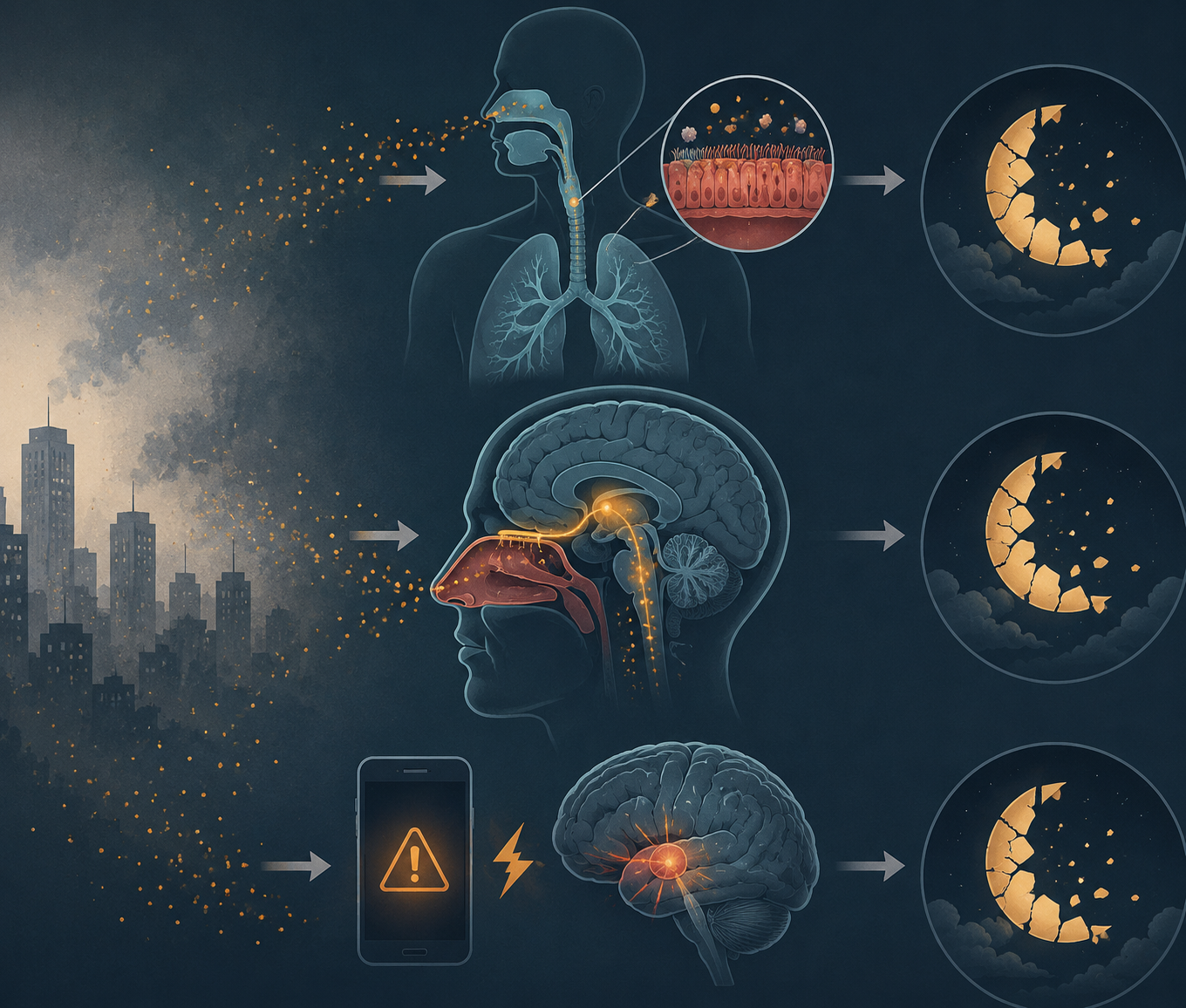
This is also where the evidence needs careful handling. The olfactory-nerve and neuroinflammation pathway is supported by animal models and mechanistic human evidence, but it is not the same thing as proving that PM2.5 travels through that route in a specific person on a specific alert night and directly causes that person’s insomnia. The more defensible conclusion is narrower and still useful: PM2.5 has biologically plausible routes into nervous-system processes that help regulate sleep, so sleep disruption on polluted nights should not be reduced only to coughing, stuffiness, or worry.
That distinction matters for anyone who has been told their poor sleep must be psychological because they did not wheeze. A night can be disrupted without a dramatic respiratory symptom. Fine particles can irritate the airway, contribute to systemic inflammation, and plausibly interact with sleep-regulating neural pathways. The bedroom experience may simply be “I kept waking up,” but the biology underneath does not have to be simple.
The Alert Itself Can Keep the Nervous System Watching
There is a third pathway, and it should be taken seriously without letting it swallow the first two. Alerts change behavior and attention. People check maps, sniff the room, debate whether to open the window, worry about children or older relatives, and try to sleep while monitoring a threat they cannot see clearly. That is not imaginary. It is a stress response layered on top of exposure.
The EPA’s wildfire smoke materials explicitly list sleep disruption among mental health symptoms associated with smoke exposure.[5] That does not mean every bad night during smoke or pollution is caused by anxiety. It means the alert environment can push the brain toward hypervigilance: lighter sleep, more awakenings, more checking, and more difficulty settling after a wake-up.
This is one reason alert-night advice should be concrete. “Try not to worry” is thin comfort when the room smells faintly smoky or the AQI map is still climbing. A better approach is to reduce the number of decisions left for bedtime: know which windows stay closed, where the purifier goes if you have one, what indoor particle sources you will avoid, and when you will stop refreshing the map unless conditions are changing fast.
What to Do Tonight When an Alert Hits
The practical target is not to perfect the whole environment in one evening. It is to weaken the pathway most likely to disturb your sleep tonight.
- Keep outdoor air out when pollution is high: close windows and doors, especially on the side facing traffic, smoke, or visible haze.
- Use filtration if available: run a portable HEPA purifier in the bedroom with the door mostly closed, and give it time to clean the room before sleep.
- Avoid adding indoor particles: skip candles, incense, smoking, unnecessary frying, and vacuuming without strong filtration close to bedtime.
- Protect the airway: if you snore, have asthma, or suspect sleep apnea, treat congestion and breathing changes as relevant sleep information, not background noise.
- Make the alert routine boring: check the forecast and AQI once, set the room, then stop turning the night into an air-monitoring shift unless conditions require action.
Filtration has some direct sleep evidence, but it should not be oversold. In a two-week randomized crossover pilot study of 30 healthy adults, a HEPA purifier was associated with 12 more minutes of total sleep time and 19 more minutes in bed per night. The same study also found higher wake after sleep onset in the HEPA condition, so the result is promising rather than cleanly conclusive.[6]
If your main problem on alert nights is snoring, choking awakenings, morning headaches, or daytime sleepiness, the airway pathway deserves priority. Poor air may be aggravating a sleep-disordered breathing problem that needs its own attention. The Sleep Apnea FAQ is the more appropriate next stop for symptoms that point beyond an occasional restless night.
If your focus is the room itself, the useful question is broader than outdoor AQI. Indoor air can carry particles from outside, particles created inside, and other sleep-relevant air-quality problems such as poor ventilation. For a deeper bedroom-level setup, see how bedroom air quality affects sleep quality. For a more complete alert-night protocol, use how to sleep well during an air quality health advisory rather than trying to redesign the bedroom at midnight.
An air quality alert is not merely stressful information, and it is not merely “bad air” in the abstract. It is a signal that several sleep-disrupting pathways may be active at once: irritated breathing, possible inflammatory effects beyond the airway, and a nervous system that has been told to stay on guard. On those nights, improve the pathway you can influence most directly before bed.
References
- Air pollution as a cause of sleeplessness: Social media evidence from a panel of Chinese cities, Journal of Environmental Economics and Management, 2019.
- Air pollution can affect how well we sleep, scientists discover, The Guardian, 2025.
- Air pollution may increase the sleep apnea severity: A nationwide analysis of smart device-based monitoring, 2023.
- Air pollution exposure and adverse sleep health across the life course: A systematic review.
- Symptoms of Mental Health Effects from Smoke Exposure, EPA.
- Can air purification improve sleep quality? A 2-week randomised-controlled crossover pilot study, Journal of Sleep Research, 2022.
Comments
Join the discussion with an anonymous comment.